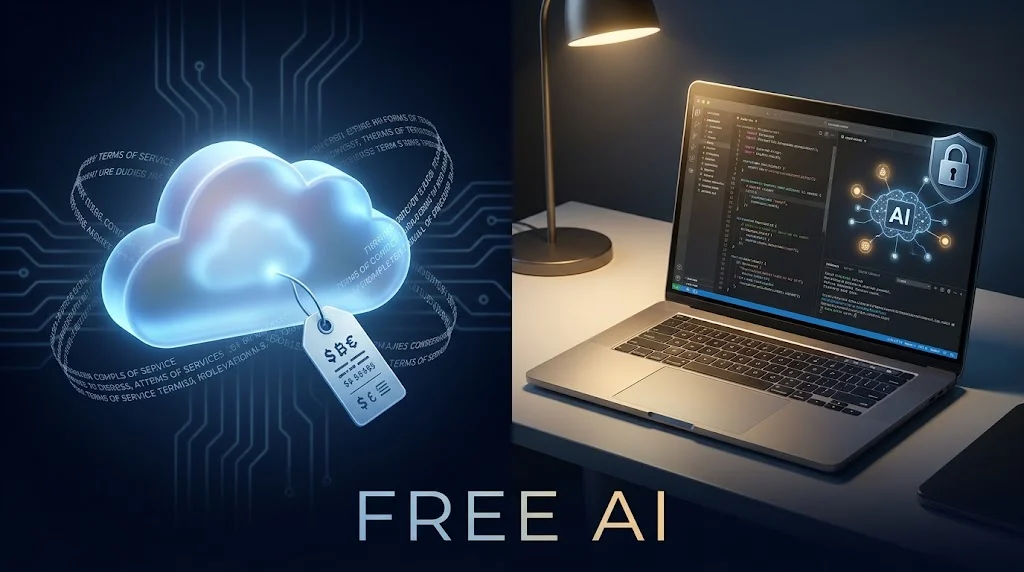
Free AI refers to tools and models you can use without paying, but most “free” tiers trade access for data, usage caps, or reduced model quality. The genuinely free options split into two camps: generous freemium platforms like Google Gemini and ChatGPT, and fully open-weight models you can run locally without limits.
At-a-Glance Box
- Most “free” AI is not free. ChatGPT Free now shows ads in some regions and uses chats for training by default; Gemini retains activity for up to three years with human review .
- Google Gemini offers the most capable free model access, including Gemini 3.6 Flash and limited 3.1 Pro usage, but the data trade-off is steep .
- Open-weight models are the only truly unlimited free AI for users willing to run them locally. Qwen3, Phi-4-mini, and Gemma 3 are practical starting points .
- Free API tiers exist but are fragmented. Cerebras offers 1M tokens/day; DeepSeek gives 5M free tokens on signup; Cloudflare Workers AI provides 10K neurons daily .
- Commercial use is often restricted on free tiers. Suno, ElevenLabs, and Meshy outputs are non-commercial unless you upgrade .
- Privacy defaults matter more than model quality for business users. Check training toggles before pasting anything sensitive.
What “Free AI” Actually Means in 2026
The phrase free AI covers two very different things, and conflating them leads to bad decisions.
The first is freemium access: a company lets you use its cloud-hosted model at no charge, with limits. The second is open-weight software: you download the model and run it on your own hardware. The first is convenient but comes with strings. The second is genuinely unlimited but demands technical effort and hardware.
Most search results for free AI push freemium tools because they are easy to try. But the users who end up frustrated are usually the ones who needed open-weight clarity and got freemium opacity instead.
This guide separates the two, names the trade-offs, and helps you pick based on what you are actually trying to do.
The Major Free Tiers, Compared Honestly
The big platforms all offer free access. Their differences matter more than their similarities.
| ChatGPT Free | GPT-5.6 Luna, unlimited text chat | 27K token context, ads in some regions, limited file/image tools | Training on by default | Casual daily use, light drafting |
| Google Gemini | Gemini 3.6 Flash, limited 3.1 Pro | Feature gates vary by account and region | Activity retained up to 3 years, human review | Google ecosystem users, research |
| Claude Free | Sonnet 5.5, Haiku 4.5 | Usage caps, no Opus access | Training toggle depends on account | Long-form writing, document reasoning |
| Microsoft Copilot | Web-grounded answers, basic image gen | Deep Research removed from consumer free tier | Varies by account type | Windows and Microsoft 365 users |
| Perplexity Free | Cited web research | Limited Pro searches | Standard retention | Source-backed quick research |
| NotebookLM | Source-grounded chat, summaries | Feature availability varies | Sources stay in your notebook | Working with your own documents |
What this table reveals: Google gives the most model capability for free, but the data retention terms are the most aggressive among the major platforms . ChatGPT’s free tier is usable but now includes advertising in some markets and a context window half the size of paid tiers . Claude’s free tier is strong for writing tasks but tighter on usage than Gemini’s .
For users who need free AI for work, the practical recommendation is to use the platform that matches your existing ecosystem, then verify the data settings before entering anything confidential. Convenience and privacy rarely align on free tiers.
The Hidden Costs Inside “Free”
Free tiers are not charity. They are acquisition channels. The costs appear in three places: data, limits, and lock-in.
Data as payment
OpenAI’s free tier uses chats for model training by default. A German account checked in September 2026 had the “Improve the model for everyone” toggle switched on . Google retains Gemini activity for up to three years, including review by human contractors, even when users delete their activity .
Anthropic’s default depends on account settings and is worth checking manually. The company says disabling the training toggle stops new chats from being used, but already-completed training runs retain the data .
The practical takeaway: free AI is often paid for with conversation data. If that is unacceptable, use temporary chat modes or switch to local models.
Usage caps that bite unexpectedly
ChatGPT Free’s 27,000-token context window sounds generous until you paste a long contract. It is roughly 12 pages of text, half what paid tiers allow . GitHub Copilot Free gives 2,000 completions and 50 premium requests monthly, but a single agentic chat session can burn through the premium requests quickly . Cursor’s free tier hits caps fast enough that students are the only group who reliably get value without paying .
Free API tiers have similar traps. DeepSeek’s 5M free tokens are a one-time grant, not a recurring allowance . Cloudflare Workers AI gives 10K neurons daily, which runs out quickly with production workloads .
Commercial restrictions
Many creative tools make free outputs non-commercial. Suno’s free songs cannot be monetized without Pro, and the restriction does not apply retroactively if you later upgrade . ElevenLabs free tier is non-commercial, and every voice clone requires a recorded passphrase . Meshy’s free 3D models carry the same restriction .
If you are using free AI for client work or products, read the license terms before you generate anything.
The Genuinely Unlimited Option: Open-Weight Models
For users who need free AI without data trade-offs or usage caps, open-weight models are the only honest answer. You download the weights, run inference on your own hardware, and no one sees your prompts.
The ecosystem has matured significantly. Qwen3 is the strongest general-purpose local family for most users, with Apache 2.0 licensing and practical sizes from 4B to larger variants . Phi-4-mini runs on weak hardware and carries an MIT license . Devstral is the current best local coding model for agentic workflows .
Running these models requires a tool. Ollama is the simplest starting point: one command downloads and runs a model. LM Studio offers a graphical interface for users who prefer not to touch the terminal .
The hardware reality: A 16GB RAM laptop can run Phi-4-mini, Gemma 3 4B, or Qwen3 4B/8B comfortably . A machine with 12GB+ VRAM opens up Qwen 2.5 14B and stronger coding models . Without a GPU, small models still run on CPU, just slower .
The licensing caveat: Not all open-weight models are equally permissive. Qwen3, Phi-4-mini, Mistral Small 3.1, and Devstral use Apache 2.0 or MIT licenses, which are commercially safe. Llama 4 uses Meta’s community license with restrictions. Gemma 3 uses Google’s terms, which require review before commercial deployment .
Free AI for Specific Tasks
The best free AI depends on what you are trying to do. General chatbots are mediocre at specialized tasks compared to focused tools.
Coding
GitHub Copilot Free is the easiest entry point inside VS Code, with 2,000 completions monthly and access to Claude Sonnet 4.6 and GPT-4.1 . Cline and Continue.dev are open-source extensions that let you bring your own API key, which is free if you already have credits . For local coding without any cloud dependency, Devstral via Ollama is the strongest option .
Research and document work
NotebookLM is the standout free tool for working with your own sources. It answers questions using only the documents you upload and provides citation links, which reduces hallucination compared to open-web chatbots . Perplexity’s free tier is better for web research with citations, though source quality varies and needs verification .
Image and 3D generation
Free image generators exist but usually watermark outputs or restrict commercial use. For 3D, Tripo AI offers 2,000 signup credits and daily refills, with clean quad topology suitable for game characters . Hunyuan3D from Tencent is open-source and unlimited if you self-host, but requires a GPU .
Voice and audio
ElevenLabs free tier provides 10,000 characters monthly and three voice clones, but outputs are non-commercial . For commercial-safe offline voice generation, Chatterbox from Resemble AI is MIT-licensed and beat ElevenLabs in 63.8% of blind tests according to the project’s claims . Self-hosting requires technical setup.
Who Should Use Which Kind of Free AI
Casual users who need drafting, summarizing, and quick answers should use Gemini or ChatGPT free tiers. Accept the data trade-off or use temporary chats for sensitive queries.
Business users handling confidential information should avoid free cloud tiers entirely. Local open-weight models or paid enterprise tiers with zero-retention agreements are the only defensible options. SOC 2 certification alone does not guarantee zero data retention; it certifies controls, not specific retention policies.
Developers building prototypes should explore free API tiers from Cerebras, DeepSeek, and Cloudflare Workers AI for testing, then plan for paid inference at production scale . For coding assistance without cloud dependency, local Devstral or Flint is worth evaluating. Flint, released by Recursive in October 2026, runs on laptops with 2.5B active parameters from a 40B total and scores well on bug-fixing benchmarks for its size class .
Creators working on commercial projects should verify license terms before generating anything. Free tiers that forbid monetization are a trap for anyone selling outputs.
Researchers and students get strong value from NotebookLM for source-grounded work and from free academic tools like Consensus and Keenious for literature search . Google’s Gemini free tier is also generous for study-related tasks, provided you avoid uploading sensitive unpublished research.
Common Mistakes With Free AI
Assuming free means private. It usually does not. Default training settings on major platforms use your conversations unless you change them .
Ignoring context limits until it matters. ChatGPT Free’s 27K token window cannot hold a long thesis chapter or a complex codebase. Plan around the limit rather than discovering it mid-task .
Using free outputs commercially. Suno, ElevenLabs, and Meshy all restrict commercial use on free tiers . Check before you build a product on generated assets.
Trusting benchmark claims without verification. Free tools sometimes cite impressive benchmarks that do not reflect real-world performance on your specific tasks. Test with your own examples before committing a workflow.
Forgetting that free API credits expire. DeepSeek’s 5M tokens and OpenAI’s $5 trial credits are one-time grants, not monthly allowances .
What to Evaluate Before Choosing
Before you invest time in any free AI tool, answer four questions:
- What data am I giving up? Check training settings, retention periods, and human review policies. If the answer is unclear, assume the worst.
- What happens when I hit the limit? Some tools degrade gracefully. Others lock you out of features entirely. Know which you are choosing.
- Can I use the outputs commercially? Read the license. Free does not imply permissive.
- Is there a path off the free tier if this works? A tool that is free but has no reasonable paid upgrade path is a dead end for anything beyond experimentation.
Conclusion
Free AI is real, but it is not free of trade-offs. The major platforms offer capable free tiers in exchange for data, usage limits, and reduced model access. Open-weight models offer genuine freedom at the cost of hardware and technical setup.
The right choice depends on what you are protecting and what you are building. For casual use, Gemini’s free tier is the most capable. For confidential work, local models are the only honest option. For commercial projects, read the license before you generate. For development, free API tiers are useful for testing but not production.
What matters most is not which tool is “best” but which trade-off you can live with. Free AI is a spectrum of compromises. Choose the compromise that fits your actual constraints.