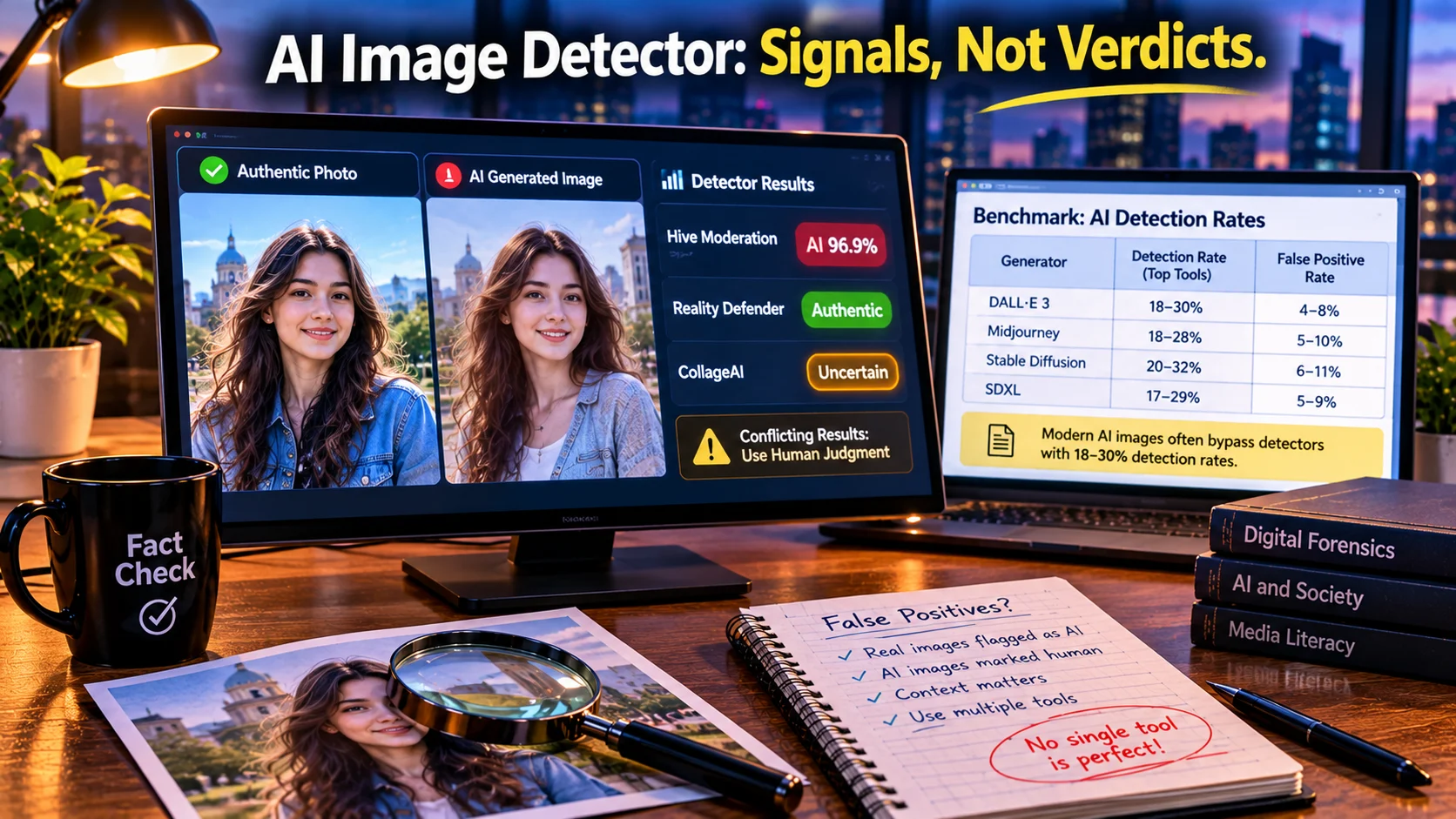
An AI image detector is a tool that analyzes an image to estimate whether it was generated or manipulated by artificial intelligence. Independent testing reveals severe limitations: no detector exceeds 80% accuracy on text-rich images, commercial generators like Midjourney v7 and Firefly v4 defeat most detectors with only 18-30% detection rates, and tools frequently misclassify authentic photos as fake.
At-a-Glance: Key Takeaways
- No detector is universally reliable. A comprehensive benchmark of 16 detection methods found no universal winner, with performance varying dramatically across datasets and generators .
- Modern generators defeat most detectors. Flux Dev, Firefly v4, and Midjourney v7 achieve only 18-30% average detection accuracy across tested tools .
- Text-rich images expose a systematic gap. No method exceeds 80% accuracy on fabricated screenshots and documents, with some dropping over 60% from natural-image benchmarks .
- False positives are common and consequential. NewsGuard found that light edits to authentic video caused Hive to flag it as AI-generated with 96.9% confidence, fueling misinformation about a world leader’s death .
- Human judgment still outperforms automated tools in controlled evaluations, with human evaluators prevailing in discordant cases .
- Free tools vary wildly. Hive and AI or Not lead on some benchmarks, but even top performers fail on manipulated or text-heavy images.
What Is an AI Image Detector?
An AI image detector is a software tool that analyzes an image’s visual, statistical, or spectral properties to estimate whether it was created by artificial intelligence or manipulated digitally. The category spans commercial APIs like Hive and AI or Not, free web tools like Illuminarty and Decopy, and open-source research models.
The search intent is primarily commercial investigation and informational. Users want to know which tools are trustworthy, what accuracy they can expect, and how to interpret results. The honest answer is uncomfortable: the technology is unreliable in ways that matter, and vendors routinely overstate their capabilities.
The market has grown as AI-generated imagery proliferates across social media, news, and e-commerce. Detectors promise a technical solution to a verification problem. But research consistently shows that promise is not yet fulfilled.
How AI Image Detectors Work
The Underlying Technology
Detectors use several approaches. Some analyze low-level artifacts: compression patterns, noise distributions, and spectral fingerprints left by generative models. Others use deep learning classifiers trained on labeled datasets of real and fake images. Some combine multiple signals into an ensemble score.
The challenge is that generative models improve continuously. Each new release from OpenAI, Google, Midjourney, or Adobe produces images that are harder to distinguish from photographs. Detectors trained on older generators often fail on newer ones.
The Generalization Problem
A 2026 benchmark study tested 16 detection methods across 12 datasets spanning 291 unique generators. Key findings included:
- No universal winner exists. Detector rankings were unstable across datasets, with Spearman correlations ranging from 0.01 to 0.87 .
- A 37 percentage-point gap separates the best detector (75% mean accuracy) from the worst (37.5%) .
- Training data alignment critically impacts performance, causing up to 20-60% variance within architecturally identical detector families .
- Modern commercial generators defeat most detectors, achieving only 18-30% average accuracy .
A separate cross-generator study found that in-distribution accuracy does not predict cross-generator performance. A spectral detector scoring 0.795 on its training generators dropped to chance (0.523) on unseen generators .
Editorial interpretation: The core problem is distribution shift. Detectors learn patterns specific to the generators they were trained on. When a new generator appears, those patterns may not transfer.
Where Detectors Fail Most Severely
Text-Rich Images
A 2026 benchmark called TextFake evaluated detection on fabricated screenshots, documents, and news pages across 28 languages. The results were stark: no method exceeded 80% accuracy, with some dropping over 60% from natural-image benchmarks .
The study identified three failure modes. The “Text Density Curse” occurs when dense glyphs overwhelm low-level detectors. “Cloaking via Rendering Fidelity” means stronger text rendering suppresses generative artifacts. “Threshold Collapse” occurs when routine perturbations drive detectors toward chance-level performance .
Modern Commercial Generators
The same benchmark found that Flux Dev, Firefly v4, and Midjourney v7 achieve only 18-30% average detection accuracy . These are not obscure open-source models. They are mainstream commercial tools used by millions.
A DailyBench study confirmed the gap. Methods reporting 91-96% balanced accuracy on older benchmarks dropped to 60-76% on modern synthesis and 54-66% on object-level manipulation .
Lightly Edited Authentic Content
NewsGuard tested 15 authentic photos from credible outlets through five detectors. Hive and Sightengine correctly identified all 15 as real. But when a video was lightly filtered or blurred, Hive flagged it as “likely to be AI-Generated” with 96.9% confidence. The video was authentic .
This false positive had real consequences. Social media users cited the Hive result as evidence that a world leader had been killed. The video’s authenticity was later confirmed .
The Tools Compared
Important note: Reported accuracies come from different tests with different datasets. They are not directly comparable. Vendor claims should be verified independently.
Real-World Testing Results
The RTBF Test
Belgian broadcaster RTBF tested seven free detectors on three images: a generated cat, a manipulated Ukrainian soldier photo, and a fabricated Maduro arrest image .
Five of seven correctly identified the cat, likely aided by Google’s SynthID watermark. But on the manipulated soldier photo, the tools that succeeded on the cat failed. On the Maduro image, all the tools that had succeeded previously failed completely. Only Grok, which is not primarily a detector, caught all three .
The Human Comparison
A 2026 study benchmarked 19 vision-language models against 1,667 adults on detecting AI-generated portraits. The best model, gpt-5.6-sol, reached 92.8% balanced accuracy, exceeding adults in their 20s (88.5%). However, model calibration was poor, with criteria spread from -1.10 to +1.45 while humans sat near zero. The best machines “out-see young adults here, without matching the human balance between suspicion and trust” .
A separate study found human evaluators substantially outperformed all automated tools, with human judgment prevailing in discordant cases .
Privacy and Security Considerations
Free detectors upload your images to remote servers. Most do not publish detailed data retention policies.
What to check:
- Whether uploaded images are stored or used for training
- How long data is retained
- Whether you can delete your uploads
- The tool’s privacy policy and terms
Important distinction: No SOC 2 certification or similar compliance framework is typically referenced for free AI image detectors. They are consumer products. Do not upload sensitive or confidential images without reviewing the privacy policy.
Who Should Use an AI Image Detector
Journalists and fact-checkers can use detectors as one signal among many, never as definitive proof. The NewsGuard and RTBF tests show both false positives and false negatives in real-world scenarios.
Researchers studying detection methods can use open-source benchmarks and datasets to develop more robust approaches.
Casual users checking suspicious images should understand that a detector’s output is a probability estimate, not a verdict. A “90% AI” result means the tool’s model assigned that confidence, not that the image is definitively fake.
Anyone making high-stakes decisions based on image authenticity should not rely on automated detectors alone. Human review, source verification, and contextual analysis remain essential.
Organizations requiring definitive proof will not find it in current detector technology.
Common Mistakes and Cautions
Trusting a single detector’s output. Different tools produce different results. The RTBF test showed tools that succeeded on one image failing on another .
Assuming high accuracy on benchmarks translates to real-world performance. A detector scoring 98% on a curated dataset may fail on the images you actually encounter .
Ignoring the generator arms race. Detectors trained on older models fail on newer ones. Midjourney v7 and Firefly v4 defeat most detectors with 18-30% accuracy .
Overlooking false positives. Authentic images are routinely flagged as fake. A lightly edited video was flagged at 96.9% confidence, fueling misinformation .
Using detectors for sensitive decisions without human review. Human judgment still outperforms automated tools in controlled studies .
Frequently Asked Questions
What is the most accurate AI image detector?
No single detector is most accurate across all scenarios. Hive performs well on unperturbed images but fails on heavily manipulated content. AI or Not claims 98.9% accuracy but vendor claims require independent verification. The best choice depends on your specific use case and threat model .
Can AI image detectors detect Midjourney or DALL-E images?
Modern commercial generators are increasingly difficult to detect. A 2026 benchmark found that Flux Dev, Firefly v4, and Midjourney v7 achieve only 18-30% average detection accuracy across tested tools .
Why do AI image detectors give false positives?
Detectors look for artifacts and patterns associated with generation. Light edits, compression, or filters can mimic those patterns, causing authentic images to be flagged. A NewsGuard test found a lightly blurred video flagged as AI with 96.9% confidence .
Are free AI image detectors reliable?
Free tools vary widely. Some, like Hive, perform well on certain benchmarks. Others, like Illuminarty, have high false positive rates. All free tools have limitations, and none should be treated as definitive without human review .
What should I do if a detector says an image is AI-generated?
Treat the result as a signal, not a verdict. Verify the image’s source, check for context, and consult multiple tools if possible. Do not make high-stakes decisions based on a single detector’s output.
Conclusion
AI image detectors offer a useful but unreliable signal in the fight against synthetic media. Research consistently shows that no detector is universally accurate, modern generators defeat most tools, and false positives are common enough to cause real harm.