A text-to-image AI generator creates pictures from written descriptions using diffusion or transformer models. Google’s Nano Banana 2.1 leads on price and speed at roughly $0.034 per 1K image, Midjourney v7 remains the aesthetic benchmark, Adobe Firefly offers commercial indemnification, and open-source models like FLUX provide local, unrestricted generation for users with capable hardware.
At-a-Glance: Key Takeaways
- Google’s Nano Banana 2.1 undercuts the market. It generates a 1K image for approximately $0.034, half the price of its predecessor, while maintaining strong prompt adherence .
- Midjourney v7 still wins on art direction. No API, public images by default on lower tiers, and a $10-$120/month price range make it a studio tool rather than a developer platform.
- Adobe Firefly is the safest commercial choice. IP indemnification, Creative Cloud integration, and unlimited standard generations on paid plans reduce legal risk for client work.
- Open-source models close the gap. FLUX.1-schnell runs on 8GB VRAM, uses the Apache 2.0 license, and permits commercial use without content filters.
- Text rendering and consistency remain unsolved. Most models garble text and cannot hold a character or product across multiple generations without manual intervention.
- API pricing has shifted to token-based billing. This aligns cost with complexity but makes budgeting less predictable than flat per-image rates.
What Is an AI Image Generator from Text?
An AI image generator from text is a system that produces visual content from a written prompt. You describe what you want, and the model returns an image that matches your description. The dominant architectures are diffusion models, which learn to reverse a noise-adding process, and transformer-based models that treat images as sequences of tokens.
The category has moved from novelty to infrastructure. It is embedded in creative workflows across media, gaming, advertising, and product design. The search intent for this keyword is commercial investigation: users want to know which tool produces usable output, what it costs, and whether the result can be used commercially.
The honest answer is that no single tool wins everywhere. Google’s Nano Banana 2.1 leads on price and speed . Midjourney leads on aesthetics. Adobe Firefly leads on legal safety. Open-source models lead on freedom. The right choice depends entirely on what you are trying to create and what constraints you operate under.
How Text-to-Image Generation Works
The Diffusion Pipeline
Diffusion models start with random noise and iteratively denoise it into a coherent image. The model learns this by training on millions of image-text pairs: it takes a real image, adds noise, and learns to predict the noise that was added. At inference time, it reverses the process, guided by the text prompt.
The quality of output depends on three factors: the model’s training data and architecture, the specificity of your prompt, and the generation settings (resolution, steps, guidance scale). Vague prompts produce generic results. Detailed prompts yield more controlled output.
The Token-Based Cost Structure
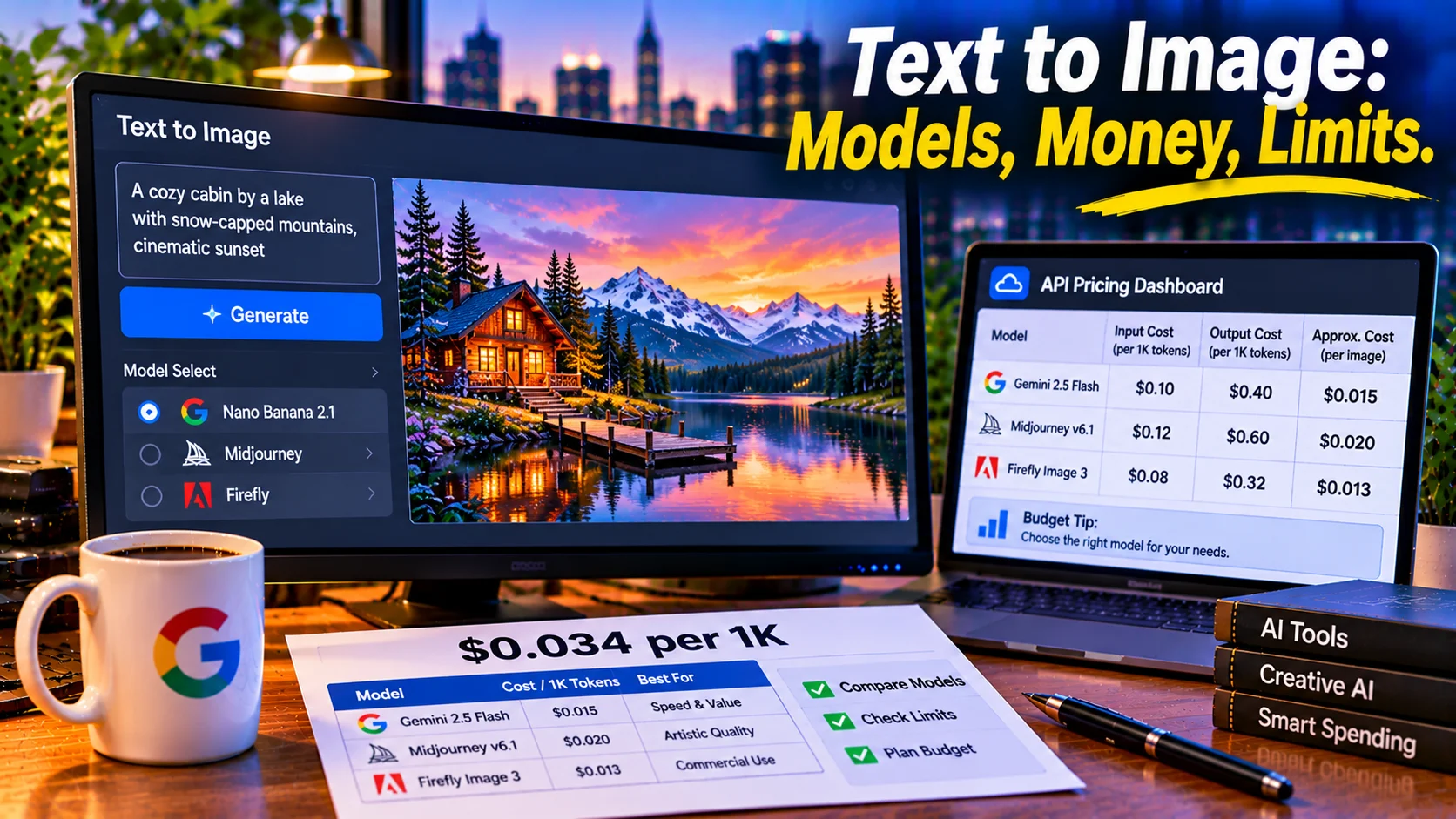
API pricing has shifted from per-image to per-token for newer models. Google’s Nano Banana 2.1 charges $30 per million output tokens, which translates to roughly $0.034 for a 1K image . This aligns cost with resolution and complexity, but it makes budgeting less predictable than a flat per-image rate.
For comparison, older models charged flat rates. Google’s Imagen 3.0 charged $0.03 per image. DALL-E 3 charged $0.04. The token model is more granular, but it requires users to understand how resolution and complexity affect consumption.
The Aesthetic Factor
Technical quality and aesthetic quality are different things. A model can follow instructions precisely and still produce an image that looks generic. Midjourney v7 remains the benchmark for distinctive, art-directed output. Its default style has a recognizable quality that other models struggle to match.
This matters for creative work where the image needs to feel intentional rather than generated. For product mockups or technical illustrations, instruction adherence matters more. For editorial or artistic work, aesthetics matter more.
The Major Text-to-Image Models Compared
Where Text-to-Image Still Fails
Text Rendering
Most models cannot render legible text reliably. A prompt asking for a sign with specific words produces garbled letterforms. This is a structural limitation of how diffusion models handle spatial precision.
If the image needs readable text, plan to add it in post-production. No current model handles this well enough for professional use without manual correction.
Character and Product Consistency
Holding a character’s face or a product’s geometry across multiple generations is unsolved. Each generation is a fresh sample from the model’s distribution. Professional workflows that need consistency require reference images, fine-tuning, or manual retouching.
The Copyright Question
AI-generated images exist in a legal gray zone. Midjourney grants ownership to users on paid plans, but the company retains a license over prompts and outputs. Adobe Firefly offers IP indemnification, meaning Adobe will defend you if the output is challenged. Open-source models like FLUX.1-schnell use the Apache 2.0 license, which permits commercial use.
The safest path for commercial work is a tool that explicitly indemnifies, like Firefly. The riskiest is a tool that grants ownership without indemnification, leaving you to defend yourself.
Who Should Use Which Tool
Developers and high-volume users should use Nano Banana 2.1. The $0.034 per image and fast generation make it the most efficient option for batch processing .
Art directors and creative studios should use Midjourney v7. The aesthetic quality remains unmatched, and the $30/month Standard plan with unlimited Relax mode is the value sweet spot.
Enterprise teams needing legal safety should use Adobe Firefly. The IP indemnification and Creative Cloud integration make it the lowest-risk option for client work.
Privacy-sensitive users and tinkerers should use FLUX.1-schnell locally. It runs on 8GB VRAM, requires no cloud transmission, and permits commercial use under Apache 2.0.
Anyone needing text in images should plan for post-production. No current model renders text reliably enough for professional use without manual correction.
Common Mistakes and Cautions
Assuming per-image pricing is stable. Token-based models like Nano Banana 2.1 make cost prediction harder. A high-resolution batch can cost significantly more than a flat-rate estimate .
Ignoring the commercial threshold on Midjourney. Companies with over $1M annual revenue must subscribe to higher tiers to own their assets. Using lower tiers for commercial work above that threshold violates the terms.
Expecting consistency without effort. Each generation is independent. Holding a character or product across assets requires reference images, fine-tuning, or manual work.
Overlooking the public gallery default. Midjourney images are public unless you are on higher tiers with Stealth Mode. Confidential or client work should not be generated on lower tiers.
Treating “free” open-source as zero cost. Stable Diffusion is free to download, but running it requires a capable GPU and technical setup. The cost shifts from subscription to hardware and time.
Frequently Asked Questions
What is an AI image generator from text?
An AI image generator from text creates visual content from a written prompt. Diffusion and transformer models learn patterns from millions of image-text pairs and generate new images that match the description. Output quality depends on the model, the prompt, and the generation settings.
How much does text-to-image AI cost?
Costs range from free (open-source Stable Diffusion) to $120/month (Midjourney Mega). Google’s Nano Banana 2.1 charges roughly $0.034 per 1K image via API . Adobe Firefly uses credit-based pricing with a free tier.
Can I use AI-generated images commercially?
It depends on the tool. Adobe Firefly offers IP indemnification. Midjourney grants ownership on paid plans but requires higher tiers for companies over $1M revenue. FLUX.1-schnell uses the Apache 2.0 license, which permits commercial use.
What is the best AI image generator for text?
No current model renders text reliably enough for professional use without correction. Some models have improved, but the general rule is to add text in post-production. Plan for manual correction regardless of the model.
Is Midjourney free?
No. The cheapest paid plan is Basic at $10/month. There is no permanent free tier. Midjourney is a subscription tool designed for studios and professional creators, not casual experimentation.
Conclusion
AI image generation from text has matured from a novelty to infrastructure. The models are faster, cheaper, and more capable than they were a year ago. Google’s Nano Banana 2.1 delivers strong output at roughly $0.034 per image . Midjourney v7 remains the aesthetic benchmark. Firefly offers legal safety. Open-source models offer freedom.