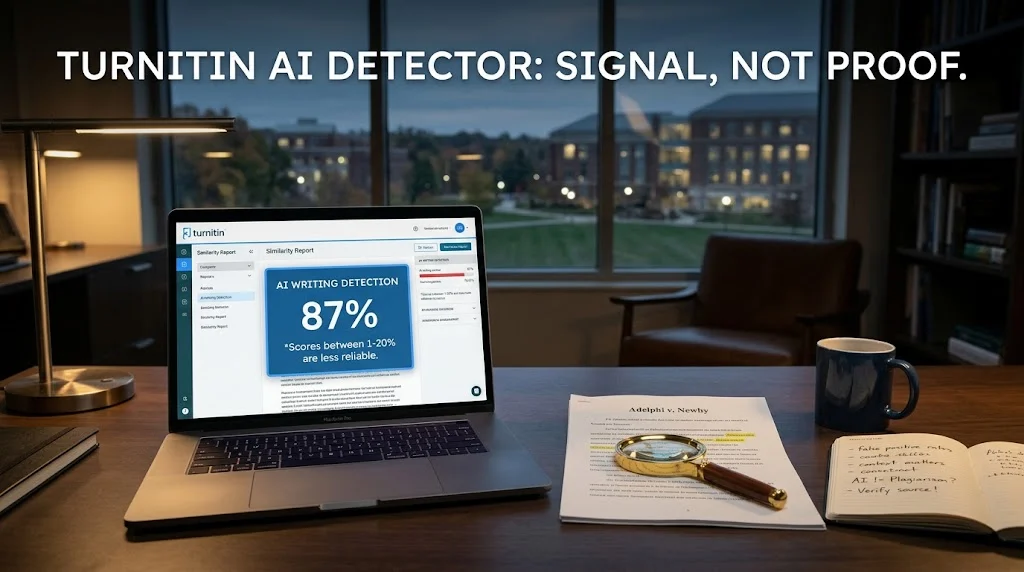
Turnitin’s AI detector is a tool that estimates the likelihood text was generated by AI, but it is explicitly positioned as a signal for review, not proof of misconduct. Independent research shows substantial limitations: a 2026 study found false positive rates of 15.6% to 30.6% across detectors, and Turnitin’s own guidance flags scores between 1% and 20% as less reliable.
At-a-Glance: Key Takeaways
- Turnitin explicitly states its AI detector “may not always be accurate” and should not be the sole basis for adverse action against a student .
- A 2026 IEEE benchmark found false positive rates across detectors ranging from 15.6% to 30.6%, raising concerns for equitable enforcement .
- Turnitin’s own accuracy showed a sensitivity of just 0.27 in a 2026 dentistry study, meaning it missed most AI-generated text at a 60% threshold .
- An Adelphi University student won a lawsuit in February 2026 after Turnitin flagged his essay as 100% AI-generated, while two other detectors said human .
- Multiple universities have restricted or stopped using AI detectors, including Vanderbilt, Yale, Johns Hopkins, and Northwestern .
- Turnitin is sold only to institutions, with no public per-seat pricing. iThenticate credits are the separate product for individuals .
What Is the Turnitin AI Detector?
The Turnitin AI detector is a feature within Turnitin’s plagiarism-checking platform that estimates the probability that a submission was generated by an AI writing tool. It produces a percentage score and highlights segments the model believes were likely AI-generated.
Turnitin introduced the feature in April 2023, shortly after ChatGPT’s mainstream arrival. It has since become one of the most widely deployed AI detection tools in higher education, used by institutions across the United States, United Kingdom, Australia, and beyond .
The critical distinction is between what the tool produces and what it proves. Turnitin itself states: “Our AI writing detection model may not always be accurate (it may misidentify both human and AI-generated text) so it should not be used as the sole basis for adverse actions against a student” . The score is a signal for instructor review, not a verdict.
How the Turnitin AI Detector Works
The Technical Approach
Turnitin’s current system uses a transformer-based deep learning architecture, trained on the company’s in-house corpus of academic data. Turnitin states it does not rely on simple metrics like “burstiness” or “perplexity” that public discussions often cite. Instead, the model learns statistical patterns from training data, meaning individual predictions may not be explainable in feature-by-feature terms .
The detector covers a long list of language models, including GPT-5, Claude Opus 4.6, Gemini 3.1 Pro, and DeepSeek. Turnitin also claims capability to detect text modified by paraphrasers and bypass tools, though this feature is English-only .
The Three Indicator States
When instructors open a Similarity Report, the AI writing indicator displays one of three states :
Blue with a percentage (0-100): The submission processed successfully. The percentage indicates the amount of qualifying text the model determined was AI-generated. This is not necessarily the percentage of the entire submission.
Asterisk (*) for 1-20%: Turnitin flags scores in this range with an asterisk because its testing found “a higher incidence of false positives” in this band. The score is marked as less reliable.
No indicator: The submission may not have processed, or the institution may not have the feature enabled.
What the Score Does Not Mean
The percentage is not a probability. A score of 100% does not mean the submission is definitively AI-generated. It means the model classified all qualifying text as likely AI-generated. The model can be wrong.
Turnitin’s guidance also notes that shorter documents are more likely to receive “all-or-nothing” predictions because the model has less text to segment and analyze .
Documented Accuracy Problems
The False Positive Risk
Independent research has consistently found that AI detectors produce false positives, flagging human-written text as AI-generated. A 2026 IEEE benchmark of five detectors found false positive rates ranging from 15.6% to 30.6%, with all tools showing “substantially reduced accuracy on hybrid texts” .
A separate 2026 study in Dentistry found Turnitin’s sensitivity at just 0.27, meaning it correctly identified only 27% of AI-generated texts at a 60% threshold . This is a false negative problem: the tool misses most AI text.
The implication is uncomfortable. The detector is both prone to flagging human work and prone to missing AI work. It is not reliable in either direction at the level required for disciplinary decisions.
The Hybrid Text Problem
A 2026 inter-rater reliability study found that while detectors agree substantially on purely human or purely AI text, agreement on hybrid texts falls to chance level. Of 30 hybrid texts, 28 received both a “human” verdict and an “AI” verdict from different tools. The classification a text receives “relies more on the choice of detector than on the text itself” .
Turnitin’s Own Acknowledgement
Turnitin does not dispute these limitations. Its guidance explicitly states the model “may not always be accurate” and flags scores between 1% and 20% as less reliable due to higher false positive incidence . The company has updated its model repeatedly, including in October 2026 to “improve AI detection while minimizing false positives” .
The Adelphi Lawsuit: When Detection Fails
The most consequential challenge to Turnitin’s reliability came in February 2026, when a federal judge ruled that Adelphi University’s finding of plagiarism against student Orion Newby was “without merit” .
What Happened
Newby, a history major, submitted a paper on Christianity and Islam in his first semester. Turnitin’s AI detector marked the essay as fully AI-written. Newby ran the same essay through two other detectors, both of which said it was written by a human. The university denied his appeal, leading his family to take legal action. They reportedly spent six figures on legal fees .
The court found that the university’s decision was arbitrary and lacked sufficient proof, emphasizing that AI detectors produce false positives and should not be the sole basis for disciplinary action. The judge also noted that Adelphi failed to follow its own internal procedures for academic integrity investigations .
The Precedent
The ruling establishes a critical precedent: institutions cannot rely solely on an AI detection score to punish students. They must provide human-led oversight and corroborating evidence. The case has been cited as a warning to schools across the country .
Institutional Backlash
The Adelphi case did not emerge in a vacuum. It followed growing institutional resistance to AI detectors across higher education.
Universities That Have Restricted or Stopped Use
Multiple universities have limited or stopped using AI detection tools due to accuracy concerns, including Vanderbilt, Yale, Johns Hopkins, Northwestern, the University of Waterloo, the University of Cape Town, and Curtin University .
The University of Melbourne’s student union advocacy service stated bluntly: “We do not believe the Turnitin AI detection tool is reliable enough to be used on its own to raise a concern about a potential breach of academic integrity” . A tutor at the same university noted that the tool “disproportionately hinders international students or students whose English is not their first language,” because formulaic writing patterns that detectors flag are often what those students were explicitly taught to use .
The Policy Vacuum
Research on UK universities found that over 40% had no publicly searchable AI use policy. A survey of 1,054 students found that 42% said they reduced their use of AI tools because they feared being falsely accused of cheating .
Pricing and Access
Turnitin is sold only to institutions. There is no self-serve consumer plan and no public per-seat price. Students and instructors access it through their school’s license .
Institutional Pricing
Turnitin’s pricing is negotiated directly with institutions based on size and products selected. A 2026 price list shows an enterprise license minimum of $7,250 for up to 1,000 users, with tiered per-license pricing for additional users .
Individual Access
Individuals who need a personal similarity check are directed to iThenticate credits, a separate product. There is no way for a student to purchase a Turnitin license independently .
Add-On Costs
AI writing detection may be included in Turnitin Originality licenses or quoted as an add-on. Other products like ExamSoft and Gradescope are separate line items .
Who Should Use the Turnitin AI Detector
Institutions with established review processes can use the detector as one signal among many, provided faculty are trained to interpret scores cautiously and never rely on them alone.
Instructors assessing hybrid work should use the detector to identify segments for discussion with students, not as evidence of misconduct.
Students cannot purchase or use Turnitin directly. They should be aware that their institution may run AI detection and that false positives are a documented risk.
Administrators designing academic integrity policy should note that courts have ruled detection scores alone are insufficient. Policy should require corroborating evidence and human review.
Anyone seeking definitive proof of AI use will not find it in Turnitin or any other detector. The technology is not reliable enough for that purpose.
Common Mistakes and Cautions
Treating the score as proof. Turnitin explicitly states the score should not be the sole basis for adverse action. A 100% score does not mean 100% certainty .
Ignoring the asterisk. Scores between 1% and 20% are flagged by Turnitin itself as less reliable due to higher false positive incidence .
Overlooking the false negative problem. Turnitin’s sensitivity was 0.27 in one 2026 study, meaning it missed most AI text. A low score does not prove human authorship .
Using detectors on non-native speakers without caution. Tutors report that formulaic writing patterns common among English language learners are disproportionately flagged .
Assuming institutional policy matches tool capability. The Adelphi case showed a university ignoring its own procedures and relying on a score. Policy and practice must align with the tool’s limitations .
Frequently Asked Questions
How accurate is the Turnitin AI detector?
Turnitin itself states the detector “may not always be accurate” and should not be the sole basis for adverse action. Independent research has found false positive rates of 15.6% to 30.6% across detectors, and one 2026 study found Turnitin’s sensitivity at just 0.27 .
Can Turnitin detect ChatGPT and other AI tools?
Turnitin maintains a list of detected models including GPT-5, Claude, Gemini, and others. It also claims detection of paraphraser and bypasser tools for English submissions. However, detection accuracy varies significantly by model and prompting strategy .
What happened in the Adelphi AI plagiarism lawsuit?
A student, Orion Newby, was accused of plagiarism after Turnitin flagged his essay as fully AI-written. Two other detectors said it was human. A federal judge ruled in February 2026 that the university’s finding was “without merit” and ordered the charge removed from his record .
Can I use Turnitin as an individual?
No. Turnitin is sold only to institutions. Individuals needing a similarity check must use iThenticate credits, a separate product. There is no public per-seat Turnitin license .
Why are some universities stopping using AI detectors?
Universities including Vanderbilt, Yale, and Johns Hopkins have restricted or stopped AI detector use due to accuracy concerns, false positives, and the risk of disproportionate harm to international students and non-native English speakers .
Conclusion
The Turnitin AI detector is a widely deployed tool with documented limitations. It produces a signal that instructors can use to prompt conversation and review. It does not produce proof of misconduct, and Turnitin itself says so.