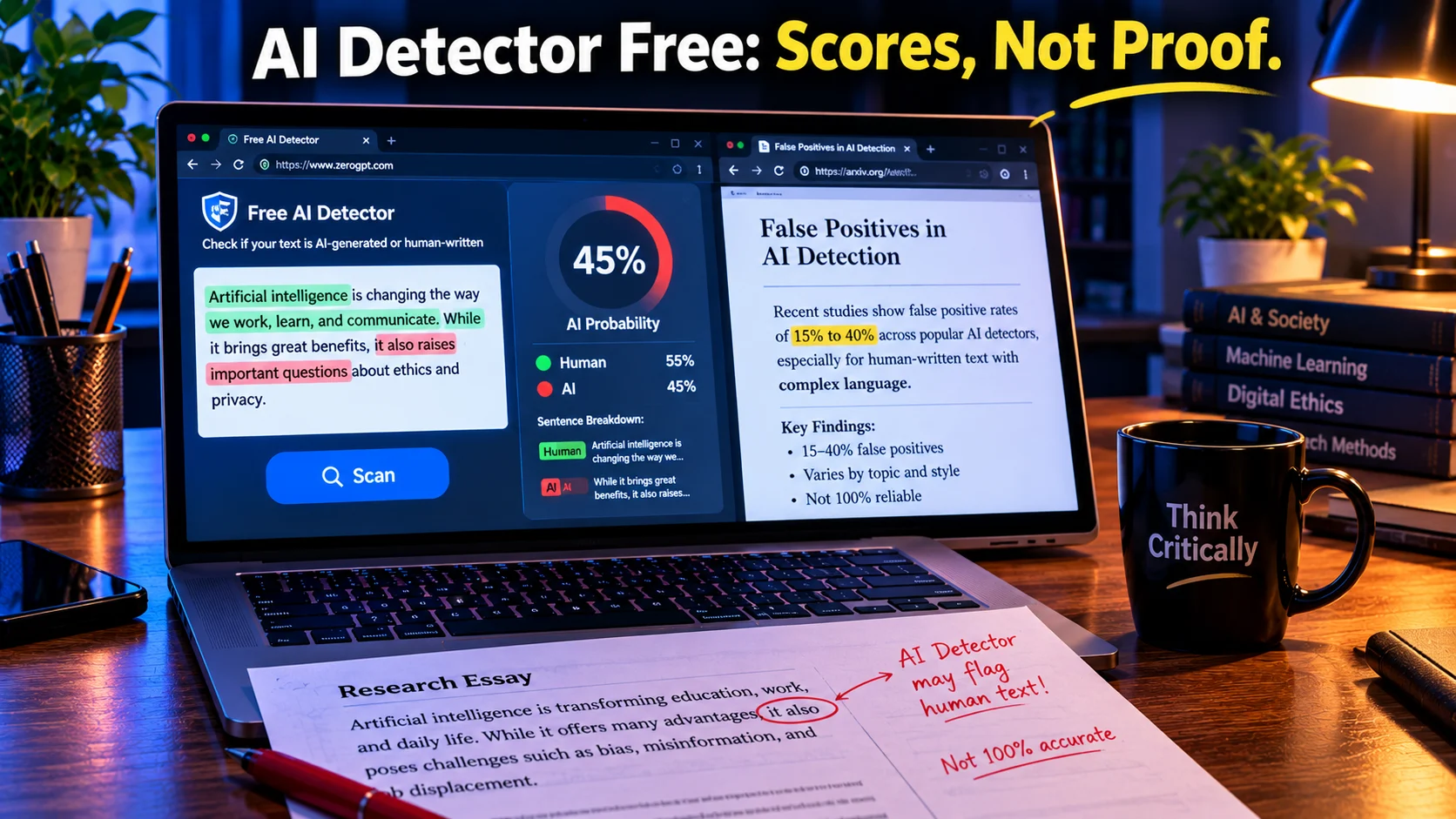
A free AI detector analyzes text patterns to estimate whether content was machine-generated. Copyleaks offers the highest free scan limit at 25,000 characters, ZeroGPT allows 15,000 characters per scan without an account, and QuillBot is free for texts under 1,200 words. However, independent research found false positive rates ranging from 0.05% to 100% across commercial detectors, meaning no free tool should be treated as definitive proof.
At-a-Glance: Key Takeaways
- Copyleaks offers the most generous free scan limit at 25,000 characters without login, higher than most major detectors .
- ZeroGPT provides 15,000 characters per scan and 1.25 million words monthly without requiring an account .
- QuillBot’s detector is free for texts up to 1,200 words and distinguishes between AI-generated, AI-refined, and human-written content .
- False positive rates vary wildly. A University of Florida study found commercial detectors producing false positives from 0.05% to 68.6%, and a separate study found rates up to 100% for non-native English writing .
- Trivial changes defeat detection. Researchers showed that asking an LLM to use more complex vocabulary rendered detectors “basically useless” .
- No free detector provides proof of authorship. They produce probability scores, not verdicts, and should inform human judgment rather than replace it.
What Is a Free AI Detector?
A free AI detector is a tool that analyzes text and estimates whether it was written by a human or generated by an AI system. It studies patterns such as sentence predictability, repetition, vocabulary choice, and structural consistency, then produces a score or label .
The search intent is commercial investigation. Users want to know which free tools are genuinely usable, what their limits are, and whether the results can be trusted. The answer requires distinguishing between what the tools claim and what independent research shows.
Detectors do not read meaning the way a human does. They calculate probability. No detector is perfect, and free versions are more limited than paid ones .
The Major Free AI Detectors Compared
Copyleaks: Highest Free Scan Limit
Copyleaks offers the most generous single-scan allowance among major detectors. You can scan up to 25,000 characters without logging in, higher than most competitors .
What Free Includes
The free scan covers AI detection across 30+ languages. Copyleaks claims over 99% accuracy and an industry-low 0.03% false positive rate, though these are company claims rather than independent verification . A free account unlocks additional monthly credits .
Where the Limits Hit
Full reports, the AI Logic feature that explains why text was flagged, and plagiarism checking require paid plans. The free scan provides a detection result but not the detailed analysis that makes the tool useful for high-stakes decisions .
Editorial interpretation: Copyleaks is the best free option for scanning longer documents in one pass. The lack of detailed reporting on the free tier limits its usefulness for anything beyond a quick check.
ZeroGPT: Generous Volume Without an Account
ZeroGPT’s free plan is unusually generous for casual use. It allows 15,000 characters per scan, roughly 2,300 words, and up to 1.25 million words monthly without requiring an account .
What Free Includes
Sentence-level highlighting, an overall probability score, and mixed human/AI classification. The interface is straightforward, and no signup is needed for basic use .
Where the Limits Hit
Accuracy is inconsistent. A 2026 IEEE benchmarking study found ZeroGPT had the lowest overall accuracy (69.4%) among five tools tested, with significantly reduced performance on hybrid texts . Full reports and deeper analysis require a subscription .
Editorial interpretation: ZeroGPT is convenient for quick, no-commitment checks. Its accuracy limitations mean results should be treated as one signal among many, not a verdict.
QuillBot: Distinguishing AI-Refined from AI-Generated
QuillBot’s detector offers something the others do not: it distinguishes between four categories. Text can be labeled as generated by AI, generated and refined by AI, written by a human and refined by AI, or written by a human .
What Free Includes
Free scans for texts under 1,200 words, no account or credit card required. The tool supports six languages including English, French, Spanish, German, Dutch, and Portuguese .
Where the Limits Hit
The 1,200-word cap is restrictive for longer documents. The accuracy of the four-category classification is not independently verified at scale, and the distinctions may not hold for all writing styles.
Editorial interpretation: QuillBot is best for writers who want to understand how much AI assistance is detectable in their own drafts. The nuanced labeling is useful for self-assessment.
The False Positive Problem
The most important finding for anyone using a free AI detector is that these tools produce false positives at rates that make them unreliable for high-stakes decisions.
The Range of Failure
A University of Florida study presented at the 2026 IEEE Symposium on Security and Privacy examined five commercial detectors. False positive rates ranged from 0.05% to 68.6%. False negative rates ranged from 0.3% to 99.6% .
An arXiv study of 135,389 document pairs found false positive rates for human-written texts varied from 0.0% to 100.0% across 13 detectors. Critically, the same edits increased AI scores in some detectors but decreased them in others .
Non-Native Writers Face Higher Risk
Research consistently shows that non-native English writers are disproportionately flagged. The arXiv study identified professional editing style as a confounding variable: polished academic English triggers detection regardless of authorship . Turnitin’s own guidance cautions that similarity scores do not constitute proof, and AI detection outputs should be interpreted as indicators of textual anomaly rather than definitive evidence .
Trivial Changes Defeat Detection
The University of Florida researchers demonstrated that asking an LLM to regenerate text using more complex vocabulary rendered detectors “basically useless.” The tools are easily swayed by fancy words .
Editorial interpretation: If a detector can be defeated by asking for bigger words, and if it flags human writing at rates up to 68.6%, it cannot be used to adjudicate authorship in academic or professional settings.
How Free Detectors Actually Work
Most detection systems rely on machine learning and natural language processing to calculate probability. They measure how predictable text is based on learned patterns .
AI writing often follows consistent probability curves with low variance in sentence length. Human writing typically contains more variation. Detection tools analyze this difference .
Copyleaks describes its approach as analyzing frequency ratios, part-of-speech patterns, syllable dispersion, and hyphenation usage against large datasets of AI and human text .
The fundamental limitation is that these are statistical patterns, not evidence of authorship. A human writing in a polished, consistent style will produce the same patterns as an AI. A non-native writer using simple English may trigger flags regardless of how the text was produced .
Who Should Use a Free AI Detector
Writers checking their own drafts can use QuillBot’s free detector to see how AI assistance is flagged. The four-category labeling helps understand what patterns trigger detection .
Users needing a quick, no-commitment scan can use ZeroGPT or Copyleaks without creating an account. Both offer generous single-scan limits .
Educators exploring detection tools should understand the false positive research before applying any tool to student work. The 2026 IEEE study found all tools had substantially reduced accuracy on hybrid texts (54.2%–70.8%), and false positive rates of 15.6%–30.6% raise concerns for equitable enforcement .
Anyone using detection results for disciplinary action should not rely on free detectors. The research is clear that these tools are not reliable enough for high-stakes decisions .
Organizations needing plagiarism checking will find that free AI detectors do not include plagiarism detection. Copyleaks and Quetext offer plagiarism tools on paid plans .
Common Mistakes and Cautions
Treating a score as proof. Detectors produce probability estimates, not verdicts. A 68.6% false positive rate means many human-written texts will be flagged .
Ignoring the non-native writer problem. Research consistently shows higher false positive rates for non-native English writing. Polished academic style, not AI authorship, may be what triggers detection .
Assuming free and paid versions are equally accurate. Free tiers often lack the detailed analysis and reporting that help interpret results. Copyleaks’ AI Logic, which explains why text was flagged, is a paid feature .
Testing text under 300 words. Short texts do not provide enough data for reliable pattern recognition. Detection scores on brief passages are especially unreliable .
Forgetting that trivial changes defeat detection. If a detector can be fooled by asking for more complex vocabulary, it cannot be trusted as a gatekeeper .
Frequently Asked Questions
What is the best free AI detector?
Copyleaks offers the highest free scan limit at 25,000 characters without login. ZeroGPT provides 15,000 characters per scan and 1.25 million words monthly without an account. QuillBot is best for texts under 1,200 words and distinguishes AI-refined from AI-generated content. The best depends on whether you need volume or nuance .
Are free AI detectors accurate?
Independent research shows they are not reliable for high-stakes decisions. False positive rates range from 0.05% to 68.6% in one study, and up to 100% for non-native English writing in another. Trivial changes to AI text can defeat detection entirely .
Can my professor tell if I used AI?
Detection tools produce probability scores, not proof. If your institution uses a detector, understand that the result is one signal among many. Polished writing and non-native English patterns can trigger flags regardless of how the text was produced .
Do free AI detectors check for plagiarism?
No. Free AI detectors check for AI-generated patterns, not plagiarism. Copyleaks and Quetext offer plagiarism checking on paid plans. Grammarly’s free plagiarism checker exists but is separate from its AI detection feature .
Why do AI detectors flag human writing?
Detectors look for patterns like low sentence variation and predictable vocabulary. Polished academic writing and non-native English can exhibit these patterns. Research identifies professional editing style as a confounding variable that triggers detection regardless of authorship .
Conclusion
Free AI detectors offer convenient access to a contested technology. Copyleaks provides the highest single-scan limit. ZeroGPT offers generous monthly volume without an account. QuillBot delivers nuanced labeling for shorter texts.