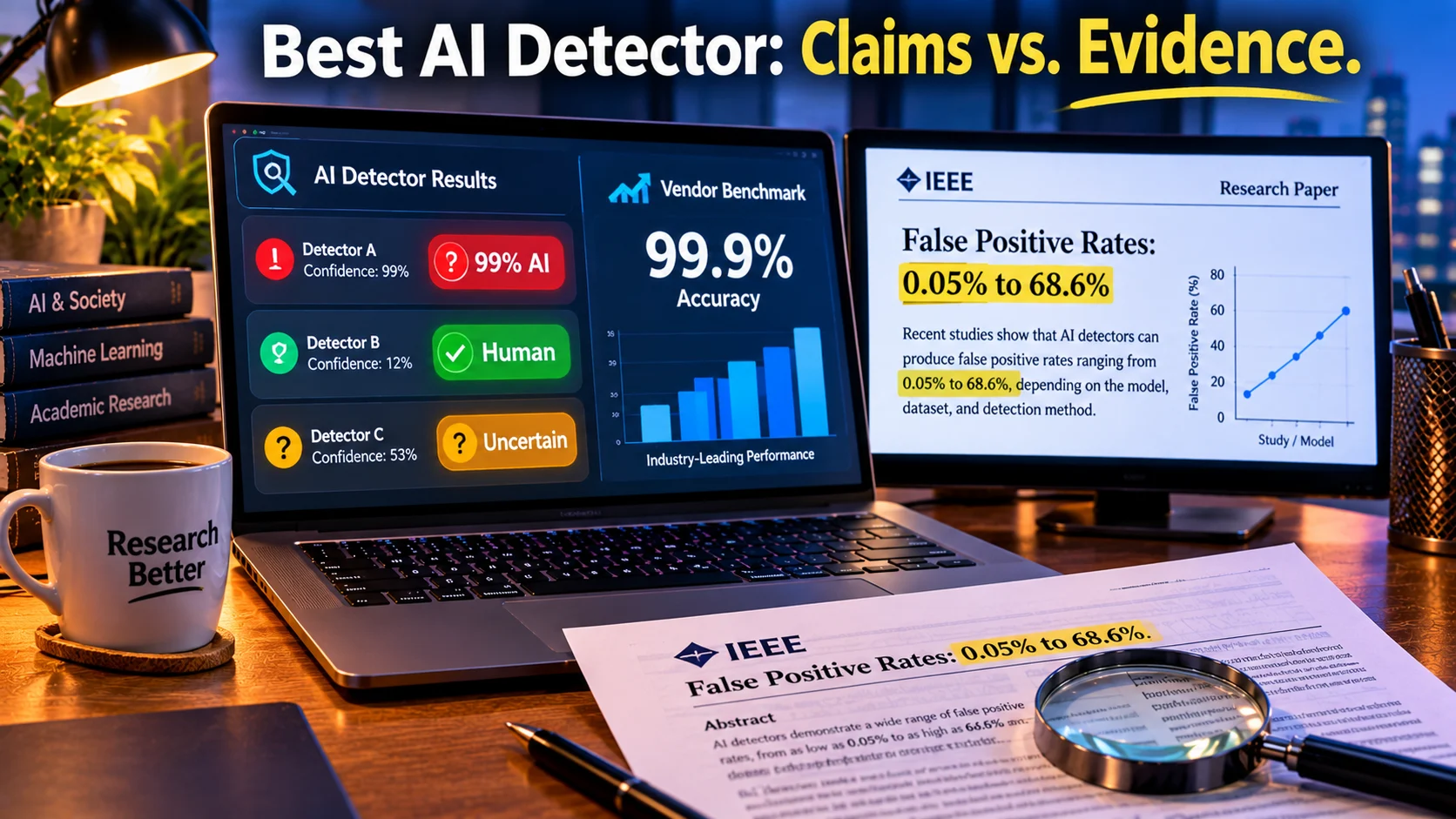
The “best” AI detector depends on which benchmark you trust. GPTZero claims the lowest false positive rate at 1 in 10,402, Copyleaks claims 99.9% true negative rate, and Originality.ai leads one independent academic study at 84.4% accuracy. However, a University of Florida study found commercial detectors produce false positive rates up to 68.6% and false negative rates up to 99.6%, making them unsuitable for high-stakes decisions.
At-a-Glance: Key Takeaways
- Vendor benchmarks conflict with independent research. GPTZero and Copyleaks publish near-perfect metrics, while a 2026 IEEE study found false positive rates of 15.6% to 30.6% across five major detectors .
- Originality.ai led one independent academic benchmark at 84.4% accuracy, but all tools dropped to 54.2%-70.8% on hybrid AI-human text .
- The University of Florida study is the starkest warning. It found detectors are “poorly suited for deployment in academic or high-stakes contexts,” with trivial lexical changes defeating them entirely .
- GPTZero published the strongest fairness testing, recording zero false positives across 914 ESL essays and 1,172 essays from students with disabilities .
- Turnitin detects paraphrasing and bypassing, but suppresses scores below 20% because false positives are more common in that range .
- No detector is reliable enough for sole-source misconduct decisions. Research consistently recommends human review and corroborating evidence .
What Is an AI Detector?
An AI detector is a software tool that analyzes text and estimates the probability that it was generated by a large language model. These tools are used in education, publishing, hiring, and content marketing to screen for AI-generated submissions.
The search intent is commercial investigation. Users want to know which detector is most accurate, what the pricing is, and whether the results can be trusted for their specific use case. The answer is complicated by a fundamental problem: the tools are measured against different benchmarks, and the benchmarks themselves are contested.
The category includes specialized AI detectors (Originality.ai, GPTZero, Copyleaks), academic integrity platforms with detection features (Turnitin), and writing assistants with detection add-ons (Grammarly). Each approaches the problem differently, and each has different strengths and failure modes.
The Major AI Detectors Compared
| Originality.ai | Content marketers, publishers | 99%+ (vendor) | 84.4% accuracy (IEEE study) | Pay-per-credit |
| GPTZero | Educators, fairness-sensitive use | 1 in 10,402 FPR (vendor) | Not in IEEE study | Free tier; paid plans |
| Copyleaks | Enterprise, multilingual | 99.9% TNR (vendor) | 15.6%-30.6% FPR range (IEEE) | Subscription |
| Turnitin | Academic institutions | Not published numerically | Low FPR, high FNR on GPT-5 | Institutional license |
| Grammarly | Integrated writing workflow | Not published | Not in IEEE study | $12-$21/month |
Originality.ai: The Independent Benchmark Leader
Originality.ai is the most established dedicated AI detector, used by publishers, agencies, and educational institutions. Its marketing emphasizes accuracy and customer service, with testimonials from writers and teachers who rely on it for content verification .
What Independent Research Shows
An IEEE conference paper evaluating five major detectors against 180 academic writing samples found Originality.ai achieved the highest overall accuracy at 84.4%. However, the same study found all tools dropped significantly on hybrid text (54.2%-70.8%), and false positive rates ranged from 15.6% to 30.6% .
Where the Limits Hit
Originality.ai is priced per credit, which can become expensive for high-volume use. The vendor does not offer a free trial, only a limited free detector . Its accuracy on academic writing may not generalize to other domains.
Editorial interpretation: Originality.ai leads the academic benchmark, but 84.4% accuracy means roughly one in six texts is misclassified. For high-stakes decisions, that error rate is unacceptable without human review.
GPTZero: The Fairness Leader
GPTZero has positioned itself as the most fairness-conscious detector, publishing extensive testing on demographic groups that other vendors ignore.
What GPTZero Claims
GPTZero 4o, launched October 2026, claims a false positive rate of 1 in 10,402 on diverse student writing corpra. The company reports 0% FPR on the EpochAI benchmark and beats Pangram 4 on false negative rate . GPTZero also claims state-of-the-art performance across DetectRL and Sem-Detect benchmarks .
The Fairness Testing
GPTZero published results showing zero false positives across 914 essays written by English language learners and 1,172 essays written by students with IEP or 504 plans. All were labeled human-written with perfect confidence . This directly addresses the documented concern that AI detectors penalize non-native speakers and developing writers.
Where the Limits Hit
GPTZero’s benchmarks are vendor-published, not independently audited. The tool was not included in the IEEE study that found high false positive rates across competitors, making direct comparison difficult.
Editorial interpretation: GPTZero’s fairness testing is the most transparent in the industry. If the goal is minimizing false accusations against vulnerable writers, GPTZero’s published evidence is the strongest available.
Copyleaks: Enterprise Scale with Transparency Gaps
Copyleaks publishes detailed testing methodology for its V11 model, claiming 99.9% true negative rate and 98.9% true positive rate on a 500,000-text dataset .
What Copyleaks Claims
The company’s data science and QA teams independently tested the model on 300,000 human texts and 200,000 AI-generated texts, including adversarial attacks. The reported TNR (accuracy on human text) was 0.999, and TPR (accuracy on AI text) was 0.989 .
Where the Limits Hit
The IEEE study found Copyleaks among the tools with false positive rates in the 15.6%-30.6% range . The discrepancy between vendor claims and independent findings is stark. Copyleaks’ testing uses its own datasets and methodology, which may not reflect real-world academic or professional writing.
Editorial interpretation: Copyleaks’ vendor benchmarks are impressive but unverified by independent researchers. The gap between 99.9% TNR and 15.6%-30.6% FPR in independent testing is a red flag for high-stakes use.
Turnitin: Academic Standard with Known Limits
Turnitin is the default AI detector in higher education, integrated into plagiarism checking workflows used by thousands of institutions.
What Turnitin Offers
Turnitin’s AI writing detection uses a transformer-based deep learning model trained on its in-house academic corpus. It detects AI-generated content that has been modified by paraphrasers or bypassers. The company suppresses scores below 20% because false positives are more common in that range .
Where the Limits Hit
A De Gruyter study found Turnitin’s false negative rate was “substantially higher” than its false positive rate, particularly for newer models like GPT-5. The study noted that detection performance may depend on prompting strategy, and refined prompts produce text that is less often detected .
Editorial interpretation: Turnitin is institutionally entrenched and relatively conservative about low-confidence scores. But its high false negative rate means it misses AI text more often than it falsely accuses human text. For catching cheaters, it underperforms. For avoiding false accusations, it is relatively safe.
The Independent Research Consensus
The most important finding for anyone evaluating AI detectors is that independent research consistently contradicts vendor benchmarks.
The University of Florida Study
Published at the 2026 IEEE Symposium on Security and Privacy, this study tested five popular commercial detectors on AI-generated clones of pre-ChatGPT academic papers. The findings were damning :
- False positive rates: 0.05% to 68.6%
- False negative rates: 0.3% to 99.6%
- Trivial evasion: Asking the LLM to use more complex vocabulary (a “lexical complexity attack”) rendered the detectors “basically useless”
The researchers concluded that current tools are “poorly suited for deployment in academic or high-stakes contexts” and that “people’s careers are on the line here” .
The IEEE Academic Writing Study
This study tested GPTZero, Turnitin, Copyleaks, ZeroGPT, and Originality.ai on 180 academic writing samples. Key findings :
- Originality.ai achieved the highest accuracy at 84.4%
- ZeroGPT had the lowest at 69.4%
- All tools dropped to 54.2%-70.8% accuracy on hybrid texts
- False positive rates ranged from 15.6% to 30.6%
The study concluded that these findings “raise substantial concerns for equitable academic integrity enforcement” .
Where the Paywall Actually Lands
AI detectors use different pricing models, each with different implications for cost predictability.
Originality.ai uses pay-per-credit pricing. You buy credits and spend them on scans. High-volume use becomes expensive quickly.
GPTZero offers a free tier with limited scans and paid plans for higher volume. The free tier is sufficient for occasional use.
Copyleaks uses subscription pricing, with enterprise plans available. Pricing is not published publicly.
Turnitin is licensed institutionally. Individual users cannot purchase access directly.
Grammarly bundles AI detection into its writing assistant at $12-$21 per month. The detection is a feature, not the primary product.
Who Should Use an AI Detector
Educators investigating suspected misconduct should use detectors as a signal, never as sole evidence. The research consensus is clear: detectors are too unreliable for standalone decisions. GPTZero’s fairness testing makes it the safest choice for avoiding false accusations against ESL students and students with disabilities .
Content marketers verifying freelancer submissions can use Originality.ai, which led the academic benchmark and offers paraphrase detection. Budget for per-credit costs.
Publishers screening submissions should combine detector scores with editorial judgment and author communication. A positive flag is a prompt for further review, not a verdict.
Institutions enforcing academic integrity should use Turnitin if already licensed, understanding its high false negative rate. Do not rely on scores below 20%, which Turnitin itself suppresses due to false positive risk .
Anyone making high-stakes decisions should not rely on any detector alone. The University of Florida study makes this explicit: the tools are not reliable enough to adjudicate career-affecting outcomes .
Common Mistakes and Cautions
Trusting vendor benchmarks as independent truth. GPTZero, Copyleaks, and Originality.ai all publish impressive metrics. Independent research tells a different story .
Using detectors as sole evidence of misconduct. The IEEE study found 15.6%-30.6% false positive rates. The University of Florida study found rates up to 68.6%. A false positive can damage a student’s or writer’s reputation .
Ignoring hybrid text limitations. All tools drop to 54.2%-70.8% accuracy on text that mixes human and AI writing. Most real-world writing is hybrid .
Assuming “99% accuracy” means reliable. A 1% error rate on 10,000 documents means 100 misclassifications. For individual decisions, that is unacceptable.
Overlooking the paraphrase arms race. Turnitin detects paraphrasing and bypassing, but the University of Florida study showed trivial vocabulary changes defeat detectors. The arms race continues .
Frequently Asked Questions
What is the best AI detector?
There is no single “best” detector. Originality.ai led one independent academic benchmark at 84.4% accuracy. GPTZero has the strongest fairness testing with zero false positives on ESL and disability essays. Copyleaks publishes detailed vendor methodology. The choice depends on whether you prioritize academic accuracy, fairness, or enterprise features .
How accurate are AI detectors really?
Independent research found false positive rates ranging from 0.05% to 68.6% and false negative rates from 0.3% to 99.6%. A 2026 IEEE study found all major detectors drop to 54.2%-70.8% accuracy on hybrid AI-human text. Vendor claims of 99%+ accuracy are not supported by independent testing .
Can AI detectors be fooled?
Yes. The University of Florida study found that asking the LLM to use more complex vocabulary (a lexical complexity attack) rendered detectors “basically useless.” Turnitin detects paraphrasing and bypassing, but the research shows evasion is trivial .
Are AI detectors biased against non-native speakers?
Early research suggested they were. GPTZero published testing showing zero false positives across 914 ESL essays and 1,172 essays from students with disabilities. Other vendors have not published comparable fairness testing .
Should schools use AI detectors to punish students?
Research consistently recommends against using detectors as sole evidence of misconduct. The IEEE study found false positive rates of 15.6%-30.6%. The University of Florida study concluded detectors are “poorly suited for deployment in academic or high-stakes contexts.” Human review and corroborating evidence are essential .
Conclusion
The search for the “best” AI detector leads to an uncomfortable conclusion: no detector is reliable enough for high-stakes decisions. Vendor benchmarks from GPTZero, Copyleaks, and Originality.ai claim near-perfect accuracy. Independent research from IEEE and the University of Florida finds false positive rates up to 68.6%, false negative rates up to 99.6%, and trivial evasion techniques that defeat the tools entirely.