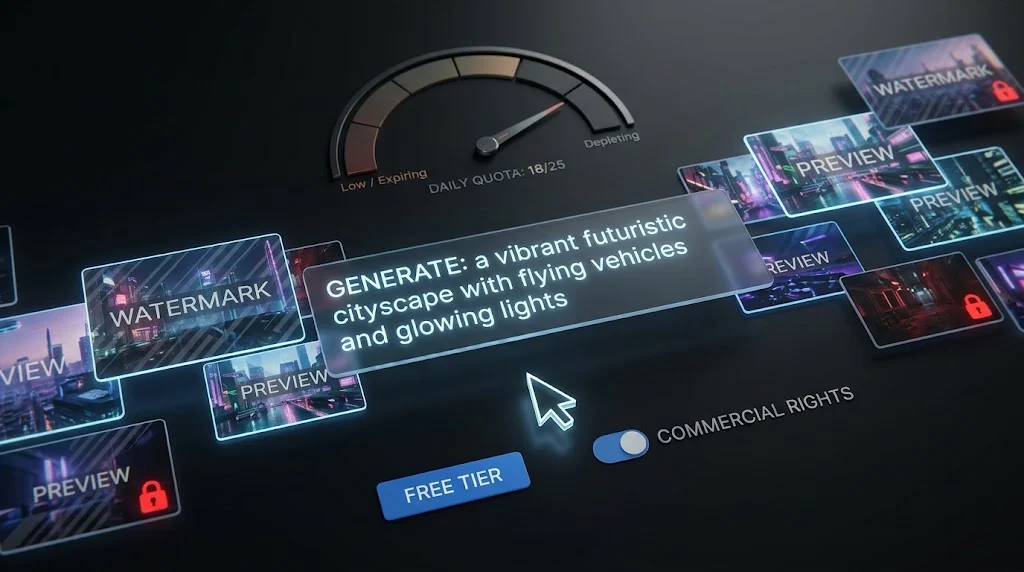
A free AI image generator lets you create images from text prompts without paying, but “free” comes with trade-offs. Most tools cap daily generations, apply invisible or visible watermarks, and restrict commercial use on their no-cost tiers.
At-a-Glance Box
- Free tiers are real, but tight. Most tools offer between 2 and 25 generations per day, depending on the platform and current load .
- Commercial rights vary wildly. Ideogram’s free tier explicitly permits commercial use; Leonardo’s free tier does not, and Microsoft Designer restricts free output to personal use .
- Watermarks are not always visible. Gemini adds a visible logo plus invisible SynthID; ChatGPT uses invisible C2PA metadata only .
- Open-source is the only truly unlimited path. Running FLUX locally on your own GPU removes credits, watermarks, and queues entirely .
- Free is for learning and low-volume work. The moment you hit limits three days in a row, a paid plan or API access usually costs less than the workarounds .
What “Free” Actually Means in 2026
The search for a free AI image generator usually starts with a simple desire: make an image without opening a wallet. That part is easy. The harder question is whether the image you get is yours to use, whether it carries someone else’s logo, and whether the tool will still exist next month.
Free tiers have matured. In 2023, free meant a trial. In 2026, several platforms offer sustained free access with real caps. The gap between paid and free image quality has narrowed for everyday use cases like blog headers, social graphics, and concept sketching . What has not narrowed is the legal and practical fine print.
Understanding that fine print is the difference between a useful free tool and a costly mistake. A free image that cannot legally appear on a client’s website is not actually free. A generator that owns the rights to your output is not a generator at all. It is a content farm, and you are the supplier.
This guide breaks down the free tier landscape by what matters: limits, rights, watermarks, and the honest ceiling of what zero dollars buys.
The Free Tier Landscape: A Comparison
The table below reflects publicly documented terms as of late 2026. Free tier policies change frequently. Always verify the current terms on the provider’s site before using an image commercially.
Two entries in this table deserve immediate clarification.
Ideogram is the outlier. Its free tier explicitly grants commercial rights in the terms of service, which is rare. For Etsy sellers, print-on-demand shops, or freelancers who need a defensible free option, Ideogram is the strongest choice in 2026 . The 10-credit daily cap is annoying, but for low-volume work it is workable.
Leonardo’s free tier is not a business tool. The terms state that ownership of free-tier outputs vests in Leonardo upon creation, and free generations are public by default . The 150 daily tokens are generous for experimentation, but anyone planning to sell or publish the output should look elsewhere or budget for a paid plan.
The Hidden Costs of Free Image Generation
Free tiers rarely fail because the model is bad. They fail because the model is good enough that you start relying on it, and then the limits bite.
Credit Expiry and Daily Resets
Most free tiers operate on daily or monthly resets. Ideogram’s 10 credits refresh daily. Adobe Firefly’s monthly credits do not roll over. Leonardo’s tokens reset daily but drain quickly on higher-quality models . The practical consequence is that free generation rewards patience and planning. If you need 30 images for a project, Ideogram will take you three days. A paid plan takes an afternoon.
The Watermark Question
Watermarks on free outputs fall into three categories. Visible logos are the most restrictive: Gemini places its logo on free-tier images generated in the app, though API outputs are exempt . Invisible watermarks, such as Google’s SynthID or OpenAI’s C2PA metadata, do not affect how an image looks but do mark it as AI-generated for anyone scanning for provenance. No watermark at all is increasingly rare on free tiers, which is part of what makes Ideogram’s offering notable.
Commercial Rights Are Not Universal
The most expensive mistake in free image generation is assuming that “free to generate” means “free to use.” It does not. Microsoft’s terms restrict Designer’s free output to personal use . Leonardo’s free tier claims ownership of outputs and publishes them publicly . Recraft’s free images are public and non-commercial . Adobe Firefly permits commercial use on free credits but does not extend its intellectual property indemnification to free accounts; that protection requires a paid plan .
If the image will appear in a client deliverable, a product listing, or an advertisement, read the terms. If the terms are ambiguous, treat the image as non-commercial until clarified.
How Free AI Image Generators Actually Work
Under the hood, most free tiers route your prompt to the same model families that power paid plans. ChatGPT’s free tier runs the same image model as paid tiers; the difference is how many generations you get, not the model’s capability . Gemini’s free tier uses Nano Banana models with a daily cap . Leonardo’s free tokens unlock the same model selection as paid users, just with fewer tokens .
The technical distinction that matters for free users is inference cost. Image generation is computationally expensive. Every free generation costs the provider money in GPU time. That economic reality explains the caps. A provider offering unlimited free generations at high quality either has a business model you have not noticed yet, or will not be around for long.
This is why open-source models occupy a different category. FLUX Schnell, released under a permissive license, can run on a consumer GPU with 12 GB or more of VRAM . The “free” here is not a marketing tier. It is the absence of a billing relationship. You supply the hardware, the electricity, and the setup time. In exchange, you get unlimited generations, no watermarks, full commercial rights, and no one training a model on your prompts without your consent.
For users with the hardware, local FLUX is the only free option without an asterisk. For everyone else, hosted free tiers are a compromise between convenience and constraints.
Who Should Use a Free AI Image Generator (and Who Should Not)
Free tiers work well for:
- Hobbyists and learners who want to understand prompt structure without financial commitment.
- Low-volume sellers on Etsy or print-on-demand who can work within 10 daily generations and need explicit commercial rights. Ideogram is the relevant tool here .
- Bloggers and social media managers who need occasional header images and can accept invisible watermarks or minor attribution requirements.
- Developers testing a concept before committing to an API integration.
Free tiers are a poor fit for:
- Client work with legal exposure. Without indemnification, you carry the copyright risk. Adobe’s free tier does not include the indemnification that paid plans provide .
- Anyone who needs private outputs. Leonardo’s free generations are public and indexed by search engines . Recraft’s free images are public . If the image contains proprietary information or an unreleased product, free tiers are the wrong choice.
- High-volume workflows. Ten images a day is not a workflow. It is a bottleneck.
The honest progression most users follow is this: start with a free tier, hit the limit three days in a row, and then decide whether to subscribe to one tool or move to a bring-your-own-API-key setup. Stacking five free accounts to avoid paying is a false economy. The cognitive overhead of managing quotas, watermarks, and divergent interfaces costs more than a $10 monthly subscription .
Privacy and Data Retention on Free Tiers
Free access often comes with a data trade. Providers absorb inference costs, and user data is one way to offset that expense.
Leonardo’s free tier is the most explicit example. Free generations are public by default and may be indexed by search engines. The terms grant Leonardo a perpetual, transferable license to use public content for model training and commercial purposes. Escaping that arrangement requires a paid subscription and private generation mode . This is not a hidden policy buried in a PDF. It is stated in the terms of service.
Recraft’s free tier also defaults to public images and does not offer the training opt-out that paid plans include . The company’s documentation is clear that free and paid accounts are included in training by default, with opt-out available only on the Pro plan.
Google and OpenAI take a different approach. Gemini outputs carry SynthID and C2PA credentials regardless of tier . ChatGPT images carry C2PA metadata . These are provenance markers, not privacy guarantees. They tell viewers the image is AI-generated. They do not prevent the provider from processing your prompts.
The practical guidance is simple: do not put anything into a free AI image generator that you would not want to see in a public gallery or a training dataset. For personal projects, that may be fine. For confidential work, it is not.
Common Mistakes and How to Avoid Them
Mistake 1: Assuming commercial rights come with free access. They often do not. Check the terms for the specific tier you are using, not the tool’s general marketing page.
Mistake 2: Ignoring the watermark until delivery day. A visible Gemini logo on a client mockup is a problem you discover too late. Test the output pipeline before committing to a tool.
Mistake 3: Using Leonardo free-tier output for a commercial project. The terms state that Leonardo owns free-tier outputs. Using them commercially is a licensing violation, not a gray area .
Mistake 4: Treating “no watermark” as “no provenance.” Invisible watermarks and C2PA metadata are increasingly standard. An image without a visible logo may still be traceable to a generator.
Mistake 5: Expecting free tiers to stay the same. Free tier terms change. Adobe, Google, and OpenAI have all adjusted quotas and features over the past year. A tool that was generous in January may be restrictive by December.
The Open-Source Alternative: When Free Means Truly Free
The one category of free AI image generation without quotas, watermarks, or licensing ambiguity is local execution of open-weight models.
FLUX Schnell, developed by Black Forest Labs, is released under the Apache 2.0 license. It runs on consumer hardware, produces quality competitive with hosted free tiers, and generates images as fast as your GPU allows . Setup requires technical comfort: installing Python dependencies, downloading model weights (several gigabytes), and configuring the inference environment. For users who already have a suitable GPU, that setup cost is a one-time investment that removes every ongoing constraint.
The trade-off is hardware. A 12 GB VRAM GPU is the practical minimum. Cloud GPU rentals can bridge the gap, but at that point the cost comparison with a $10 monthly subscription becomes less favorable. Local generation is genuinely free only if the hardware is already in hand.
For developers and technical users, the open-weight path is the most honest answer to the “free AI image generator” query. It is not convenient. It is not instant. But it is the only version of free that does not come with a hidden bill.
Latest Developments to Watch
The free tier landscape moves quickly. Three trends are worth monitoring.
First, model quality on free tiers is converging with paid tiers. ChatGPT’s free image model is the same as its paid model; only the quota differs . Gemini’s free Nano Banana access is limited by volume, not capability . This means the free tier is no longer a degraded experience. It is a throttled one.
Second, provenance marking is becoming standard. SynthID, C2PA, and invisible watermarks are appearing across providers. The days of untraceable AI images are ending. This is good for transparency and complicated for users who assumed free output was anonymous.
Third, the economics of free are tightening. Pollinations, once a popular zero-signup image API, now requires a key and operates on a credit system for image models . Free inference at scale is expensive, and providers are experimenting with ways to make it sustainable. Users should expect free tiers to become more restrictive, not less, over time.
Frequently Asked Questions
Which free AI image generator allows commercial use?
Ideogram’s free tier explicitly permits commercial use in its terms of service, with no watermark and roughly 10 daily credits. Google Gemini also permits commercial use under its terms, though outputs carry a visible logo and SynthID watermark when generated in the app .
Is ChatGPT’s free image generation really free?
Yes, but the free tier is limited to roughly 2 to 3 images per 24-hour window, according to community reports. OpenAI does not publish an exact number, and the limit can vary with demand. The model itself is the same as paid tiers, and outputs carry invisible C2PA metadata .
Can I sell images made with a free AI generator?
Only if the tool’s terms grant you commercial rights and you own the output. Ideogram’s free tier meets both conditions. Leonardo’s free tier does not: Leonardo claims ownership of free-tier outputs and publishes them publicly. Microsoft Designer’s free tier is restricted to personal use .
What is the truly unlimited free option?
Running an open-weight model like FLUX Schnell locally on your own GPU. There are no credits, watermarks, or commercial restrictions. The trade-off is hardware requirements and setup time. For users without a suitable GPU, no hosted free tier is truly unlimited .
Do free AI image generators watermark their outputs?
It depends on the tool. Gemini adds a visible logo plus SynthID on in-app free generations. ChatGPT uses invisible C2PA metadata. Ideogram, Leonardo, and Adobe Firefly do not add visible watermarks on free tiers, though invisible provenance markers may still be present .
Conclusion
A free AI image generator is a genuine resource in 2026, but it is not a substitute for a paid plan in every situation. The tools that offer free access do so with constraints: daily caps, invisible or visible watermarks, public galleries, and commercial rights that range from explicit permission to outright prohibition.
The practical decision comes down to three questions. Do you need commercial rights? If yes, Ideogram is the only free tier that clearly grants them without a watermark. Do you need privacy? If yes, no hosted free tier is suitable for sensitive work. Do you need volume? If yes, free tiers will frustrate you within a week.
For learning, experimentation, and low-volume personal projects, the free tier is sufficient. For client work, product listings, or anything that carries your name, read the terms before you generate. The image is free. The consequences are not.