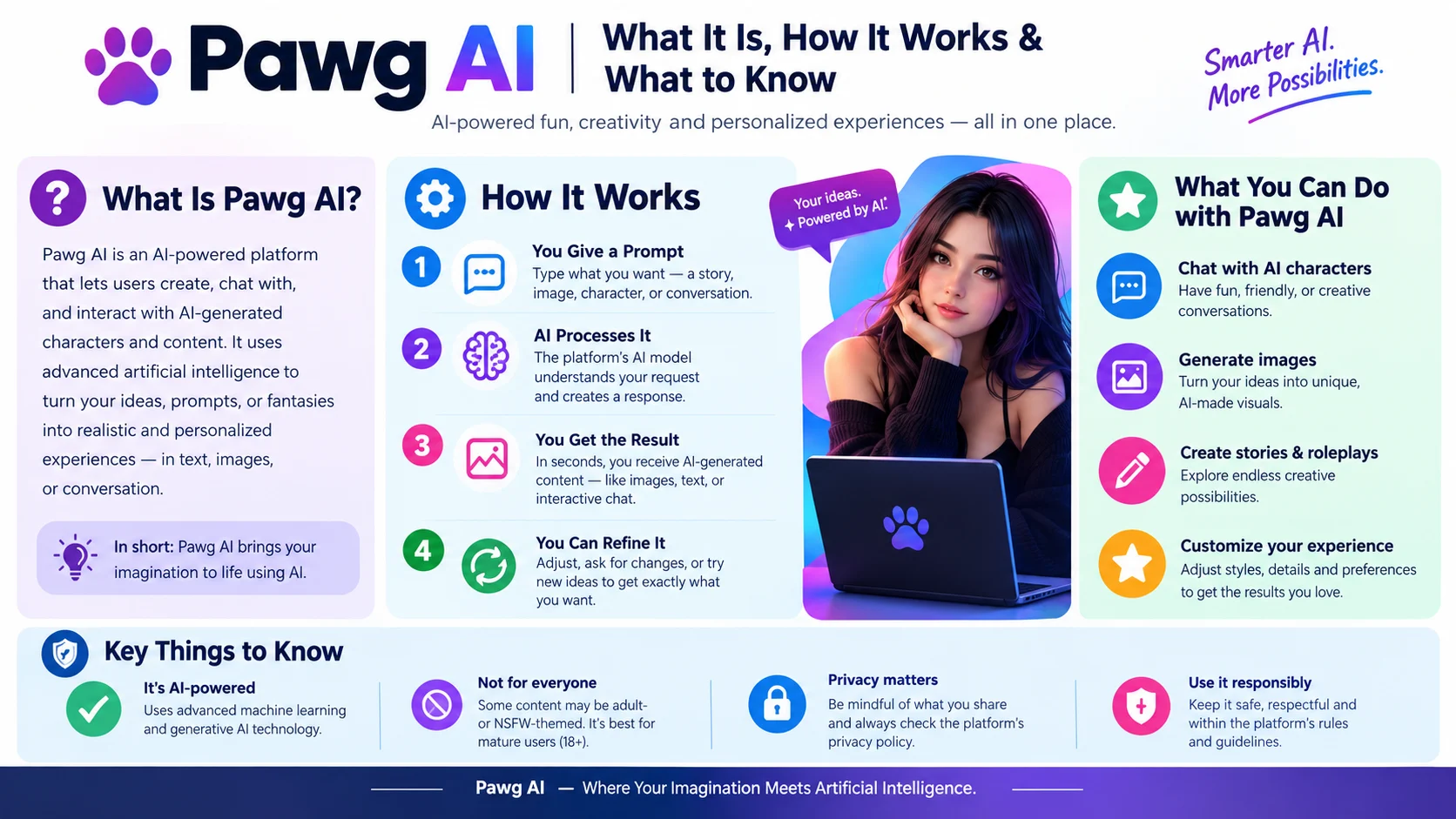
Pawg AI refers to AI-powered tools or platforms associated with generating, customizing, or exploring character-based digital imagery. Features vary by platform and may include AI image generation, character customization, and interactive experiences. Before using any service, check its privacy policy, content rules, and safety features.
At a Glance
- Meaning: PAWG is an adult internet slang acronym; PAWG AI generally refers to AI-generated imagery associated with that term.
- Search intent: Users may be trying to understand the terminology or the role of AI in synthetic images.
- Technology: AI image generators can create pictures from text prompts or transform existing images.
- Authenticity: An AI-generated image can look realistic without depicting a real event or photograph.
- Privacy: Using an identifiable person’s likeness without permission can create serious privacy and consent concerns.
- Key distinction: A keyword is not necessarily a product name, a verified company, or a specific AI model.
What Does PAWG AI Mean?
PAWG is an adult internet slang acronym associated with a particular body-type aesthetic. When paired with “AI,” the phrase commonly refers to synthetic images generated using artificial intelligence.
The keyword is therefore different from the name of a recognized AI technology standard. It does not, by itself, establish which image-generation model, website, or application someone is discussing.
Context matters. A search result might use the phrase as a descriptive label, a category name, or part of a website’s marketing language.
Readers should distinguish between the meaning of a search term and the verified capabilities of a specific service.
Why does the keyword appear in AI image searches?
Generative AI has made it possible to create images from written descriptions. A user can describe a fictional character, a setting, clothing, lighting, and an artistic style, and an image model can generate a corresponding visual.
The resulting image may be realistic, illustrated, or stylized. Its appearance depends on the model, the prompt, the training process, and any editing performed afterward.
Search phrases that combine internet slang with “AI” often describe a subject category rather than a distinct technology.
However, the phrase alone does not establish whether a particular image is synthetic, whether its subject is fictional, or whether the image was created with permission.
How Does AI Image Generation Work?
AI image generators use machine-learning systems trained to recognize patterns in visual data. Many modern systems use diffusion-based methods or related generative techniques, although not every image model follows the same architecture.
These systems learn relationships between visual features and other information, such as text descriptions. During generation, they use those learned relationships to produce a new image.
Text-to-image generation
Text-to-image systems accept a written description and generate a visual response.
A general, non-explicit example might describe a fictional adult character wearing everyday clothing, standing in a city park at sunset, photographed with soft natural lighting.
The model interprets the description and produces an image that approximates the requested scene. Results can vary, even when the same description is used more than once.
Image editing and transformation
Some generative systems can also modify an existing image. Depending on the tool, they may change backgrounds, adjust lighting, alter colors, or produce an artistic variation.
These capabilities require particular care when the source image depicts an identifiable person.
A technically possible edit is not automatically an ethical or permitted one. Consent, the person’s age, the intended use, and the platform’s rules all matter.
Why can synthetic images look realistic?
Image models learn visual patterns involving skin, lighting, perspective, textures, and other features.
A convincing result can still contain inconsistencies. Hands, reflections, accessories, shadows, and background details may reveal that an image has been generated or edited.
Conversely, visual inspection alone may not reliably identify every synthetic image. Provenance information and trustworthy source context can provide additional evidence.
Important Differences Between AI Images and Real Photographs
An image’s appearance does not prove how it was created.
A synthetic image may depict a fictional person who resembles a real individual. An edited photograph may combine authentic photographic elements with generated details. A genuine photograph may also undergo ordinary adjustments to color, exposure, or composition.
These situations should not be treated as equivalent.
| Image type | How it is created | Important consideration |
|---|---|---|
| AI-generated image | A generative model creates a new visual | The depicted scene may never have occurred |
| AI-edited photograph | A model modifies an existing image | The final image may no longer represent the original scene accurately |
| Traditional photograph | A camera records a real scene | Editing and context can still affect interpretation |
| Digital illustration | An artist creates an image using digital tools | Digital artwork does not necessarily depict a real person |
When authenticity matters, look for the original source, available provenance details, and reliable contextual information. Do not rely on appearance alone.
Common Uses of AI Image Technology
Generative image technology supports many legitimate creative and professional activities beyond any particular internet search category.
Digital art and fictional characters
Artists can use generative tools to explore character concepts, experiment with visual styles, and develop fictional settings.
Human direction remains important. Artists may need to refine composition, correct errors, and ensure that their work does not reproduce another person’s identity without authorization.
Marketing and product concepts
Design teams can use synthetic visuals to explore advertising concepts, presentation layouts, and product ideas.
Before commercial publication, teams should check licensing terms, usage restrictions, brand requirements, and any applicable disclosure obligations.
Education and visual communication
Illustrations can help explain abstract concepts, demonstrate historical settings, or make educational material more engaging.
Accuracy becomes especially important when an image represents a real person, event, scientific process, or historical subject. A generated image should not be presented as documentary evidence when it is not.
Prototyping and creative experimentation
Designers can test different compositions and visual directions before investing time in a finished project.
This can help with brainstorming, but generated outputs may still require manual editing and review.
Privacy, Consent, and Responsible Image Creation
Privacy is one of the most important issues surrounding realistic synthetic images.
AI systems can sometimes generate or alter images in ways that make a fictional scene appear authentic. When identifiable people are involved, the risks extend beyond image quality.
A February 2026 joint statement from privacy regulators highlighted concerns about AI-generated imagery involving identifiable people without their knowledge or consent. These concerns include non-consensual intimate imagery, defamatory depictions, and potential harm to vulnerable people.
Source: Office of the Privacy Commissioner of Canada.
Respect consent and personal identity
Do not assume that an image found online is available for unrestricted reuse.
Using someone’s photograph to create a misleading or intimate synthetic image can violate their privacy and may breach platform rules or applicable laws.
A fictional character created without reference to an identifiable person raises different questions from an image that reproduces a real person’s face or identity.
Protect uploaded photographs
Before uploading a photograph to an image-generation service, review its privacy policy and terms.
Check how the provider handles uploaded files, whether it retains prompts and images, whether content may be used to improve its services, and whether deletion options are available.
Do not upload another person’s private photograph without appropriate authorization.
Understand platform restrictions
Image-generation providers use different rules and safeguards. Some restrict sexualized content, non-consensual imagery, impersonation, or the use of real people’s likenesses.
For example, OpenAI’s published usage policies prohibit non-consensual intimate content and certain uses of people’s likenesses without consent. Its image-generation safety documentation describes safeguards against sexual exploitation and harmful synthetic imagery.
Sources: OpenAI Usage Policies and OpenAI image-generation safety documentation.
Policies can change, and different services may impose different restrictions. Review the current terms of the particular provider rather than assuming that all generators operate alike.
How to Evaluate an AI Image Platform
A search keyword does not establish that a platform is reputable. Before using any image-generation service, evaluate its transparency, privacy practices, costs, and intended use.
Check the provider’s identity
Look for a clearly identified company or developer, accessible terms of service, and a privacy policy.
Be cautious when a website provides little information about who operates it, how it processes uploaded images, or how users can request deletion.
Review pricing and usage limits
Some services use subscriptions, credits, or limits on the number of generations available.
Check the actual billing terms, maximum file sizes, usage allowances, cancellation conditions, and whether advertised features require a paid plan.
Do not assume that a free trial includes unlimited access or that an advertised price covers every feature.
Examine image ownership and licensing
The right to generate an image and the right to use it commercially are separate questions.
Review the provider’s licensing terms, restrictions on uploaded material, and any obligations to disclose synthetic content. Legal rights may also depend on local law and the circumstances of creation.
Look for meaningful privacy controls
A provider’s general security statements do not answer every question about data handling.
Read the specific policy governing image retention, model improvement, third-party processing, and deletion. A security certification, where one exists, does not automatically guarantee zero data retention.
Common Misunderstandings About PAWG AI
Assuming the term identifies one official product
The keyword is descriptive and ambiguous. Without a verified provider name, it is not possible to attribute specific features, prices, or capabilities to one service.
Assuming every image is AI-generated
An image appearing on a page associated with AI does not prove that the image itself was generated by AI.
The content might be an illustration, an edited photograph, or a conventional image reused in a new context.
Treating realism as proof of authenticity
A convincing visual is not reliable evidence that the depicted person or event exists.
When the distinction matters, check the original source and any available provenance information.
Assuming public availability means permission
An image being publicly accessible does not automatically grant permission to modify it, impersonate the person depicted, or use it in a misleading context.
Ignoring the difference between technical capability and responsible use
A model’s ability to generate or edit an image does not establish that every requested use is appropriate, lawful, or permitted by the provider.
Frequently Asked Questions
1. What does PAWG AI mean?
PAWG AI generally refers to AI-generated imagery associated with the adult internet slang term PAWG. It is a descriptive search phrase rather than the name of one universally recognized AI model.
2. Is PAWG AI a specific AI model?
The keyword alone does not identify a particular model or provider. A specific product must be evaluated using its official documentation, terms, and published capabilities.
3. Can AI-generated images look like real photographs?
Yes. Some image-generation systems produce photorealistic results. However, a realistic appearance does not prove that a photograph depicts an actual person or event.
4. What privacy issues should people consider with AI images?
Important concerns include unauthorized use of someone’s likeness, image retention, misleading edits, and the potential creation or distribution of intimate images without consent. Review the provider’s policies and avoid uploading private photographs without authorization.
5. How can someone check whether an image was generated by AI?
Start with the original source and the circumstances in which the image was published. Where available, inspect provenance information or content credentials, but remember that their absence does not prove an image is authentic.
Conclusion
PAWG AI is a search phrase associated with AI-generated imagery and adult internet slang, not a universally defined AI technology. Understanding the term requires distinguishing the subject being described from the model or website that may generate an image.
The most important considerations are authenticity, consent, privacy, platform transparency, and permitted use. Anyone evaluating an AI image service should verify the provider’s identity, review its policies, and avoid using synthetic media to mislead, impersonate, or harm identifiable people.