A free AI detector scans text for patterns associated with machine-generated writing, but free tiers impose strict word limits and produce results that vary widely across tools. As of October 2026, free allowances range from 15,000 characters per check on ZeroGPT to 1,500 words on Grammarly, and independent benchmarks consistently show accuracy well below vendor claims, particularly on shorter texts and formal human writing .
At-a-Glance Box
- Free scans are short. ZeroGPT accepts 15,000 characters per check without an account. Grammarly allows 1,500 words. Quetext caps free scans at 1,000 words .
- Vendor accuracy claims do not survive independent testing. ZeroGPT advertises 98.4% accuracy. Independent benchmarks place it between 64% and 75% depending on content type .
- False positives are the damaging error. A 2026 benchmark found GPTZero falsely flagged 4 of 20 human-written scripts while catching all 20 AI scripts. QuillBot missed 17 of 20 AI scripts but flagged only one human text .
- Formal writing gets punished. Academic prose, structured investigative reporting, and semicolon-heavy lists trigger AI flags regardless of authorship .
- Text under 300 words is unreliable. Detectors lack sufficient data for pattern recognition. Short passages produce scores closer to guesses than measurements .
- No free detector is suitable for enforcement. Disciplinary decisions, hiring filters, and academic penalties require human review regardless of what any scan reports.
What a Free AI Detector Actually Does
An AI detector is a classification tool. It analyzes text for statistical patterns that differ between machine-generated and human-written prose, then returns a probability score.
The core signals are perplexity and burstiness. Perplexity measures how predictable each word is given the preceding context. AI models tend toward lower perplexity because they select probable tokens. Human writing, with its tangents and inconsistencies, produces higher perplexity. Burstiness tracks variation in sentence length and structure. AI output often falls into rhythmic uniformity; human prose swings between short and long sentences.
Free detectors run simplified versions of this analysis. They cap input length, skip sentence-level breakdowns, and often rely on older models that struggle with newer AI outputs. That does not make them useless. It makes them screening tools rather than arbiters of authorship.
Free Tier Comparison
How Free Detection Tools Actually Work
Most consumer-facing checkers rely on machine learning classifiers and stylometric analysis. They examine sentence length, punctuation patterns, vocabulary diversity, and syntactic complexity, then compare those features against training data labeled as human or AI.
The training data matters more than the marketing suggests. A detector trained primarily on GPT-3.5 output may miss Claude-generated text entirely. Vendors rarely disclose which models their detectors were trained against, and free tiers often run older classifier versions than paid plans.
What the Scores Mean
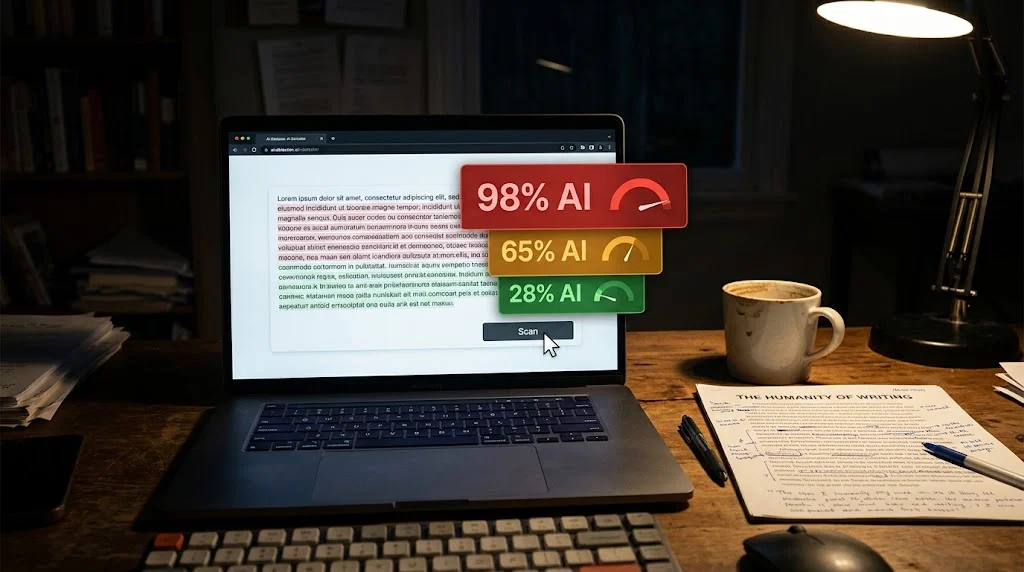
A score of 100% AI does not mean the text is definitely AI-generated. It means the classifier found patterns strongly correlated with its training examples. A score of 0% does not certify human authorship. It means the text did not trigger the detector’s flags.
The difference matters for anyone using these results to make decisions. A free detector provides a signal. It does not provide proof.
The False Positive Problem
False positives, where human-written text gets flagged as AI, are the most serious limitation of free detection tools. They cause real harm: students accused of misconduct, freelancers questioned by clients, writers forced to defend their own prose.
A July 2026 benchmark tested GPTZero, ZeroGPT, and QuillBot against 40 scripts: 20 written by a human in 2023, before AI tools entered his workflow, and 20 AI-generated scripts matched by topic and length. The results were stark .
On a matched pair about Bath & Body Works shopping hacks, all three detectors produced near-identical scores for the human and AI scripts. ZeroGPT scored the human text at 59.2% AI and the AI text at 59.8%. GPTZero scored both at 100% AI. QuillBot scored the human at 5% and the AI at 9% .
The detectors were not measuring authorship. They were measuring register. Structured investigative prose got flagged as AI no matter who wrote it. Conversational finance and motivational writing passed as human no matter who wrote it .
The Error Trade-Off
GPTZero caught all 20 AI scripts but falsely accused 4 of the 20 human scripts. QuillBot falsely flagged only one human script but missed 17 of the 20 AI scripts .
Neither trade-off is acceptable for consequential decisions. A detector that catches everything but accuses innocent writers causes direct harm. A detector that flags almost nothing provides false reassurance.
A separate 2026 study published in the Journal of Computer Sciences Institute tested GPTZero, ZeroGPT, Copyleaks, and Scribbr across 150 Polish and English samples. ZeroGPT achieved the highest overall accuracy at 64.0%. GPTZero reached 58.7%. Scribbr and Copyleaks scored 44.0% and 42.7% respectively .
These numbers are far below the 98%+ figures vendors advertise. The gap between marketing and independent measurement is the single most important thing to understand about free AI detectors.
Formal Writing Gets Punished
A pattern runs through independent testing with uncomfortable consistency. The more polished and structured the writing, the higher the AI score.
A 2026 analysis of student writing found that semicolon-separated lists, precise factual reporting, and standard academic closing sentences all triggered high AI probability scores. One student text scored 81.92% AI on a semicolon list, a punctuation feature academic writing courses explicitly teach .
The better the writing, the higher the detection score. The one moment of awkward phrasing in an otherwise controlled paragraph scored lowest, as if the machine was granting partial credit for imperfection .
This creates a perverse incentive. Writers who follow formal conventions get flagged. Writers who introduce typos and irregularities pass. The detector is not measuring authorship. It is measuring polish.
When Detectors Disagree
One of the most useful tests of any AI checker is comparing its output against another tool. The results often diverge sharply.
A Tech & Learning review tested Grammarly, Quetext, Dupli Checker, and Plagiarism Detector on the same AI-generated texts. Grammarly scored all three at 100% AI. Dupli Checker scored them at 100%, 89%, and 82%. Plagiarism Detector scored 100%, 78%, and 82% .
The discrepancies arise from different training data, different feature weighting, and different thresholds for flagging. A text flagged by one free checker might pass another. A text that passes one might be flagged elsewhere.
What Humanized Text Does to Free Checkers
AI humanizers rewrite machine-generated text to reduce detectable patterns. Free checkers, with their simpler models and limited analysis, struggle to catch humanized output. The tools that perform best on humanized samples typically require paid plans or advanced analysis that free tiers do not include.
Most free checkers will classify humanized text as human. That is not because the text is genuinely human. It is because the checker lacks the sophistication to detect the residual patterns humanizers leave behind.
Privacy and Data Handling
Free AI detectors process text you paste into them. That text may contain unpublished work, client drafts, personal statements, or academic submissions. What happens to it after scanning matters.
Most free tools do not publish clear retention policies. GPTZero’s free tier requires an account, meaning submissions are tied to a profile. ZeroGPT allows anonymous checks but does not clearly state how long submitted text is stored. Quetext requires a free account after the first scan .
No major free AI detector publicly commits to Zero Data Retention. SOC 2 certification, where present, addresses organizational controls rather than whether your specific submission is retained for training or analysis. Assume any hosted free tool stores input for some period unless its policy explicitly states otherwise.
The Local Option
A Python package called Uncanny runs entirely on your machine, with no API calls and no data leaving your network. It combines compression analysis, burstiness measurement, and optional perplexity scoring in an ensemble model. On a 36-sample benchmark, it reported 91.7% overall accuracy with a 5.6% false accusation rate .
The tradeoff is technical setup. Uncanny requires Python installation and command-line comfort. For users with that skillset, it eliminates the data exposure risk that hosted free tools carry. For everyone else, hosted tiers remain the practical starting point.
Common Mistakes With Free AI Detectors
Treating a score as a verdict. A 98% AI result is a probability, not proof. A 0% result is not a certification of human authorship. Free detectors provide signals for human interpretation, not conclusions .
Checking short text. Detectors struggle with passages under 300 words. There is not enough data for reliable pattern recognition. A short paragraph that scores 100% AI may simply lack the variation the detector needs .
Ignoring the false positive risk for formal writers. Academic prose, structured reporting, and polished professional writing all trigger AI flags more readily than casual text. If you are checking work by careful writers, free detectors are more likely to misclassify their prose as AI.
Assuming one tool’s result transfers. A text that passes ZeroGPT may fail GPTZero. Running the same content through two free checkers provides a clearer picture than relying on one.
Using free detectors for enforcement. Academic misconduct proceedings, hiring decisions, and client disputes require evidence beyond a single free scan. The documented false positive rate makes free detectors unsuitable for high-stakes judgments .
Who Should Use a Free AI Detector
Students checking their own work can use Quetext for its full DeepSearch report at 1,000 words per scan, or Grammarly for a quick 1,500-word pass. Neither proves the text is human-written, but both catch obvious patterns.
Writers testing their drafts can run a paragraph through two tools and compare results. If they disagree, the detector has told you something useful about the limits of the technology.
Educators demonstrating detector limitations can use free tools in classroom exercises. Showing students that the same essay scores differently across three checkers teaches more about AI detection than any lecture.
Anyone making consequential decisions should not rely on free detectors alone. The accuracy limitations and false positive risks make them unsuitable for discipline, hiring, or publication decisions without human review.
Latest Developments
The detection landscape remains unstable. Vendor accuracy claims continue to outpace independent measurements. ZeroGPT’s advertised 98.4% accuracy sits against a 64% result in peer-reviewed testing .
The more significant development is the growing recognition of detection’s limits. Research published in 2026 consistently finds that detectors perform acceptably on unaltered AI output but fail on mixed content, short passages, and formal human writing. Academic institutions increasingly treat detectors as screening tools rather than enforcement mechanisms.
Free detectors will continue to exist because people want quick answers. What they deliver is a signal, not certainty.
Conclusion
A free AI detector identifies patterns in text but cannot reliably prove whether content was written by a human or AI. Its scores are estimates, not definitive evidence.
Free detectors are useful for quick checks, but they should not be used alone for academic or professional decisions. Compare results from multiple tools and use human judgment, as AI detection remains imperfect.