A free AI generator lets you create text, images, or other content without paying, but free tiers in 2026 impose real limits on model access, volume, and commercial rights. ChatGPT offers unlimited text chats on a lightweight model with a 27K context window, Leonardo.AI provides 150 daily image tokens but makes all output public, and Google Gemini’s free tier lost its best models in October 2026, leaving only Flash-Lite .
At-a-Glance Box
- “Free” means constrained, not unlimited. ChatGPT caps uploads and image generation. Leonardo’s daily tokens run out on premium models. Gemini’s free tier shrank sharply in October 2026 .
- Model access is tiered. Free users get older or smaller models. ChatGPT runs GPT-5.6 Luna. Gemini dropped to Flash-Lite. Leonardo’s “Auto” model costs 8 tokens per image .
- Commercial rights split the field. Adobe Firefly grants explicit commercial rights on free output. Leonardo’s free images are public by default. Canva allows commercial use with conditions .
- Context windows matter. ChatGPT’s free context sits at 27K tokens. Gemini free caps at 32K. Leonardo’s image generation does not depend on context in the same way.
- The strongest free setup is a rotation, not a single tool. Firefly for licensing, Leonardo for stylized art, ChatGPT for text, and local open-source when you need unrestricted access .
- Local open-source remains the only truly unlimited path. Tools like FLUX and self-hosted studios eliminate credit caps and commercial restrictions, but require GPU hardware and setup time .
What “Free AI Generator” Actually Means in 2026
Searching for a free AI generator usually starts with a broad need. You want to create something, whether that is text, an image, a video, or audio, without committing to a subscription. The results page delivers dozens of options, each promising free generation without explaining what that phrase includes.
The reality is fragmented. “AI generator” is not one product category. It spans chatbots, image tools, video platforms, voice synthesizers, and writing assistants. Each has its own free-tier logic, its own limits, and its own hidden costs. A free image generator and a free chatbot impose completely different constraints.
This guide cuts through the category confusion. It covers the major free AI generator categories as of late October 2026, maps what each platform actually delivers on its free tier, and identifies where the real boundaries sit. It does not pretend any free tier is unlimited. It explains what you can do before hitting a wall.
The Major Free AI Generator Categories
Free AI generators fall into five rough categories, each with distinct constraints.
Text and chat generators. ChatGPT, Gemini, Claude, and Copilot belong here. Free tiers usually allow unlimited or generous text conversations but cap uploads, context, and access to frontier models.
Image generators. Leonardo.AI, Adobe Firefly, Canva, and Google’s image tools sit in this category. Free allowances are measured in daily tokens, monthly credits, or fast-queue generations.
Video generators. Google’s Veo, accessed through Gemini subscriptions and limited free trials, represents the emerging video tier. Free access is extremely limited and often trial-based .
Voice generators. ElevenLabs, Play.ht, and cloud providers like Google Cloud TTS offer free tiers with character caps and commercial restrictions.
Open-source studios. Self-hosted tools like Open Generative AI and FLUX run locally or through API keys, eliminating platform quotas at the cost of technical setup .
The rest of this guide focuses on the two most-searched categories: text and image generation. Those are where free tiers are most usable and where the hidden limits matter most.
Platform-by-Platform Breakdown: Text Generators
| ChatGPT | GPT-5.6 Luna | 27K tokens | Unlimited text, but limited uploads, images, deep research |
| Gemini | Flash-Lite only | 32K tokens | Lost Flash/Pro access on October 9, 2026 |
| Claude | Sonnet 4.6, Haiku 4.5 | 200K tokens | Roughly 15–40 messages per 5-hour window |
| Copilot | Varies by entry point | Not published | Opaque daily limits, feature-dependent |
| DeepSeek | Full model | 1M tokens | No paid consumer plan, but server congestion and China hosting |
ChatGPT: Unlimited Text, Limited Everything Else
ChatGPT’s free tier offers the most straightforward promise: unlimited text chats on GPT-5.6 Luna . For everyday questions, drafting, and brainstorming, that covers a lot of ground.
The restrictions appear at the edges. Image generation is slower and capped. File uploads are limited. Deep research and Codex access are restricted. The 27K context window suits short sessions but struggles with long documents .
For users who need a capable general assistant for casual use, ChatGPT’s free tier delivers. For anything requiring frontier model capabilities or extended context, it does not.
Gemini: The Free Tier That Shrank
Google’s free Gemini tier was once the most generous in the market. That changed on October 9, 2026. Flash and Pro models moved behind the AI Plus paywall, leaving free users with Flash-Lite and a 32,000-token context window .
Flash-Lite handles basic queries but struggles with complex reasoning, long documents, and multi-step tasks. The compute-based metering refreshes every five hours up to a weekly cap, and free users are first to be throttled when servers are busy .
Gemini’s free tier remains usable for lightweight tasks. It is no longer a viable sandbox for serious experimentation.
Platform-by-Platform Breakdown: Image Generators
| Leonardo.AI | 150 tokens/day | None | Public outputs only | Free images visible to others |
| Adobe Firefly | ~3 images/day (unpublished) | None | Yes, explicit | Daily limit not clearly published |
| Canva | ~20 AI uses/month | No | With conditions | Output is editable design, not flat image |
| Microsoft Designer | Fast queue + slow queue | None stated | Prohibited | Personal use only |
| Google Flow | 50 credits/day | SynthID embedded | Restricted terms | Invisible watermark |
Leonardo.AI: The Most Usable Image Allowance
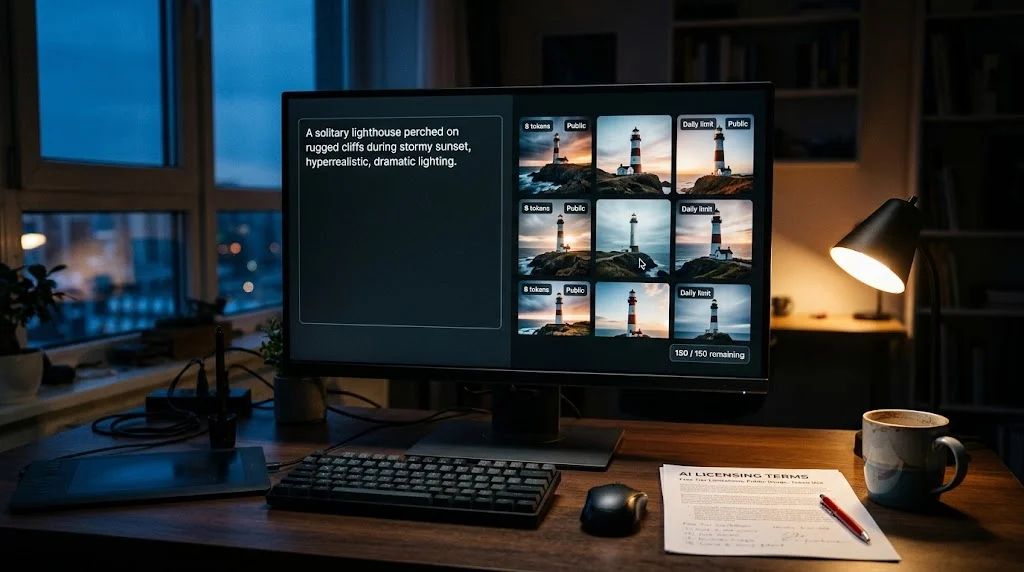
Leonardo.AI provides 150 tokens per day on its free tier, a renewable budget that supports real creative exploration . On the “Auto” model, each image costs 8 tokens, meaning roughly 18 generations per day before hitting the limit. Images return in 30 to 40 seconds .
The quality is strong for a free tier. In a recent seven-tool comparison, Leonardo’s Auto model, which selected GPT Image 2 for all test jobs, scored highest overall, winning on invitation design and tying on poster work . The tradeoffs are public visibility and limited control over lettering style. Free images are visible to other users, and private generation requires payment .
For hobbyists and creators testing concepts before committing to a subscription, Leonardo offers the best daily allowance and quality among hosted image tools.
Adobe Firefly: Licensing Clarity, Tiny Free Volume
Firefly’s differentiator is its licensing position. Adobe trained the model on licensed stock and public domain works, and grants explicit commercial-use rights even on the free tier . That clarity matters for anyone producing client work or monetized content.
The free allowance is small and poorly published. In a recent test, the free plan yielded three images per day on Google’s Gemini 3.1 model, which Firefly’s home page defaults to. Adobe does not publish this limit . Switching to Adobe’s own model, the one marketed as commercially safe, changes the output but not the volume constraint.
Firefly suits users who prioritize legal provenance and are willing to pay for volume once the free credits run out.
Canva: Design Integration Over Raw Generation
Canva bundles its image generator into a wider design suite. Generation quality is mid-tier, but the output drops straight into an editable canvas with text, layout, and brand tools . For social graphics and quick design work, the integrated path saves more time than a better raw generator would.
The free tier allows roughly 20 AI uses per month. In testing, five designs consumed 77% of that allowance . Canva allows commercial use with conditions, and does not watermark output. For anyone whose end goal is a finished graphic rather than a standalone image, Canva’s integration justifies the lower generation quality.
What About Video, Voice, and Open-Source?
Free video generation remains extremely limited. Google offers a trial of Veo 3.1 Lite through Gemini subscriptions, but free access is trial-based rather than an ongoing allowance . Standalone free video generators typically impose watermarks and short clip limits.
Free voice generation follows the pattern described in the voice generator guide: character caps, attribution requirements, and commercial restrictions on consumer tools, with larger allowances and commercial rights available through cloud APIs.
The open-source path deserves mention. Tools like Open Generative AI provide a self-hosted studio with access to 500+ models including FLUX, Midjourney, Kling, and Veo, under an MIT license . The catch is technical: Node.js setup, API key configuration, or local GPU hardware. For users with the skills, it eliminates every platform restriction described above. For everyone else, hosted free tiers remain the practical starting point.
Privacy and Data Considerations
Free AI generators process everything you send them. That includes prompts, uploads, and generated content. What happens to that data varies by provider.
ChatGPT, Gemini, and Claude tie conversations to your account. Free-tier data may be used for model improvement unless you opt out. Leonardo’s free images are public by default, visible to other users . Canva’s AI outputs live within your design workspace, subject to Canva’s privacy policy.
No major free AI generator publicly commits to Zero Data Retention on free accounts. SOC 2 certification, where present, addresses organizational controls rather than whether individual prompts are stored. Assume free-tier inputs are retained for some period unless the provider explicitly states otherwise.
Common Mistakes With Free AI Generators
Assuming “unlimited” means unrestricted. ChatGPT’s unlimited text chats come with caps on uploads, images, and advanced tools . Read the fine print before planning a workflow.
Ignoring public visibility on image tools. Leonardo’s free generations are visible to other users . If the image is client work or anything confidential, the free tier exposes it.
Burning daily tokens on premium models. Leonardo’s 150 daily tokens go fast on higher-quality models. The Auto model at 8 tokens per image stretches the allowance furthest .
Expecting Gemini’s free tier to match its former self. Flash and Pro models moved behind a paywall in October 2026 . Flash-Lite is a lightweight model, not a frontier one.
Overlooking Firefly’s licensing advantage. Adobe grants explicit commercial rights on free output, a rarity among free image tools . For client work where legal footing matters, that clarity is worth the small daily volume.
Who Should Use a Free AI Generator
Casual users with everyday text needs should use ChatGPT’s free tier. Unlimited text chats cover most general questions and drafting.
Writers and researchers with long documents should use Claude’s free tier for its 200K context window, accepting the message limits as the tradeoff.
Hobbyists exploring image generation should use Leonardo.AI’s 150 daily tokens. The quality and allowance are the strongest among hosted free tools, provided public visibility is acceptable .
Anyone needing commercial images with clear licensing should use Adobe Firefly’s free tier, accepting the tiny daily volume in exchange for explicit commercial rights .
Users who need volume or privacy should explore open-source studios. The setup cost pays for itself in unrestricted generation and zero platform oversight .
Latest Developments
The free tier landscape contracted sharply in late 2026. Google’s October 9 decision to pull Flash and Pro models from free Gemini accounts signaled a broader trend: providers are tightening free access as inference costs remain significant .
Open-source alternatives continued to mature. Tools like Open Generative AI and local FLUX setups now offer access to models that rival commercial platforms, without platform quotas or content filters . For users willing to invest setup time, the gap between free and paid has never been smaller.
The next shift will likely come from regulatory pressure. Transparency requirements and data residency rules may force providers to disclose more about free-tier capabilities and data handling. For now, users should verify limits directly on each platform before committing to a workflow.
Conclusion
Free AI generators like ChatGPT, Gemini, Claude, Leonardo, Firefly, and Canva offer useful features, but limits on usage, model access, and commercial rights vary.
Choose a tool that fits your needs, and check its current free limits, licensing terms, and privacy policy before using it. For greater control and fewer platform restrictions, consider local open-source models.