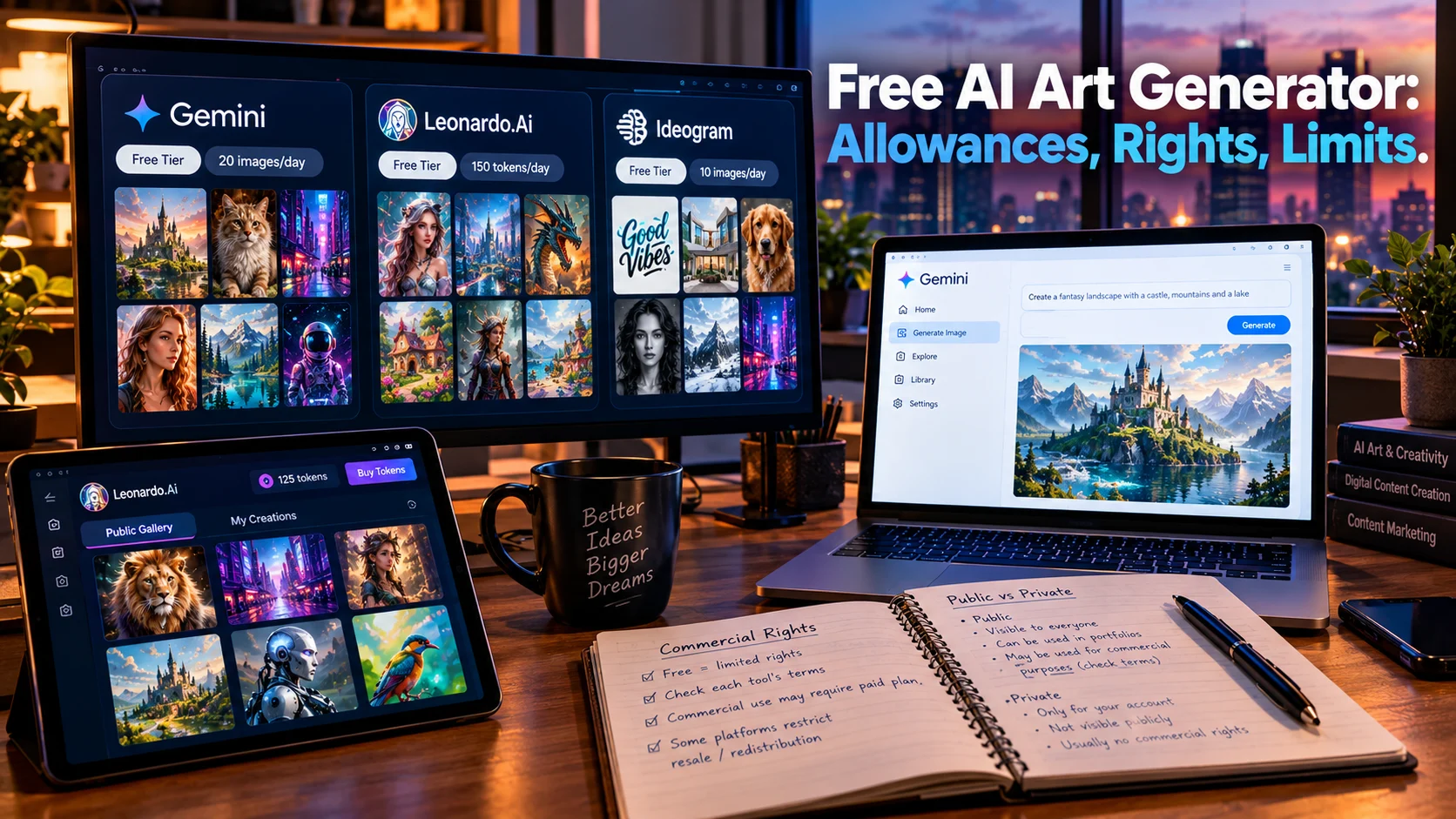
A free AI art generator creates images from text prompts at no cost, but “free” ranges from genuinely usable daily allowances to tight trials. Google Gemini offers the most generous free tier at roughly 20 images daily, Leonardo provides 150 daily tokens, and Ideogram gives 30 weekly credits, though each carries restrictions on commercial use and privacy.
At a Glance: Key Takeaways
- Google Gemini is the best free option for most users, offering roughly 20 daily images through the Nano Banana 2 model with no credit card required .
- Leonardo AI offers 150 free tokens daily, but free outputs are public and Leonardo retains ownership of the generated images .
- Ideogram provides 30 weekly credits for accounts signed in with Google, Apple, or Microsoft, with all free outputs being public .
- Commercial rights vary dramatically, with some tools granting full ownership and others retaining broad licenses over your creations .
- Free tiers change frequently, and several tools have reduced or eliminated their free offerings over the past year .
- Local, open-source options exist for users who need unlimited generation and full privacy, though they require technical setup .
What Is a Free AI Art Generator?
A free AI art generator is a tool that uses machine learning to create images from text descriptions at no cost. The technology behind these tools relies on diffusion models or generative adversarial networks trained on vast datasets of images and text pairs.
The category has matured significantly. In 2024, most free tiers were demos designed to convert users to paid plans. By 2026, several platforms offer genuinely usable free allowances that support real creative work, albeit with limitations on commercial use, privacy, and volume.
The critical distinction for anyone searching for a “free” option is understanding what “free” actually includes. Some tools give you ownership of your creations. Others retain broad rights. Some keep your generations private. Others make everything public. Some offer daily allowances that renew. Others provide one-time trials that expire.
The Best Free AI Art Generators Compared
How Free AI Art Generators Work
The Generation Pipeline
Most free AI art generators follow a similar workflow. You enter a text prompt describing the image you want. The tool’s AI model processes the prompt and generates one or more images matching your description. You can then refine the prompt, adjust settings, or download the results.
The underlying technology varies. Some tools use proprietary models developed in-house. Others rely on third-party models like Stable Diffusion or Flux. The quality of output depends heavily on the model, the training data, and the specificity of your prompt.
Credit and Token Systems
Most free tiers use a credit or token system to meter usage. The mechanics differ across platforms:
Google Gemini provides a fixed daily allowance of approximately 20 images through the Gemini app using the Nano Banana 2 model . The limit is straightforward, with no token math to calculate.
Leonardo AI uses a token system where different models cost different amounts. Free users receive 150 tokens daily, which translates to roughly 15 standard images at 10 tokens each, though premium models consume more . The token system is confusing, as one review notes: “different models cost different amounts, higher resolution costs more, and the math isn’t obvious until you’ve burned through a day’s allocation unexpectedly” .
Ideogram provides 30 credits per week for free accounts signed in with Google, Apple, or Microsoft. Accounts created with email and password do not receive free credits .
Privacy and Public Outputs
A critical but often overlooked limitation is privacy. Many free tiers make your generations public by default.
Leonardo’s free plan states that “free generations are public” and “the free plan does not own its outputs” . Ideogram similarly notes that “on the free plan, everything you generate is public” . This means other users can see what you create, which matters if you are generating sensitive, client-specific, or commercially valuable imagery.
For private generation, paid plans are generally required. Leonardo’s private mode and image upload for video are paid features .
Key Features to Evaluate
Commercial Rights and Ownership
The ownership terms for free generations vary significantly across platforms.
Leonardo AI retains ownership of free outputs. Paid subscribers own their outputs, but free users receive only a commercial license while Leonardo keeps ownership and a broad license over public content, including for model training .
starryai stands out for its clarity. The app states that users have “full ownership of your creations” even on the free tier, allowing use for art projects, printing, or social media without restrictions .
Microsoft Designer restricts free outputs to non-commercial, personal use and applies a visible watermark .
Google Gemini applies SynthID invisible watermarks and C2PA content credentials to all outputs, including free ones . Users should check current terms for commercial use rights.
Model Access
Free tiers often provide access to standard models while gating premium models behind paid plans.
Leonardo’s free plan includes access to Phoenix, its own model, plus some third-party models like Veo 3, Kling 3.0, Nano Banana, and GPT Image 1 . However, video generation is limited on the free tier, with image upload requiring payment .
Ideogram’s free plan provides access to its own models but does not disclose which specific model is used for free credits .
Image Quality and Text Rendering
Different tools excel at different tasks. Ideogram is noted for its ability to generate readable text within images . Google Gemini’s Nano Banana 2 handles complex text rendering across 10+ languages and produces clean results across a wide range of styles .
Leonardo offers a variety of models optimized for different aesthetics, including photorealistic (Kino XL), concept art (Phoenix), and anime styles .
Who Should Use Which Free AI Art Generator
Beginners and casual users should start with Google Gemini. The fixed daily allowance of roughly 20 images is the most generous and easiest to understand, with no token calculations required .
Users who need volume should consider Leonardo AI’s 150 daily tokens, understanding that outputs will be public and ownership rests with Leonardo . The token system rewards users who learn which models offer the best value per token.
Users who need text in images should evaluate Ideogram, which is specifically noted for its text rendering capabilities .
Users who prioritize ownership clarity should consider starryai, which grants full ownership even on the free tier .
Users who need privacy must look beyond free tiers or explore local, open-source options like Stable Diffusion or Flux. Free tiers on most platforms make outputs public .
Users seeking unlimited generation should explore open-source options. Stable Diffusion and Flux can be run locally with no generation limits, though they require technical setup and capable hardware .
Common Mistakes and Cautions
Assuming “free” means unlimited. Every free tier has caps. Google Gemini’s ~20 daily images, Leonardo’s 150 tokens, and Ideogram’s 30 weekly credits are all binding constraints .
Overlooking public outputs. Most free tiers make your generations visible to other users. Do not generate sensitive or client-specific imagery on these plans .
Ignoring commercial use restrictions. Leonardo retains ownership of free outputs. Microsoft Designer restricts free outputs to non-commercial use. starryai grants full ownership. Check the terms before using any image commercially .
Forgetting about watermarks. Microsoft Designer applies visible watermarks. Google Gemini applies SynthID invisible watermarks. Ideogram’s free outputs are public. starryai explicitly states no watermarks on free generations .
Assuming free tiers are permanent. Free offerings change frequently. Ideogram has cut free credits before, and other tools may follow .
Frequently Asked Questions
What is the best free AI art generator?
Google Gemini is the best free option for most users, offering roughly 20 daily images with no credit card required. Leonardo AI offers 150 daily tokens for users who want more volume, though outputs are public and Leonardo retains ownership .
Are free AI art generators really free?
Yes, but with limitations. Free tiers provide daily or weekly allowances, but they restrict commercial use, make outputs public, and apply watermarks in some cases. For unrestricted use, paid plans or local open-source options are necessary .
Can I use free AI art commercially?
It depends on the tool. starryai grants full ownership even on the free tier . Leonardo retains ownership of free outputs . Microsoft Designer restricts free outputs to non-commercial use . Always verify the terms before commercial use.
Do free AI art generators watermark images?
Some do. Microsoft Designer applies visible watermarks. Google Gemini applies SynthID invisible watermarks. starryai explicitly states no watermarks. Check each tool’s current terms .
Are there unlimited free AI art generators?
Local open-source options like Stable Diffusion and Flux offer unlimited generation with no cost, but they require technical setup and capable hardware. Most web-based free tiers have caps .
Conclusion
Free AI art generators have become genuinely useful tools in 2026. Google Gemini offers the most accessible free tier with roughly 20 daily images and no credit card requirement. Leonardo provides more volume through its token system, though with trade-offs on privacy and ownership. Ideogram excels at text-in-image generation.