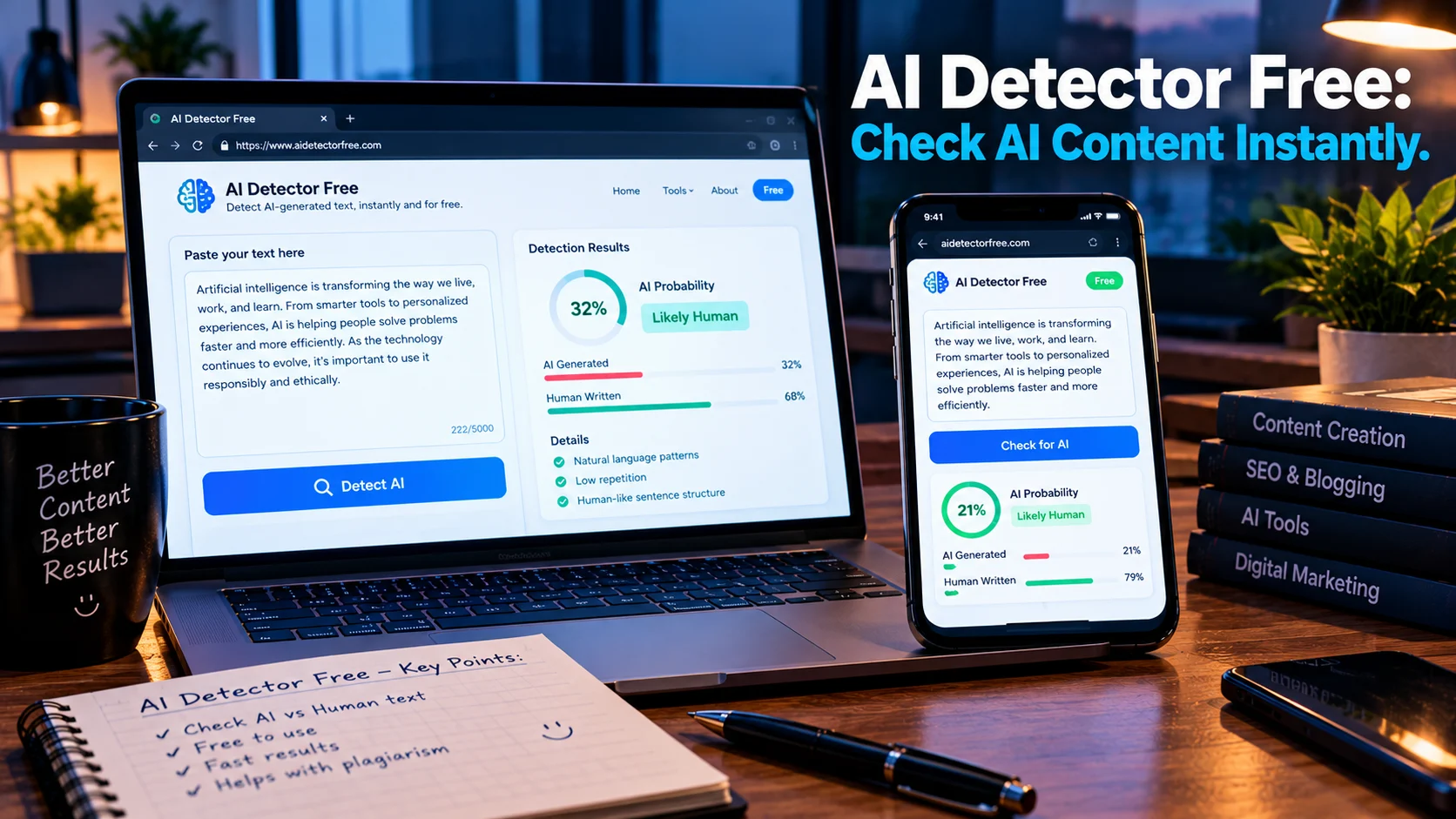
A free AI detector analyzes text patterns to estimate whether content was written by a large language model. These tools are useful for quick checks, but they produce false positives and false negatives, so no single score should be treated as proof.
At-a-Glance
- Free tiers are real but limited. Most tools cap word counts, hide detailed reports, or push users toward subscriptions after one or two scans .
- Accuracy claims deserve skepticism. Vendor-reported numbers often exceed independent testing results, sometimes by wide margins .
- Short text is unreliable. Anything under roughly 300 words gives detectors too little data to work with .
- Human writing gets flagged. Non-native English speakers and formulaic academic prose face higher false positive risk .
- Privacy varies wildly. Some tools retain submitted text for weeks; others delete it quickly. Read the policy before pasting sensitive work .
- Free tools work best as a first filter. Use two detectors, review flagged sentences manually, and never treat a score as a verdict.
What Is an AI Detector, and Why Are People Searching for a Free One?
An AI detector is software that estimates the likelihood of text being generated by a model like ChatGPT, Claude, or Gemini. It does not read minds. It looks at statistical patterns, word choices, and sentence structures, then returns a probability score .
Searches for “ai detector free” spike for predictable reasons. Students want a quiet check before submission. Freelancers want to confirm a draft does not look machine-written. Editors want a second opinion on a contributor’s work. Teachers want a rough signal before a conversation with a student.
The appeal of a free tool is obvious: no subscription, no institutional login, no paper trail. The catch is equally obvious once you use a few. Free tiers are deliberately constrained, and the scores they produce carry more uncertainty than the interface suggests.
How Free AI Detectors Actually Work
Most detectors rely on a combination of machine learning and natural language processing. The classical approach measures perplexity (how predictable each word is) and burstiness (how much sentence length and structure vary). AI writing tends to be more predictable and more uniform than human writing .
Newer detectors, including Turnitin and Pangram, use deep learning classifiers trained on paired human and AI texts. Pangram’s team describes a “synthetic mirror” method: take a human essay, generate an AI version of the same prompt in the same style, and train the model to distinguish the two . Turnitin uses a transformer-based model trained on its own academic corpus and explicitly says it does not rely on burstiness or perplexity as hand-coded rules .
Free tools rarely disclose which method they use. That matters because the classical approach is cheap to run and easy to scale for free tiers, while classifier-based detection is more expensive and usually sits behind a paywall.
The Best Free AI Detector Options in 2026
Free access comes in different shapes. Some tools offer a permanent free tier with word caps. Others allow one scan before requiring an account. A few are genuinely free with no account at all. Here is how the main options compare.
A note on “free.” Several tools advertise a free detector but route users toward a paid plan after the first scan. GPTZero’s free tier is limited, and its full sentence-level report sits behind a subscription . Grammarly’s AI detection is bundled into its writing assistant, which means the free experience is shaped by its broader product strategy . None of this is dishonest, but it is worth knowing before you paste a 5,000-word document into a tool that accepts 1,500 words.
Where Free AI Detectors Fail
Free detection tools struggle for structural reasons, not just because they are cheap.
Short text produces unreliable scores
Pattern detection needs data. A 100-word paragraph does not give the model enough material to distinguish human variation from AI uniformity. Pangram’s CEO notes that most of its false positives occur in the 50-to-100-word range, where the model has “a lot less data” and is “more making an educated guess” . Free tools often accept short texts without warning you about this limitation.
False positives hit real writers
Human writing gets flagged. Formulaic academic prose, technical documentation, and writing by non-native English speakers all trigger higher false positive rates . A single score is not evidence of misconduct. It is a signal that something in the text’s statistical profile resembles AI output, and that resemblance can come from style, genre, or editing.
Vendor accuracy claims are not independent
ZeroGPT advertises 98.4% accuracy on its homepage. Independent testing cited by Quetext landed in the 68% to 75% range depending on content type . Turnitin’s own research shows a false negative rate of 26% for GPT-4o text and 47% for GPT-5 text in one academic study . The gap between marketing numbers and measured performance is the single most important thing to understand about this category.
Paraphrasing changes the signal
Light paraphrasing shifts detection scores. Turnitin says it can detect content modified by paraphrasers and bypassers, but only for English submissions . Free tools rarely disclose whether they handle paraphrased text at all.
Privacy: What Happens to the Text You Paste
Free tools have bills to pay. Some offset costs by retaining submitted text for model improvement. Others delete reports quickly but keep metadata.
SlopTotal’s privacy policy states that reports are automatically deleted after 30 days and that it does not keep copies of submitted text beyond the report excerpt . GPTZeroPro retains detector text for up to 30 days, then deletes raw text while retaining limited operational metadata . These are specific, checkable claims. Many free tools do not publish comparable details.
A practical rule: Do not paste unpublished manuscripts, confidential client work, or personal data into a free detector unless you have read its retention policy. A tool being free does not make it a safe place for sensitive text.
Who Should Use a Free AI Detector, and for What?
Students can use free detectors as a self-check before submission, but should treat the result as a conversation starter, not a grade. A high score on a human-written draft is common enough that panic is not warranted .
Writers and editors can run drafts through two tools and compare results. Divergence between scores is more informative than either score alone.
Teachers should avoid using free detectors as sole evidence of misconduct. The false positive risk is too high, and the tools do not explain their reasoning in terms a student can contest .
Developers and researchers looking for detection APIs will find that free tiers rarely include API access. Originality.ai offers API access on paid plans, and Gartner reviewers note its cost as a barrier for some users .
Free vs. Paid AI Detectors: What You Actually Get
Paid detectors offer more than higher word counts. They typically provide sentence-level explanations, API access, batch processing, and lower false positive rates through more expensive model architectures.
Turnitin, which is licensed by institutions rather than sold as a consumer subscription, has published research on its false positive rate, placing it below 1% in some studies . Pangram claims a false positive rate of one in 10,000, though that figure is company-reported . Free tools rarely publish either number.
The honest trade-off: free tools are adequate for casual curiosity and rough first passes. They are not adequate for formal evaluation, academic integrity proceedings, or professional content decisions where someone’s work or reputation is on the line.
Common Mistakes When Using Free AI Detectors
Treating one score as final. Different tools produce different results on the same text. A 40% score from one detector and a 5% score from another tells you the text is ambiguous, not that one tool is broken.
Testing very short text. Under 300 words, the signal is weak. If you must test short content, expect noise .
Ignoring the genre. Academic writing, legal prose, and technical documentation all have repetitive structures that resemble AI output. A detector that flags a methods section is doing what it was trained to do, not revealing misconduct.
Pasting confidential material. Free does not mean private. Check the retention policy first.
Assuming paraphrased text is invisible. It is not. Turnitin says it detects paraphraser-modified content, and humanizers introduce artifacts that detectors can learn to spot .
The Bottom Line
A free AI detector is a useful first filter and a poor final judge. The technology has improved, but the fundamental limits remain: short text is unreliable, false positives affect real writers, and vendor accuracy claims deserve scrutiny. The best free tools offer enough functionality to run a quick check and see how detection works. They do not offer certainty.
If you need a free check, start with Grammarly or QuillBot for convenience, or ZeroGPT if volume matters more than report depth. Run the same text through two tools. Read the flagged sentences yourself. And keep the score in perspective: it is one signal among many, not a verdict.
FAQs
Is a free AI detector accurate enough to trust?
For casual checks, sometimes. For formal decisions, no. Independent testing shows accuracy varies widely by tool, text length, and content type. Treat free detector scores as estimates, not conclusions.
What is the best free AI detector with no word limit?
Most free tiers have limits. ZeroGPT offers 15,000 characters per check on its free plan, which is more generous than most. Plagiarism Detector allows unlimited free checks of text up to 1,000 words .
Can free AI detectors flag human-written text as AI?
Yes. False positives are a documented problem, especially for non-native English speakers, formulaic academic writing, and short texts. A positive result is not proof of AI use .
Do free AI detectors store the text I paste?
It depends on the tool. Some delete reports after 30 days and do not retain raw text. Others keep text for model improvement. Read the privacy policy before submitting sensitive content .
What should I do if my human-written text gets flagged?
Do not panic. Try a longer excerpt, run it through a second tool, and review the flagged sentences. If you are submitting for academic or professional purposes, keep drafts and version history as evidence of your process.