Calypso AI is an enterprise AI security platform that sits between users and large language models to prevent prompt injection, data leakage, and policy violations in real time. Founded in 2018 for national security applications and acquired by F5 in 2025, it is used by Fortune 500 companies and government agencies requiring auditable, model-agnostic AI governance.
At-a-Glance: Key Takeaways
- Calypso AI protects AI at the inference layer, scanning every prompt and response for threats before they reach or leave the LLM .
- It was acquired by F5 Networks for $180M in 2025, validating the market for enterprise AI security and bringing the technology into a broader application security portfolio .
- The platform is model-agnostic and supports both cloud and on-premises deployment, making it suitable for air-gapped government and defense environments .
- SOC 2 and ISO 27001 certified, with alignment to NIST AI RMF, the EU AI Act, and DoD AI ethics principles .
- Enterprise-only pricing is custom-quoted, which may be prohibitive for smaller organizations and requires expertise to implement .
- A separate “Calypso” AI agent platform operated by Calypso 1, Inc. offers a different product for building custom AI agents, which is unrelated to the security platform .
What Is Calypso AI?
Calypso AI is an enterprise AI security and governance platform purpose-built to secure generative AI deployments. It was founded in 2018 by Neil Serebryany after his work at the U.S. Department of Defense, where he identified the risks of deploying machine learning models in critical environments without adequate security controls .
The company’s core insight was that traditional security tools—firewalls, web application firewalls, and intrusion detection systems—are blind to AI-specific threats. A prompt injection attack does not look like a SQL injection or cross-site scripting attempt. It looks like a normal user query. Calypso AI was built to understand AI’s language and detect these novel attack vectors .
The platform serves enterprise and government customers, with a strong initial focus on defense and intelligence. Over time, it expanded into commercial sectors including financial services, consumer goods, and healthcare, where data sensitivity and regulatory compliance are paramount .
How Calypso AI Works
The Inference-Layer Architecture
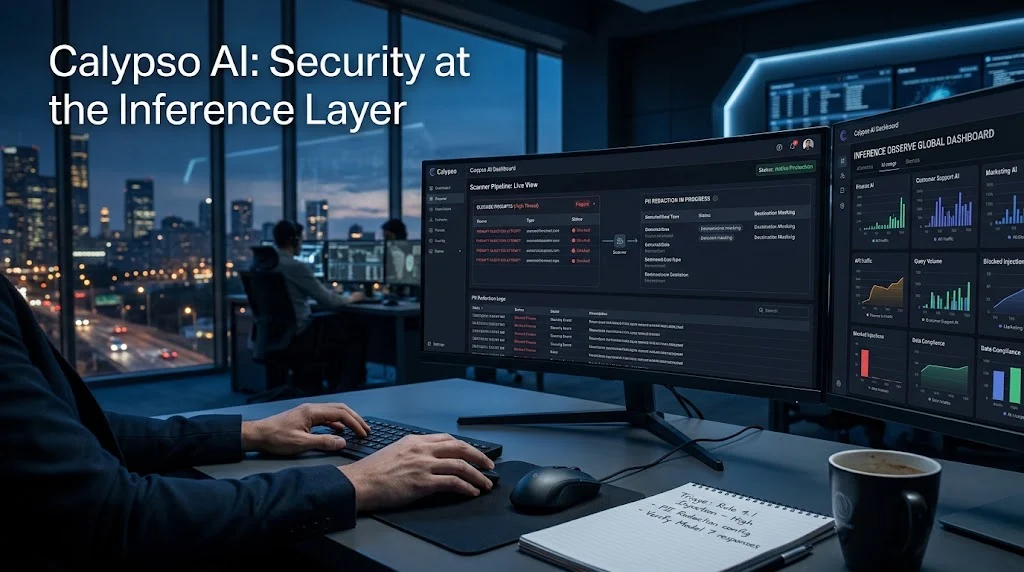
Calypso AI operates as a trust layer between applications and LLM endpoints. Every interaction—whether from a chatbot, a coding assistant, or an internal analysis tool—flows through Calypso’s scanner pipeline before reaching the model .
The platform is model-agnostic, meaning it works with any custom or third-party LLM, including GPT, Claude, Gemini, and self-hosted open-source models. This flexibility is critical for enterprises that use multiple AI providers or deploy models in air-gapped environments .
The Scanner Pipeline
The core of the platform is a sequence of customizable security scanners. Each interaction passes through scanners that check for specific threat categories :
| Prompt Injection | Attempts to override system instructions or manipulate model behavior |
| PII Detection | Personal identifiers, financial data, or proprietary information |
| Toxic Content | Hate speech, harassment, or off-brand outputs |
| Policy Violations | Interactions that breach organizational or regulatory rules |
When a scanner flags an issue, the platform can block the request, redact sensitive content, or alert administrators based on configured policies .
Real-Time Performance
Performance is a critical differentiator for inference-layer security. Calypso AI reported a 5x improvement in scanner latency through re-engineered PII and prompt injection detection packages as of April 2025. The platform combines Named Entity Recognition (NER) with classification models to achieve 90%+ accuracy on PII detection .
Company-published metrics include 97% of harmful prompts blocked, 95% decision accuracy, and 92% of blocked prompts identified as potential threats .
Key Features and Capabilities
Inference Defend: Real-Time Threat Prevention
Inference Defend is the platform’s primary security product. It analyzes every input and output in real time, blocking prompt injections, jailbreaks, and data exfiltration attempts. The system includes preconfigured scanners that activate upon deployment, enabling rapid implementation without disrupting AI workflows .
A key design principle is “protect, not obstruct.” Security settings can be dialed up or down to align with business needs, ensuring that security does not become a bottleneck for innovation .
Inference Observe: Enterprise-Wide Visibility
Inference Observe addresses the visibility gap that plagues enterprise AI adoption. It provides a unified, real-time view of all AI interactions across the organization, with detailed logging and audit trails .
The platform integrates with SIEM, SOAR, and ticketing systems, allowing security teams to action alerts within their existing workflows. Global dashboards enable compliance tracking across the entire enterprise, automatically flagging AI applications that do not adhere to corporate governance or regulatory requirements .
Autonomous Red-Teaming
Calypso AI offers agent-driven red-teaming capabilities that proactively discover vulnerabilities in AI deployments. Rather than relying on manual penetration testing, the platform uses autonomous agents to simulate attacks and identify weaknesses before malicious actors can exploit them .
Customizable Security Scanners
Organizations can build custom scanners tailored to their specific threats and compliance requirements. This allows enterprises to define vulnerability categories, establish content policies, and create detection rules that go beyond the platform’s default scanner capabilities .
Policy-Based Access Controls
Administrators configure policies at the team and individual user level, defining which models are accessible, what rate limits apply, and which security scanners to run on each interaction. Model-specific rate limits and content restrictions are supported .
Pricing and Plans
Calypso AI does not publish public pricing for its enterprise security platform. According to comparison platforms, pricing is custom and per annual contract . This enterprise-only model may be prohibitive for smaller organizations, and the platform’s complex security features require expertise to implement .
Important distinction: A separate product called “Calypso” (operated by Calypso 1, Inc.) publishes transparent pricing starting at $19/month for a RAG starter plan . This is a different company and product, despite the shared name.
Privacy and Security
Calypso AI publishes extensive security and compliance documentation.
Certifications and Compliance
The platform aligns with key governance frameworks including the NIST AI Risk Management Framework, the EU AI Act, and DoD-specific AI ethics principles .
Deployment Flexibility
Calypso AI supports both cloud and on-premises deployment, which is critical for government and defense customers operating in air-gapped or highly restricted network environments. This flexibility extends to support for multiple LLM providers and self-hosted models .
Audit and Traceability
Every prompt, response, user, timestamp, and scanner result is recorded for full auditability. This enables organizations to maintain detailed records of all AI interactions for regulatory compliance and forensic analysis .
Important distinction: SOC 2 certification does not automatically mean Zero Data Retention. Calypso AI’s audit capabilities imply data retention for security and compliance purposes.
How Calypso AI Compares to Alternatives
Editorial interpretation: Calypso AI’s differentiation is its inference-layer focus and deep government credentials. It secures the conversational layer where data leaks and compliance risks erupt, rather than the network or model supply chain. The F5 acquisition provides validation and potential integration with broader application security workflows, though it also introduces uncertainty about product direction .
Who Should Use Calypso AI
Government and defense agencies are the historical core audience. The platform’s on-premises deployment options, air-gapped support, and alignment with DoD AI ethics principles make it suitable for classified and sensitive environments .
Fortune 500 enterprises in regulated industries—financial services, healthcare, consumer goods—use Calypso AI to enforce acceptable use policies, prevent data leakage, and maintain audit trails for compliance .
Security teams needing centralized AI governance benefit from the unified monitoring and policy enforcement capabilities. Inference Observe provides the enterprise-wide visibility that many organizations lack .
Smaller organizations may find the enterprise-only pricing and implementation complexity prohibitive. The separate Calypso AI agent platform (Calypso 1, Inc.) offers more accessible pricing but is a different product entirely .
Common Mistakes and Cautions
Confusing Calypso AI with the Calypso AI agent platform. The security platform (CalypsoAI, acquired by F5) and the agent-building platform (Calypso 1, Inc.) are unrelated companies that happen to share a name .
Assuming public pricing exists. Calypso AI’s security platform is enterprise-quoted. Any published pricing for “Calypso” at $19/month refers to the separate agent platform .
Expecting plug-and-play deployment. The platform’s complex security features require expertise to implement. Organizations should plan for configuration and tuning .
Overlooking the F5 acquisition. Calypso AI is now part of F5 Networks. Product direction, support, and integration with F5’s broader portfolio may evolve. Organizations should confirm current roadmap and commitments .
Assuming SOC 2 means zero retention. Calypso AI’s audit capabilities require data retention for security and compliance purposes. SOC 2 certification does not imply zero data retention.
Frequently Asked Questions
What is Calypso AI?
Calypso AI is an enterprise AI security platform that secures LLM interactions at the inference layer. It prevents prompt injection, data leakage, and policy violations in real time. Founded in 2018 for national security applications, it was acquired by F5 Networks in 2025 .
Is Calypso AI SOC 2 compliant?
Yes. Calypso AI is SOC 2 and ISO 27001 certified, and complies with GDPR. The platform aligns with NIST AI RMF, the EU AI Act, and DoD AI ethics principles .
How much does Calypso AI cost?
Calypso AI does not publish public pricing. Pricing is custom and per annual contract, making it enterprise-only. Smaller organizations may find it cost-prohibitive .
What is the difference between Calypso AI and Calypso?
Calypso AI (acquired by F5) is an enterprise AI security platform. “Calypso” (operated by Calypso 1, Inc.) is a separate AI agent platform with transparent pricing from $19/month. The companies are unrelated despite the shared name .
What are the best Calypso AI alternatives?
Alternatives depend on the specific need. Protect AI focuses on ML supply chain security. Lasso Security offers GenAI security and governance. Salus provides runtime action validation for AI agents. The choice depends on whether the requirement is inference-layer protection, model scanning, or agent action safety .
Conclusion
Calypso AI has built a category-defining position in enterprise AI security. By focusing on the inference layer—where live data creates opportunities for attacks and compliance failures—it addresses a gap that traditional security tools cannot fill. The platform’s model-agnostic architecture, on-premises deployment options, and deep government credentials make it a strong fit for organizations with stringent security and compliance requirements.
What matters most is understanding the trade-offs. Calypso AI is an enterprise platform with enterprise pricing and enterprise complexity. It is not a lightweight tool for small teams. The F5 acquisition validates the market opportunity but introduces uncertainty about product direction. And the shared “Calypso” name with an unrelated AI agent platform creates genuine confusion for buyers.
Calypso AI may suit government agencies, defense contractors, and Fortune 500 enterprises in regulated industries that need real-time AI threat prevention and auditable governance. It may not suit smaller organizations, teams seeking transparent pricing, or those who can tolerate higher risk in exchange for simpler implementation.