Cobalt AI is a physical security company founded in 2016 that combines autonomous indoor security robots with Cobalt Monitoring Intelligence, an AI-powered platform that triages and resolves up to 94% of security alarms without human escalation. It is SOC 2 Type II certified and serves enterprise customers including Salesforce across distribution centers, logistics hubs, and commercial facilities.
At-a-Glance: Key Takeaways
- Cobalt AI was founded in 2016 and is headquartered in San Francisco, with 116 employees as of 2026 .
- The platform resolves up to 94% of security events without human escalation, compared to an industry benchmark of approximately 80% .
- SOC 2 Type II certified with no exceptions, plus GDPR, CCPA, POPIA, and HIPAA compliance .
- Robotic endpoints integrate with elevator systems (Otis, KONE, ThyssenKrupp, Schindler) for autonomous multi-floor patrols .
- Cobalt layers over existing infrastructure including LenelS2, Genetec, Milestone XProtect, and Brivo without requiring rip-and-replace .
- The company was acquired in June 2024, according to PitchBook data, though it continues operating under the Cobalt AI brand .
What Is Cobalt AI?
Cobalt AI is a physical security technology company that builds autonomous indoor robots and an AI-powered monitoring platform for enterprise security operations. The company was founded in 2016 by Travis Deyle and Erik Schluntz, with headquarters in San Francisco, California .
The core premise is that enterprise security teams are drowning in alarms. Traditional access control and video management systems generate thousands of events daily, most of which are false or nuisance alarms. Cobalt’s solution is an intelligence layer that reasons about context before deciding whether an event requires human attention .
Cobalt operates across three deployment models: robotic endpoints that physically patrol facilities, camera-only monitoring through Cobalt Monitoring Intelligence, and hybrid configurations combining both . The platform is designed to layer over existing security infrastructure rather than replace it.
How Cobalt AI Works
The Detect, Reason, Act, Resolve Workflow
Cobalt Monitoring Intelligence processes every security event through a structured four-stage workflow :
Detect: Access control systems, cameras, and sensors generate events such as Door Held Open, Door Forced Open, badge violations, or unauthorized access attempts. These events enter the platform in real time.
Reason: AI Handlers pull associated camera feeds, correlate them with badge activity and door schedules, and apply contextual reasoning. Is someone propping a door for a delivery? Is the door malfunctioning? Is this a genuine intrusion attempt?
Act: Based on root cause analysis, the Handler either clears the alarm automatically, generates a maintenance ticket for device issues, or escalates to a security operator with full context including video, access logs, and a recommended action.
Resolve: The event is logged with a complete audit trail. Recurring patterns surface in dashboards for trend analysis and policy adjustment.
AI Handlers
Handlers are purpose-built workflows within Cobalt Monitoring Intelligence that autonomously process specific event types. Named Handlers include :
- Door Forced Open (DFO) Handler: Triages forced entry alarms at perimeter gates and restricted zones
- Door Held Open (DHO) Handler: Distinguishes scheduled deliveries from genuine security breaches
- Tailgating Handler: Detects when multiple people pass through on a single badge event
- Loitering Handler: Tracks extended presence in high-value inventory zones
- Fall Detection Handler: Identifies person-down events in racking aisles and warehouse floors
- Gun Detection Handler: Identifies weapons in camera feeds
Each Handler reasons about context before deciding whether to resolve an event automatically or escalate for human review.
Robotic Endpoints
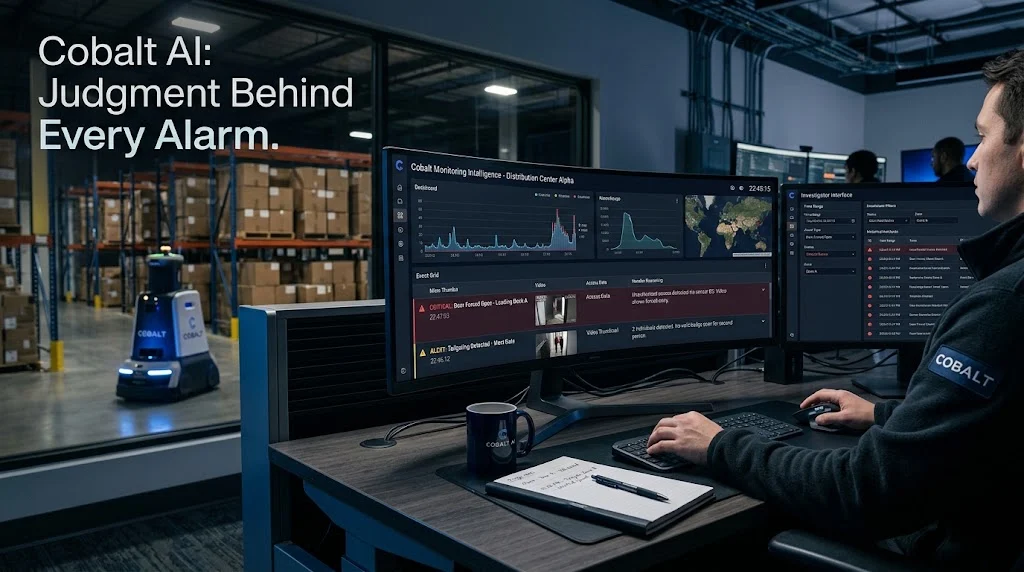
Cobalt’s autonomous robots serve as mobile security sensors that patrol facilities on scheduled or on-demand routes. They capture video that feeds into Cobalt Monitoring Intelligence for real-time analysis. The robots use lidar, ultrasound, depth sensors, and wide-angle day and night cameras .
A key differentiator is elevator integration. Cobalt robots integrate with Otis, KONE, ThyssenKrupp, and Schindler elevator systems, enabling autonomous navigation between floors during patrol routes. This multi-floor patrol capability is particularly valuable for multi-story distribution centers where fixed cameras cannot cover every level .
Key Features and Capabilities
Integration with Existing Infrastructure
Cobalt Monitoring Intelligence is designed to layer onto existing security systems without requiring infrastructure replacement. Named integrations include :
| Access Control | LenelS2 OnGuard, Genetec, C·CURE 9000, Avigilon, S2 NetBox, Brivo, Feenics |
| Video Management | Milestone XProtect, Genetec, RTSP/RTSPS camera streams |
| Identity & SSO | Okta |
| Ticketing & Workflow | ServiceNow, Salesforce, Slack |
The platform supports edge, cloud, or hybrid deployment. Edge processing handles camera analytics locally for facilities with bandwidth constraints or data residency requirements. Video never leaves the facility in edge mode .
The Investigator
The Investigator provides a searchable, filterable event grid for multi-site security operations. Security teams can filter by site, zone, alarm category, status, and date range. Each event includes camera snapshots and the Handler’s reasoning chain. The system identifies top-offender doors generating the most alarms and tracks auto-resolve rates across sites .
Root Cause Analysis
A distinguishing feature is root cause analysis. Rather than simply flagging an alarm, Cobalt determines why it occurred: a propped door for a delivery, a malfunctioning closer, or a badge policy violation. Persistent false alarms from specific devices automatically generate maintenance tickets, turning alarm data into a facility health tool .
Pricing and Plans
Cobalt does not publish public pricing for its enterprise security platform. According to CostBench, pricing snapshots show a tier restructure in September 2026, with “Premium” renamed to “Enterprise.” A May 2026 snapshot showed a price range of $8,500 to $50,000 per month, though the current live pricing page displays $0 for the starting tier .
Important caution: The $0 starting price on the current pricing page likely indicates a contact-for-quote model rather than a free tier. Enterprise security platforms of this scale typically require custom pricing based on facility count, camera volume, and deployment configuration.
For organizations evaluating Cobalt, the pricing model is consultative and tied to the scope of deployment. Cobalt publishes service tickets, access control updates, Slack, SMS, and guard dispatch as available workflow actions .
Privacy and Security
Cobalt AI publishes extensive security documentation.
Certifications and Compliance
- SOC 2 Type II: Certified with no exceptions for security, availability, and confidentiality trust principles
- GDPR: Compliant
- CCPA: Compliant
- POPIA: Compliant
- HIPAA: Compliant
Data Handling
All data on Cobalt robots is encrypted at rest using AES-256 and in transit using TLS 1.2. Depending on data type, information may be stored in AWS cloud, streamed live to the SOC via a Wireguard VPN tunnel, stored encrypted locally, or destroyed. Data is never shared with unauthorized personnel and is logged and audited according to NIST 800-92 guidelines .
Third-Party Verification
Cobalt maintains annually-reviewed Disaster Recovery and Business Continuity Plans, implements network security and access control measures, and routinely withstands internal and external OWASP 10 penetration tests .
Important distinction: SOC 2 Type II certification does not automatically mean Zero Data Retention. Cobalt’s documentation describes encrypted storage and streaming to its SOC, indicating data retention for security monitoring purposes.
Real-World Results
Alarm Reduction Metrics
Cobalt publishes performance data from enterprise deployments :
| Events Resolved Without Human Escalation | Up to 94% | ~80% |
| Avg. Alarm Response Time | 58-75 seconds | 6-8.5 minutes |
| False Alarm Reduction | 55% | N/A |
| Events Requiring Human Review | <10% | N/A |
Operational Impact
Based on a simplified model, a facility processing 6,632 monthly alarm-handling hours before Cobalt reduces to 2,482 hours with the platform, freeing 4,050 hours per month for higher-value security work. At $20 per hour, this represents estimated monthly savings of $81,000 .
Named Customers
Cobalt publishes Salesforce as a named enterprise customer. A Fortune 50 global logistics provider operates Cobalt Monitoring Intelligence across 7+ facilities in 5 countries .
Customer Perspective
One Fortune 100 customer quote shared by Cobalt captures the platform’s value proposition: “You do not find the needle in the haystack. You get rid of all of the hay” .
Who Should Use Cobalt AI
Global security operations centers (GSOCs) drowning in alarm volume are the primary audience. If the bottleneck is triaging thousands of events rather than coverage, Cobalt is designed to address exactly that problem .
Distribution centers and logistics hubs with multi-story facilities benefit from robotic endpoint elevator integration and after-hours intrusion detection. The platform handles high-value inventory zones, loading docks, and perimeter security .
Enterprise security teams with existing infrastructure can layer Cobalt over their current access control and video management systems without rip-and-replace. The named integration list makes qualification straightforward .
Organizations with strict compliance requirements benefit from SOC 2 Type II, HIPAA, and GDPR certifications. Edge deployment options address data residency requirements .
Single-site facilities with low alarm volume may not realize the ROI. The platform’s value scales with multi-site deployments and high event volumes.
Common Mistakes and Cautions
Expecting physical deterrence from Cobalt alone. Cobalt publishes workflow actions including service tickets, access control updates, Slack, SMS, and guard dispatch. Speaker, talk-down, strobe, or horn behavior is not publicly specified. The platform tells someone rather than physically intervening .
Assuming Cobalt replaces the underlying video platform. Cobalt is a reasoning layer, not a video management system. It inherits the retention, search, camera compatibility, and bandwidth profile of the system underneath it. If your constraint is in the video system of record, Cobalt will not fix it .
Ignoring camera compatibility questions. Cobalt names three video platforms (Eagle Eye Networks, Milestone XProtect, Genetec) and accepts RTSP/RTSPS streams, but does not publish a camera manufacturer or model list. For mixed estates, verify that your specific cameras work with the desired Handlers before selecting a pilot site .
Overlooking the acquisition. PitchBook lists Cobalt as “Acquired/Merged” as of June 2024. Organizations should confirm current ownership, product roadmap, and support commitments before signing multi-year contracts .
Confusing Cobalt AI with other “Cobalt” products. Multiple companies use the Cobalt name: a legal AI company, a recruitment platform, and a cloud coding agent platform. This article covers Cobalt AI, the physical security company .
Frequently Asked Questions
What is Cobalt AI?
Cobalt AI is a physical security company founded in 2016 that combines autonomous indoor security robots with Cobalt Monitoring Intelligence, an AI-powered platform for alarm triage and security event resolution. It serves enterprise customers across distribution centers, logistics, and commercial facilities .
How does Cobalt AI work?
Cobalt uses AI Handlers that process security events through a Detect, Reason, Act, Resolve workflow. The system pulls camera feeds, correlates them with access control data, and determines whether an event requires human attention. Up to 94% of events are resolved automatically .
Is Cobalt AI SOC 2 compliant?
Yes. Cobalt is SOC 2 Type II certified with no exceptions for security, availability, and confidentiality trust principles. The company also complies with GDPR, CCPA, POPIA, and HIPAA .
How much does Cobalt AI cost?
Cobalt does not publish public pricing. CostBench snapshots showed a range of $8,500 to $50,000 per month in May 2026, though current pricing requires contact for quote. Pricing scales with facility count, camera volume, and deployment configuration .
What are the best Cobalt AI alternatives?
Alternatives depend on the use case. For video AI, Spot AI offers a different approach as a video platform with agent-first AI rather than a reasoning layer over existing systems. For robotics, competitors include SMP Robotics, Blue Frog Robotics, and Clearpath Robotics .
Conclusion
Cobalt AI has built a differentiated position in the physical security market. Rather than adding another source of alarms, it layers judgment on top of existing systems, reducing alarm noise by up to 90% and resolving the vast majority of events without human intervention. The combination of robotic endpoints and AI-powered monitoring gives enterprises a flexible deployment model that scales from camera-only to full hybrid configurations.
What matters most is understanding the platform’s role. Cobalt is a reasoning layer, not a replacement for your video management system. It inherits the strengths and limitations of the infrastructure underneath. The integration list is published, the metrics are documented, and the security certifications are verifiable. But the physical intervention capabilities are limited to workflow actions, and the camera compatibility details require evaluation.
Cobalt AI may suit global security operations centers drowning in alarm volume, multi-site distribution networks needing consistent monitoring, and enterprises with existing infrastructure seeking an intelligence layer without rip-and-replace. It may not suit single-site facilities with low alarm volume, organizations seeking physical deterrence capabilities, or teams whose bottleneck is in the video system of record rather than the reasoning above it.
Before committing, request the certification pack, verify camera compatibility for your specific estate, confirm current ownership and roadmap following the 2024 acquisition, and run a pilot at a representative facility. Cobalt offers genuine operational value for the right use case, but that value depends on fit, not just capability.