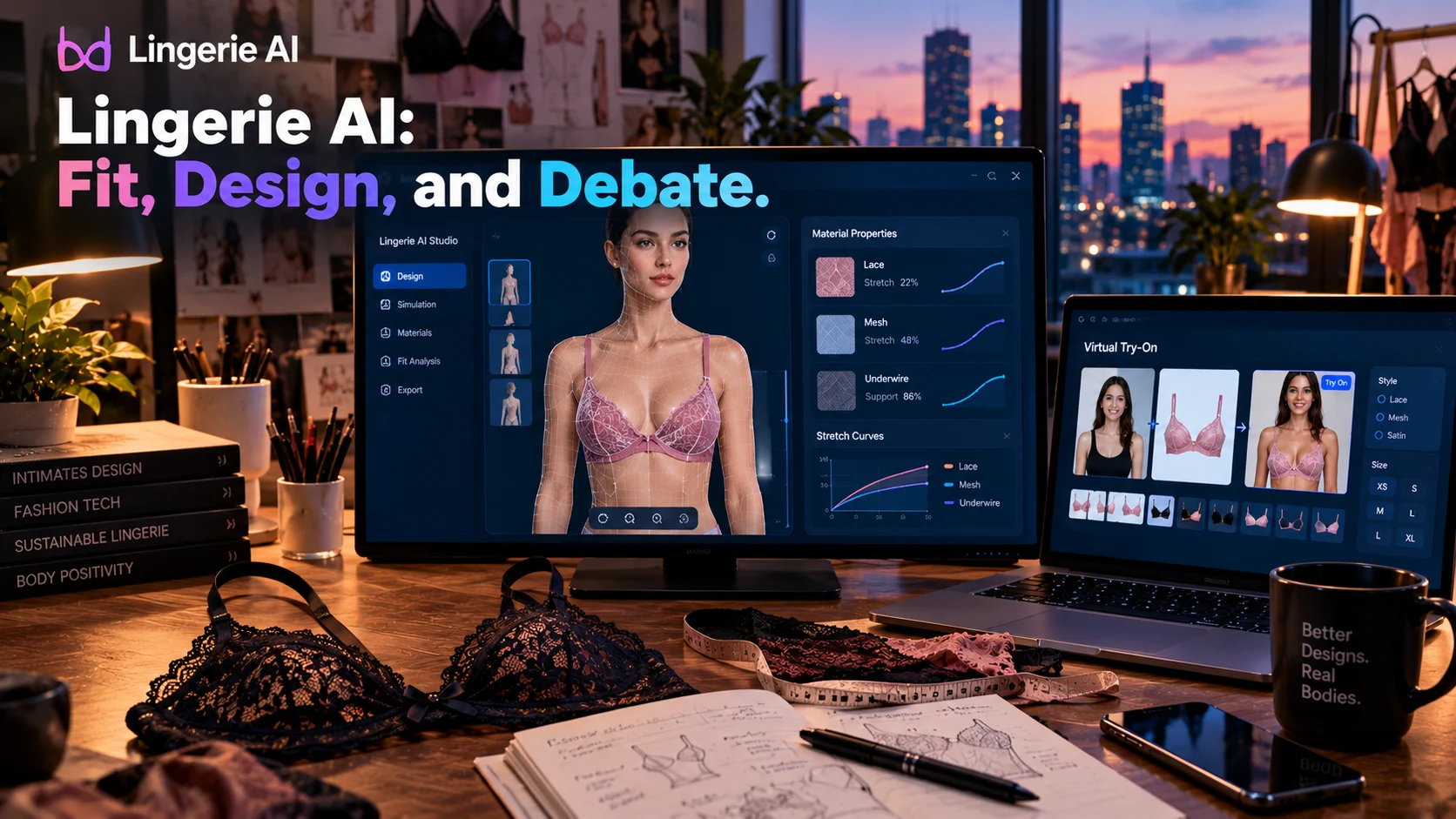
Lingerie AI refers to artificial intelligence tools applied across the intimate apparel industry, including virtual try-on for shoppers, 3D design and simulation for brands, and AI-generated models for marketing. It addresses the category’s core challenge: fit and feel are difficult to judge online, and traditional photoshoots for intimate apparel are expensive and logistically complex.
At-a-Glance: Key Takeaways
- Lingerie AI spans three distinct areas: virtual try-on for shoppers, 3D design and simulation for brands, and AI-generated models for marketing .
- Fit is the central problem. AI fitting chatbots and virtual try-on aim to reduce returns by helping shoppers find the right size and style .
- 3D simulation handles intimate apparel’s complexity, including underwire rigidity, lace stretch, and multi-material construction .
- AI-generated models cut photoshoot costs by up to 90%, but raise concerns about diversity, consent, and unrealistic beauty standards .
- The ethical debate is significant. Modeling agent Chelsea Bonner calls AI models a “cataclysmic step backwards” for diversity in fashion .
- Pricing varies widely. API-based try-on tools charge per generation; 3D design platforms are enterprise-licensed; consumer apps offer subscriptions from $7.99/month .
What Is Lingerie AI?
Lingerie AI is the application of artificial intelligence across the intimate apparel value chain. It covers several distinct use cases, each addressing different stakeholders and problems.
For shoppers, it means virtual try-on tools that show what a bra or set might look like on a photo of themselves, and AI fitting chatbots that provide personalized size and style recommendations .
For brands and designers, it means 3D simulation software that models how lace, mesh, and underwire behave, allowing digital prototyping before physical samples are cut . It also means AI-generated marketing imagery that replaces traditional photoshoots .
For marketers, it means on-demand generation of on-model product photos across diverse body types, ethnicities, and sizes, at a fraction of the cost of traditional photography .
The category has grown rapidly because lingerie is uniquely difficult to photograph and shop for online. Fit is critical, models are expensive, and platform content policies add friction. AI offers potential solutions to each of these problems .
How Lingerie AI Works
Virtual Try-On Technology
Virtual try-on for lingerie works by combining a product image with a person’s photo to generate a realistic preview. The Genlook API, for example, accepts a product image and a customer photo, then automatically classifies the product type and routes the generation to the appropriate model .
Supported product types include bras, underwear, intimates, corsets, and bodysuits, alongside clothing, accessories, and even petwear . The API handles the entire workflow: image upload, try-on generation, and result delivery .
For consumer-facing apps, the workflow is simpler. Lace Riot allows users to select a style from a catalog of 120 lingerie options (including 68 lingerie styles: 36 female, 32 male) and add their own photo to see a generated preview. The app explicitly states that results are approximate visualizations, not actual try-ons, and do not measure the body or guarantee fit .
3D Design and Simulation
For brands, 3D design platforms simulate how lingerie garments behave. Style3D’s platform handles the specific engineering challenges of intimate apparel: multi-material simulation at the cup and cradle level, underwire and hardware treatment as structural elements, and fine-grain strap behavior that accounts for elastic elongation and recovery .
Designers can assign different stretch curves to the lower cup, upper lace cup, power bar, and wing, so the virtual bra lifts and supports in a way that mirrors real wear. Rigid wires, sliders, and hook-and-eye closures are defined with collision and rigidity parameters, ensuring they maintain shape while surrounding fabrics deform .
The practical benefit is fewer physical prototypes. Wolf Lingerie, a French intimates company established in 1947, develops all of its models directly in 3D. The team reports faster color approvals (10 to 15 variations created instantly), virtual photoshoots without models or studios, and improved collaboration between design, marketing, and sales teams .
AI-Generated Models and Imagery
For marketing, AI generates on-model product photos without a physical photoshoot. VogueShot, an AI fashion studio app, creates high-quality on-model product photos for clothing brands, including lingerie models. The company claims retailers report a 90% reduction in photoshoot costs, 10x faster turnaround, and a 1.5x increase in conversion rate .
Apiway takes a different approach for lingerie specifically. Its White Studio template generates clean on-model PDP images on pure-white backgrounds compliant with marketplace rules. Its Ghost Mannequin template produces garment-alone shots. The company emphasizes that lingerie “breaks most generic AI fashion tools” because models trained on outerwear lose the very details shoppers rely on to evaluate fit: cup shape, lace patterns, and strap configuration .
Key Features and Use Cases
AI Fitting Chatbots
Brarista, a London-based company founded in 2020, offers an AI Fit Chatbot that functions as a fit expert and stylist for lingerie retailers. It provides personalized fitting recommendations and styling advice. The company partnered with Shock Absorber UK in May 2026 to provide instant, expert fitting advice for sports bras, handling questions from sport-specific recommendations to first bra purchases and post-surgery support .
Flat-Lay to On-Model Generation
Apiway’s workflow starts with a flat-lay photo of the garment. The company emphasizes preparation: lay the garment on a smooth, clean surface, steam out wrinkles, open every clasp, and shoot top down with the phone level. Tilt distorts the cup shape, and the AI copies the distortion onto the model .
For sets, Apiway recommends photographing each piece separately. A bra-and-brief set generated from a single combined image tends to lose detail on whichever piece is smaller .
Colorway Visualization
3D platforms allow instant colorway visualization. Wolf Lingerie’s team selects a color, provides Pantone codes, and sees the update in minutes. The team can experiment with a wide range of colorways without additional production effort .
iWish Digital Models
Style3D’s iWish feature creates realistic digital models that showcase products in realistic contexts. The team can simulate product movement and create visuals without traditional photoshoots. Wolf Lingerie’s team used it to generate a five-second video of a model walking along a beach, without hiring a real model .
Pricing and Access
Pricing varies significantly by use case and platform.
Important pricing context: Enterprise 3D design platforms like Style3D are licensed to brands and manufacturers. Pricing is custom and requires direct contact. Consumer apps offer accessible entry points but with limited catalogs and generation credits .
Privacy and Security Considerations
Privacy practices vary across lingerie AI tools, and the sensitive nature of the content warrants careful evaluation.
Consumer try-on apps: Lace Riot’s privacy policy states the developer may collect data but will not link it to personal identity. The app requires users to be 18 or older and instructs users to only upload their own photos or photos of consenting adults .
API platforms: Genlook’s SDK sends images to its API for processing. Organizations integrating try-on should review data retention and processing policies before deployment .
3D design platforms: Enterprise platforms like Style3D operate under business agreements that typically include data handling provisions. Brands should confirm data residency and retention terms .
AI model generation: Platforms generating on-model imagery may use real faces or fully synthetic models. Apiway emphasizes that in its Hollywood-VFX approach, “the face has to be real. The skin has to be real. The room has to be real. Only the garment is AI” .
Important distinction: SOC 2 certification or similar compliance frameworks are not referenced in available documentation for most lingerie AI tools. Organizations with strict compliance requirements should conduct independent due diligence.
Ethical Concerns and Industry Debate
The rise of AI in lingerie has generated significant ethical debate, particularly around AI-generated models and their impact on diversity and body image.
The Diversity Backslide
Chelsea Bonner, a modeling agent who founded the Australian agency Bella Management, experimented with an AI app that dressed her in lingerie. The result was a “cartoonish anime porn version” of herself: a size eight with flawless skin and incredible abdominal muscles .
Bonner’s concern extends beyond her own experience. She fears AI models represent a “cataclysmic step backwards” for diversity in fashion. “Over the last 20 years, we’ve made huge inroads into size diversity, into ethnic inclusion, into the use of models with different abilities,” she said. “I just feel like we’re going back in time” .
The Consent and Theft Problem
Bonner also discovered that the bodies of real women, women who had posted photos of themselves at the beach or out for dinner, were being given AI faces and used for porn or dating sites. “It’s stealing somebody’s identity in order to create false identities to sell for financial gain,” she said .
Some models are embracing digital twins. Alexsandrah Gondora, a London-based model, is paid when brands book her AI replica, “Alex,” and retains final approval over the results. She sees it as a way to be in two places at once. But she criticizes brands that use images created from databases scraped from the internet without paying a model .
The Beauty Standard Problem
AI models are trained on image banks that often reflect a “white and Western” aesthetic, according to Carl-Axel Wahlström, co-founder of the AI creative studio Copy Lab. MidJourney, for example, tends to generate models with fuller lips .
Bonner worries about the impact on young girls. “The prevalence of eating disorders after AI is introduced is just going to be catastrophic,” she said .
Regulation on the Horizon
The Fashion Workers Act, scheduled to take effect in New York in summer 2026, will allow models to control the use of AI in reproducing their image. However, practical enforcement appears complicated .
Who Should Use Lingerie AI
Lingerie brands and retailers seeking to reduce photoshoot costs, accelerate design cycles, or offer virtual try-on to shoppers. The technology addresses real operational challenges in a category where fit is critical and photography is expensive .
E-commerce platforms wanting to add virtual try-on to reduce returns. The Genlook API provides a developer-friendly path to integrate try-on functionality .
Design and technical teams in intimate apparel who need to simulate complex material behavior before cutting physical samples. 3D platforms like Style3D are built for this workflow .
Consumers curious about how specific styles might look. Apps like Lace Riot offer a low-cost way to preview, though results are approximate and should not be treated as accurate fit predictions .
Organizations with strict compliance requirements should evaluate data handling practices carefully. Most lingerie AI tools do not publish security certifications.
Modeling professionals should understand the evolving landscape around digital replicas and consent. The Fashion Workers Act may provide new protections .
Common Mistakes and Cautions
Treating AI try-on as accurate fit prediction. Lace Riot explicitly states its results are approximate visualizations, not actual try-ons. The app does not measure the body or guarantee size or fit .
Using generic AI tools for lingerie. Generic image models trained on outerwear lose lingerie-specific details like cup shape, lace patterns, and strap configuration. Apiway notes that cups merge, lace blurs, and straps disappear .
Ignoring platform content policies. Open-ended image AIs often add coverage, change pose, or refuse generation on lingerie inputs. Brands need predictable, repeatable outputs across an entire catalog .
Assuming AI models improve diversity. The training data often reflects narrow beauty standards. Without deliberate intervention, AI can reinforce rather than expand representation .
Overlooking consent and compensation. Using real people’s images or likenesses without permission or payment raises serious ethical and legal concerns. The Fashion Workers Act aims to address this, but enforcement remains unclear .
Frequently Asked Questions
What is Lingerie AI?
Lingerie AI refers to artificial intelligence tools applied to intimate apparel, including virtual try-on for shoppers, 3D design and simulation for brands, and AI-generated models for marketing. It addresses the category’s unique challenges around fit, photography cost, and online shopping uncertainty .
How does virtual lingerie try-on work?
Virtual try-on combines a product image with a person’s photo to generate a realistic preview. APIs like Genlook accept product and customer images, automatically classify the product type, and return a try-on result. Consumer apps like Lace Riot offer a simpler workflow with a curated catalog .
Is Lingerie AI accurate for fit?
No. Consumer apps explicitly state that AI-generated previews are approximate visualizations, not actual try-ons. They do not measure the body or guarantee size or fit. For accurate fit, professional fittings or AI fitting chatbots like Brarista provide better guidance .
What are the ethical concerns with Lingerie AI?
Key concerns include the potential backslide in body diversity, the use of real women’s images without consent, the reinforcement of narrow beauty standards, and the impact on models and photographers’ livelihoods. Modeling agent Chelsea Bonner calls AI models a “cataclysmic step backwards” for the industry .
How much does Lingerie AI cost?
Pricing varies. Consumer apps like Lace Riot offer subscriptions from $7.99/month with in-app purchases. API tools like Genlook charge per generation. Enterprise 3D platforms like Style3D are custom-licensed. AI model generation platforms claim up to 90% cost reduction versus traditional photoshoots .
Conclusion
Lingerie AI represents a significant shift in how intimate apparel is designed, marketed, and shopped for. Virtual try-on offers shoppers a way to preview styles without the awkwardness of in-store fittings. 3D simulation lets brands iterate designs digitally before cutting physical samples. AI-generated models cut photoshoot costs dramatically while enabling on-demand visualization across body types and ethnicities.
What matters most is understanding the trade-offs. AI try-on is approximate, not precise. 3D simulation requires investment and expertise. AI-generated models raise unresolved ethical questions about diversity, consent, and the displacement of human workers. The technology solves real problems, but it also creates new ones.
Lingerie AI may suit brands seeking operational efficiency, e-commerce platforms wanting to reduce returns, and designers needing faster iteration cycles. It may not suit organizations unwilling to address the ethical dimensions, or consumers expecting perfect fit prediction.
Before adopting any Lingerie AI tool, evaluate the accuracy claims against your actual needs. Review privacy and data handling policies, particularly for tools processing customer photos. Consider the ethical implications of AI-generated imagery and whether your brand’s values align. And remember that the most sensitive category in fashion demands the most careful implementation.