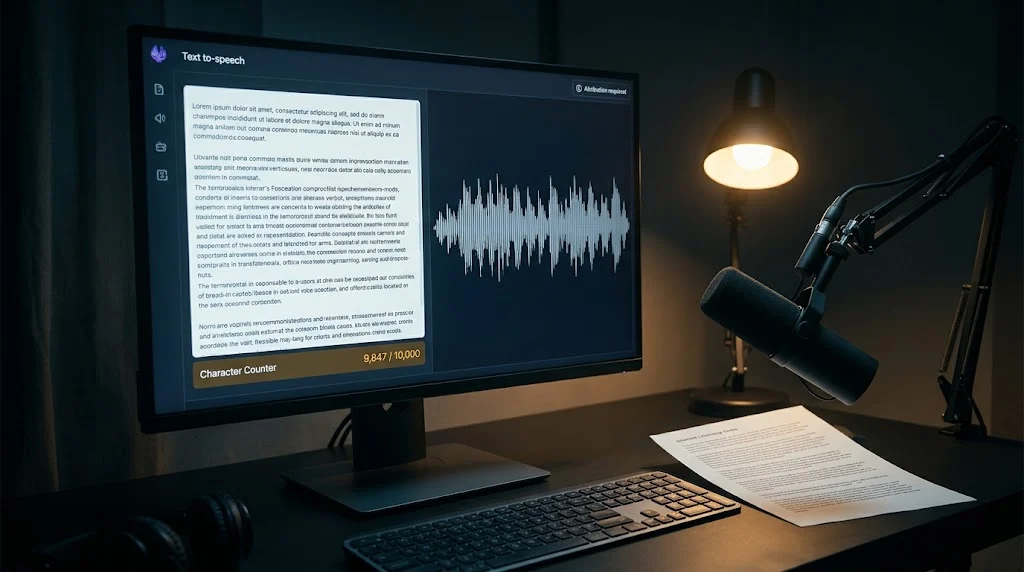
A free AI voice generator converts text to speech without upfront payment, but free tiers in 2026 impose strict character limits and often prohibit commercial use. ElevenLabs allows 10,000 characters monthly for non-commercial use only, Play.ht offers 12,500 characters with mandatory attribution, and cloud providers like Google and Azure include commercial rights in their free allowances .
At-a-Glance Box
- Free tiers are small. ElevenLabs caps at 10,000 characters monthly. Play.ht offers 12,500. Murf AI allows just 10 minutes of generation with no downloads .
- Commercial rights split the field. Google Cloud, Azure, and Amazon Polly permit commercial use on free tiers. ElevenLabs, Play.ht, and Murf prohibit it .
- Attribution is often mandatory. ElevenLabs free output requires crediting the company. Play.ht requires attribution on published audio .
- Open-source models eliminate every restriction. Kokoro, Chatterbox, and CosyVoice2 run locally under permissive licenses with no character caps .
- Cloud free tiers are the most generous. Google Cloud offers 1 million standard characters monthly. Azure provides 500,000. Both include commercial rights .
- The free tier you choose depends on intent. Testing voice quality, producing a monetized video, and building an app each require different tools.
What “Free” Actually Means for AI Voice Generators
Searching for a free AI voice generator usually starts with a practical need. You want to narrate a video, test a voice for a project, or add speech to an application without committing to a subscription. The results page delivers dozens of options, each promising free text-to-speech without explaining what that phrase includes.
The reality is more constrained. Every free tier imposes three limits: a character or time cap, a rights restriction, and often an attribution requirement. Some platforms prohibit commercial use entirely. Others allow it but require you to credit the company every time the audio plays. A few reserve their best voices for paying customers.
Understanding these boundaries before investing time in a tool is the difference between a useful experiment and a wasted afternoon. This guide maps the free tier landscape as of late October 2026. It covers what each major platform delivers, what it quietly withholds, and which tools match which use cases.
How Free Tiers Actually Work
The Character and Time Caps
Free allowances follow three models. Monthly character refills reset each billing cycle. One-time grants appear at signup and never return. Time-based limits cap total audio minutes regardless of character count.
ElevenLabs provides 10,000 credits per month on its free plan, enough for roughly one short podcast segment before hitting the wall . Play.ht offers 12,500 characters monthly, a slightly larger allowance with stricter attribution requirements . Murf AI caps free generation at 10 minutes total, with no downloads allowed at all .
The cloud providers operate differently. Google Cloud Text-to-Speech includes 1 million standard characters monthly, roughly 90 hours of audio, with no expiration . Microsoft Azure provides 500,000 characters monthly, about 11 hours . Amazon Polly grants 5 million characters for the first 12 months only, after which billing begins .
The practical math matters more than the headline number. ElevenLabs’ 10,000 monthly credits disappear after a single five-minute narration. Google’s 1 million monthly characters support hundreds of short videos before requiring payment.
Commercial Rights and Attribution
This is where free tiers diverge most sharply, and where reading the terms of service becomes essential.
ElevenLabs restricts free-plan output to non-commercial use with attribution. Any monetized video, client project, or paid course requires a paid plan . Play.ht limits its free tier to non-commercial use and requires attribution to Play.ht for any published audio . Murf AI prohibits commercial use and blocks downloads entirely on the free plan .
The cloud providers take a different approach. Google Cloud, Azure, and Amazon Polly treat free-tier output under the same customer agreements as paid usage. Commercial use is permitted without attribution . This distinction matters for anyone planning to monetize audio, whether through ads, client work, or product integration.
Voice Quality and Feature Access
Free tiers rarely include the features that make a voice generator useful for production. Voice cloning, high-quality neural voices, and API access usually sit behind paid plans.
ElevenLabs free users get access to pre-made voices and basic instant voice cloning, but standard audio quality only . Murf AI blocks downloads, meaning you can generate audio but cannot export it . Play.ht includes access to all voices and one instant voice clone, but caps output at 12,500 characters .
The cloud providers offer neural voices with quality comparable to consumer tools, though setup requires a developer account and credit card verification. The tradeoff is complexity in exchange for commercial rights and larger allowances.
Platform-by-Platform Breakdown
| ElevenLabs | 10,000 chars/month | Prohibited | Required | Non-commercial only |
| Play.ht | 12,500 chars/month | Prohibited | Required | Hard cap, no overage |
| Murf AI | 10 minutes total | Prohibited | N/A | No downloads |
| Google Cloud TTS | 1M chars/month | Permitted | Not required | Requires Cloud account |
| Azure TTS | 500K chars/month | Permitted | Not required | Requires Azure account |
| Amazon Polly | 5M chars (12 months) | Permitted | Not required | Expires after year one |
| Kokoro (open-source) | Unlimited | Permitted | Not required | Requires local setup |
ElevenLabs: Best Quality, Strictest Free Terms
ElevenLabs produces the most natural-sounding synthetic speech among consumer tools, with expressive voices and strong multilingual support. The free tier provides access to over 300 pre-made voices and basic voice cloning, enough to evaluate whether the quality justifies a subscription.
The restriction is severe. Free-plan output is non-commercial only and requires attribution . The 10,000 monthly characters support roughly one five-minute narration before resetting . For anyone testing voice quality before upgrading, the free tier works. For anyone producing monetized content, it does not.
Play.ht: Slightly Larger Allowance, Same Restrictions
Play.ht offers 12,500 characters monthly on its free plan, a marginally larger allowance than ElevenLabs. The free tier includes access to all voices and one instant voice clone, making it useful for evaluating the platform’s range .
Commercial use is prohibited, and published audio must credit Play.ht . The character cap is hard, with no overage option. For personal projects and testing, Play.ht provides a workable sandbox. For professional work, the paid step is unavoidable.
Murf AI: The Most Restrictive Free Tier
Murf AI’s free plan is the least useful among consumer tools. It allows 10 minutes of voice generation total, not per month, and blocks downloads entirely . You can hear what the voices sound like, but you cannot export the audio.
Commercial use is prohibited on the free tier . Murf’s strength lies in its editor, integrations with tools like Canva and Google Slides, and API access, but none of those features are available without payment. The free tier functions as a voice preview, not a generation tool.
Cloud Providers: Commercial Rights and Generous Allowances
The major cloud platforms offer the most generous free tiers, provided you can navigate their setup processes.
Google Cloud Text-to-Speech includes 1 million standard characters monthly, permanently, with commercial use permitted under the same terms as paid usage . Neural and WaveNet voices have separate, smaller allowances, but the standard tier supports substantial volume.
Microsoft Azure provides 500,000 characters monthly for neural voices, with commercial rights included . Amazon Polly grants 5 million standard characters for the first 12 months, then converts to paid billing .
The tradeoffs are complexity and setup friction. All three require account creation, credit card verification, and familiarity with API calls or console interfaces. They are not consumer-friendly tools. But for developers, small businesses, and anyone needing commercial rights without paying upfront, the cloud free tiers are the most viable path.
Open-Source: The Only Truly Unrestricted Option
The only structurally free AI voice generation comes from open-source models running on your own hardware. No platform policy governs output, no character cap applies, and no attribution is required.
Kokoro is an 82 million parameter model under Apache 2.0, generating studio-quality speech nearly 100 times faster than real-time on a GPU . Chatterbox, developed by Resemble AI under MIT license, excels at voice cloning from short reference audio and includes a built-in watermark for responsible use . CosyVoice2 from Alibaba handles multilingual synthesis with voice cloning under Apache 2.0 .
The tradeoff is hardware and setup. A capable GPU, Python environment, and comfort with command-line tools are prerequisites. Cloud GPU rentals offer a middle path, but that is not free either. For users with the technical setup, open-source eliminates every restriction described above.
Privacy and Data Handling
Free AI voice generators process the text you submit. That text may contain client scripts, unpublished content, or personal writing. What happens to it after generation matters.
Consumer tools tie generations to your account. ElevenLabs, Play.ht, and Murf all publish privacy policies, but free-tier data may be retained for model improvement unless you opt out. The cloud providers operate under enterprise data agreements that offer clearer protections, though free-tier usage still falls within those terms.
No major free AI voice generator publicly commits to Zero Data Retention on free accounts. SOC 2 certification, where present, addresses organizational controls rather than whether individual scripts are stored. Assume free-tier inputs are retained for some period unless the provider explicitly states otherwise.
Voice cloning adds another layer. Free tiers that include cloning, like ElevenLabs’ basic instant clone, require you to upload a voice sample. That sample is biometric data. Read the retention policy before uploading anyone’s voice, including your own.
Common Mistakes With Free AI Voice Generators
Assuming “free” means “commercial.” ElevenLabs, Play.ht, and Murf all prohibit commercial use on free tiers. Publishing monetized content with free-tier audio breaches their terms regardless of whether you are caught .
Ignoring attribution requirements. ElevenLabs free output requires crediting the company. Play.ht requires attribution on published audio. These requirements apply even to non-commercial sharing.
Burning the character cap on test runs. A 10,000-character allowance disappears after a few script revisions. Test with short samples before generating full narrations.
Expecting downloads from Murf. The free plan blocks exports entirely. You can preview voices, but you cannot use them .
Overlooking the cloud providers. Google Cloud and Azure offer larger allowances and commercial rights that consumer tools withhold. The setup is more involved, but the tradeoff often favors anyone with technical comfort.
Who Should Use a Free AI Voice Generator
Creators testing voice quality should use ElevenLabs or Play.ht to evaluate whether synthetic speech suits their content. Neither permits commercial use, but both demonstrate what the technology can do.
Developers and small businesses needing commercial rights should use Google Cloud, Azure, or Amazon Polly. The allowances are larger, the commercial terms are clear, and the output can be used in products and client work.
Hobbyists with technical skills should explore Kokoro and Chatterbox. The setup takes effort, but the result is unrestricted generation with no attribution and no character caps.
Anyone producing monetized content should skip free tiers that prohibit commercial use. The paid step on ElevenLabs or Play.ht is modest relative to the legal risk of using non-commercial audio in a monetized product.
Latest Developments
The free tier landscape remains stable heading into late 2026. ElevenLabs continues to offer 10,000 monthly credits on its free plan, with commercial rights reserved for paid tiers . Play.ht’s 12,500-character allowance and attribution requirement remain unchanged .
The more significant shift is the maturation of open-source models. Kokoro, Chatterbox, and CosyVoice2 now produce speech quality that rivals commercial tools, and they run without platform oversight . For users willing to invest setup time, the gap between free and paid has never been smaller.
Cloud providers continue to offer the most generous commercial-friendly free tiers. Google’s 1 million monthly standard characters remain the largest permanent allowance available without payment .
Conclusion
Free AI voice generators like ElevenLabs, Play.ht, and Murf let you test AI voices, but limits on characters, attribution, and commercial rights vary. Google Cloud and Azure are alternatives for more flexible usage.
Before choosing a tool, check its current usage limits, commercial-use policy, and attribution requirements. For greater control without platform restrictions, consider open-source models.