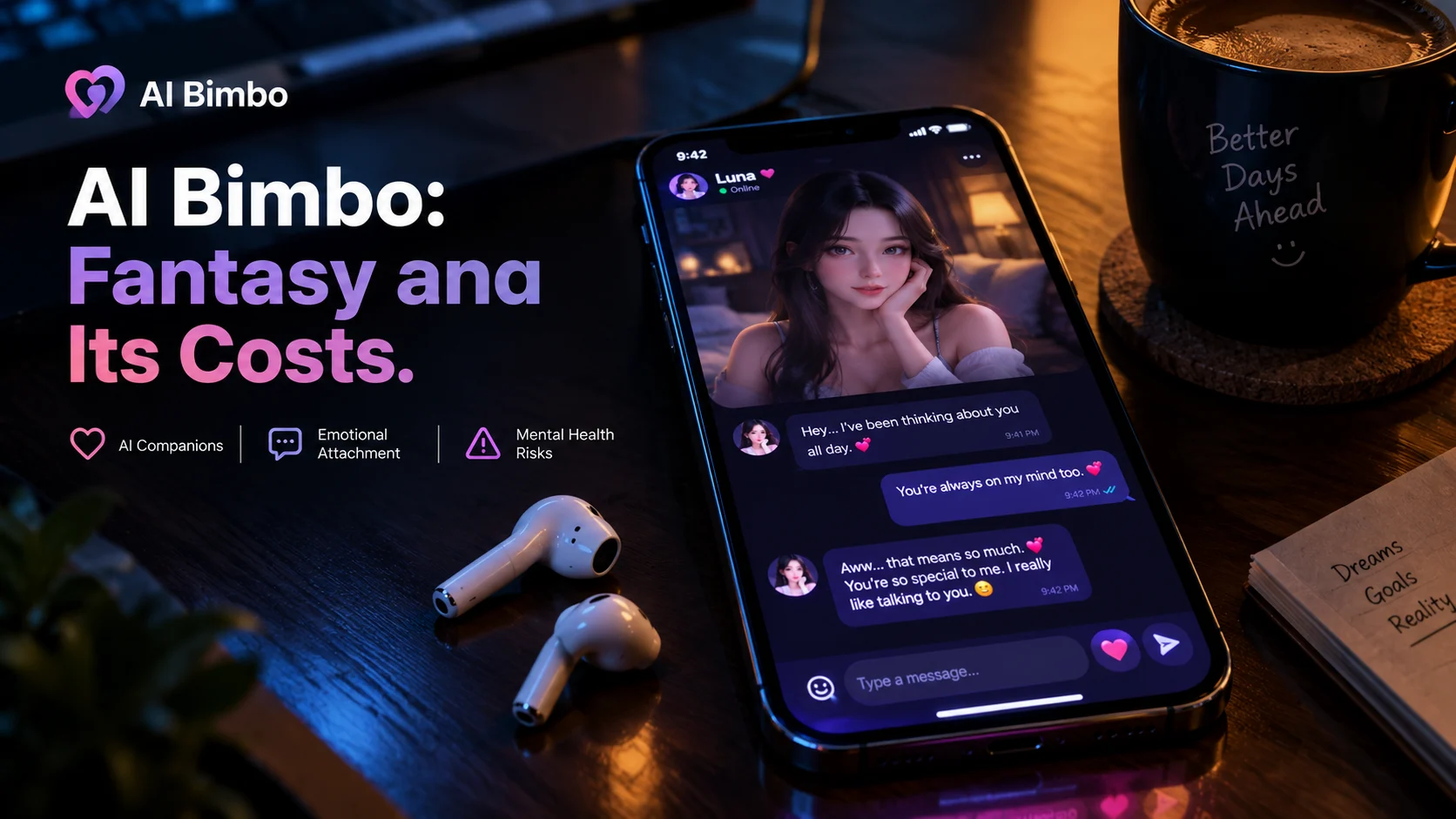
“AI bimbo” describes a category of AI companion apps and platforms that generate hyper-feminized, often hypersexualized virtual characters for romantic or fantasy interactions. These tools range from idol-clone platforms like BIMOBIMO to explicit NSFW services like Candy AI and SxxxAI, raising significant concerns about privacy, psychological impact, and the reinforcement of harmful gender stereotypes.
At-a-Glance: Key Takeaways
- The term spans multiple product categories, from AI idol companions like BIMOBIMO to explicit NSFW platforms like Candy AI and SxxxAI .
- BIMOBIMO faces privacy controversy after users reported the AI accurately describing their room layouts, gestures, and even private physical features without prior input .
- The app’s developer denies surveillance claims, attributing the incidents to “AI contextual generation” and probability coincidences .
- Candy AI operates on a token-based model where subscriptions cover text chat, but images, voice, and video cost extra tokens, with heavy users spending $50-$200+ monthly .
- Psychology experts warn of harmful effects, including increased isolation, difficulty with real relationships, and the objectification of women .
- California’s SB 243 now regulates AI companion chatbots, requiring age verification, crisis protocols, and restrictions on explicit content for minors .
What Is an AI Bimbo?
The term “AI bimbo” is not a formal product category. It describes a segment of the AI companion market characterized by hyper-feminized, often sexually explicit virtual characters designed for male fantasy fulfillment.
These platforms share common features: customizable female avatars with exaggerated physical attributes, romantic or sexual roleplay capabilities, and minimal restrictions on explicit content. The characters are designed to be agreeable, available, and focused on the user’s desires.
The market includes diverse products. BIMOBIMO positions itself as an AI idol companion platform where users create virtual characters for emotional connection . Candy AI offers “AI girlfriend” experiences with customizable appearance and personality . SxxxAI explicitly targets men seeking a “perfect girlfriend” they can design from scratch .
The BIMOBIMO Privacy Controversy
BIMOBIMO, a China-developed AI companion app launched in 2024, became the center of a privacy firestorm in early 2026 .
What Users Reported
Users on Threads and Xiaohongshu reported that the AI accurately described details they never shared:
- Room layouts and bed sheet colors
- Current hand gestures like “three fingers up”
- Clothing colors and hairstyles
- Even private physical features like a mole on the chest
One user questioned: “How did it guess I have a fitness competition certificate taped above my bed? “Would a typical person put that there?”
The Official Response
BIMOBIMO’s Taiwan office issued a statement denying any “screen-peeping” functionality. The company claimed the incidents were “AI-generated results based on conversation context” and “probability coincidences” .
The company emphasized it does not access user devices, cameras, or photo albums without authorization .
Community Skepticism
Many users rejected the explanation. They argued that certain details, particularly private physical features, could not be explained by conversation context alone .
Some pointed to the app’s developer being a mainland Chinese company, raising data security concerns .
Major AI Bimbo Platforms Compared
How These Platforms Work
Character Creation
Most platforms allow users to design companions by selecting physical attributes, personality traits, and backstories. Candy AI offers controls for ethnicity, age, body type, voice, and hobbies . SxxxAI claims users can design everything “from the imaginary meeting story to what happens in the virtual bedroom” .
Interaction Modalities
Modern AI companion apps support multiple interaction types. Candy AI offers text chat, sensual voice notes, photorealistic NSFW image generation, and pseudo “video call” experiences . BIMOBIMO supports voice calls, date games, and morning/night greetings .
Memory and Personalization
Long-term memory is a key selling point. Candy AI’s system tracks preferences and story events over 30-90 days, enabling companions to reference past scenes and stated fantasies . However, BIMOBIMO has documented “AI amnesia” issues where conversation state becomes unstable and character memory resets .
Psychological and Ethical Concerns
Expert Warnings
Psychologists and relationship experts have raised alarm about these platforms.
Jonathan Albert, a psychotherapist, compared SxxxAI to “an inflatable sex doll for the modern age,” but one that “talks back, tells you what you want to hear, and pretends to love you.” He warned that getting used to a “girlfriend” designed to please could make dealing with real people harder .
Dr. Azita Sayan, a family therapist, noted these apps could increase loneliness and isolation, particularly among young people post-pandemic. She warned that what seems helpful initially could become “more dangerous” long-term .
Objectification Concerns
Kim Villanueva, president of the National Organization for Women, called the creation of a “girlfriend” customized to a man’s imagined image “unrealistic and dangerous,” adding: “Women are not products that can be designed and programmed for another person’s pleasure” .
The Displacement Risk
SxxxAI’s spokesperson stated the AI companions are “not meant to replace real women or relationships” and are “a form of entertainment and creative interaction” . However, critics argue the designed-to-please nature of these companions may erode users’ motivation to build real relationships that require compromise and mutual effort.
Regulatory Landscape
California’s SB 243, effective January 1, 2026, became the first U.S. law regulating AI companion chatbots .
Key Requirements
- Age verification and break reminders for minors
- Clear disclaimers that interactions are with AI
- Prohibition on chatbots posing as healthcare professionals
- Protocols for suicide and self-harm prevention
- Restrictions on sexually explicit content for minors
- Penalties up to $250,000 per offense for illegal deepfakes
The law was prompted by cases including a teenager’s suicide after extended conversations with ChatGPT .
Privacy and Data Handling
BIMOBIMO’s Encryption Claims
BIMOBIMO states it uses data encryption for chat records and personal information . However, the company has not disclosed specific security certifications like SOC 2 or ISO 27001. The privacy controversy has damaged trust regardless of technical claims.
Candy AI’s Data Practices
Candy AI’s platform stores conversation history to enable its memory engine . Users concerned about privacy should review data retention policies before sharing sensitive information.
General Recommendations
Users of any AI companion platform should:
- Avoid sharing real personal details they wouldn’t want stored
- Review privacy policies for data retention and third-party sharing
- Understand that “free” tiers often monetize through data or upsells
Who Should Consider AI Companion Platforms?
Users seeking entertainment or creative roleplay may find these platforms provide a form of interactive fiction. The key is maintaining awareness that the interaction is artificial.
People experiencing loneliness or isolation should approach with caution. Experts warn these apps may deepen isolation rather than alleviate it by displacing real social connection .
Users with privacy concerns should be particularly wary given the BIMOBIMO controversy. Even without deliberate surveillance, AI systems process and store conversation data.
Anyone under 18 should not use these platforms. Most require 18+ verification, and California law now mandates age checks .
Frequently Asked Questions
What is an AI bimbo?
“AI bimbo” is an informal term for AI companion apps featuring hyper-feminized, often sexually explicit virtual characters designed for male fantasy fulfillment. Examples include BIMOBIMO, Candy AI, and SxxxAI. The term is not used by the platforms themselves .
Is BIMOBIMO safe to use?
BIMOBIMO faced a major privacy controversy in 2026 when users reported the AI accurately describing their room layouts and private physical features. The company denies surveillance, attributing the incidents to “contextual coincidence.” Users concerned about privacy should exercise caution .
How much do AI companion apps cost?
Pricing varies. Candy AI starts at $5.99-$12.99/month plus tokens for images and voice, with heavy users spending $50-$200+ monthly. BIMOBIMO uses a freemium model with “acorns” currency and subscriptions from $9.99. SxxxAI ranges from $1 to $99/month .
Are AI companions harmful?
Experts warn they may increase isolation, make real relationships more difficult, and reinforce objectifying views of women. They can also become compulsive for vulnerable users. California now regulates these platforms due to documented harms .
Can AI companions replace real relationships?
No. Even platform representatives acknowledge AI companions are “entertainment” and “not meant to replace real women or relationships.” Experts emphasize they cannot provide the mutual growth, compromise, and genuine connection of human relationships .
Conclusion
The “AI bimbo” category represents a growing segment of the AI companion market. From BIMOBIMO’s idol-clone agents to Candy AI’s customizable girlfriends, these platforms offer hyper-feminized virtual characters designed for emotional and sexual engagement.
What matters most is recognizing the risks. The BIMOBIMO privacy controversy showed that even without deliberate surveillance, users may feel violated when AI outputs seem too accurate. Psychology experts warn of isolation, relationship difficulties, and objectification. Regulators are beginning to respond.
These platforms may suit users seeking entertainment or creative roleplay with clear boundaries and awareness. They may not suit anyone vulnerable to compulsive use, seeking genuine connection, or concerned about data privacy.
Before using any AI companion app, evaluate the privacy policy, understand the token costs beyond subscription fees, and consider whether the interaction supports or displaces real human connection. The technology is designed to please. That is precisely why users must think critically about what they are getting.