A free AI picture generator lets you create images from text prompts without paying upfront, but free tiers in 2026 impose hard limits on volume, rights, and visibility. ChatGPT allows 2 to 3 images per day with commercial rights, Leonardo.AI offers 150 daily tokens but retains ownership of free output, and Google Flow provides 50 daily credits with embedded SynthID watermarks .
At-a-Glance Box
- Free means capped. ChatGPT produces 2 to 3 images daily. Leonardo.AI offers 150 tokens per day. Google Flow provides 50 daily credits on the free tier .
- Commercial rights split the field. ChatGPT and Google Gemini permit commercial use. Microsoft Designer prohibits it. Leonardo.AI retains ownership of free-tier images .
- Watermarks vary. Gemini applies a visible logo. ChatGPT uses invisible C2PA markers. Google Flow embeds SynthID watermarks in all output .
- Recraft is the only free tool with native SVG output. But free images become public and Recraft retains ownership .
- Adobe Firefly’s free tier withholds indemnification. Commercial use may be permitted, but legal protection is reserved for paid plans .
- Local open-source remains the only unrestricted path. Stable Diffusion runs without quotas or platform oversight, but requires GPU hardware.
What “Free” Actually Means for AI Picture Generators
Searching for a free AI picture generator usually starts with a straightforward goal. You want to test an idea, create a graphic, or illustrate something without committing to a subscription. The results page promises free image generation dozens of times without explaining what that phrase includes.
The reality is more constrained. Every free tier imposes three limits: a generation cap, a rights restriction, and often a visibility penalty. Some platforms watermark output. Others claim ownership of what you create. A few prohibit commercial use entirely. Understanding these boundaries before investing time is the difference between a productive session and a dead end.
This guide maps the current free tier landscape as of late October 2026. It covers what each major platform delivers, what it quietly withholds, and which tools match which use cases.
How Free Tiers Actually Work
The Quota Landscape
Free allowances follow three models. Daily refills reset each day and never accumulate. Monthly credits arrive once and vanish if unused. One-time grants appear at signup and never return.
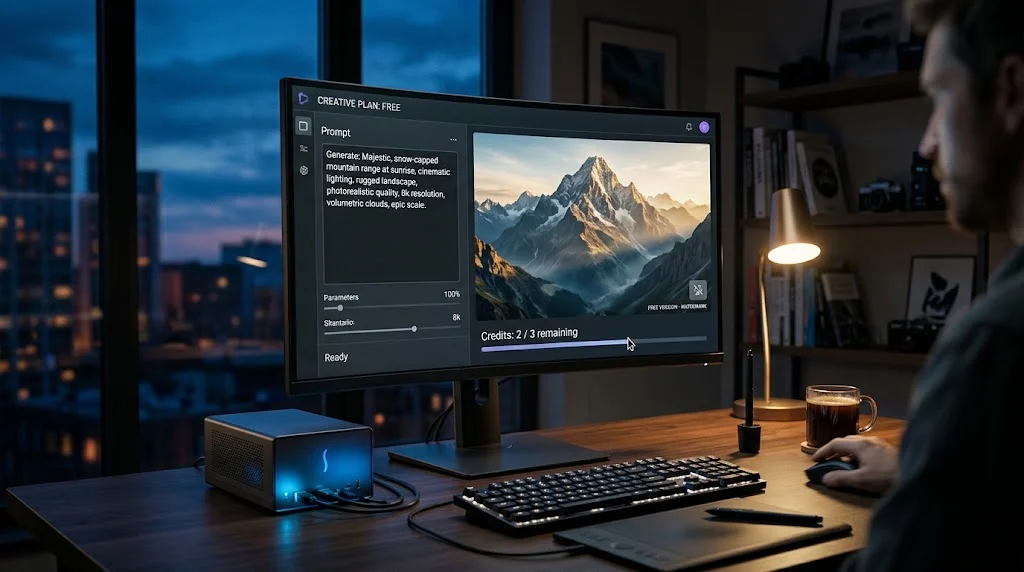
ChatGPT produces 2 to 3 images per 24 hours on the free plan, enough for occasional needs but useless for volume work . Leonardo.AI provides 150 tokens per day, reset every 24 hours with no rollover, and no card required . Google Flow, which absorbed ImageFX, grants 50 daily credits on the free tier .
Adobe Firefly offers a small monthly credit quota, generally around 25 credits, which do not roll over . Microsoft Copilot and Designer provide a handful of priority generations followed by a slower queue .
The practical math matters more than the headline number. Leonardo’s 150 daily tokens support a dozen or more generations depending on the model and settings chosen. Token costs vary by model, so the same allowance goes further on some options than others .
Watermarks and Visibility
Visible watermarks serve brand advertising and cost recovery. Every watermarked image posted publicly recruits new users for the platform that made it.
Google Gemini applies a visible Gemini logo to images generated within its application, regardless of subscription tier. Only API outputs escape the branding . ChatGPT applies no visible watermark, instead embedding invisible C2PA metadata that tracks AI provenance . Google Flow embeds SynthID watermarks in all generated images, invisible to viewers but detectable by tools .
The watermark question matters most for client-facing work. A visible logo disqualifies an image from professional use regardless of resolution or quality.
Commercial Rights and Ownership
This is where free tiers diverge most sharply, and where reading the terms of service becomes essential.
ChatGPT grants users ownership of generated images, including commercial use, on the free plan . Google Gemini permits commercial use under its content policies, though the visible watermark limits practical application . Microsoft Designer explicitly prohibits commercial use on the free tier; the documentation states that Designer is licensed for personal, non-commercial projects only .
Adobe Firefly permits commercial use on the free tier but withholds the IP indemnification that paid plans include. The legal protection against copyright claims is not part of the free offering . Recraft retains ownership of free-tier images, which remain public and available in the community gallery . Leonardo.AI retains intellectual property ownership of free-tier outputs; users receive a license to use them, but Leonardo holds the actual rights .
The distinction between “commercial use permitted” and “IP ownership assigned” matters for professional work. A platform can allow you to use an image while retaining the right to license it to others, or to train on your creations.
Platform-by-Platform Breakdown
ChatGPT: Clean Output, Tiny Quota
ChatGPT’s free tier produces the cleanest commercial-ready output among free options. Images carry no visible watermark, only invisible C2PA metadata. OpenAI attributes ownership to the user, and commercial use is permitted .
The limitation is volume. Two to three images per day barely covers a single project, let alone iterative design work. For a single hero image or a quick concept test, the free tier works. For anything resembling production work, it does not.
Google’s Two Free Paths: Gemini and Flow
Google offers two distinct free entry points, each with different tradeoffs.
Gemini, powered by the Nano Banana model, generates roughly 20 images daily depending on server load. Commercial use is permitted under Google’s terms, and Google does not claim ownership of output. The catch is visible: every image generated in the Gemini app carries a Gemini logo, plus an invisible SynthID watermark. Only API outputs avoid the visible branding .
Google Flow, which now houses the former ImageFX functionality, grants 50 daily credits on the free tier . Output quality from Google’s image models is consistently strong, and the credits support more iteration than most competitors. SynthID watermarks are embedded in all output, invisible to viewers but present in the file . Commercial use terms should be verified against Google’s current generative AI policy before monetization.
For volume and quality together, Flow’s 50 daily credits are the strongest free offering among major platforms. For commercial clarity, Gemini’s ownership terms are more straightforward, provided you can work around the logo.
Leonardo.AI: The Most Usable Daily Allowance
Leonardo.AI provides 150 tokens per day on its free tier, a renewable budget that supports real creative exploration . The platform includes model selection, canvas tools, and some video functionality in one interface.
Two restrictions limit professional use. Free-tier generations are public, visible to other users. And Leonardo retains intellectual property ownership of free-tier outputs; users receive a non-exclusive license to use them, but the actual IP rights stay with Leonardo . Free content is also used for model training and platform improvement .
Token costs vary by model, so 150 tokens can be a dozen generations on one model and a handful on another . For hobbyists and creators testing concepts before committing to a subscription, Leonardo offers the best daily allowance among hosted tools. For anyone planning to monetize output, the free tier is a sandbox, not a workspace.
Adobe Firefly: Legal Safety, Limited Free Access
Firefly’s differentiator is its training data. Adobe trained the model on licensed Adobe Stock content and public domain works, an approach designed to reduce copyright risk . The free tier permits commercial use, but withholds the IP indemnification that paid plans include .
The free allowance is a small monthly credit quota, generally around 25 credits, which expire at the end of each billing cycle . That supports perhaps a dozen standard generations, enough to evaluate the model’s aesthetic but not enough to integrate into any recurring workflow.
Adobe does not publish clear details about watermarking or resolution caps on the free tier. The company’s plans page says nothing about watermarks, and its FAQ does not tie commercial use statements specifically to the free plan . For professional work, checking the actual output file before delivery is the only reliable verification.
Microsoft Designer: Free but Not for Business
Microsoft Designer and Copilot offer free image generation through a priority queue system, followed by slower processing for additional requests . Output quality is competitive, drawing on multiple models.
The critical limitation is licensing. Microsoft’s documentation states that Designer is licensed for personal, non-commercial use only . For client work, business marketing, or any monetized application, the free tier is off-limits. Users needing commercial rights must upgrade to a paid Copilot plan.
Bing Image Creator has a separate licensing arrangement. Microsoft documentation indicates that images created through Bing Image Creator may be used commercially, though Microsoft does not claim ownership and users are responsible for third-party rights . The distinction between Designer and Bing Image Creator is easy to miss and consequential for anyone planning to monetize output.
Recraft: The SVG Exception
Recraft stands alone in offering native SVG output on its free tier, making it valuable for logo and icon design that requires vector editing in Illustrator or Figma . The tradeoff is severe: free-tier images are public, visible in the community gallery, and Recraft retains ownership. Commercial use is prohibited without a subscription .
For designers who need vector output and are working on personal projects, Recraft’s free tier is a useful sandbox. For anyone needing ownership or commercial rights, the paid step is unavoidable.
When Free Is Not Enough: The Open-Source Path
The only structurally free AI picture generation comes from open-source models running on your own hardware. No platform policy governs output, no watermark applies, and no credit system limits iteration.
Stable Diffusion and its derivatives remain the most accessible entry point. The tradeoff is hardware. A capable GPU, setup time, and familiarity with interfaces like ComfyUI or Automatic1111 are prerequisites. Cloud GPU rentals offer a middle path, typically $0.50 to $2 per hour depending on the provider, but that is not free either.
For users with the hardware and technical comfort, local generation eliminates every restriction described above. For everyone else, the hosted free tiers remain the practical starting point.
Privacy and Data Considerations
Free tiers rarely offer meaningful privacy guarantees. Data retention policies vary by platform and change without notice. No major free AI picture generator publicly commits to Zero Data Retention on free accounts.
Leonardo.AI’s terms are unusually explicit: free-tier content is public and used for model training . Recraft’s free gallery makes visibility explicit as well . ChatGPT and Gemini tie generations to your account, meaning submissions are associated with your profile.
SOC 2 certification, where present, addresses organizational controls rather than the specific question of whether your prompts and images are retained for training or analysis. Assume free-tier inputs are stored and potentially used for model improvement unless the terms explicitly state otherwise.
Common Mistakes With Free AI Picture Generators
Burning the daily quota on failed prompts. Iterate at the lowest quality setting and smallest batch size first. A prompt that works at draft quality transfers upward; the reverse wastes limited credits.
Assuming “free” means “commercial.” Microsoft Designer prohibits commercial use outright. Recraft retains ownership. Leonardo’s free plan retains IP rights and trains on your content . The absence of a watermark does not imply commercial permission.
Overlooking public visibility. Leonardo and Recraft publish free-tier images by default. If the image is client work, a personal photo transformation, or anything confidential, the free tier exposes it.
Expecting IP ownership from free plans. Leonardo’s terms explicitly state that free users do not own their outputs . Adobe Firefly’s indemnification applies to paid tiers . A license to use an image is not the same as owning it.
Confusing Microsoft’s products. Designer and Bing Image Creator have different licensing terms. Designer is personal-use only; Bing Image Creator may permit commercial use . Reading the specific product’s terms matters.
Who Should Use a Free AI Picture Generator
Casual creators testing concepts benefit from ChatGPT’s clean output or Google Flow’s generous daily credits. Two to fifty daily images suit occasional needs without financial commitment.
Hobbyists learning prompt structure should use Leonardo.AI’s 150 daily tokens. The allowance supports experimentation and iteration without the anxiety of a vanishing quota .
Designers evaluating tools before subscribing can use Firefly’s monthly credits to assess output quality, then upgrade for commercial rights and indemnification.
Anyone needing commercial output should skip free tiers that prohibit it. Microsoft Designer, Recraft, and Leonardo’s free plan are not viable paths for monetized work without upgrading.
Vector designers with personal projects can use Recraft’s SVG output, accepting that the images are public and Recraft retains ownership .
Latest Developments Worth Watching
Free tier terms shift frequently. Google consolidated ImageFX into Flow, raising the free allowance to 50 daily credits while embedding SynthID watermarks across all output . Leonardo’s token allowance remains at 150 daily, but ownership terms have been clarified in updated terms of service .
Adobe’s Firefly free plan remains vague on key details. The company does not publish a daily or monthly count, does not mention watermarking, and does not tie its commercial-use statements specifically to free accounts . Users relying on Firefly for professional work should verify output characteristics directly.
The broader trend is toward tighter free tiers. As inference costs remain significant for image models, platforms face pressure to convert free users into paying customers. The generous allowances available in 2026 may not persist indefinitely.
Conclusion
Free AI picture generators like ChatGPT, Google, Leonardo.AI, Adobe, and Recraft offer useful image creation features, but limits on credits, commercial rights, and privacy vary.
Choose a tool that matches your needs, and check its current usage limits, image rights, and privacy policy. For greater control and fewer platform restrictions, consider local open-source models.