A free AI checker scans text for statistical patterns associated with machine generation and returns a probability score, not proof of authorship. These tools can flag obvious AI drafts, but false positives on formal or non-native human writing remain a documented limitation.
At-a-Glance
- Free AI checkers are screening tools, not authorship proof. Most return probabilistic scores that require human interpretation.
- Accuracy varies widely by tool, text length, and generator. Academic benchmarks show significant differences between platforms on the same documents.
- False positives disproportionately affect non-native English writers and formal academic prose.
- Privacy policies differ dramatically. Some free tools store submitted text; others process locally or anonymize.
- No free checker can reliably detect paraphrased or “humanized” AI text. Detection and evasion evolve together.
- Use scores as one signal among several. Never base an accusation, grade, or publishing decision on a single detection result.
What Is a Free AI Checker?
A free AI checker is a web tool or browser extension that analyzes text and estimates the likelihood it was generated by a large language model. It does not verify authorship. It measures patterns.
These tools emerged alongside the rapid adoption of ChatGPT, Claude, Gemini, and similar systems. Publishers wanted a way to screen submissions. Educators wanted a way to flag suspicious essays. The market responded with dozens of detectors, many offering free tiers with daily limits.
The core technology varies. Some checkers use fine-tuned transformer models trained on human and machine text pairs . Others rely on stylistic signals like sentence-length variation, word predictability, and punctuation regularity. A few combine both approaches. None can look inside a writer’s process.
The keyword “ai checker free” reflects a specific audience: people who need a quick answer without a subscription. That audience includes students checking their own work, freelance writers verifying drafts, small publishers screening submissions, and curious users testing the tool’s claims. Their expectations often exceed what the technology can deliver.
How Detection Actually Works
Most free AI checkers perform a version of the same task: classify text into “human-like” or “machine-like” based on patterns learned from training data.
The Signals Detectors Look For
Detection models analyze measurable properties of text. Common signals include:
- Perplexity: How surprised a language model is by each word. Lower perplexity suggests more predictable, machine-like phrasing.
- Burstiness: Variation in sentence length and structure. Human writing tends to be more erratic.
- Repetition patterns: Recurring transitions, hedging phrases, or structural templates common in AI output.
- Punctuation regularity: Unusually consistent comma placement, em dash usage, or quotation formatting.
These signals are correlations, not causes. A human who writes in a measured, formal style can trigger the same flags as a machine. A machine prompted to write erratically can evade them.
The Training Data Problem
Detectors are trained on specific datasets. When those datasets skew toward certain generators, writing styles, or domains, the model learns those biases. A checker trained primarily on ChatGPT outputs may perform poorly on Claude or Gemini text. A checker trained on academic essays may misfire on marketing copy.
Turnitin, one of the most widely deployed detectors, confirms that its system uses a transformer-based deep learning approach trained on its own academic corpus . The company explicitly states that its model does not evaluate individual signals like burstiness or perplexity in a transparent, rule-based way. The output emerges from many learned patterns working together, which makes individual predictions difficult to explain .
That opacity matters. When a free checker returns a score, users rarely know what signals drove the result or how confident the model actually is.
Free vs. Paid: What You Sacrifice
Free tiers exist for a reason: they serve as acquisition funnels. The limitations are deliberate, though not always disclosed clearly.
| Word limit per scan | 500–1,500 words | 5,000–25,000+ words |
| Daily scans | 3–10 | Unlimited or high cap |
| Model coverage | Limited (often ChatGPT-focused) | Broader (GPT-5, Claude, Gemini, Llama) |
| Paraphrase detection | Rarely included | Often included |
| Report detail | Score only or basic highlights | Sentence-level evidence, exportable reports |
| API access | Not available | Available on higher plans |
| Privacy guarantees | Vague or absent | Sometimes explicit (ZDR, no training on data) |
A free checker that caps at 800 words cannot evaluate a full article, thesis chapter, or report. Users often paste fragments, which reduces accuracy further. Short text gives detection models less signal to work with, and many tools explicitly warn that confidence drops below certain length thresholds.
The free tier also rarely includes the feature most users actually need: paraphrase detection. A student who runs an AI draft through a paraphrasing tool can often evade a basic free checker. Turnitin claims its paid system can detect AI-paraphrased content, but that capability is not available in free consumer tools .
Accuracy: What the Research Shows
Academic evaluations of AI detectors paint a sobering picture. A 2026 study published in the International Journal for Educational Integrity tested four major detectors (GPTZero, Copyleaks, Turnitin, and Pangram) on 160 papers across four categories: fully AI-generated, hybrid, humanized, and fully human .
The results were uneven. For fully AI-generated papers, Pangram’s median score was closest to the true value, but variability remained substantial. The other three tools performed “markedly worse,” with medians under 20% detection. Turnitin consistently reported 0% for fully AI-generated papers in one analysis, a significant false negative rate .
A separate benchmark of eight detection platforms found a different pattern: Turnitin and GPTZero showed high mean AI scores for AI-generated documents (97.46 and 97.22 respectively) and near-zero means for human documents . The discrepancy between studies likely stems from differences in text length, domain, generator, and prompt sophistication.
What the research consistently shows:
- No detector is universally accurate. Performance depends heavily on the text being tested.
- False positives occur at non-trivial rates, particularly for non-native English writers and formal academic prose .
- Detection degrades with newer models and refined prompting. A 2025 study found Turnitin’s false negative rate was “substantially higher” for GPT-5 generated text compared to earlier models .
- Paraphrasing and humanization tools reduce detection rates across platforms, though some detectors claim counter-capabilities.
For a free checker user, the practical takeaway is blunt: a score above 80% does not prove AI generation, and a score below 20% does not prove human authorship. The tool is offering a probability, often with undisclosed uncertainty.
Privacy: The Hidden Cost of Free
Detection requires text. Text can contain sensitive information. What happens to that text after the scan is where free tools diverge sharply.
Some free checkers process text locally in the browser. Opace’s WordPress plugin, for example, offers an on-device mode that downloads a model (approximately 34.5 MB) and analyzes text without uploading it . That approach eliminates server-side retention risk, though it requires a download and may be slower.
Most free web checkers upload text to a server. Their privacy policies vary from explicit (“anonymous scans are never stored”) to vague or absent. ScanForAI states that anonymous scans are never stored and no analytics or tracking are used . ContentDetector.ai discloses that submitted text is sent over HTTPS to its service and processing provider, but does not read pages in the background .
The critical distinction is between transient processing and retention. A tool that processes text in memory and discards it poses less risk than one that logs submissions for model training or quality review. Free tiers often have the weakest privacy guarantees because the business model may depend on data aggregation or upsell conversion.
For anyone submitting unpublished manuscripts, client work, or personal statements, the privacy question should come before the accuracy question. A slightly less accurate local tool is often the better choice.
What Free Checkers Cannot Do
Understanding limitations is more useful than memorizing feature lists.
They cannot detect all AI models equally. A checker trained on GPT-4 outputs may miss Claude or Gemini text. Model coverage is rarely disclosed in detail, and free tiers often lag behind paid ones.
They cannot prove authorship in either direction. A high score means “this text shares patterns with training data labeled AI.” It does not mean a person did not write it. A low score means the opposite.
They cannot reliably handle short text. Under 300–500 words, most detectors lack sufficient signal. Results become noise.
They cannot see the writing process. A human who heavily edits an AI draft may produce text that scores low. An AI prompted to mimic human errors may score high. The tool sees the output, not the process.
They cannot replace editorial judgment. The most important limitation is institutional, not technical. Schools, publishers, and platforms that treat detection scores as verdicts create perverse incentives and harm innocent writers. The tools are screening aids, not judges.
Practical Use Cases Where Free Checkers Help
Despite the caveats, free checkers serve legitimate purposes when used appropriately.
Self-checking before submission. A writer who used AI for brainstorming or outlining can run a draft through a checker to see if the final prose retains machine-like patterns. The score is a prompt for revision, not a grade.
Screening low-stakes content. A blogger receiving guest post submissions can run a quick free scan to flag obvious AI dumps. The result triggers human review, not automatic rejection.
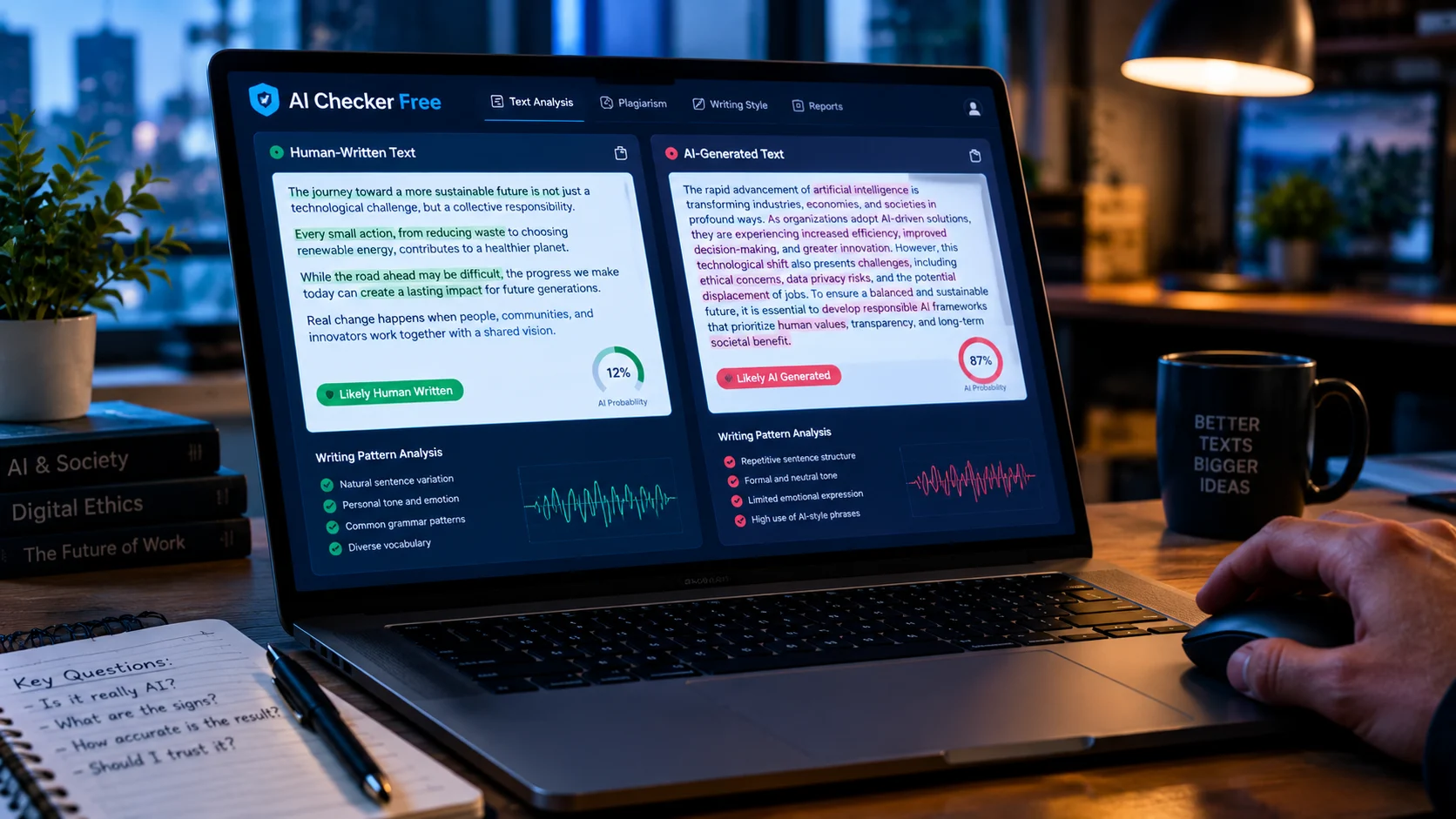
Testing detection claims. Researchers, journalists, and curious users can run controlled experiments: paste a known human text, paste a known AI text, compare scores. This builds intuition for how unreliable the tools can be.
Educational demonstration. Teachers can show students how detectors work and fail. A side-by-side scan of a student’s essay and an AI-generated paragraph illustrates the probabilistic nature of the technology better than any lecture.
What free checkers should not be used for: formal disciplinary action, academic grading, or publishing decisions made without human review.
Alternatives and the Broader Tool Landscape
The detection market extends beyond standalone checkers. Understanding the alternatives clarifies where free tools fit.
Integrated Writing Platforms
Tools like Grammarly and ProWritingAid have added AI detection features to their editing suites. The detection is rarely the primary product, and free tiers may exclude it. The advantage is workflow integration: writers see detection scores alongside grammar and style suggestions.
Academic Integrity Systems
Turnitin, Copyleaks, and similar platforms are sold to institutions, not individuals. Their detection models are trained on larger corpora and integrate with learning management systems. Free consumer access is limited or nonexistent. These systems also carry institutional accountability that standalone free tools lack.
Browser Extensions
Extensions like Copyleaks’ Chrome plugin and ScanForAI offer in-context scanning . The convenience is real: highlight text on any page, right-click, get a score. The privacy trade-off depends on the extension’s data handling. Some process locally; others send text to a server.
Open-Source Detectors
A small but growing number of open-source detection models are available on Hugging Face. These require technical setup and are not user-friendly for non-developers. Their advantage is transparency: users can inspect the training data, model architecture, and inference code.
Platform Curation
Some publishing platforms and marketplaces now run automated AI screening on submissions. Futurepedia and Product Hunt, for example, curate AI tools and may flag obviously machine-generated listings. These are not detection tools in the traditional sense, but they shape the information ecosystem where detection claims circulate.
Common Mistakes Users Make
Treating the score as a verdict. A 95% AI score feels definitive. It is not. The number reflects pattern similarity, not authorship evidence.
Ignoring length limits. Pasting 200 words into a detector designed for 1,000-word minimums produces unreliable results. Many free tools do not warn users about this.
Assuming free equals private. Free tools have diverse data practices. Reading the privacy policy takes two minutes and prevents regret.
Using detection on non-native writers without context. Research consistently shows elevated false positive rates for second-language English writers . A high score on a non-native speaker’s essay is weak evidence at best.
Forgetting that detectors compete with generators. Every published detection method gives generator developers a target. The arms race is structural, not a temporary phase.
Believing “100% accurate” marketing claims. No independent benchmark supports universal accuracy. Company claims about false positive rates (Copyleaks cites 0.2%) are self-reported and difficult to verify externally .
How to Evaluate a Free AI Checker Before Trusting It
A practical checklist for anyone considering a free tool:
- Check the word limit. If it is under 500 words, the tool is for snippets only.
- Read the privacy policy. Look for explicit statements about retention, training use, and third-party sharing.
- Test it against known text. Paste a paragraph you wrote yourself. Paste a ChatGPT output you generated. Compare scores.
- Look for confidence indicators. Does the tool say “low confidence” for short text? Does it explain what drove the score?
- Check model coverage. Does it claim to detect Claude and Gemini, or only ChatGPT?
- Search for independent evaluations. Academic studies and journalist tests are more reliable than vendor claims.
- Assume the score is wrong until proven otherwise. The default posture should be skepticism, not trust.
FAQ
Is a free AI checker accurate enough to use for school assignments?
No. Free checkers lack the text length capacity, model coverage, and calibration of institutional systems. Even institutional systems produce false positives and false negatives at rates that make sole reliance unethical. Use free checkers for self-assessment and revision, not for judging others.
Can a free AI checker detect ChatGPT text that has been paraphrased?
Rarely. Paraphrasing tools rewrite surface patterns while preserving meaning, which reduces the signals detectors rely on. Some paid systems claim paraphrase detection, but free tools almost never include this capability.
Do free AI checkers store the text I paste?
It depends entirely on the tool. Some process locally and never upload. Others upload to servers with varying retention policies. Always read the privacy policy before pasting sensitive content.
Why does my human-written essay get flagged as AI?
Formal prose, technical writing, and non-native English writing can share surface features with machine output: consistent sentence structure, predictable transitions, and low lexical variation. This is a known limitation of detection technology, not evidence that you did something wrong.
What is the best free AI checker?
There is no single “best” tool because accuracy depends on the text, generator, and use case. The most responsible approach is to use a free checker as one signal, verify with a second tool, and apply human judgment. Avoid any tool that presents its score as definitive proof.
Conclusion
A free AI checker is a useful screening instrument and a poor judge. It can flag text that shares statistical patterns with machine generation. It cannot determine who wrote what, why, or whether the writing meets a standard of integrity.
The technology is improving, but the fundamental limitation persists: detection is probabilistic pattern matching, and patterns can be mimicked, evaded, or accidentally reproduced by humans. The arms race between generators and detectors shows no sign of resolution.
For individual users, the practical path is cautious experimentation. Test free tools against known text. Read their privacy policies. Treat scores as conversation starters, not conclusions. For institutions, the path is more demanding: invest in human review, establish clear policies, and resist the temptation to automate judgment because the tool exists.
The question worth asking is not “what score did the checker give?” but “what decision am I about to make based on that score, and is the score strong enough to support it?” Most of the time, the honest answer is no.