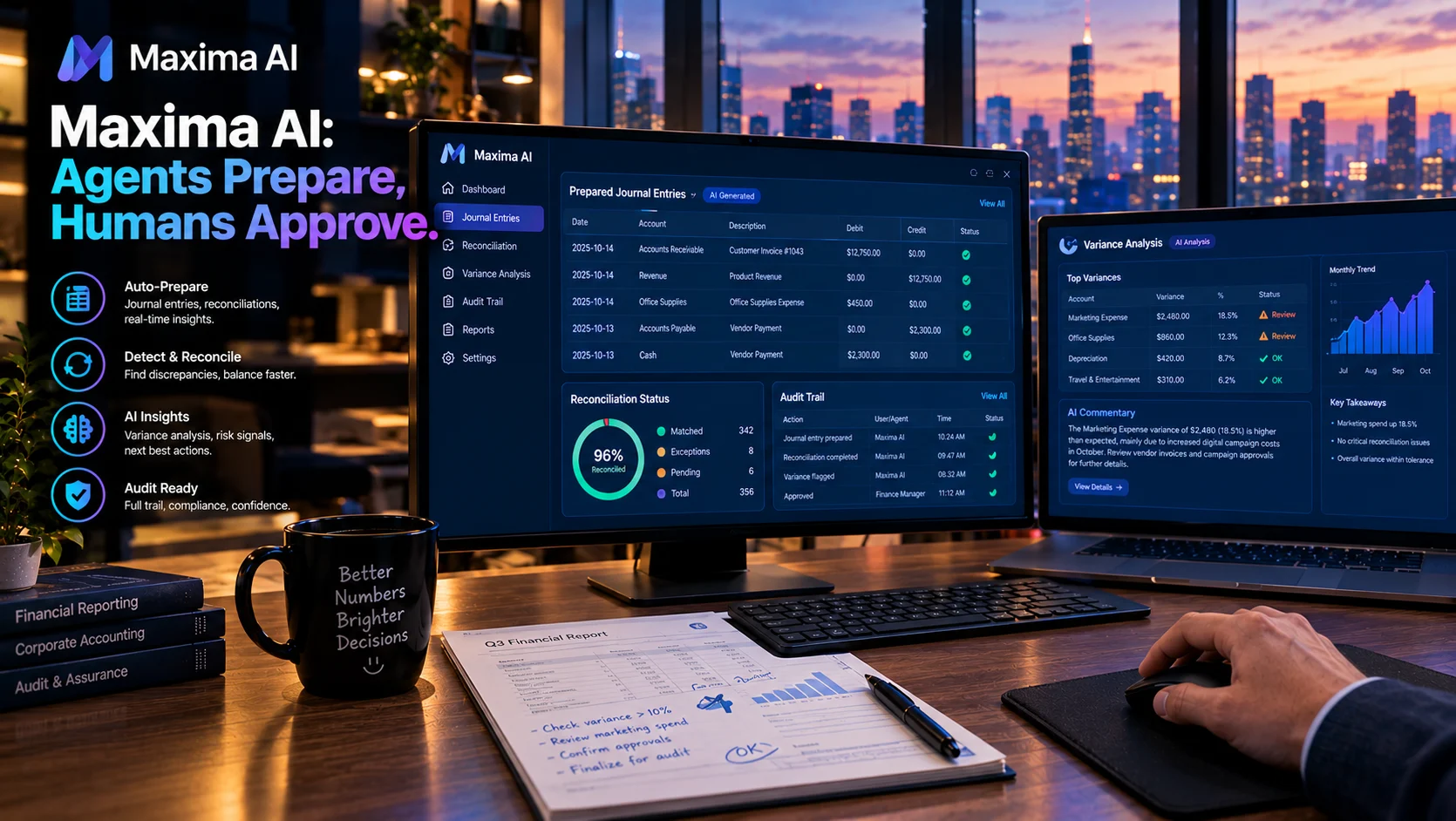
Maxima AI is an agentic artificial intelligence platform purpose-built for enterprise accounting that deploys AI agents to prepare journal entries, reconciliations, and variance analyses, then routes them to accountants for review before posting to the general ledger. The company has raised $41 million in Seed and Series A funding at a $143 million valuation and processes over $400 billion in accounting transaction volume .
At-a-Glance: Key Takeaways
- Maxima raised $41 million in Seed and Series A funding led by Redpoint Ventures, Kleiner Perkins, and Audacious Ventures, with participation from former BlackLine executives and NFL legend Joe Montana .
- The platform deploys AI agents that prepare work and route it for human approval, following an “agent-prepared, human-reviewed” model rather than fully autonomous posting .
- Customers report up to 80% faster closes, 95% automation of repetitive workflows, and 100% auditability, with deployments at Scale AI, Rippling, SpotOn, and Bilt Rewards .
- The “Max” AI agent launched in June 2026 consolidates multiple agent capabilities into one interface covering payroll, accruals, intercompany transactions, and revenue recognition .
- Maxima processes over $400 billion in accounting transaction volume and claims over 90% automation with 100% accuracy across millions of transactions .
- The company was founded in 2024 by Yogi Goel (former Rubrik finance leader), Akshaya Srivatsa (ex-Meta AI infrastructure), and Jack Liao (ex-Netflix billing systems) .
What Is Maxima AI?
Maxima AI is an agentic artificial intelligence platform for enterprise accounting automation. Founded in 2024 and headquartered in San Mateo, California, the company positions itself as the first agentic system of work for accounting, layered on top of existing ERP systems rather than replacing them .
The company’s core thesis is that accounting does not need another workflow tracker or ERP replacement. It needs a system that performs the work itself with accuracy and auditability, operating alongside the system of record . Maxima’s AI agents prepare journal entries, perform reconciliations, explain variances, and flag anomalies. When accountants log in, the work is already prepared, validated, and documented, ready for review and approval .
Maxima is not a model developer. It builds domain-specific agents using existing AI infrastructure, with engineering talent drawn from Meta, Twitter, Netflix, Robinhood, and Apple, combined with accounting domain expertise from EY, BlackLine, and FloQast . This hybrid team structure reflects the company’s belief that solving enterprise accounting requires both technical rigor and deep domain knowledge .
How Maxima AI Works
The Agent-Prepared, Human-Reviewed Model
Maxima’s operating model inverts the traditional accounting software paradigm. Legacy providers like SAP and BlackLine operated on the assumption that humans do the work and software logs it for auditors to check. Maxima starts from a different premise: agents do the work, and humans review it .
The platform deploys AI agents embedded into every step of the close process. These agents coordinate across systems to pull data, transform it into accounting entries, apply company policies, prepare journals, perform reconciliations, and flag anomalies with automated commentary . Every output carries a complete audit trail, step-by-step proof of work, validation checks, and segregated human-in-the-loop approvals .
Crucially, nothing posts to the general ledger without accountant approval. The platform operates as an intelligence layer above existing ERPs, not as a replacement .
The Max AI Agent
In June 2026, Maxima launched “Max,” an AI agent that consolidates capabilities previously handled by multiple separate agents. Max handles payroll entries, accrued operating expenses, balance sheet reconciliations, and variance explanations in one interface .
Max comes equipped with domain-specific skills across the accounting lifecycle:
- Cash accounting: Classifies bank statements, reconciles cash to the general ledger, prepares cash journal entries
- Accruals and accounts payable: Calculates estimation-based accruals, processes reversing entries, prepares AP journal entries
- Payroll: Prepares payroll journal entries, reconciles payroll to the general ledger, calculates compensation accruals
- Intercompany and allocations: Executes intercompany elimination, builds consolidation support, applies allocation methodology
- Commissions and equity: Capitalizes commissions, tracks equity compensation, calculates fixed asset depreciation
- Revenue: Recognizes revenue, processes true-ups and reversals
Yogi Goel, co-founder and CEO, described the shift: “Rather than interacting with individual agents or modules, accountants can now delegate prep work across multiple use cases directly to Max, just like a teammate” .
Integration with Existing Systems
Maxima connects to a company’s existing enterprise systems rather than requiring migration. The platform pulls data from various sources, applies accounting logic, and uploads results back into the ERP. Scale AI’s accounting head Joshua Waldron noted that Maxima’s ability to connect to systems, pull data, and automatically upload into NetSuite contrasts favorably with tools requiring manual bank statement downloads and uploads .
Funding and Investors
Maxima has raised approximately $41 million across Seed and Series A rounds, achieving a $143 million valuation .
| Redpoint Ventures | Lead investor |
| Kleiner Perkins | Lead investor |
| Audacious Ventures | Participant |
| Joe Montana | Angel (Liquid 2 Managing Partner) |
| Andres Botero | Angel (former BlackLine CMO) |
| Eric Borrmann | Angel (former BlackLine SVP Operations) |
| Kiran Choudary | Angel (Rubrik CFO) |
| David Eckstein | Angel (Vanta CFO) |
Source: Business Wire, Reuters
The involvement of former BlackLine executives is notable. BlackLine is a legacy accounting automation provider, and the participation of its former CMO and SVP of Operations signals industry recognition that Maxima’s approach represents a meaningful shift .
Satish Dharmaraj, Managing Director at Redpoint Ventures, explained the investment thesis: “The complexity of accounting operations has outgrown human capacity. AI can now take on the heavy lifting for accountants in ways that simply weren’t possible before” .
Key Features
Real-Time Close
Maxima’s stated vision is the “real-time close” — the ability for financials to update continuously so decisions keep pace with the business. Rather than a monthly scramble to reconcile scattered data, the platform aims to maintain current books at all times .
Anomaly Detection and Variance Explanations
Beyond transaction processing, Maxima’s agents continuously monitor the books, detect anomalies, and explain movements before month-end arrives. When an accountant logs in, variances already have automated commentary attached .
Audit Trails and Compliance
Every output Max prepares includes a complete audit trail with step-by-step proof of work, validation checks, and segregated human-in-the-loop approvals. The platform is designed to be SOX-compliant .
Role-Based Permissions and Segregation of Duties
Maxima implements role-based permissions and segregation of duties controls, addressing a critical requirement for enterprise accounting where the same person cannot both prepare and approve entries .
Real-World Results
Scale AI
Joshua Waldron, CAO and interim CFO at Scale AI, reported that Maxima reduced reconciliation of outward payments from as long as two weeks to instantaneous processing. “It would take us at times the entire month in order to close the books and this last month we closed in the first two weeks of the month which is a record for us” .
Rippling
Vipin Sethi, Controller at Rippling, described the impact: “What used to be repetitive, low-value work is now automated, freeing our team to focus on deeper reconciliations, analytical reviews, and cross-functional insights” .
Platform Metrics
Across its customer base, Maxima reports:
- Up to 80% faster closes
- 95% automation of repetitive workflows
- 100% accuracy and auditability
- Over $400 billion in transaction volume processed
- Over 90% automation across millions of transactions
Who Should Use Maxima AI
Enterprise accounting teams at high-growth companies are the primary audience. Maxima’s customers like Scale AI and Rippling manage millions of transactions monthly across hundreds of entities and multiple currencies. The platform is designed for this scale and complexity .
Public companies with SOX compliance requirements benefit from the audit trails, segregation of duties, and role-based permissions built into the platform .
Companies with multi-entity, multi-currency operations face exponential complexity as they grow. Maxima’s agents are designed to handle consolidation, intercompany eliminations, and currency variations automatically .
Finance teams struggling with month-end close timelines can use Maxima to shift from reactive scrambling to proactive review. The “agent-prepared, human-reviewed” model lets accountants focus on judgment and analysis rather than data gathering .
Smaller companies or startups without complex accounting needs may find Maxima’s enterprise focus and integration requirements a barrier. The platform is designed for organizations with hundreds of entities and rigorous audit requirements .
Common Mistakes and Cautions
Assuming fully autonomous accounting. Maxima explicitly does not post to the general ledger without human approval. The platform is designed for agent-prepared, human-reviewed workflows, not hands-off automation .
Confusing Maxima AI with other “Maxima” entities. A separate company called Maxima Consulting offers AI-enabled engineering pods and agent deployment services. The npm package “maxima-agentic-framework” is an unrelated cost-optimized AI project manager .
Overlooking integration requirements. Maxima connects to existing ERPs and systems. Companies without modern ERP infrastructure may find integration more challenging. The platform works best with NetSuite, SAP, and similar enterprise systems .
Underestimating the complexity of multi-entity accounting. Maxima’s CEO noted that growing from one entity and one currency to twenty-five of each increases workload 625 times, not 25 times. Companies considering Maxima should assess whether their complexity justifies the platform .
Expecting public pricing. Maxima does not publish pricing. As an enterprise platform, costs are custom and likely based on transaction volume, entity count, or similar usage metrics. Prospective customers should contact sales for a quote.
Frequently Asked Questions
What is Maxima AI?
Maxima AI is an agentic artificial intelligence platform for enterprise accounting automation. It deploys AI agents that prepare journal entries, reconciliations, and variance analyses, then routes them to accountants for review before posting to the general ledger. The company has raised $41 million and serves customers including Scale AI and Rippling .
How much has Maxima AI raised?
Maxima has raised approximately $41 million across Seed and Series A rounds at a $143 million valuation. Investors include Redpoint Ventures, Kleiner Perkins, Audacious Ventures, and Joe Montana .
Does Maxima AI replace accountants?
No. Maxima operates on an “agent-prepared, human-reviewed” model. AI agents do the preparation work, but nothing posts to the general ledger without accountant approval. The platform is designed to free accountants from repetitive work so they can focus on judgment and analysis .
What are Maxima AI’s reported results?
Maxima reports up to 80% faster closes, 95% automation of repetitive workflows, and 100% auditability. Customers include Scale AI, Rippling, SpotOn, and Bilt Rewards. Scale AI reported reducing reconciliation from two weeks to instantaneous processing .
Is Maxima AI secure and compliant?
Maxima implements role-based permissions, segregation of duties, validation checks, and complete audit trails. The platform is designed to be SOX-compliant. Specific security certifications like SOC 2 are not detailed in available public documentation, though the company emphasizes auditability and compliance in its marketing .
Conclusion
Maxima AI has built a compelling thesis for the future of enterprise accounting: agents do the work, humans review it. The $41 million in funding from top-tier investors, the involvement of former BlackLine executives, and the customer roster of Scale AI and Rippling validate that thesis in the market.
What matters most is understanding what Maxima is and is not. It is not a fully autonomous accounting solution. It is an agentic preparation layer that sits on top of existing ERPs, does the heavy lifting of data gathering and entry preparation, and routes work to accountants for approval. The platform’s value proposition rests on the claim that this model delivers faster closes, fewer errors, and complete auditability.
Maxima may suit enterprise accounting teams at high-growth companies with multi-entity, multi-currency operations and rigorous audit requirements. It may not suit smaller companies without complex accounting needs or those expecting a plug-and-play solution without integration effort.
Before evaluating Maxima, assess your actual accounting complexity. Confirm that your ERP infrastructure can support the integration. Request references from customers with similar profiles. And understand that the platform’s value depends on how well its agents prepare work that your accountants can confidently approve. Maxima’s bet is that the future of accounting is human-reviewed agent preparation. The funding and customer traction suggest that bet is gaining ground.