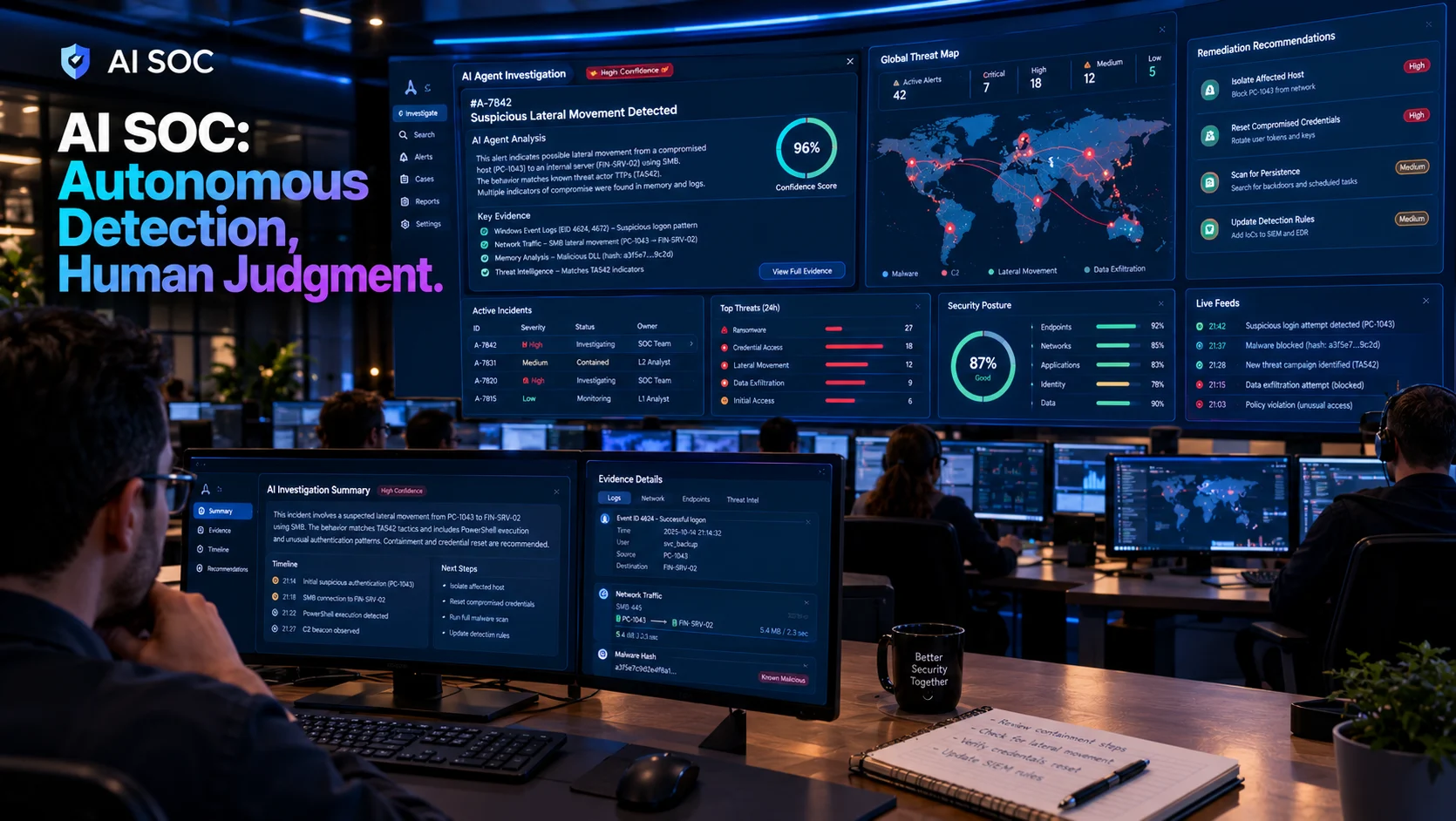
An AI SOC (Autonomous Security Operations Center) uses artificial intelligence and agentic workflows to automate alert triage, investigation, and response within security operations. Lenovo reported an 87.5% reduction in threat-detection time across 140,000 devices after deploying agentic AI, while vendors emphasize that human oversight remains essential for critical decisions .
At-a-Glance: Key Takeaways
- The AI SOC market is projected to grow from $18.1 billion in 2026 to $47.07 billion by 2031, a 21.1% CAGR driven by alert overload and analyst burnout .
- Lenovo’s internal deployment cut mean time to detect threats by 87.5% and achieved a 20-fold improvement in detection accuracy across 140,000 devices .
- Pricing models vary widely: per-alert, per-endpoint, per-data, and flat fees. D3 Security’s Morpheus absorbs all AI token costs into fixed annual pricing .
- The market has 123 tracked vendors, but no settled capability set. Vendors are solving different slices of the same alert-fatigue problem .
- Human judgment remains non-negotiable. AI struggles with organizational context, novel attacks, and high-consequence decisions that require business-aware reasoning .
- Data quality determines outcomes. AI applied to poor telemetry operationalizes bad data at machine speed, producing confident-looking outputs from unreliable inputs .
What Is an AI SOC?
An AI SOC is a security operations center where artificial intelligence serves as the operational foundation for threat detection, investigation, and response, not merely as a tool layered on top of traditional workflows . The term signals a shift from “SOC that uses AI” to “SOC whose operations are driven by AI capabilities” .
Traditional SOCs rely on rule-based detection and manual investigation. Analysts triage alerts, gather context from multiple tools, and decide on response actions. The model was designed for a world where attacks moved at human speed. That world no longer exists .
AI SOCs introduce behavioral analytics, machine learning models, and increasingly agentic AI that can autonomously investigate alerts, correlate signals across data sources, and recommend or execute response actions. The goal is to collapse response times from hours to minutes while freeing human analysts for strategic work .
How AI SOCs Work
The Core Architecture
AI SOC architecture rests on several interconnected layers :
Centralized Security Data Platform: SIEM systems and data lakes ingest logs and telemetry from endpoints, network devices, identity providers, and cloud environments. This unified foundation enables analytics that siloed tools cannot support.
Behavioral Analytics and Machine Learning: AI models establish behavioral baselines for users, devices, and applications. Deviations trigger alerts that rule-based systems would miss.
Automated Investigation and Response: SOAR platforms execute predefined playbooks. When a threat is detected, automation can isolate devices, block IPs, or revoke credentials without waiting for human action.
Human Analyst Oversight: Analysts validate AI outputs, hunt for threats the models haven’t learned, and make risk-informed decisions that shape security posture .
The Agentic Shift
The defining evolution in 2026 is the move toward agentic AI. Rather than a single AI model processing alerts, coordinated networks of specialized agents handle different investigation domains in parallel. CrowdStrike’s agentic SOC, announced at Fal.Con 2026, sends domain agents to work investigations simultaneously, sharing context through a common memory layer .
Microsoft’s internal testing found its task agents automate 75% of phishing and malware investigations . Lumu Technologies introduced an Agentic SOC enabling autonomous investigation and remediation, reducing manual triage by nearly 70% .
Human-in-the-Loop vs. Human-on-the-Loop
Both oversight models are legitimate and serve different risk profiles :
Human-in-the-loop means AI pauses and waits for human approval before acting. Used for high-stakes or ambiguous decisions.
Human-on-the-loop means AI acts autonomously within defined guardrails while humans monitor and can intervene. Used for high-confidence, lower-risk actions.
Most mature AI SOCs use both, matching oversight intensity to the risk of each action .
Key Features and Capabilities
Automated Alert Triage
Alert triage is the strongest evidence-backed use case for AI in security operations. AI applied to triage workflows has the highest single impact on breach costs: a $2.2 million reduction per breach . Industry surveys show 67% of teams prioritize AI for alert triage and investigation .
Multi-Agent Investigation
AI investigation agents execute evidence-gathering workflows: querying identity systems, examining endpoint telemetry, correlating threat intelligence, and assembling context automatically. Microsoft’s Security Copilot, Google’s Gemini-powered SecOps, and CrowdStrike’s Charlotte AI all embody this approach .
Remediation Recommendations
Sumo Logic’s Dojo AI SOC Analyst Agent now recommends specific remediation actions. An analyst examining a suspicious login can receive a recommendation like “Click to temporarily suspend access as I help you investigate,” with explainable reasoning behind the suggestion .
Threat Hunting and Pattern Discovery
AI supports threat hunting by surfacing behavioral anomalies and connecting events that appear normal in isolation but become meaningful when viewed as a sequence across multiple systems .
Pricing and Plans
AI SOC pricing is not standardized. Four primary models exist, each metering a different variable .
Representative Pricing
D3 Security Morpheus AI charges a fixed annual subscription tied to daily alert volume (500 to 10,000 alerts per day). D3 absorbs 100% of AI token and inference costs. There is no metered LLM usage .
Gordon AI SOC starts at $1,787 per month for its base tier, with Enterprise at $6,607 per month including 24×7 monitoring, dedicated analysts, and proactive threat hunting .
Intezer prices by endpoints, with the Complete plan offering the same price even if alert volume increases .
Common Mistakes and Cautions
The Hidden Costs Beyond the Price Tag
Software pricing tells only part of the story. Implementation, integration, and ongoing tuning add substantial hidden costs .
Integration work connecting log sources and normalizing schemas. Rule tuning to validate AI triage outputs and fix false positive cascades. Workflow maintenance as environments change. Ownership overhead assigning engineer time to monitor drift and retrain analyst trust. At $150,000 to $200,000 fully loaded per security engineer, even partial FTE ownership approaches MDR service pricing .
Suppression Drift and the Black-Box Problem
Two failure modes emerge six months in :
Suppression drift occurs when suppression models expand their definition of “safe” over time. Sophisticated attackers deliberately camouflage activity as routine operations, exploiting this boundary creep.
The black-box problem creates two equally dangerous outcomes. Over-trust: analysts rubber-stamp AI verdicts and miss weak reasoning. Under-trust: analysts manually verify everything, erasing automation benefits. Explainability is a security control, not a usability feature .
Data Quality Determines Everything
AI performance depends more on input quality than model marketing. Poor data doesn’t improve with AI; it gets operationalized at machine speed. Teams that skip data normalization and playbook documentation spend months troubleshooting AI outputs that looked right but weren’t .
Who Should Use an AI SOC
Mid-sized companies with lean security teams benefit most. The Autonomous SOC levels the playing field, making threat hunting and modeling accessible to organizations without resource-rich security operations .
Enterprises with high alert volumes where analyst capacity is the bottleneck. IDC reports 63% of organizations experience frequent alert overload, with false positives and process limitations cited as the top reason analysts cannot investigate every alert .
Managed Detection and Response (MDR) providers can deploy AI SOC capabilities to scale their service delivery without proportional headcount growth .
Organizations with mature playbooks and clean data will see the strongest near-term ROI. Teams without well-defined detection logic, labeled data, and documented playbooks should address those foundations first .
Frequently Asked Questions
What is an AI SOC?
An AI SOC is a security operations center where artificial intelligence serves as the operational foundation for detection, investigation, and response, not just as a tool layer. AI handles alert triage, investigation automation, and routine response while humans handle judgment, complex cases, and oversight .
Does AI SOC replace human analysts?
No. Security vendors at Infosecurity Europe 2026 unanimously agreed that AI won’t replace the SOC. It replaces copy-pasting and routine ticket-taking. Analysts shift to “tier-1.5” roles supervising AI investigations, and new roles like “cyber defense engineer” are emerging for those who build and tune AI systems .
How much does an AI SOC cost?
Pricing varies widely by model. D3 Security Morpheus uses fixed annual pricing by alert volume with all token costs absorbed. Gordon AI SOC starts at $1,787 per month. Intezer prices by endpoints. Hidden costs for integration, tuning, and ownership can approach MDR service pricing .
What are the risks of AI SOC deployment?
Suppression drift can create blind spots over time. Black-box reasoning undermines analyst trust. Data quality issues get operationalized at machine speed. Automated response without organizational context can act on the wrong assets. These risks compound silently and hit lean teams hardest .
Why are there so many AI SOC vendors?
The technical floor for a V1 product is low, and the perceived reward is high. KuppingerCole tracks 123 vendors, each pursuing a different slice of the alert-fatigue problem. The market has not settled on a comprehensive capability set, so vendors solve different problems under the same label .
Conclusion
The AI SOC represents a structural shift in security operations. Traditional SOCs, designed for attacks at human speed, cannot keep pace with AI-accelerated adversaries. The data is clear: Lenovo cut detection time by 87.5%, Microsoft automates 75% of phishing investigations, and the market is projected to nearly triple by 2031.
What matters most is understanding the boundaries. AI SOC is not a self-driving car. It is a force multiplier that handles volume, speed, and repetitive triage while humans provide judgment, context, and oversight. The vendors themselves agree on this. The “autonomous SOC” is a marketing claim, not a production reality .
AI SOC may suit mid-sized companies with lean teams, enterprises drowning in alerts, and MDR providers scaling delivery. It may not suit organizations without clean data foundations, documented playbooks, and clear governance for automated actions.
Before investing, audit your data readiness. Model the hidden costs of integration and tuning. Define which actions require human approval. And expect the first six months to surface issues that looked solved in the demo. The AI SOC is a genuine operational advancement, but it requires investment beyond the software license to deliver on its promise.