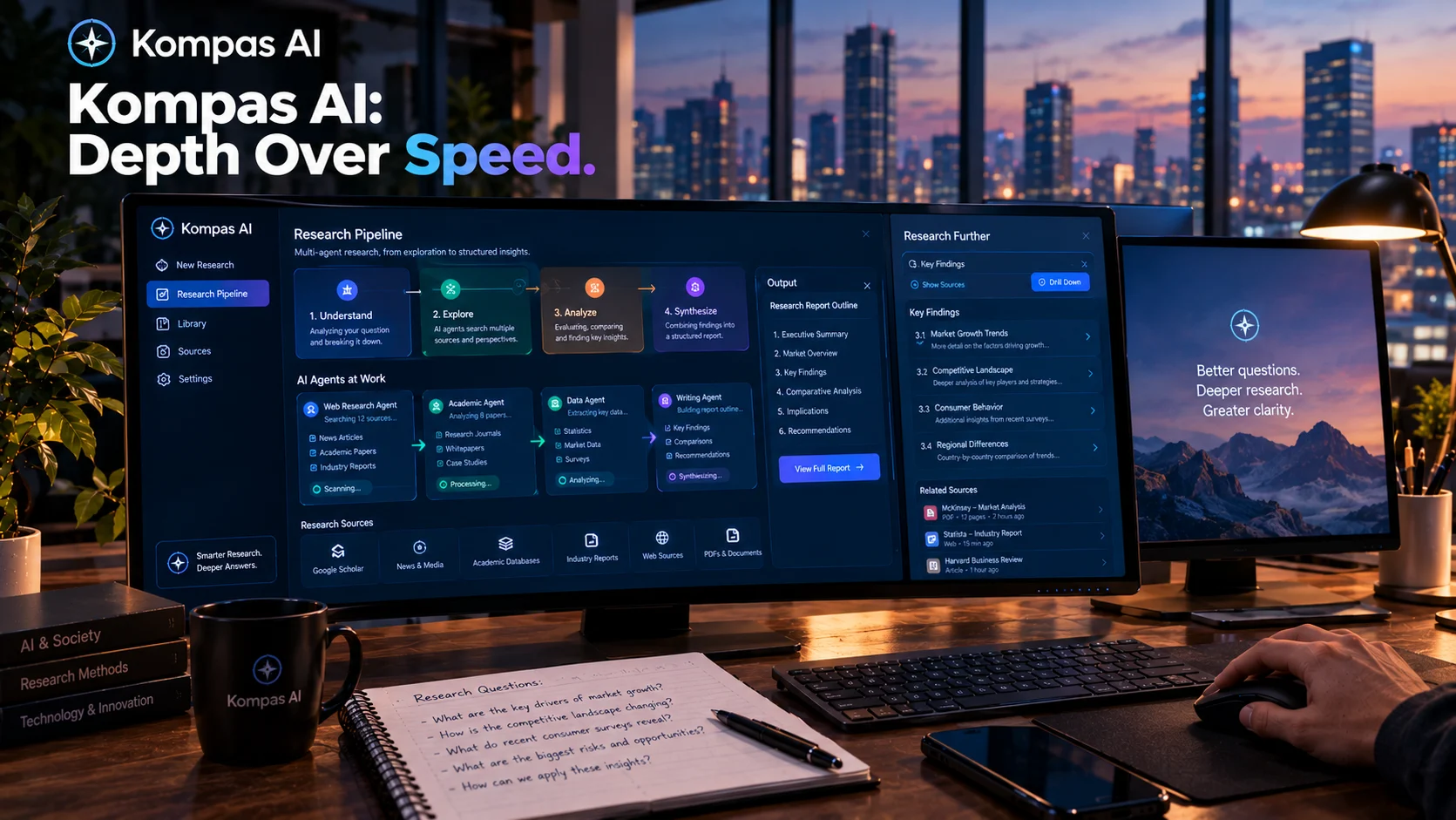
Kompas AI is a multi-step research and report generation platform that deploys multiple AI agents to analyze hundreds of pages iteratively, producing structured long-form reports with citations. It is developed by ByteBridge, supports over 100 languages, and distinguishes itself from ChatGPT and Perplexity through its “Research Further” iterative deep-dive capability and explicit no-training-on-user-data policy.
At-a-Glance: Key Takeaways
- Kompas AI uses multi-agent orchestration rather than a single model, deploying multiple AI agents to research, synthesize, and structure findings .
- The “Research Further” feature enables iterative deepening, letting users drill into specific sections across multiple stages rather than accepting a one-shot answer .
- Pricing is credit-based with a free tier: unregistered users get up to 4 reports; paid credits range from 2,000 (฿399) to 100,000 (฿19,990) .
- Data privacy is a core differentiator: Kompas AI explicitly states it does not use user content for AI training, does not sell data, and does not claim ownership of user content .
- The platform is developed by ByteBridge, a Korean AI technology company, and supports over 100 languages with TTS and STT capabilities .
- Output is structured and report-ready: sections, subsections, data tables, and presentation slides can be generated from the same research base .
What Is Kompas AI?
Kompas AI is a multi-step, in-depth research and report generation platform developed by ByteBridge, a Korean AI technology company . Unlike general-purpose AI chatbots that optimize for speed and conversational back-and-forth, Kompas AI is engineered for depth: it deploys multiple AI agents that iteratively analyze hundreds of pages from reliable online sources to produce comprehensive, structured reports .
The platform’s philosophy is explicitly different from single-model tools. While ChatGPT focuses on fast Q&A interactions and Perplexity specializes in quick, source-cited answers, Kompas AI positions itself as an “end-to-end” research platform that automates the most time-consuming parts of manual research: planning, data collection, synthesis, and report writing .
The target audience is professionals, researchers, students, and teams who need more than surface-level information. The platform is designed for business analysis, academic research, market trend assessment, and competitive intelligence .
How Kompas AI Works
The Multi-Agent Research Pipeline
Kompas AI operates through a structured four-stage workflow :
Research Planning: The system automatically structures a research outline based on the user’s initial input, creating a logical framework for investigation.
Data Collection & Consolidation: Multiple AI agents explore various online sources and documents simultaneously, filtering out irrelevant material to present the most relevant data.
In-Depth Analysis: Advanced analytics uncover trends, correlations, and conclusions, delivering a well-rounded perspective on the topic.
Report Generation: Findings are presented in a clear, structured format with sections, subsections, and citations, making it easy to skim for highlights or dive into details.
The “Research Further” Iterative Capability
A distinguishing feature is the ability to conduct research iteratively rather than in a single pass. After receiving an initial report, users can use “Research Further” to drill deeper into specific sections or aspects . This mimics the way human researchers work: starting broad, identifying gaps, then investigating specific threads more deeply.
The platform also offers an AI Edit function for adjusting tone, translating content, and refining style, alongside manual editing for precise control .
Multi-Source Input
Users can specify sources beyond general internet search. The platform supports uploading files and importing from Google Docs, allowing research to incorporate proprietary documents alongside public web sources .
Key Features and Capabilities
Structured, Report-Ready Output
Unlike tools that return raw text, Kompas AI generates properly structured reports with introduction, body, conclusion, and subheadings. The output can be directly used without extensive reformatting .
The platform also offers one-click conversion to other formats including tables and presentation slides, making the same research base usable for different presentation needs .
Multi-Language Support
Kompas AI supports over 100 languages with text-to-speech and speech-to-text capabilities . Research is conducted in English, but reports can be generated in the user’s preferred language, making the tool accessible to non-English speakers .
Cross-Platform Access
The platform is available on Mac, Windows, iOS, and Android, with cloud synchronization ensuring data is current across all devices .
AI Editing and Manual Override
The built-in AI Edit function can adjust tone, translate, and refine sentence structure. Users can switch to manual editing mode at any time for detailed modifications or rewrites .
Pricing and Plans
Kompas AI uses a credit-based pricing model. The platform is free to use with limitations, and paid credits unlock additional reports and features.
Important pricing context: The credit packs are one-time purchases, not subscriptions. The exact credit consumption per report is not published, which means users discover costs by usage .
Privacy and Security
Kompas AI publishes extensive privacy commitments that differentiate it from many AI research tools.
No Training on User Data
The platform explicitly states that content submitted for analysis is used solely to produce reports and is not retained for further model training . This is positioned as a key differentiator from ChatGPT and similar services that use user data for model improvement .
No Data Selling or Sharing
Kompas AI states it never sells or shares user data. Data privacy is described as the platform’s top priority .
No Ownership Claims
The platform respects user privacy and does not claim ownership of user content. User content and AI interactions are not used for AI model training .
Data Retention and Security
Unused data is periodically removed from the system to minimize unnecessary storage. Files are protected with strong encryption, and data in transit is protected .
Important distinction: Kompas AI’s privacy claims are company statements. No SOC 2, ISO 27001, or independent third-party certifications are referenced in available documentation. Organizations with strict compliance requirements should conduct independent due diligence.
How Kompas AI Compares to Alternatives
Editorial interpretation: Kompas AI occupies a distinct niche: the structured, end-to-end research report. ChatGPT Deep Research offers conversational depth but requires manual formatting for final output. Perplexity excels at quick, cited answers but is not built for long-form document creation. Elicit is specialized for academic literature. Kompas AI’s multi-agent architecture and iterative research capability make it suited for users who need a finished report, not just raw analysis.
Who Should Use Kompas AI
Business analysts and strategy teams needing structured market trend reports, competitor overviews, and industry assessments. The structured output format reduces post-research formatting effort .
Academic researchers conducting literature reviews and topic exploration. The platform’s multi-source capability and structured output support both preliminary surveys and detailed investigations .
Content creators and consultants who need well-researched long-form content with proper structure. The ability to convert research into slides and tables adds flexibility .
Teams with sensitive data requirements benefit from the explicit no-training and no-data-selling commitments. Organizations handling proprietary information can use the platform with greater confidence .
Users needing quick answers may find the multi-step process slower than conversational alternatives. Kompas AI is optimized for depth, not speed.
Budget-conscious individuals can use the free tier of up to 4 reports to evaluate the platform before purchasing credits .
Common Mistakes and Cautions
Assuming unlimited free usage. The free tier caps at approximately 4 reports. After that, credits are required .
Underestimating credit consumption. The exact credit cost per report is not published. Users discover consumption by usage, making budget prediction difficult .
Expecting conversational back-and-forth. Kompas AI is a research platform, not a chatbot. Its strength is producing structured reports, not answering follow-up questions in natural conversation.
Overlooking the ByteBridge connection. Kompas AI is developed by ByteBridge, a Korean AI company. Organizations with data sovereignty requirements should understand the data processing implications .
Assuming certifications exist. The privacy policy is detailed, but no SOC 2 or ISO 27001 certifications are referenced. Enterprise buyers should verify security documentation independently.
Frequently Asked Questions
What is Kompas AI?
Kompas AI is a multi-agent research and report generation platform developed by ByteBridge. It deploys multiple AI agents to iteratively analyze hundreds of pages and produce structured, long-form reports with citations. It is designed for depth rather than speed .
How much does Kompas AI cost?
The platform is free for up to approximately 4 reports without registration. Paid credits range from 2,000 credits (฿399, ~$11) to 100,000 credits (฿19,990, ~$560). Basic team plans for 4-5 users start at ฿1,990 (~$55) .
Is Kompas AI private and secure?
Kompas AI explicitly states it does not use user content for AI training, does not sell or share user data, and does not claim ownership of user content. Unused data is periodically removed, and files are encrypted. No SOC 2 or ISO certifications are referenced .
How does Kompas AI differ from ChatGPT Deep Research?
ChatGPT Deep Research focuses on conversational deep analysis within a chat window. Kompas AI is built for end-to-end report generation with structured output, multi-agent orchestration, and iterative “Research Further” capability. It also offers explicit no-training-on-user-data guarantees .
Can I use Kompas AI for free?
Yes. Unregistered users can generate up to 4 reports for free. After that, credits are required. The free tier is sufficient for evaluating the platform before purchasing .
Conclusion
Kompas AI has built a differentiated position in the AI research tool market. Its multi-agent architecture, iterative “Research Further” capability, and structured report output address a genuine need that conversational AI tools do not fully serve: the production of finished, citation-backed research documents.
What matters most is understanding what Kompas AI is and is not. It is not a chatbot or a quick-answer engine. It is a research automation platform designed for depth, structure, and report readiness. The credit-based pricing and free tier allow evaluation without commitment, though the opacity of credit consumption per report complicates budgeting.
Kompas AI may suit business analysts, academic researchers, consultants, and teams needing structured long-form reports. It may not suit users seeking conversational back-and-forth, quick answers, or transparent per-use pricing. Organizations with strict compliance requirements should verify security certifications independently, as none are referenced in available documentation.
Before committing, use the free tier to evaluate report quality against your actual research needs. Test the “Research Further” capability to see if iterative deepening matches your workflow. And review the privacy policy to confirm the data handling commitments align with your organization’s requirements. Kompas AI offers genuine depth, but that depth requires the right use case to deliver value.