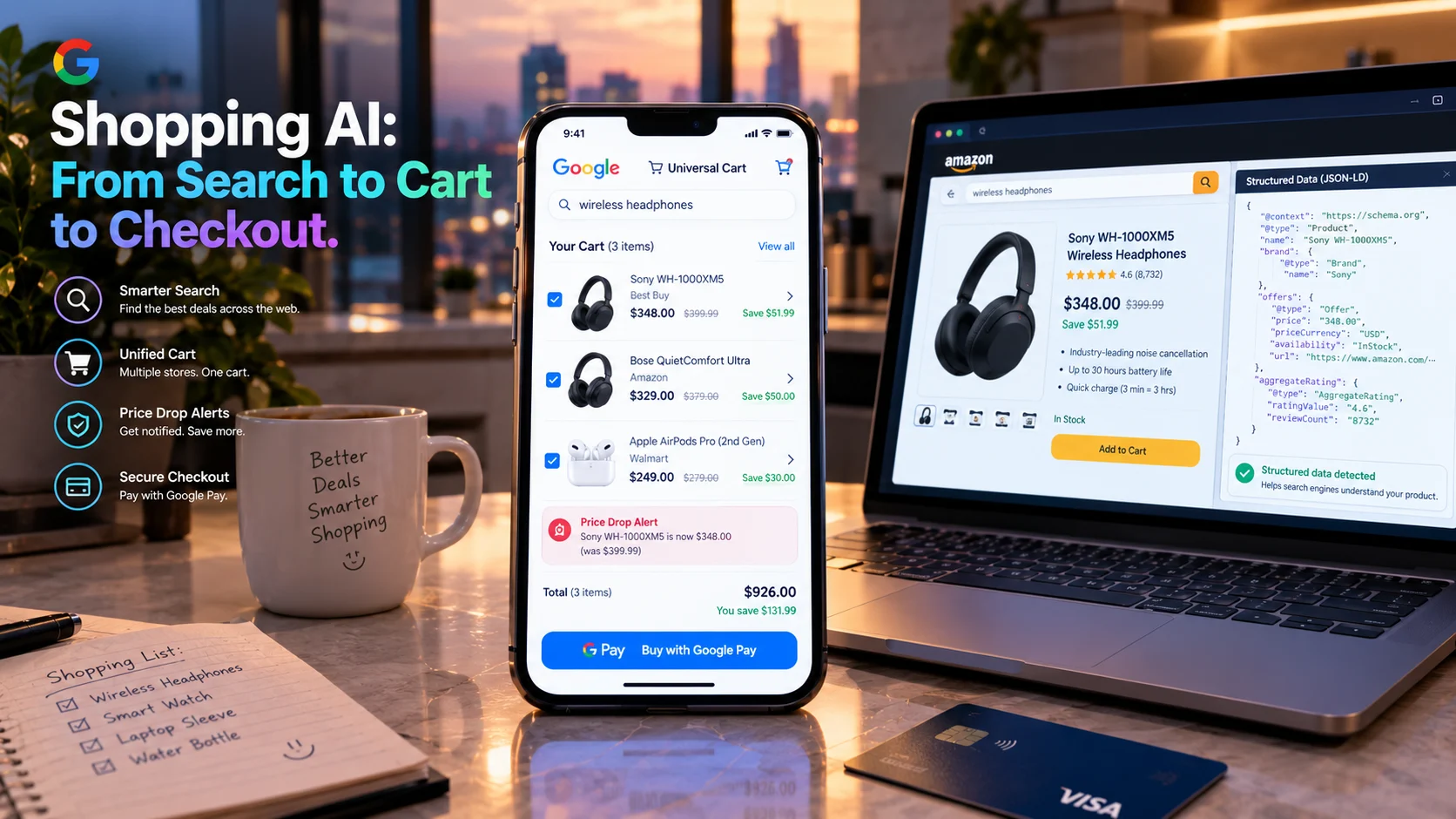
Shopping AI refers to artificial intelligence that assists or autonomously handles product discovery, comparison, and purchasing on behalf of consumers. In 2026, agentic commerce has moved from experiment to infrastructure, with Google’s Universal Cart, Shopify’s agent catalog, and Meta’s Muse all competing to become the layer between shoppers and merchants.
At-a-Glance: Key Takeaways
- Agentic commerce is infrastructure now, not a demo. Google’s Universal Cart launched in the US in October 2026, Shopify opened its 1-billion-product catalog to any compatible AI agent, and Meta’s Muse is actively browsing and buying .
- Consumer adoption outpaces retail readiness. 65% of consumers plan to use AI for holiday shopping, but only 8% of retailers say they are prepared .
- Trust and control remain the biggest barriers. Roughly half of American consumers are uncomfortable letting AI complete transactions, and experts warn of security and accountability gaps .
- Product data quality determines visibility. AI agents are “inherently lazy” and will skip brands they cannot easily understand and verify .
- The buyer and seller ecosystems are in competitive tension. Agents want to compare everything; merchants want to control pricing and access .
- GEO is replacing SEO as the discovery battleground. 74% of shoppers use AI for product discovery, but less than 3% of LLM citations come from brand-owned pages .
What Is Shopping AI?
Shopping AI is the application of artificial intelligence across the e-commerce journey: discovering products, comparing options, negotiating prices, completing purchases, and handling post-purchase tasks like returns and tracking.
The category has two distinct layers. The first is assistive AI, which helps humans research and decide. The second is agentic commerce, where AI agents act autonomously on the consumer’s behalf, often completing transactions with minimal or no human intervention .
The shift matters because it changes who the “customer” is. For decades, e-commerce platforms optimized for human browsing behavior. In 2026, they must optimize for AI agents that read structured data, not marketing copy. As one retail executive put it, “Your product page is your new home page” when it comes to discovery in the agentic AI era .
How Shopping AI Works
The Agentic Commerce Architecture
Agentic commerce operates through a buyer-side and seller-side ecosystem. On the buyer’s side, AI agents handle searching, comparing, negotiating, and purchasing. On the seller’s side, agents present catalogs, verify buyer agents, handle checkout, and manage customer insight .
The two sides connect through protocols like Google’s Universal Commerce Protocol (UCP) and Anthropic’s Model Context Protocol (MCP). These protocols provide a common language for agents to communicate with merchants, handle authentication, and verify transaction mandates .
Product Discovery and Recommendation
Traditional recommendation systems use collaborative filtering and content-based filtering. Modern shopping AI adds behavioral signals like views, cart additions, and wishlist activity, combined with generative models that can reason about complex queries .
Google’s architecture for personalized recommendations illustrates the pipeline: clickstream data flows through Dataflow, user profiles and vector embeddings are stored in BigQuery, and Gemini generates personalized recommendations based on vector similarity search .
Checkout and Payment
The hardest part of agentic commerce is checkout. As Shopify’s product manager noted, agents get tripped up by CAPTCHAs, age verification, split shipping, and buy-now-pay-later installments .
Google’s Agent Payments Protocol (AP2) addresses this by creating a verifiable link between user, merchant, and payment processor. Users set strict guardrails: specific brands, products, and spending limits. The agent only completes a purchase when all criteria are met .
Major Platforms and Tools
The Trust and Security Gap
Consumer Reluctance
Bain & Company research from September 2025 found that about half of American respondents were uncomfortable with AI completing transactions. Only a small share trusted AI agents to handle payments .
Josh Woodward, VP of Google Labs, framed the design challenge simply: “On the team, we think of it like you’re giving a teenager their first debit card. There’s sort of limits and sort of constraints around it” .
Security Vulnerabilities
Cybersecurity analyst Ritesh Kotak warned that agents could be manipulated into buying from dubious or unencrypted websites. Protections would need to stop agents from transacting with bad actors .
There is also the problem of accountability. “When your bot goes out and makes a purchase, everything that comes afterwards may be problematic,” Kotak said. “I don’t think saying, ‘My bot made me do it’ is going to be an excuse” .
The Citation Problem
Meta’s Muse and Instinct agents have drawn scrutiny for not naming the sources they visit when gathering information. Unlike ChatGPT and Perplexity, which expose links, Muse recommends products without showing where it learned about them .
More concerning: Muse routes traffic through residential internet connections and presents as ordinary human visitors, making it “difficult to separate from human traffic.” This defeats the two checks most site operators rely on: user agent strings and published IP ranges .
What Retailers Must Do
Master Product Data
L’Oréal Europe is expanding its product attributes from 18-20 data fields to hundreds. As their Chief Digital and Marketing Officer explained, “This is necessary for the agentic AI future” .
Ping Identity’s EMEA Field CTO put it bluntly: “AI agents are inherently lazy, so if you’re too hard to find they will just move on” .
Invest in Generative Engine Optimization
GEO is the practice of structuring content so AI models can find and recommend your brand. The starting point is mapping the AI discovery journey: identifying likely consumer questions, testing whether your brand appears, examining which competitors are recommended instead, and tracing the sources shaping those answers .
Build Trust Infrastructure
Ping Identity’s Berzinski argued that “Know Your Agent” (KYA) compliance could become as vital as “Know Your Customer” (KYC). “Trust is crucial in this coming era where the ability to know who is a human, who is an agent, and to have appropriate verification is key” .
Who Should Use Shopping AI
Consumers can use AI shopping assistants for product research, price monitoring, and automated purchases with guardrails. Google’s Universal Cart is free and available to US users .
Retailers and brands must prepare for agentic discovery whether they adopt agents or not. If product data is unclear or inconsistent, AI agents will recommend competitors instead .
Developers can build on Shopify’s Shop MCP or Google’s UCP to create custom shopping agents .
Enterprise procurement teams can apply the same agentic patterns to B2B purchasing, though the ecosystem is less mature .
Common Mistakes and Cautions
Assuming agents will find you. If your product data is unstructured or inconsistent, agents will skip your brand. Data hygiene is now a revenue-critical activity .
Ignoring the trust gap. Half of consumers are uncomfortable with agentic payments. Retailers that rush to automate without addressing security and control may lose customer confidence .
Overlooking pricing pressure. AI agents will tend to direct users to the cheapest price. As Rithum’s MD noted, “LLMs will tend to direct you to the cheapest price.” Differentiation requires more than price .
Confusing GEO with SEO. AI models do not rank pages the way search engines do. They extract entities and relationships. Brand-owned content is less than 3% of LLM citations .
Forgetting the emotional layer. AI models weigh objective criteria. They struggle with gift-giving symbolism. Brands with strong identity have an opportunity to “win the override” when consumers reject AI recommendations .
Frequently Asked Questions
What is shopping AI?
Shopping AI is artificial intelligence that assists or autonomously handles product discovery, comparison, and purchasing. It ranges from assistive tools that help humans research to agentic systems that complete transactions with minimal human intervention .
How does Google’s Universal Cart work?
Universal Cart is a cross-merchant shopping cart that works across Google Search and the Gemini app. It finds price drops, alerts on restocks, checks product compatibility, and integrates with Google Wallet for checkout. It launched in the US in October 2026 .
Is it safe to let AI agents buy things for me?
Safety depends on the platform’s guardrails. Google’s AP2 protocol lets users set strict spending limits and brand restrictions. Shopify requires buyer approval for each purchase. However, experts warn of security vulnerabilities and accountability gaps if agents make mistakes .
What is agentic commerce?
Agentic commerce is a model where AI agents buy, sell, or manage transactions on behalf of users and businesses. Morgan Stanley estimates AI shopping agents could influence $190-385 billion in US e-commerce sales by 2030 .
What is GEO and why does it matter?
Generative Engine Optimization (GEO) is the practice of structuring content so AI models can find and recommend your brand. It matters because 74% of shoppers use AI for product discovery, and AI recommendations determine which brands enter the consideration set .
Conclusion
Shopping AI has moved from novelty to infrastructure. Google’s Universal Cart, Shopify’s agent catalog, and Meta’s Muse are competing to become the layer between consumers and merchants. The protocols, payment rails, and trust frameworks are being built in real time.
What matters most is visibility and trust. For consumers, AI shopping assistants offer convenience and potential savings, but require guardrails and oversight. For retailers, the priority is product data quality and GEO. AI agents will recommend brands they can clearly understand and verify. Brands that fail this test become invisible.
Shopping AI may suit consumers comfortable with delegated purchasing and retailers willing to invest in structured data and trust infrastructure. It may not suit those uncomfortable with AI-mediated commerce or merchants unwilling to adapt their data practices.
Before adopting any agentic shopping tool, evaluate the guardrails. Set spending limits. Review the platform’s data practices. And for retailers, audit your product data now. The agents are already browsing.