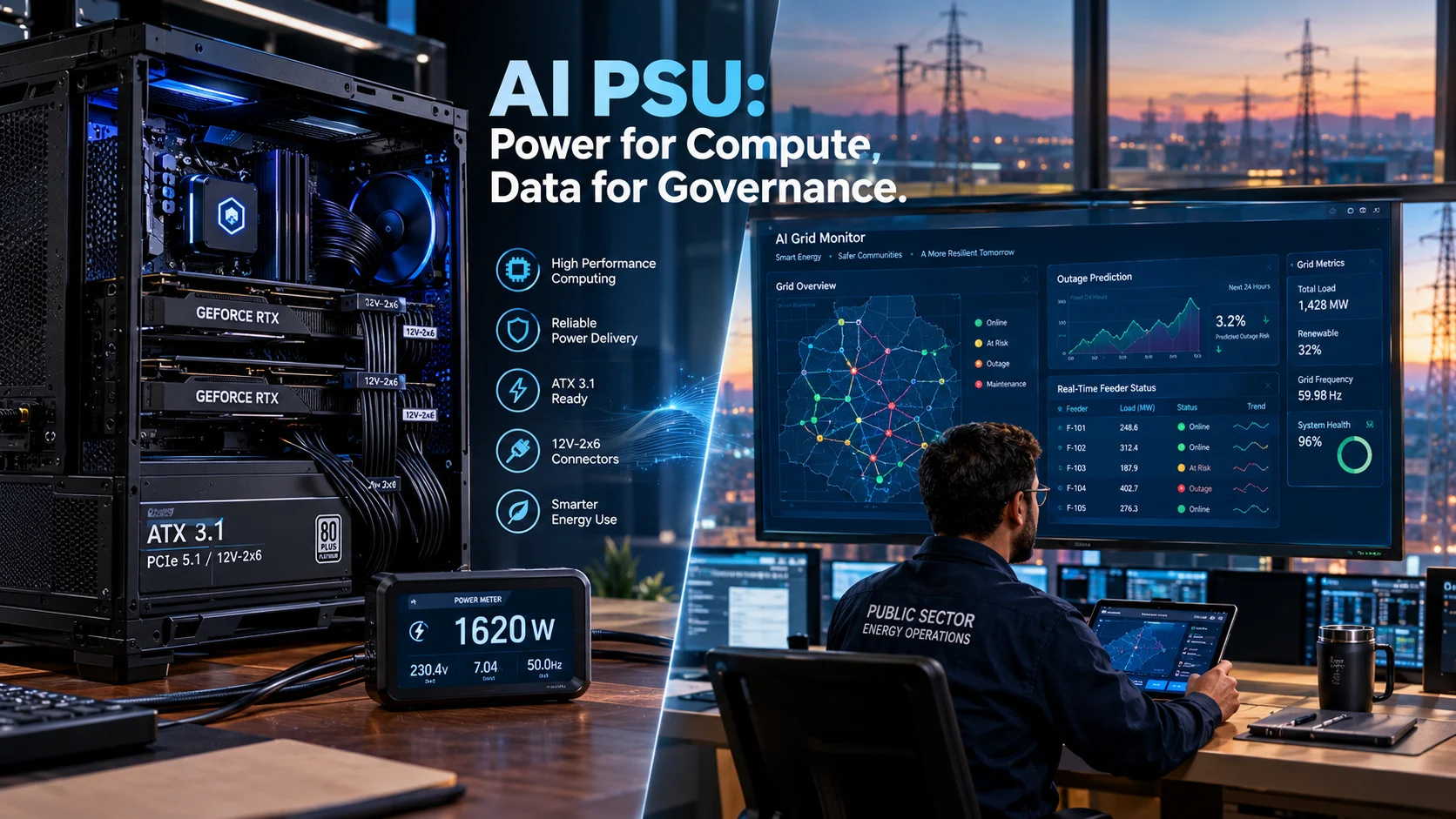
“AI PSU” has two distinct meanings. In hardware, it refers to power supply units engineered for AI workstations, requiring higher wattage, ATX 3.1 support, and sustained load reliability . In governance, it describes the adoption of artificial intelligence by Public Sector Undertakings, where India is exploring AI deployment as a benchmark for PSU classification .
At-a-Glance: Key Takeaways
- AI workstations need different PSUs than gaming PCs. Sustained high-load operation demands higher efficiency ratings (80 PLUS Platinum or Titanium) and better thermal performance .
- A 20-30% headroom rule applies for continuous AI compute. A workstation drawing 900W under load should use a 1200W PSU, not a 1000W unit .
- ATX 3.1 and PCIe 5.1 support is essential. These standards handle the transient power spikes modern GPUs produce during AI workloads .
- Public Sector Undertakings face a data problem, not a technology problem. Tech leaders say AI projects fail because data remains siloed, unstructured, or trapped in legacy systems .
- Sovereign AI is reshaping PSU strategy in India. The IndiaAI Mission and AIKosh platform aim to reduce dependence on overseas data systems while improving model relevance for local languages and sectors .
- Cyber resilience is now board-level risk for PSUs. MeitY frames sovereign AI as a strategic necessity, with cybersecurity managed as enterprise-wide risk, not a narrow IT function .
What Is AI PSU?
“AI PSU” is an ambiguous search term. It aggregates two unrelated topics that happen to share an acronym.
The first meaning is hardware. PSU stands for power supply unit. An “AI PSU” is a power supply engineered for AI workstations, not general-purpose computers. These units face sustained high loads rather than the dynamic spikes of gaming, and they must handle the transient power excursions of modern GPUs without voltage drops or protection triggers .
The second meaning is organizational. PSU stands for Public Sector Undertaking. “AI PSU” in this context describes the adoption of artificial intelligence by government-owned enterprises, particularly in India where the term is widely used. This covers AI-led transformation across energy, transport, mining, finance, and defense-linked infrastructure .
The two domains share no technical overlap. One concerns electrical engineering and thermal management. The other concerns data governance, cybersecurity, and organizational change. This article addresses both, starting with hardware.
AI PSUs for Workstations: How They Differ
Sustained Load vs. Dynamic Load
A gaming PC creates a dynamic power load. Consumption fluctuates with scene complexity, frame rate, and CPU demand. An AI workstation runs differently. Demanding workloads can keep GPUs and CPUs at high utilization for hours, sometimes around the clock .
This sustained load places greater demands on the PSU’s stability, efficiency, and thermal performance. The unit must continuously deliver high power without voltage drops, overheating, or unnecessary triggering of protection mechanisms .
The Headroom Rule
A 20-30% power reserve is the common guideline for continuous AI compute. This margin allows the PSU to operate reliably under sustained loads, compensate for short-term spikes, and provide headroom for future upgrades .
The math is straightforward. If an AI workstation consumes 900-950W at full load, a 1200W power supply makes more sense than a 1000W unit. The margin means more stable operation during simultaneous CPU/GPU peaks, lower component temperatures, and a power supply that is not pushed to its limits continuously .
ATX 3.1 and PCIe 5.1 Requirements
Modern GPUs produce brief power spikes that can exceed their rated wattage. ATX 3.1 certification ensures the PSU can handle these transient excursions without shutting down or causing instability. PCIe 5.1 native 12V-2×6 connectors deliver up to 600W to next-generation graphics cards .
Without these standards, an otherwise capable PSU may fail under AI workloads despite having sufficient rated wattage.
AI PSU Specifications and Sizing
Multi-GPU Configurations
The GPU is often the most power-hungry component in an AI workstation. The NVIDIA RTX PRO 6000 Blackwell Workstation Edition has a max power consumption of 600W. Two of these GPUs require up to 1200W before accounting for CPU, motherboard, storage, cooling, and other components .
A configuration with two RTX PRO 6000 GPUs plus a high-core-count processor can easily exceed 1500W total system consumption .
Recommended PSU Wattage by Configuration
| RTX 5090 (single) | Core Ultra 9 / Ryzen 9 | 1600W | 1000W |
| RTX 5090 (single) | Core Ultra 7 / Ryzen 7 | 1300W | 1000W |
| RTX 5090 (dual) | AI / HEDT | 1600W+ | Not recommended |
| RTX PRO 6000 (dual) | Workstation | 2000W class | Not applicable |
Source: MSI recommended PSU table, Seasonic AI PSU guidance
For dual-GPU AI systems, 1600W is the practical minimum for current-generation hardware. FSP has introduced a 2000W ATX 3.1 unit specifically for this segment, with dual native 12V-2×6 connectors and three CPU 8-pin connectors .
Why Efficiency Ratings Matter
80 PLUS Platinum certification guarantees 89% efficiency at 100% load and 92% at 50% load . This matters for AI workstations running continuously. Higher efficiency means less energy lost as heat, reduced fan noise, and longer component lifespan.
The ASUS Pro WS 1600W Platinum uses server-grade Japanese capacitors, extruded aluminium heatsinks up to twice the mass of standard designs, and dual ball-bearing fans rated for 80,000 hours .
Connector Requirements
AI PSUs must provide sufficient independent PCIe or 12V-2×6 power cables for each GPU. The ASUS Pro WS 1600W Platinum includes two native 12V-2×6 connectors, supporting up to two RTX 5090 cards . The FSP 2000W unit includes dual 12V-2×6 and three CPU 8-pin connectors for workstation motherboards .
Who Needs an AI PSU?
Local AI researchers and developers running model fine-tuning, inference, or parallel GPU processing need power supplies that can sustain high loads. The 20-30% headroom rule applies directly to this audience .
Workstation builders configuring dual-GPU systems for machine learning, 3D rendering, or scientific computing should target 1600W or higher depending on GPU selection .
Professionals upgrading existing workstations should calculate total system power including all components, then apply the headroom rule. A PSU sized for a single-GPU gaming build will likely fail under dual-GPU AI loads.
Users running occasional AI tasks on otherwise gaming-focused hardware may not need a dedicated AI PSU. The sustained load requirement is what distinguishes AI workstations from general-purpose machines.
AI in Public Sector Undertakings: The Data Problem
The second meaning of “AI PSU” concerns artificial intelligence adoption by Public Sector Undertakings, particularly in India. At the ET Government National PSU Summit 2026, technology leaders delivered a consistent message: the technology is not the barrier. Data is .
Data Trapped in Silos
Manoj Tandon, Director at RailTel Corporation of India, said the biggest barrier to AI adoption in PSUs is not the technology itself, but the quality, structure, and usability of data. Organizations sit on large volumes of information, but much remains trapped in silos or lacks the quality required for reliable AI outcomes .
D Porpathasekaran, Director at Telecommunications Consultants India Ltd, reinforced this. “The data is in silos. Some of it is in physical format, and it is not available in a very structured format” .
The 80/20 Approach
Porpathasekaran recommended that PSUs start by identifying high-impact areas using an 80:20 approach rather than applying AI across all domains at once. This allows organizations to demonstrate measurable efficiency gains before scaling further .
Human Accountability
Sharmistha Dasgupta, Deputy Director General at the National Informatics Centre, emphasized that AI systems need strong lifecycle management from data collection through model monitoring. “In each stage, you should have humans in the loop,” she said. Accountability cannot be entirely outsourced to vendors; responsibility must remain with the deploying organization .
Alok Kumar Tiwari, MD at NICSI, cautioned that compliance remains a major concern. “All PSUs and government organisations are not compliant with the norms set by the government,” he said, noting that phishing, honey traps, and data leakage continue to pose risks .
Sovereign AI and PSU Transformation
India’s approach to AI in Public Sector Undertakings has moved beyond pilot projects toward platform building. The IndiaAI Mission is designed to expand compute capacity, improve dataset quality, develop indigenous AI capabilities, and promote safe, trusted AI adoption .
AIKosh and Indigenous Data
Platforms like AIKosh give developers, startups, researchers, and public institutions access to India-specific datasets, models, and AI resources. This reduces dependence on overseas data systems while improving model relevance for local languages, sectors, and governance needs .
Real Deployments
ONGC’s Pragya-AIX initiative brings multiple AI applications into a single framework for upstream exploration and drilling operations .
SAIL’s AI-led resource optimization at the Bokaro Steel Plant shows how targeted AI systems can reduce coal consumption, lower emissions, and generate measurable savings .
TGNPDCL won the “Adopting AI in Energy Award” for an AI-based feeder outage prediction model, drone-based monitoring of power assets, real-time feeder management, GIS monitoring, and an AI-powered WhatsApp chatbot .
The Integration Layer Approach
Many PSUs carry decades of legacy systems, siloed databases, and fragmented reporting processes. Full replacement is often costly, risky, and slow. The emerging approach is to build integration layers and enterprise data lakes that harmonize structured and unstructured data across the organization. This allows stronger governance checks before feeding information into predictive analytics and generative AI systems .
Cyber Resilience as Board-Level Risk
MeitY Secretary S. Krishnan has framed sovereign AI as a strategic necessity, not just a technology upgrade. Cybersecurity must be managed as enterprise-wide risk. For PSUs, this means cyber defense cannot remain limited to technical teams. It must be built into governance, operations, procurement, and crisis response .
Common Mistakes and Cautions
For hardware buyers: Assuming a gaming PSU will handle AI workloads. The sustained load profile is different. Calculate total system power including all components, apply the 20-30% headroom rule, and verify ATX 3.1 / PCIe 5.1 support .
Underestimating connector requirements. A PSU may have sufficient wattage but insufficient independent PCIe cables for multiple GPUs. Check native connector counts before purchasing .
For PSU leaders: Treating AI as a technology procurement exercise. The data foundation comes first. AI projects fail when built on unreliable, siloed, or unstructured data .
Ignoring the human element. Technology leaders emphasized that people are the real change agents. AI systems must be taken into confidence across the organization if they are to move from pilots to scalable enterprise use .
Assuming compliance exists. Government norms for cybersecurity and data handling are not universally met. PSUs should assess vulnerabilities, scan infrastructure, and strengthen systems before deploying AI at scale .
Frequently Asked Questions
What size PSU do I need for an AI workstation?
Apply the 20-30% headroom rule. A workstation drawing 900-950W under full load should use a 1200W PSU. Dual-GPU configurations with RTX 5090 or RTX PRO 6000 class cards typically need 1600W or higher .
What is ATX 3.1 and why does it matter for AI PSUs?
ATX 3.1 is a power supply standard that handles the high transient power spikes modern GPUs produce. Without it, a PSU may shut down or cause instability during AI workloads despite having sufficient rated wattage .
What does “AI PSU” mean in government context?
In Indian governance, “AI PSU” refers to artificial intelligence adoption by Public Sector Undertakings. The focus is on data readiness, sovereign AI platforms like AIKosh, and cyber resilience as board-level risk .
Why do AI projects in PSUs fail?
Technology leaders say the biggest barrier is data quality, not technology. Information is often trapped in silos, stored in physical formats, or lacks the structure required for reliable AI outcomes. Human adoption and organizational change are equally critical .
Can I use a gaming PSU for AI workloads?
A gaming PSU may work for occasional AI tasks, but sustained high-load operation places different demands on stability, efficiency, and thermal performance. For continuous AI compute, a workstation-class PSU with higher efficiency and proper headroom is recommended .
Conclusion
“AI PSU” describes two separate domains that share an acronym. For hardware builders, it means power supplies engineered for sustained AI workloads: higher efficiency, ATX 3.1 compliance, adequate headroom, and sufficient connectors for multi-GPU configurations. For Public Sector Undertakings, it means AI-led transformation built on data foundations, sovereign platforms, and cyber resilience.
What matters most differs by context. Hardware buyers should calculate total system power, apply the 20-30% headroom rule, and verify ATX 3.1 / PCIe 5.1 support before purchasing. PSU leaders should address data silos, build integration layers, and ensure human accountability at every stage of the AI lifecycle.
AI PSUs for workstations may suit researchers, developers, and professionals running local AI compute. They may not suit users running occasional AI tasks on gaming-focused hardware. AI adoption in Public Sector Undertakings may suit organizations with data infrastructure and change-ready cultures. It may not suit those expecting technology alone to solve organizational problems.
Before investing in either domain, assess your actual requirements. For hardware, measure your real power consumption under load. For PSUs, audit your data readiness before selecting tools. And remember that in both cases, the foundation matters more than the headline specification.