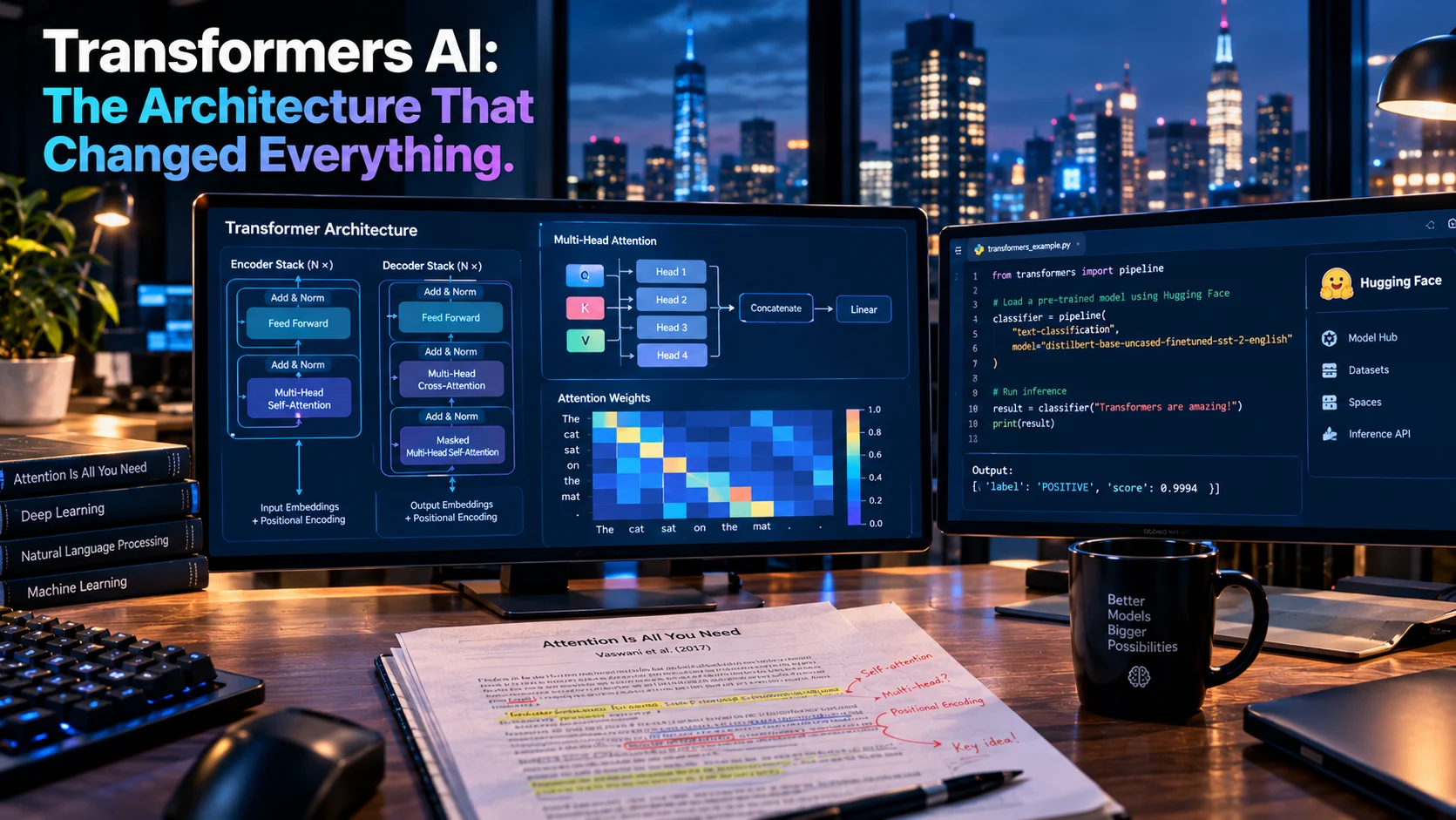
Transformers AI refers to the neural network architecture introduced in the 2017 paper “Attention Is All You Need” that powers nearly all modern language models, including GPT, BERT, and Claude. The architecture replaces sequential processing with self-attention, allowing models to weigh relationships between all words in a sequence simultaneously .
At-a-Glance: Key Takeaways
- Transformers use self-attention to process all words in parallel, eliminating the sequential bottleneck of older recurrent neural networks (RNNs) .
- The 2017 paper “Attention Is All You Need” introduced the architecture, which has become the foundation for virtually all modern AI language models .
- Hugging Face Transformers is the most widely used library for working with pretrained transformer models, offering over 500,000 model checkpoints .
- Transformers v5 unified modeling code and introduced a dynamic weight loader for performance optimizations like fusing MoE expert projections .
- Self-attention complexity is O(n²·d), meaning processing time grows quadratically with sequence length .
- Fine-tuning pretrained models is now standard practice, requiring only hundreds to thousands of examples rather than millions .
What Is Transformers AI?
Transformers AI is not a single product or company. It is a neural network architecture that fundamentally changed how machines process language. Introduced in the 2017 paper “Attention Is All You Need” by Vaswani et al., the Transformer replaced the sequential processing of recurrent neural networks (RNNs) with a parallel mechanism called self-attention .
The name “Transformer” comes from the architecture’s ability to transform input sequences into output sequences through stacked layers of attention and feedforward networks. Unlike RNNs that process words one at a time, Transformers look at all words in a sequence simultaneously, weighing the importance of each word relative to every other word .
This parallel processing capability is why Transformers train dramatically faster than their predecessors. The original paper noted that self-attention enables “100x faster” training compared to recurrent approaches . This speed advantage, combined with superior performance on translation and language understanding tasks, made Transformers the dominant architecture for natural language processing.
Today, when people search for “Transformers AI,” they are usually looking for one of three things: an explanation of the architecture itself, the Hugging Face Transformers library for implementing models, or specific pretrained models like BERT, GPT, or T5.
How Transformers AI Works
The Self-Attention Mechanism
Self-attention is the core innovation of the Transformer architecture. It allows the model to weigh how much each word in a sequence should influence the representation of every other word .
The mechanism operates through three learned projections: queries (Q), keys (K), and values (V). For each word, the model computes a query vector representing what it is looking for, a key vector representing what it offers, and a value vector containing the information it carries. The attention score between two words is computed as the dot product of one word’s query with another’s key, scaled by the square root of the dimension .
The formula for scaled dot-product attention is:
Attention(Q, K, V) = softmax(QKᵀ / √dₖ) V
This produces a weighted sum of value vectors, where the weights indicate how much attention each word should pay to every other word. Multi-head attention extends this by running multiple attention operations in parallel, allowing the model to focus on different types of relationships simultaneously .
Positional Encoding
Self-attention has no inherent sense of word order. To address this, Transformers add positional encodings to word embeddings. The original architecture used sinusoidal functions of different frequencies, allowing the model to learn relative positions through linear relationships .
Modern implementations often use learned positional embeddings or rotary position embeddings (RoPE), which encode relative positions more efficiently for long sequences.
The Encoder-Decoder Structure
The original Transformer used an encoder-decoder architecture. The encoder processes the input sequence through stacked layers of self-attention and feedforward networks. The decoder generates the output sequence, using masked self-attention (so each position only attends to earlier positions) and cross-attention to the encoder’s output .
Modern architectures have diverged. BERT uses only the encoder for understanding tasks. GPT uses only the decoder for generation. T5 returns to the full encoder-decoder for text-to-text tasks .
Computational Complexity
Self-attention has a computational complexity of O(n²·d) per layer, where n is sequence length and d is representation dimension. This quadratic scaling is why processing very long documents remains challenging. The original paper’s complexity table showed that self-attention has O(1) sequential operations (fully parallelizable) but O(n²) complexity per layer, compared to O(n) complexity for recurrent layers but O(n) sequential operations .
This trade-off is fundamental. Transformers sacrifice linear complexity for parallelization, which works well on modern GPUs but creates memory challenges for very long sequences.
Key Models Built on Transformers
Getting Started with Hugging Face Transformers
The Hugging Face Transformers library is the most accessible way to work with pretrained transformer models. It provides a unified API for loading, running, and fine-tuning models across text, vision, and audio modalities .
Installation
Transformers works with Python 3.9+ and PyTorch 2.1+. Installation is straightforward :
bash
pip install transformers torch
Note that since version 5, Transformers runs on PyTorch only. Earlier releases also supported TensorFlow and JAX, but code using those frameworks will not work with current installations .
Running a Pipeline
The simplest way to use a pretrained model is through the pipeline() function, which handles preprocessing, model execution, and postprocessing :
python
from transformers import pipeline

classifier = pipeline("sentiment-analysis")
result = classifier("I'm excited about using Transformers!")
print(result)
This loads a default sentiment model and returns a label and confidence score. The first run downloads the model weights, which are cached for future use .
Text Generation
For generative tasks, the pipeline API works the same way :
python
from transformers import pipeline

generator = pipeline("text-generation", model="Qwen/Qwen2.5-1.5B")
output = generator("The secret to baking a good cake is ")
print(output)
Fine-Tuning
Fine-tuning adapts a pretrained model to a specific task using your own labeled data. The core workflow involves loading a model, preparing a dataset, and training for a few epochs .
Small models like distilbert-base-uncased can be fine-tuned on a free Google Colab GPU in under an hour. Fine-tuning typically requires only hundreds to thousands of examples, compared to millions needed for training from scratch .
Latest Developments in Transformers
Transformers v5
Hugging Face released Transformers v5 in January 2026, marking a significant architectural refactor. The release unified modeling code across architectures, making shared bottlenecks obvious and allowing optimizations to apply across model families .
The most notable technical change is a new dynamic weight loader. This loader converts tensors on the fly during parallel loading, removing constraints on how parameters are laid out in safetensors files. This enables performance optimizations beyond what torch.compile can achieve, including fusing MoE expert projections, merging attention QKV projections, and enabling more compute-dense kernels .
The v5 release makes from_pretrained a unified entry point where users can mix and match parallelism, quantization, custom kernels, flash/paged attention, and continuous batching .
Transformers.js v4
For JavaScript developers, Transformers.js v4 brought a completely rewritten WebGPU runtime in C++. This allows the same code to run across browsers, Node.js, Bun, and Deno with hardware acceleration .
The v4 release added support for advanced architectures including Mamba (state-space models), Multi-head Latent Attention (MLA), and Mixture of Experts (MoE). Performance improvements include a 4x speedup for BERT-based embedding models through specialized ONNX Runtime operators .
Ongoing Optimizations
Recent releases continue to refine attention implementations. v5.15.0 added paged attention tests for XPU, optimized flash attention max sequence length computation in vision attention, and improved MPS support through metal-flash-sdpa integration .
Who Should Use Transformers AI?
Developers and data scientists building NLP applications benefit from the Hugging Face ecosystem’s pretrained models and simple API. Loading a state-of-the-art model requires only a few lines of code .
Researchers can fine-tune models on domain-specific data using modest compute resources. A single GPU and hundreds of examples often suffice for competitive results .
Businesses deploying AI features can use transformers for classification, summarization, question answering, and generation tasks without building models from scratch.
JavaScript developers can run models directly in the browser or server-side JavaScript using Transformers.js .
Users seeking to understand modern AI should start with the transformer architecture because it underpins nearly every major language model in use today.
Common Mistakes and Cautions
Assuming all Transformers work the same way. Encoder-only models (BERT) excel at understanding tasks. Decoder-only models (GPT) excel at generation. Choosing the wrong architecture for your task wastes effort.
Underestimating memory requirements. Self-attention’s O(n²) complexity means long sequences consume quadratically more memory. Processing a 10,000-token document requires far more resources than processing ten 1,000-token documents.
Fine-tuning without enough data. While fine-tuning requires less data than training from scratch, too few examples can cause overfitting. Aim for hundreds of examples at minimum .
Ignoring the PyTorch-only transition. Transformers v5 dropped TensorFlow and JAX support. Code using TFAutoModel or similar classes will not work with current installations .
Confusing the library with the architecture. “Transformers AI” can mean the neural network architecture or the Hugging Face library. The context determines which is relevant.
Frequently Asked Questions
What is Transformers AI?
Transformers AI refers to the neural network architecture introduced in the 2017 paper “Attention Is All You Need.” It uses self-attention to process all words in a sequence in parallel, replacing the sequential processing of older RNNs. The architecture powers BERT, GPT, T5, and nearly all modern language models .
What is the Hugging Face Transformers library?
Hugging Face Transformers is a Python library that provides access to over 500,000 pretrained models for text, vision, and audio tasks. It offers a simple pipeline API for inference and tools for fine-tuning models on custom data .
How does self-attention work?
Self-attention computes relationships between all words in a sequence by projecting each word into query, key, and value vectors. The attention score between two words is the dot product of one word’s query with another’s key, scaled by dimension. This determines how much each word should influence the representation of every other word .
Do I need a powerful GPU to use Transformers?
For inference with small models, a CPU is sufficient. Fine-tuning small models like DistilBERT can be done on a free Google Colab GPU. Larger models and training runs benefit from dedicated GPUs with more VRAM .
What are the limitations of Transformers?
The primary limitation is self-attention’s O(n²) computational complexity, which makes processing very long sequences memory-intensive. Transformers also lack inherent understanding of word order, requiring positional encodings. Some tasks may still benefit from architectures designed specifically for sequential data .
Conclusion
Transformers AI is the architecture that made modern language models possible. Its self-attention mechanism allows parallel processing of entire sequences, enabling faster training and better performance than sequential predecessors. Nearly every major AI language model today builds on this foundation.
What matters most is understanding the distinction between the architecture and the tooling. The Transformer is the underlying design. Hugging Face Transformers is the library that makes it accessible. Most users interact with the library, loading pretrained models and fine-tuning them for specific tasks.
Transformers AI may suit developers building NLP applications, researchers fine-tuning models on domain data, businesses deploying AI features, and anyone seeking to understand how modern language models work. It may not suit users seeking complete solutions without technical implementation, as using the library requires Python knowledge and understanding of model selection.
Before starting, clarify your task. Classification and extraction benefit from encoder-only models. Generation requires decoder-only or encoder-decoder architectures. Check memory requirements for your sequence lengths. And remember that fine-tuning a small model often outperforms using a large model without adaptation.