Typecast AI is a text-to-speech platform developed by Neosapience that specializes in emotional voice generation, offering over 600 AI voices across 37 languages with emotion presets, voice cloning, and API access. The Studio plans start at $5 per month, while the API plans offer separate pricing from $15 per month for developers integrating voice into applications.
At-a-Glance: Key Takeaways
- Typecast focuses on emotional expressiveness, with preset emotions like happy, sad, angry, and whisper, plus context-aware “Smart Mode” that infers emotion from text .
- The platform supports 37 languages, including English, Korean, Japanese, Chinese, Spanish, and 32 more, with character-level timestamp alignment for subtitles .
- Studio plans range from Free to Business ($69/month), with credits deducted by character count on download, not by generation time .
- API pricing is separate from Studio plans, starting at $15/month for Lite with 200,000 credits, and free API audio requires attribution and cannot be used commercially .
- Instant voice cloning requires only a short audio sample (≤25 MB), while Professional Cloning offers higher fidelity for branding .
- Neosapience went public on KOSDAQ in September 2026, reporting 106.4 billion KRW in revenue and expanding into conversational AI with the Neona platform .
What Is Typecast AI?
Typecast AI is a generative voice platform developed by Neosapience, a South Korean AI company founded in 2017. The platform transforms text into speech with a focus on emotional expression and character acting, positioning itself as a tool for content creators producing videos, podcasts, e-learning materials, and short-form social content .
Unlike general-purpose TTS tools that prioritize neutral narration, Typecast emphasizes what the company calls “voice acting.” Users can select from over 600 AI voice characters and apply emotions like joy, anger, sadness, or whispers to match the script’s tone .
Neosapience has grown to over 3.2 million cumulative users across 226 countries. The company reported 106.4 billion KRW in revenue for 2025, with an 80% contribution margin on Typecast, attributing this to in-house technology that reduces computational costs by over 65% compared to using external models .
How Typecast AI Works
The Voice Generation Pipeline
Typecast operates through a straightforward workflow: select a voice, enter text, adjust emotion and audio settings, and generate. The platform offers unlimited generation and preview on Studio plans, with credits consumed only when downloading the final audio file .
This “preview free, pay on download” model differs from platforms that meter every generation attempt. Users can iterate on scripts and voice settings without consuming credits until they are satisfied with the result .
Emotion Control Technology
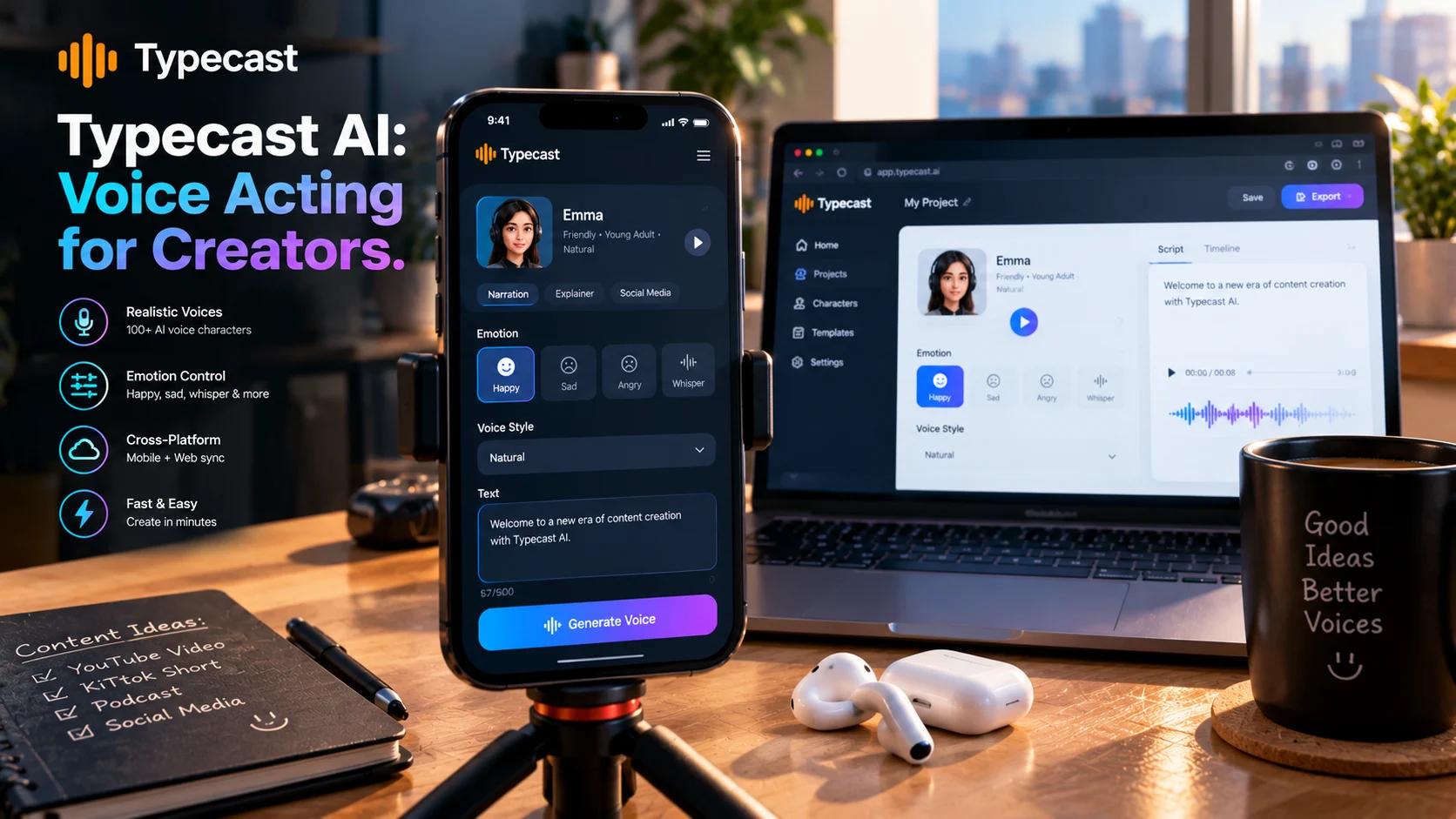
Typecast’s differentiating feature is its emotion system. The platform offers two approaches :
- Preset Mode: Users manually select emotions like normal, happy, sad, angry, whisper, tone up, or tone down. Intensity can be adjusted with a multiplier value.
- Smart Mode (Context-Aware): The system infers appropriate emotion from the text itself, eliminating manual emotion selection for natural-sounding delivery.
The emotion presets vary by model. The ssfm-v21 model supports basic emotions, while the newer ssfm-v30 adds whisper and tone adjustment capabilities .
Voice Cloning
Typecast offers two cloning tiers. Instant Cloning requires a short audio sample (maximum 25 MB in WAV or MP3 format) and returns a voice ID that works immediately with text-to-speech . Professional Cloning provides higher fidelity and is included in the Plus plan and above, though slot limits apply .
Timestamp Alignment for Subtitles
A notable API feature is timestamp generation. The text_to_speech_with_timestamps() function returns base64 audio alongside word-level or character-level timestamps aligned with the synthesized speech. The result object includes to_srt() and to_vtt() helpers for subtitle file generation .
For non-whitespace languages like Japanese and Chinese, the SDK recommends granularity="char" because word-level alignment may collapse entire sentences into single segments .
Key Features and Capabilities
Voice Library
The platform offers over 600 professional AI voice characters. Voices can be filtered by model, gender, age, and use case through the Voice Discovery API . The mobile app provides access to the full voice library, not a stripped-down subset .
Language Support
Typecast supports 37 languages with a consistent credit cost regardless of language. Every character, including spaces and symbols, costs one credit . This uniformity simplifies budgeting for multilingual content.
Mobile App with PC Synchronization
The Typecast mobile app, launched in January 2026, offers the full Studio experience on smartphones. Projects synchronize across devices, allowing users to start on mobile and finish on desktop . Audio files save directly to the phone for immediate use in Reels, Shorts, or TikTok .
API and SDKs
Typecast provides official SDKs for Python and Go, with async support and full type hints . The API supports multiple models (ssfm-v21 and ssfm-v30), voice discovery, instant cloning, and timestamp generation .
Pricing and Plans
Typecast separates Studio (web/app) and API pricing. Usage on both is measured in credits, where 1 character = 1 credit .
Studio Plans
| Free | $0 | 3,000 lifetime | Trial voices | 1 GB |
| Basic | $5/month | 30,000/month | 1 cloning slot | 5 GB |
| Plus | $19/month | 40,000/month | 1 cloning slot | 30 GB |
| Pro | $29/month | 75,000/month | 2 cloning slots | 50 GB |
| Business | $69/month | 200,000/month | 10 cloning slots | 100 GB |
Critical detail: Unused credits do not roll over to the next billing cycle. Credits expire at the end of each month .
Talking Avatars: Each avatar video generation costs 5,000 credits, significantly higher than standard voice generation .
API Plans
| Free | $0 | 15,000/month | 2 | No (attribution required) |
| Lite | $15/month | 200,000/month | Higher | Yes |
| Plus | $280/month | 4M/month | Higher | Yes |
| Enterprise | Custom | Custom | Custom | Yes |
Additional API usage is billed in fixed increments: $9 per 100,000 credits for Lite and $100 per 1.25M credits for Plus .
Important distinction: Studio and API plans are separate subscriptions with independent billing. Subscribing to one does not include the other .
How Typecast Compares to Alternatives
Editorial interpretation: Typecast’s differentiation lies in emotional expressiveness and the character-based voice library. For creators producing narrative-driven content, the emotion presets and Smart Mode offer more nuance than neutral TTS tools. ElevenLabs competes on conversational AI and realism, while Murf focuses on workflow integrations.
Privacy and Data Handling
Typecast’s privacy policy, updated August 2026, outlines several commitments .
Third-party processors include Kakao Business (notifications), NHN Cloud (SMS/MMS), Mailchimp (email), Mixpanel (usage analytics), and Google Analytics .
International data transfers comply with GDPR safeguards, including Standard Contractual Clauses for EEA data transferred outside the region .
Facial image handling: The Korean privacy policy states the company does not collect or analyze facial recognition data or biometrics. Uploaded images are processed as regular image files for avatar content generation and are not used to identify individuals or shared with third parties .
Security measures include administrative controls (internal management plans, employee training), technical controls (access management, encryption, access logs), and physical controls (facility access restrictions) .
Important caveat: The privacy policy does not reference SOC 2 certification, ISO 27001, or Zero Data Retention guarantees. Organizations with strict compliance requirements should conduct their own due diligence.
Who Should Use Typecast AI
Content creators producing narrative-driven videos benefit from the emotion presets and character voices. The mobile app’s direct-to-phone saving simplifies workflows for Reels, Shorts, and TikTok .
Multilingual creators can use the 37-language support with consistent credit costs, simplifying budgeting across markets .
Developers integrating TTS into applications can use the API and SDKs, with timestamp generation for subtitle workflows .
Businesses and agencies on the Business plan gain 10 voice cloning slots and 200,000 monthly credits for team use .
Users seeking free TTS can use the Free plan, but should note the 3,000 lifetime credit limit on Studio and the non-commercial restriction on API audio .
Common Mistakes and Cautions
Assuming credits roll over. Unused Studio credits expire at the end of each billing cycle. Plan usage accordingly .
Confusing Studio and API plans. They are separate subscriptions. Subscribing to Studio does not include API access, and vice versa .
Overlooking the Talking Avatar cost. At 5,000 credits per video, avatar generation consumes credits far faster than standard voice generation .
Using free API audio commercially. The API free plan’s output cannot be used commercially and requires attribution. Commercial use requires a paid API plan .
Ignoring language-specific timestamp settings. For Japanese and Chinese, use character-level granularity for subtitles to avoid collapsed segments .
Frequently Asked Questions
What is Typecast AI?
Typecast AI is a text-to-speech platform developed by Neosapience that specializes in emotional voice generation. It offers over 600 AI voices across 37 languages with emotion presets, voice cloning, and API access for developers .
How much does Typecast AI cost?
Studio plans start at $5/month for Basic (30,000 credits) and go up to $69/month for Business (200,000 credits). API plans start at $15/month for Lite (200,000 credits), with a free tier offering 15,000 monthly credits but restricting commercial use .
Does Typecast AI offer voice cloning?
Yes. Instant Cloning requires a short audio sample (maximum 25 MB) and returns a voice ID usable immediately. Professional Cloning offers higher fidelity and is available on Plus plans and above, with slot limits varying by tier .
Is Typecast AI safe and private?
The privacy policy states compliance with GDPR safeguards for international transfers and specifies that facial images are not used for biometric analysis. However, no SOC 2 or ISO 27001 certifications are referenced. Organizations with strict requirements should review the policy independently .
What are the best Typecast AI alternatives?
Alternatives include ElevenLabs for conversational AI agents, Murf AI for API integrations with design tools, Speechify for celebrity voices, and Fish Audio for budget-friendly voice generation .
Conclusion
Typecast AI has built a distinct position in the crowded text-to-speech market. Its focus on emotional expressiveness and character-based voice acting differentiates it from neutral narration tools. The PC-mobile synchronization and direct-to-phone saving reflect a workflow designed for creators working across devices.
What matters most is understanding the pricing model. The character-based credit system is transparent, but credits expire monthly. The separation between Studio and API plans requires careful planning for teams needing both. The Free tier is genuinely useful for testing, but its limits become apparent quickly.
Typecast may suit content creators producing narrative videos, multilingual teams needing consistent pricing across languages, and developers integrating emotional TTS into applications. It may not suit users seeking simple, low-cost narration without emotion controls or those needing commercial API access on a budget.
Before subscribing, test the Free plan with your actual scripts. Evaluate whether the emotion presets match your content needs. Confirm that your workflow fits within the credit allowance. And review the privacy policy if handling sensitive content. Typecast’s strength is emotional range, but that range requires understanding the tools and the billing model.