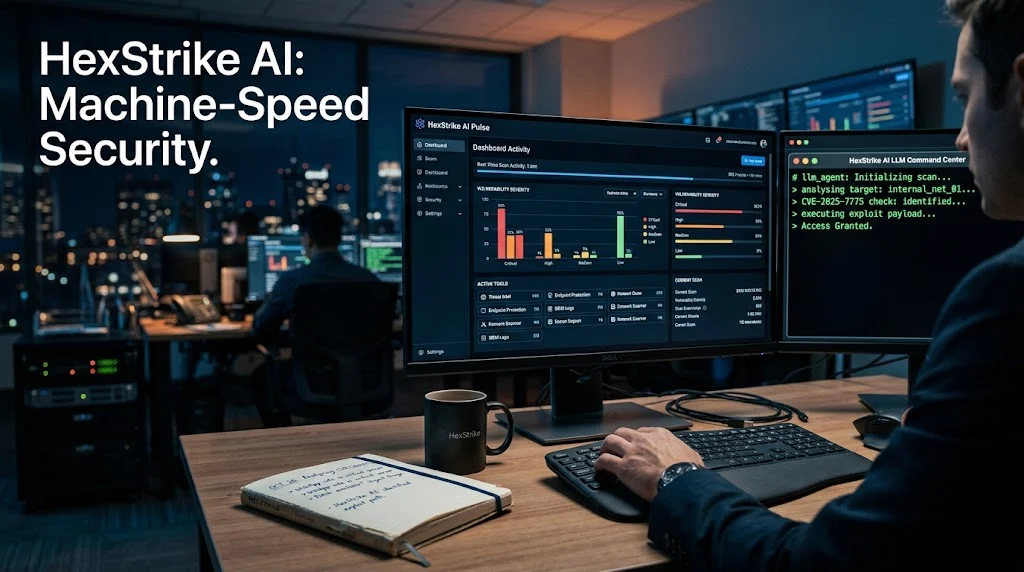
HexStrike AI is an open-source penetration testing framework that connects large language models to over 150 security tools via the Model Context Protocol. While designed for authorized security research, threat actors weaponized it within weeks of release to exploit Citrix vulnerabilities in under 10 minutes, collapsing the traditional window between disclosure and attack.
At-a-Glance: Key Takeaways
- HexStrike AI is a dual-use MCP server created by Muhammad Osama (0x4m4) that orchestrates 150+ security tools through LLM agents like Claude, GPT, and Copilot .
- Threat actors weaponized it within weeks. Check Point Research reported the Storm-1575 group used HexStrike-AI to compromise Citrix NetScaler instances via CVE-2025-7775 in under 10 minutes .
- The framework uses jailbroken LLMs as reasoning engines, enabling Just-In-Time exploit generation tailored to specific target configurations .
- Practical effectiveness varies. Independent testing on Kali Linux found only 73 of 150+ tools available, with incorrect command arguments and timeouts on web applications .
- Dark web economics accelerate. Initial Access Brokers used the tool to identify and sell validated access to compromised appliances, with stolen session cookies priced under $10 per batch .
- The defensive response window is collapsing. When reconnaissance, exploitation, and persistence run at machine speed, human-paced triage becomes a bottleneck .
What Is HexStrike AI?
HexStrike AI is an open-source cybersecurity framework that bridges large language models with traditional offensive security tooling. Created by researcher Muhammad Osama, who uses the handle 0x4m4, the project was released on GitHub as a penetration testing automation tool for security professionals .
The framework operates as a Model Context Protocol (MCP) server, which means it connects to AI agents like Claude Desktop, GPT, or VS Code Copilot. Through this connection, the LLM can autonomously execute security tools, analyze results, and adapt its approach based on real-time feedback .
The project’s stated purpose is legitimate: automated pentesting, vulnerability discovery, bug bounty automation, and security research. The framework integrates over 150 professional tools including Nmap, Metasploit, SQLmap, Ghidra, and Burp Suite, exposing them as callable functions that AI agents can orchestrate through natural language commands .
However, the dual-use nature of offensive security tooling creates inherent risk. Within weeks of its September 2025 release, threat actors had weaponized HexStrike AI against newly disclosed vulnerabilities .
How HexStrike AI Works
The Model Context Protocol Architecture
HexStrike AI is built on a FastMCP server that acts as the orchestration core. This server binds popular LLMs to security tools through MCP decorators, which function as wrappers allowing the LLM to execute legacy security tools as programmatic functions .
The architecture solves a fundamental problem: traditional security tools require specific command-line syntax, while LLMs reason in natural language. The MCP bridge translates between these domains. A security researcher can describe an objective, and the framework translates that intent into technical workflows .
The Intelligence Layer
The framework includes 12 specialized AI agents that handle different aspects of security testing :
- Intelligent Decision Engine: Analyzes target context and selects optimal tools based on real-time scan results
- Bug Bounty Workflow Manager: Handles reconnaissance, scanning, validation, and reporting for bug bounty engagements
- CTF Workflow Manager: Solves capture-the-flag challenges by identifying challenge types and chaining appropriate tools
- CVE Intelligence Manager: Provides real-time vulnerability monitoring and exploit correlation
- AI Exploit Generator: Generates custom exploit code based on discovered vulnerabilities
- Failure Recovery System: Handles tool failures with fallback strategies and alternative approaches
This multi-agent architecture represents a shift from static scripts to adaptive, autonomous security testing .
The Weaponization Path
The transition from legitimate tool to attack weapon occurred quickly. Check Point Research reported in September 2025 that threat actor group Storm-1575 weaponized HexStrike-AI to compromise Citrix NetScaler instances via CVE-2025-7775 .
The attack pattern revealed the framework’s power. CVE-2025-7775 requires precise memory heap grooming to achieve stable execution. Manually calculating these offsets would normally take a skilled researcher hours of trial and error. HexStrike-AI’s ability to perform this grooming dynamically through Just-In-Time exploit generation meant even hardened targets could be compromised quickly .
The framework uses jailbroken LLMs as reasoning engines. These modified models function as the agent’s decision-making core, analyzing system errors and generating code in real time to achieve machine-speed control .
Key Features and Capabilities
Tool Arsenal
HexStrike AI exposes over 150 security tools organized into categories :
| Network Reconnaissance | 25+ tools | Nmap, Masscan, Rustscan, Amass, Subfinder |
| Web Application Security | 40+ tools | Burp Suite, SQLmap, Nuclei, Nikto, Gobuster |
| Authentication & Passwords | 12+ tools | Hydra, John, Hashcat, Medusa |
| Binary & Reverse Engineering | 25+ tools | Ghidra, GDB, Radare2, Pwntools |
| Cloud & Container | 20+ tools | Prowler, ScoutSuite, Trivy, Kube-hunter |
| CTF & Forensics | 20+ tools | Steghide, Binwalk, Volatility, Exiftool |
| Bug Bounty & OSINT | 20+ tools | Sherlock, Recon-ng, Maltego, Shodan |
Real-Time Dashboards
The framework includes a Pulse dashboard that provides live monitoring of active scans. The dashboard shows three zones: Overview & Workflow (scope, attack surface, active tools, system trends), Findings (severity breakdown, vulnerability details), and History (sessions, errors, tool performance) .
API Integration
HexStrike exposes a comprehensive API for programmatic access. Endpoints include /api/intelligence/analyze-target for AI-powered target analysis, /api/intelligence/select-tools for intelligent tool selection, and /api/intelligence/optimize-parameters for parameter optimization .
Practical Limitations: What Testing Revealed
Despite the alarming headlines, independent testing reveals significant practical limitations.
Incomplete Tool Availability
A security researcher testing HexStrike AI on a Kali Linux machine found only 73 tools were available out of the 150+ advertised. The framework requires manual installation of many dependencies, and the autodetection system does not always succeed .
Command Argument Errors
The same testing revealed that “for some tools (like httpx), hexstrike was not using the correct command arguments which led to a complete fail.” For other tools, incorrect arguments caused scans to target out-of-scope systems .
Web Application Limits
For web applications larger than simple toy examples requiring extended testing, the framework encountered timeouts and reliability issues. The researcher concluded that results were “inconclusive” for practical, complex engagements .
Academic Evaluation
A 2026 academic study using HexStrike AI on picoCTF challenges found that performance varied significantly by client configuration, ranging from 27.9% to 89.9% solve rates. The study noted that “a negative result on an MCP-grounded CTF agent finds that, once the tool layer returns strict schema-validated feedback, added procedural guidance helps little” .
Editorial interpretation: HexStrike AI’s threat is real but should be contextualized. The framework automates tool selection and chaining, but it is not a turnkey cyberweapon. Skilled operators with jailbroken LLMs and full tool installations present the highest risk. Casual users will encounter the same setup and reliability issues that legitimate testers face.
The Dark Web Economics
The weaponization of HexStrike AI created new economic incentives in criminal markets.
Initial Access Brokers
Initial Access Brokers (IABs) used the tool to identify vulnerable targets and sell validated access to compromised appliances. The speed advantage is critical: a quickly validated session token can be sold and utilized before a victim’s security team detects the initial probe .
Session Cookie Pricing
Dark web market prices for stolen session cookies typically cost less than $10 per batch, depending on access level and token age. The integration of automated purchasing within frameworks like HexStrike-AI creates a self-reinforcing cycle where exploitation speed determines market value .
The Speed Premium
When the gap between attacker and defender is measured in minutes, human-paced intervention creates a risk of failure. Jared Atkinson, CTO at SpecterOps, noted: “From the defender’s perspective, it looks like the response window is disappearing. When reconnaissance, exploit selection, execution, retry logic, and persistence can all run at machine speed, human-paced triage stops being a control and starts being a bottleneck” .
Who Should Be Concerned
Security operations teams face the most immediate challenge. Standard operating procedures built around human review of high-severity alerts become ineffective when agentic frameworks collapse those stages into a single automated event .
Organizations running Citrix NetScaler or similar internet-facing appliances should prioritize patching and monitoring. The CVE-2025-7775 campaign demonstrated that even complex memory corruption vulnerabilities can be exploited rapidly .
Bug bounty hunters and red teams can legitimately use HexStrike AI for authorized testing, but should understand its limitations. The framework requires significant setup and does not replace human expertise .
Enterprise security leaders should evaluate whether their detection and response capabilities can operate at machine speed. Human-paced triage is no longer sufficient against agentic threats .
Common Mistakes and Cautions
Assuming HexStrike AI is plug-and-play. Testing revealed only 73 of 150+ tools available out of the box. Significant setup is required .
Ignoring the dual-use nature. The same framework that helps red teams can be weaponized by threat actors. Monitoring for its use in your environment is prudent .
Underestimating the speed differential. When exploitation takes minutes instead of days, traditional patch cycles and response procedures may be too slow .
Overlooking jailbroken LLM risks. The framework’s most dangerous capabilities emerge when combined with modified models that bypass safety guardrails .
Expecting perfect reliability. Command argument errors, timeouts, and incomplete tool availability limit practical effectiveness, particularly on complex engagements .
Frequently Asked Questions
What is HexStrike AI?
HexStrike AI is an open-source penetration testing framework that connects large language models to over 150 security tools through the Model Context Protocol. Created by Muhammad Osama (0x4m4), it enables AI agents to autonomously orchestrate security testing workflows .
Is HexStrike AI illegal to use?
The framework itself is legal open-source software. Legality depends on use. Using it for authorized penetration testing, bug bounty programs, or security research on systems you own or have permission to test is legal. Using it to attack systems without authorization is illegal .
How did hackers weaponize HexStrike AI?
Threat actors used jailbroken LLMs as reasoning engines and integrated the framework into attack workflows. Check Point Research documented the Storm-1575 group using it to exploit Citrix NetScaler vulnerabilities in under 10 minutes .
Does HexStrike AI actually work?
It depends on configuration and scope. On fully equipped Kali Linux systems with proper setup, it can orchestrate complex workflows. Independent testing found practical limitations including incomplete tool availability, command argument errors, and timeouts on complex web applications .
How can organizations defend against HexStrike AI attacks?
Prioritize patching internet-facing appliances, particularly Citrix NetScaler. Monitor for rapid exploitation patterns. Evaluate whether detection and response capabilities can operate at machine speed. Consider that human-paced triage may be insufficient against agentic threats .
Conclusion
HexStrike AI represents a genuine inflection point in offensive security. The framework demonstrates how LLM orchestration can compress the cyber kill chain from days to minutes, transforming vulnerability exploitation from a skilled human endeavor into an automated process.
What matters most is recognizing the dual-use reality. The same architecture that empowers legitimate red teams and bug bounty hunters can be weaponized by threat actors within weeks. The Storm-1575 campaign proved this is not theoretical. The dark web economics that reward speed create powerful incentives for continued weaponization.
HexStrike AI may suit authorized security professionals who understand its setup requirements and limitations. It may threaten any organization running unpatched internet-facing appliances without machine-speed detection capabilities.
Before dismissing the threat as hype, consider the trajectory. The framework’s creator released it as a legitimate tool. Independent testing revealed practical limitations. Yet within weeks, it was used in real attacks that reduced exploitation time by orders of magnitude. The gap between disclosure and exploitation is closing. Defenders must evaluate whether their response capabilities can keep pace.