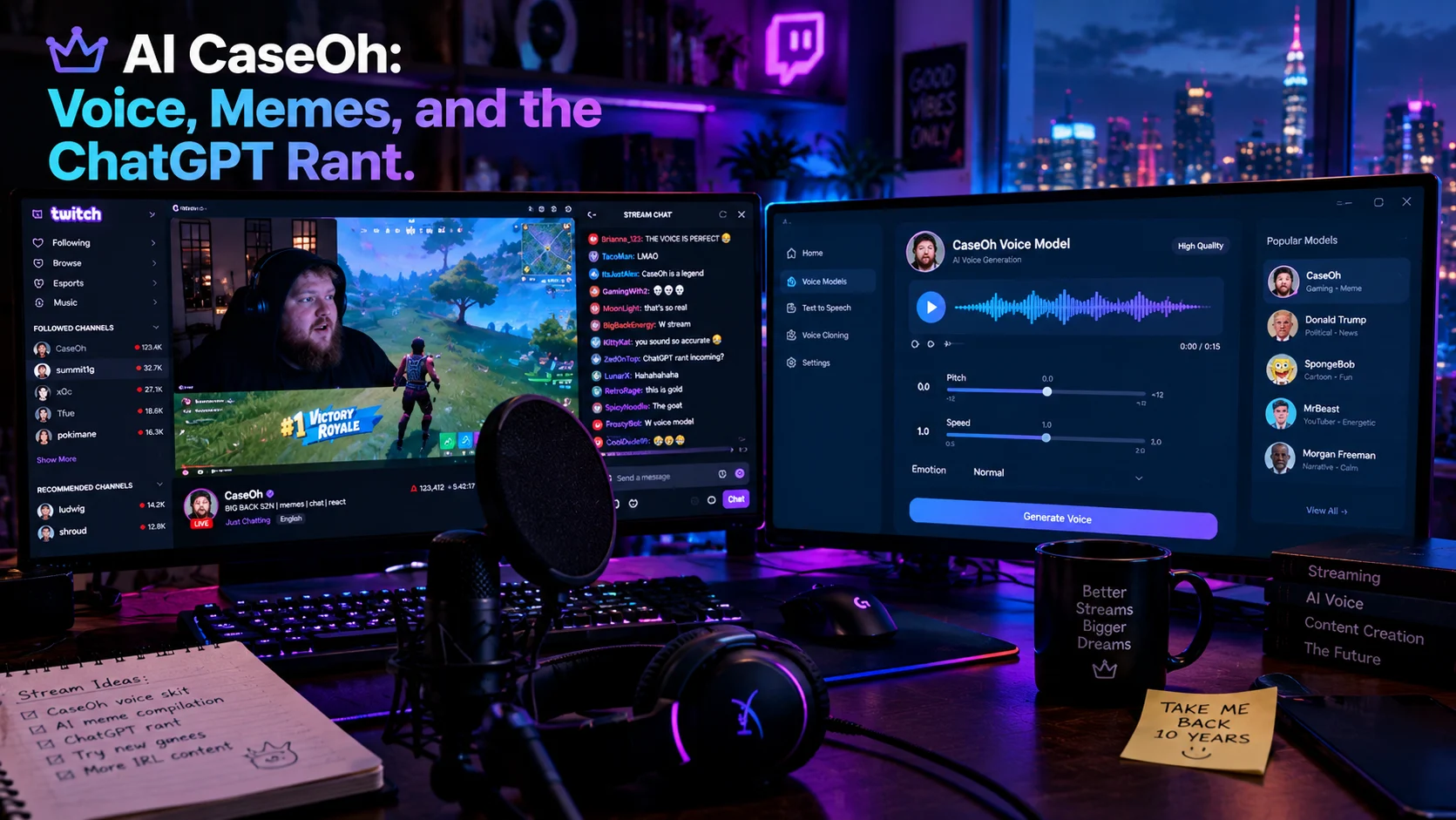
“AI CaseOh” refers to the ecosystem of AI-generated content built around Twitch streamer CaseOh, primarily voice models that clone his distinctive deep, energetic vocal style. The term also connects to his viral November 2025 rant against ChatGPT, where he shouted “take me back 10 years” and insisted he would rather use Google and read articles himself.
At-a-Glance: Key Takeaways
- CaseOh is a massive gaming streamer with 10.1 million YouTube subscribers, 8.4 million Twitch followers, and 9.3 million TikTok followers as of April 2026 .
- Multiple AI voice generators offer CaseOh models, including Vocalize, FakeYou, Fish Audio, and EaseUS VoiceWave, with use cases ranging from song covers to real-time voice changing .
- His viral ChatGPT rant in November 2025 generated over hundreds of thousands of views in hours, sparking a broader debate about AI dependency versus traditional search .
- A fan-created UTAU voicebank called CASE turns CaseOh into a Vocaloid-style virtual singer, complete with a robot character who rescues stray cats .
- An RVC v2 voice model is freely downloadable from Hugging Face, trained for 250 epochs, enabling anyone to create CaseOh covers locally .
- The AI content spans voice changers, text-to-speech, and chat bots, reflecting CaseOh’s status as a meme-generating machine whose chaotic energy translates well to AI experimentation .
What Is “AI CaseOh”?
“AI CaseOh” is not a single product. It is a category term for the various AI tools and projects built around the persona and voice of CaseOh, a popular American Twitch streamer and content creator.
CaseOh, whose real name is Case Dylan Baker, was born on May 9, 1998, in Arkansas . He rose to prominence in late 2022 through viral gaming content on TikTok before transitioning to full-time streaming. His channel features gameplay of titles like NBA 2K, Minecraft, Roblox, and horror games, often accompanied by his dramatic reactions and distinctive loud, bass-heavy voice .
The “AI CaseOh” ecosystem emerged because of two factors. First, his voice is instantly recognizable and distinctive, making it an appealing target for voice cloning. Second, his chaotic, meme-friendly personality generates the kind of content that AI tools are designed to replicate or parody.
The AI CaseOh Voice Ecosystem
Multiple platforms now offer AI voice models trained on CaseOh’s vocal characteristics. These tools serve different purposes and vary in quality, pricing, and use cases.
Voice Generation Platforms
How Voice Cloning Works
The CaseOh voice models primarily use Retrieval-based Voice Conversion (RVC), a technique that separates vocal characteristics from content . The process typically involves:
- Source audio preparation: Uploading a song or recording
- Vocal isolation: Separating lead vocals from instrumental
- Voice conversion: Replacing original vocals with the CaseOh model
- Mixing and export: Blending the converted voice back with the instrumental
For real-time applications like Discord calls or streaming, tools like EaseUS VoiceWave use low-latency processing to modify the user’s voice as they speak .
The Hugging Face Model
A downloadable RVC v2 model trained on CaseOh’s voice for 250 epochs is available on Hugging Face. The file CaseOhRemastered.zip contains the weights needed for local processing, allowing users to run conversions on their own hardware without relying on cloud services .
Important caveat: The download link comes from external platforms and has not been scanned for malware. Users download at their own discretion.
The Viral ChatGPT Rant
The most significant “AI CaseOh” moment came not from a voice generator, but from CaseOh’s own reaction to AI.
What Happened
During a Twitch stream on November 27, 2025, a viewer suggested CaseOh use ChatGPT to look something up. CaseOh snapped. He leaned toward his camera and shouted:
“Man, take me back 10 years… I’m so tired of hearing about this ChatGPT action. I will go to Google. You can look it up. You’d better read the article.”
The 43-second clip spread across X, TikTok, and Instagram within hours, accumulating hundreds of thousands of views .
The Debate
The clip ignited a broader conversation about AI dependency versus traditional search. Some viewers supported CaseOh’s position:
- “Facts. I refuse to let a robot take away my curiosity”
- “People need to stop running to AI for everything. A simple Google search works”
Critics pushed back:
Fellow streamer Jojo added fuel to the fire, posting that people who depend on AI for simple answers are “already brain dead.” Her tweet received thousands of likes .
Editorial interpretation: The rant resonated because it captured a genuine cultural tension. CaseOh’s frustration wasn’t about technology itself but about what he perceived as intellectual passivity. His “take me back 10 years” line became the meme because it expressed a longing for a time before AI mediation became default.
CASE: The Vocaloid-Style AI Character
Beyond voice cloning tools, fans created something more elaborate: a UTAU voicebank called CASE.
What Is CASE?
UTAU is a Japanese singing voice synthesizer that allows users to create and distribute their own virtual singers. A fan developer known as Near used RVC technology to build a bass-boosted deep male voice based on CaseOh’s personality and vocals .
CASE is characterized as “a robot on a mission to spread joy and enjoy life throughout the world.” The character is depicted as a “gentle giant with a heart of gold who loves to rescue and care for stray cats” .
Fan Response
The UTAU community embraced CASE. A cover of the song “Aishite Aishite Aishite” performed by CASE generated significant views. CaseOh himself reacted with amazement and gratitude, calling it evidence of his fans’ creativity and dedication .
A song called “Case by Case” featuring CASE and Hatsune Miku was released, further cementing the character’s place in fan-created content.
AI Chat Bots and Character Simulations
Several platforms offer AI chat bots designed to simulate conversations with CaseOh or characters based on his persona.
Shapes, Inc. hosts several CaseOh-inspired AI characters, including one portrayed as a 26-year-old character who enjoys fast food and making lighthearted jokes The bot’s description warns that “his tone can get pretty annoying” and that users should “just don’t call him fat” .
Other chat bot variations describe CaseOh as a “grotesquely obese yet charismatic persona” with a “loud voice and dry sense of humor,” or as a 24-year-old gaming creator specializing in “comedic clips and streams of horror games” .
Editorial note: These AI chat bots are unofficial fan creations. They reflect the community’s playful engagement with CaseOh’s persona rather than any official representation.
The Ethics and Practicality of AI Voice Cloning
The AI CaseOh ecosystem raises questions that apply broadly to celebrity voice cloning.
Consent and Attribution
CaseOh has not publicly endorsed any of the voice generators using his likeness. The models are created by fans and third-party developers without formal permission. This is common in the AI voice cloning space, where the technology moves faster than legal frameworks for personality rights.
Platform Terms of Service
Most voice generation platforms place responsibility on users to ensure they have the right to use a voice model. This creates a gray area when the voice belongs to a public figure who has not explicitly licensed it.
Practical Limitations
AI voice models capture vocal characteristics but not the spontaneity that makes CaseOh’s content entertaining. The “spontaneous screaming” and “raw energy” of his real reactions are difficult for AI to replicate . Voice changers can mimic his tone, but they cannot generate his comedic timing or improvisational humor.
Who Uses AI CaseOh Content
Content creators use CaseOh voice models to create covers, narration, or meme content without needing his actual participation. The models are particularly popular for TikTok and YouTube Shorts .
Fans create AI covers, TTS clips, and chat bot interactions as a form of participatory fandom. The UTAU character CASE represents the most elaborate expression of this creativity .
Streamers may use real-time voice changers to entertain audiences by sounding like CaseOh during gameplay or Discord calls .
Meme enthusiasts generate short clips and reactions using text-to-speech tools, feeding the endless demand for CaseOh-adjacent content.
Common Mistakes and Cautions
Expecting perfect replication. AI voice models capture the sound but not the personality. The result may sound like CaseOh but lack the chaotic energy that defines his content.
Ignoring platform limitations. Free tiers often have character limits, watermarks, or wait times. Paid tiers unlock longer text and faster processing.
Overlooking ethical considerations. Using a public figure’s voice without consent is a legal gray area. The platforms shift responsibility to users.
Assuming all models are equal. Quality varies significantly. The Hugging Face RVC model requires technical setup, while online tools offer convenience but less control.
Forgetting the human behind the model. CaseOh is a real person with a career built on genuine reactions. AI clones are imitations, not replacements.
Frequently Asked Questions
What is AI CaseOh?
“AI CaseOh” refers to AI voice generators, chat bots, and fan projects built around Twitch streamer CaseOh. These include voice models that clone his distinctive sound, text-to-speech tools, and a UTAU virtual singer character called CASE .
What did CaseOh say about ChatGPT?
During a November 2025 stream, CaseOh snapped at a viewer who suggested he use ChatGPT, shouting “take me back 10 years” and saying he would rather use Google and read articles himself. The 43-second clip went viral and sparked a debate about AI dependency .
How do I make an AI CaseOh voice?
You can use platforms like Vocalize, FakeYou, Fish Audio, or EaseUS VoiceWave. Upload audio or type text, select the CaseOh voice model, and generate. For local processing, download the RVC v2 model from Hugging Face .
Is it legal to use CaseOh’s AI voice?
This is a legal gray area. CaseOh has not publicly licensed his voice for AI use. Most platforms place responsibility on users to ensure they have the right to use a voice model. Using it for commercial purposes without permission carries risk.
What is CASE the Vocaloid?
CASE is a fan-created UTAU voicebank based on CaseOh’s voice. Created by a developer called Near using RVC technology, CASE is characterized as a robot who rescues stray cats. CaseOh has expressed amazement and gratitude for the project .
Conclusion
“AI CaseOh” describes a vibrant fan ecosystem that emerged from a streamer’s distinctive voice and chaotic energy. Voice generators allow anyone to create covers, narration, or meme content in his style. A UTAU character transforms him into a virtual singer. Chat bots simulate his persona. And his own viral rant against ChatGPT added a layer of irony: the streamer most associated with AI content became famous for rejecting AI in daily life.
What matters most is understanding the boundaries. AI voice models capture sound, not personality. They replicate tone, not comedic timing. The tools are impressive for what they do, but they are imitations of a human whose appeal comes from genuine reactions and spontaneous humor.
AI CaseOh content may suit fans creating participatory content, creators needing a distinctive voice for memes or covers, and anyone exploring voice cloning technology. It may not suit those seeking authentic CaseOh experiences or commercial applications without legal clarity.
Before using any CaseOh voice model, consider the ethical implications of cloning a public figure’s voice without consent. Check the platform’s terms of service. And remember that the best CaseOh content comes from CaseOh himself, not from an algorithm trained on his sound.