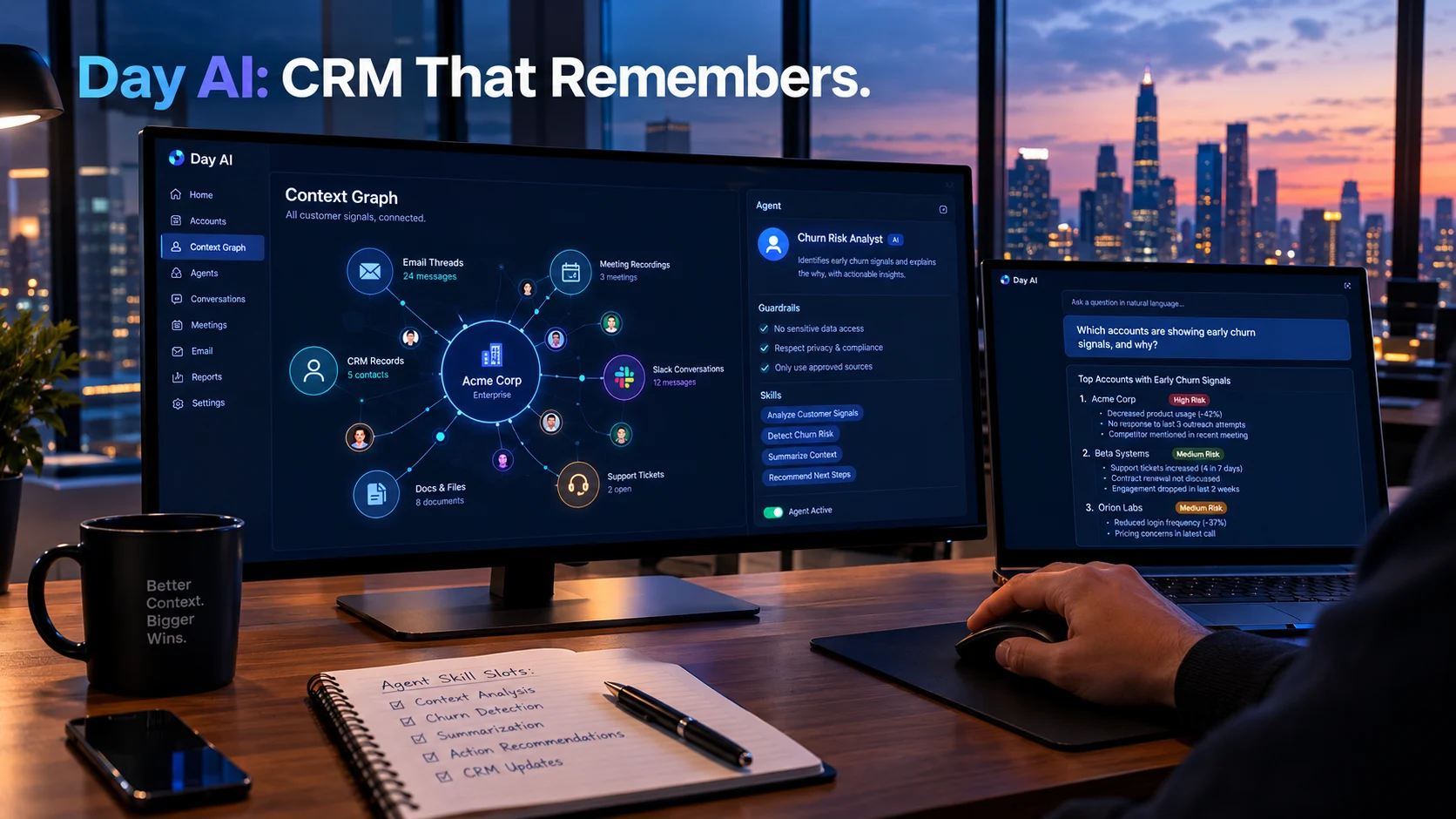
Day AI is an AI-native CRM platform where autonomous agents capture every email, meeting, and Slack conversation to build a “context graph” of your customer relationships. It charges per agent rather than per seat, with a free tier and paid plans from $24 to $200 per agent per month.
At-a-Glance: Key Takeaways
- Day AI replaces manual CRM data entry with automatic ingestion from email, calendar, meetings, and Slack .
- It raised $24M total from Sequoia Capital, Greenoaks, and Sound Ventures, reaching general availability in early 2026 .
- Pricing is per agent, not per seat, starting free, then $24, $60, and $200 per agent monthly .
- Day AI achieved SOC 2 Type 1 compliance, with a stated policy that customer data is never used to train third-party models .
- The platform is early-stage with roughly 120 customers at general availability, meaning limited independent reviews and ecosystem maturity .
- A separate entity, “Days AI,” is an unrelated consumer app for generating anime-style character art, available on iOS and Android .
What Is Day AI?
Day AI is an AI-native customer relationship management platform built on the premise that traditional CRMs fail because they require humans to do the work. Founded in 2023 by Michael Pici and Christopher O’Donnell, former HubSpot executives, the company raised a $4M seed from Sequoia Capital in June 2024, followed by a $20M Series A in February 2026 .
The core thesis is that CRM has always captured what happened—a deal closed, a meeting occurred—but never why it happened . The context that matters most—what a customer actually said three weeks ago, what commitment was made, what concern remains unresolved—has always lived in people’s heads or in transcripts nobody has time to read.
Day AI addresses this by building a context graph from automatically ingested communications. Every email, meeting recording, and Slack conversation becomes part of a structured, reasoning-enabled memory layer. The system doesn’t ask reps to log data; it watches and listens .
How Day AI Works
The Context Graph
Day AI’s foundation is what the company calls a “context graph”—an LLM-optimized ontology built from permissioned ingestion of Gmail, Google Calendar, meeting recordings, Slack, and connectors like Gong and Snowflake . Rather than recording isolated events, the graph captures relationships, reasoning, and the connective tissue between conversations .
The practical result: when you ask “Which accounts are showing early churn signals, and why?”, the system returns specific accounts, the changes in stakeholder engagement that triggered the flag, a timeline of unresolved issues, and a recommended next step .
The Agent Architecture
Day AI’s distinguishing feature is its agent model. Each agent is a named persona with a job title, a written job description, a set of skills, and a schedule . Agents operate within explicit guardrails—drafting follow-ups but not sending them without approval, flagging deals but not changing stages autonomously .
Published examples include a CRM Data Specialist that reads meeting transcripts and updates opportunities with cited justification, a BDR that researches prospects and returns a prioritized target list, and a Chief of Staff that reviews pipeline daily and flags only deals where intervention would change the outcome .
Natural Language Interaction
Instead of navigating screens and forms, users talk to their assistant. The platform supports queries like “Show me deals closing this month and flag any that look at risk,” “What happened in yesterday’s call with Acme Corp?”, and “Find pricing emails we exchanged with Acme last quarter” .
Agents can also be set up for intelligent automation: drafting follow-up emails after every sales call, sending Slack notifications when deals go dark, or generating weekly reports .
Pricing and Plans
Day AI’s pricing model is structurally different from traditional CRM. You pay per agent, not per seat. Human colleagues can join workspaces at no cost .
| Free | $0 | 0 | Email/calendar ingestion, meeting recording, search, sharing |
| Turbo | $24/month per agent | 2 | Basic automation |
| Professional | $60/month per agent | 5 | Standard sales workflows |
| Executive | $200/month per agent | 10 | Complex multi-agent setups |
Key pricing details:
- Annual billing offers 20% off but requires contacting sales
- Volume discounts scale from 10% (21-50 agents) to 50% (301+ agents)
- The pricing page’s metadata previously cited Professional at $75/month while the page body showed $60, suggesting a recent price change
The real constraint is skill slots, not agent count. A BDR agent needing prospecting, enrichment, outreach drafting, follow-up sequencing, and reporting consumes all five Professional-tier slots .
Privacy and Security
Day AI publishes clear data commitments.
Certifications and Compliance
- SOC 2 Type 1 compliant
- Stated policy: “Your data is never used to train third-party models”
- Per-user OAuth access with scoped permissions
Email Privacy Controls
The platform applies email sharing rules everywhere. Messages not shared with a workspace are labeled “Private” and visible only to participants. Exclusion rules (by domain or address) keep specific communications private to the user and their agent .
What Is Not Documented
Available public information does not reference SOC 2 Type II, ISO 27001, or Zero Data Retention (ZDR) guarantees. The company’s Trust Center and data policy should be reviewed directly for compliance requirements.
Important distinction: SOC 2 Type 1 certification does not automatically mean Zero Data Retention. Type 1 covers point-in-time controls; Type 2 covers operational effectiveness over time.
How Day AI Compares to Alternatives
Editorial interpretation: Day AI’s differentiation is its agent-native architecture and per-agent pricing. For a ten-person sales team, running two Professional agents costs $120/month total, with everyone else on free seats—a fundamentally different cost curve from per-seat CRM . The trade-off is ecosystem immaturity. Day AI cannot match Salesforce’s AppExchange or HubSpot’s integration marketplace .
Who Should Use Day AI
Early and growth-stage B2B teams without heavily customized Salesforce or HubSpot instances. The platform is designed for teams willing to run an AI-native CRM rather than layering agents on legacy systems .
Teams where reps don’t keep the CRM up to date. If deal context lives in email, meetings, and Slack rather than in CRM fields, Day AI’s automatic ingestion addresses the root problem .
Organizations exploring agent-first workflows. The named-agent model with job descriptions and guardrails provides a structured way to delegate work to AI .
Teams with complex, deeply customized CRM requirements should evaluate carefully. Day AI cannot replicate Salesforce’s enterprise depth in CPQ, territory management, or forecasting .
Organizations requiring Type II security certifications should verify Day AI’s current compliance status before committing.
The Separate “Days AI” App
A distinct entity called Days AI is a consumer mobile app for anime-style character art, developed by Meltly K.K. . It allows users to design original characters (OCs), generate illustrations from text prompts, and chat with their characters .
The app offers free basic usage with Gold and Premium subscription tiers. It is unrelated to Day.ai the CRM platform. Users searching for the CRM should verify they are on day.ai, not the mobile app .
Frequently Asked Questions
What is Day AI?
Day AI is an AI-native CRM platform where autonomous agents capture emails, meetings, and Slack conversations to build a context graph of customer relationships. It replaces manual data entry with automatic ingestion and charges per agent rather than per seat .
How much does Day AI cost?
Day AI offers a free tier with email/calendar ingestion. Paid plans are per agent: Turbo at $24/month, Professional at $60/month, and Executive at $200/month. Human colleagues can join workspaces at no cost .
Is Day AI SOC 2 compliant?
Day AI is SOC 2 Type 1 compliant and states that customer data is never used to train third-party models. SOC 2 Type II or ISO 27001 certifications are not referenced in available documentation .
What are the best Day AI alternatives?
Alternatives include Attio (modern data-model-first CRM), HubSpot (mature ecosystem), Salesforce (enterprise depth), and Momentum (conversation automation layered on existing CRM). The choice depends on whether you want to replace or augment your current system .
What is Days AI?
Days AI is a separate, unrelated consumer app for generating anime-style character art and chatting with original characters. It is developed by Meltly K.K. and available on iOS and Android .
Conclusion
Day AI represents a genuinely different approach to CRM. Instead of asking humans to log data, it captures conversations automatically and builds a context graph that agents can reason over. The per-agent pricing model aligns cost with autonomous work, not headcount. And the Sequoia backing with a $24M raise validates the thesis that legacy CRM is ripe for reinvention .
What matters most is understanding the trade-offs. Day AI is early-stage, with roughly 120 customers at general availability and limited independent reviews . It requires deep trust in AI access to sensitive communications . And its ecosystem cannot yet match established platforms.
Day AI may suit early and growth-stage B2B teams frustrated with manual CRM updates, organizations willing to adopt an agent-first workflow, and teams where customer context lives in conversations rather than fields. It may not suit organizations with heavily customized enterprise CRM requirements or those needing Type II security certifications before deployment.
Before evaluating Day AI, connect your email and calendar to test the context graph on your actual data. Model your workflows against skill slots, not just agent count. Review the data policy against your compliance requirements. And consider whether replacing or augmenting your CRM aligns with your team’s operational reality. Day AI offers a compelling vision of CRM that works for you rather than the other way around .