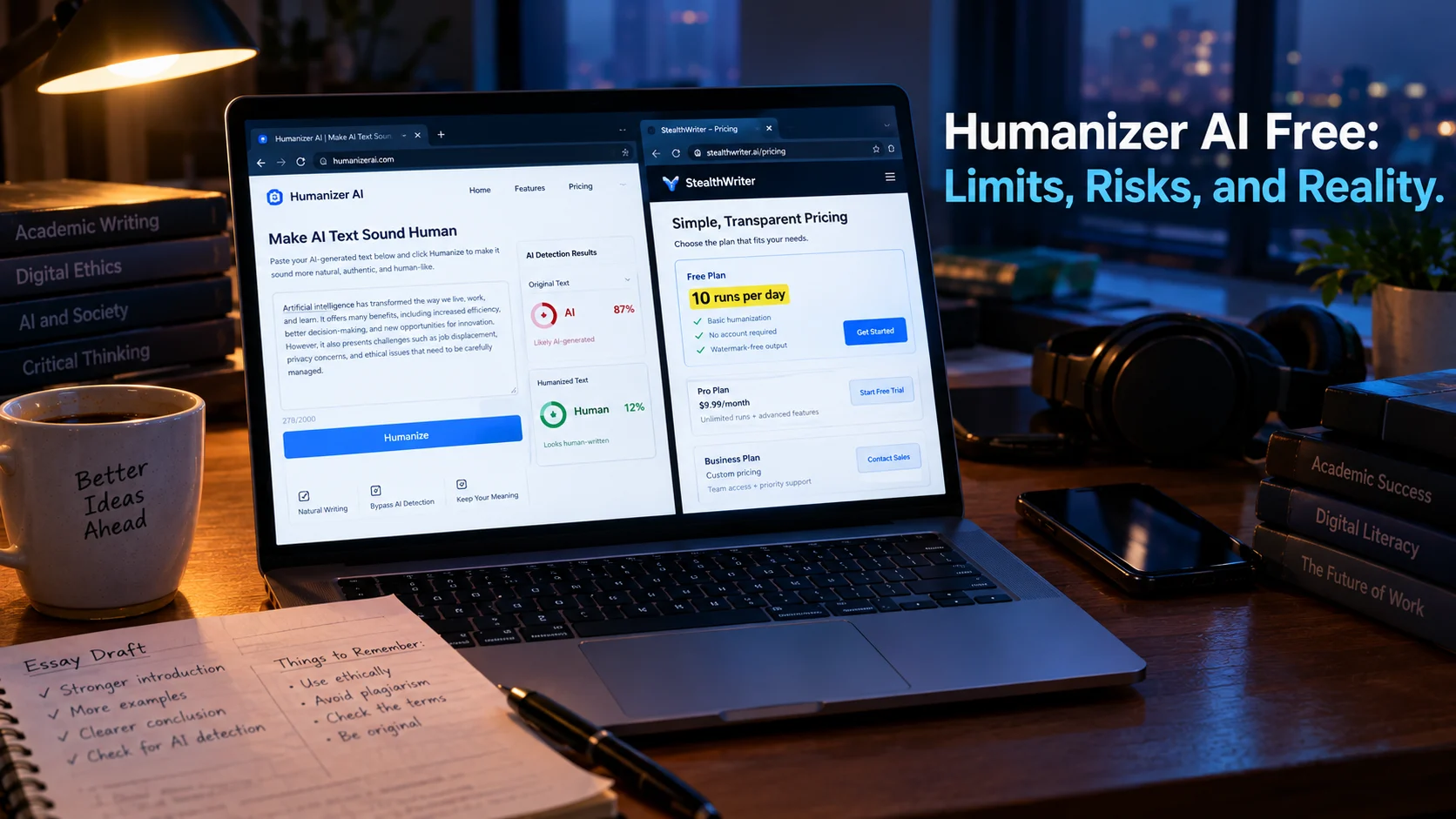
A free AI humanizer is a tool that rewrites AI-generated text to make it sound more natural and evade AI detectors at no cost. The most usable free tiers are StealthWriter (10 runs daily, 1,000 words each) and WriteHuman (3 requests monthly, 250 words each), but research shows humanizer effectiveness is inconsistent and detectors remain unreliable for high-stakes decisions.
At-a-Glance: Key Takeaways
- Free tiers are for testing, not production. StealthWriter offers the most usable free allowance: 10 humanizations daily at up to 1,000 words each, while WriteHuman caps at 750 words per month .
- Detector bypass claims are unreliable. A 2026 study found WriteHuman reduced detection to 1.98%, but Writesonic and QuillBot performed inconsistently with detection rates of 64.39% and 93.56% respectively .
- Content preservation matters more than pass rates. Research shows tools with the highest GPTZero pass rates also fabricated facts and introduced grammar errors, making them unusable for professional work .
- AI detectors themselves are unreliable. False positive rates across commercial detectors range from 0.05% to 68.6%, and honest AI editing can be flagged more often than humanized evasion .
- Most “free” tools are trials. Undetectable AI offers a one-time 250-word trial requiring payment details, while GPTHuman offers a 300-word test with no ongoing free plan .
- StealthWriter is the only tool for daily free use. Its daily renewal makes it viable for regular small tasks, unlike monthly-capped alternatives .
What Is a Humanizer AI Free?
A humanizer AI free is a tool that rewrites text to make it appear human-written, offered at no cost with usage limitations. The category exists because AI detectors flag machine-generated text, and some users want to avoid that flagging.
The free tier structure varies significantly. Some tools offer daily renewing allowances. Others provide monthly caps. Many label themselves “free” while offering only one-time trials that require payment details to continue.
The practical question is not whether a tool is free, but whether its free allowance covers your actual use case. A 250-word monthly limit serves a product note or a short email. It does not serve a blog post, a report, or anything approaching professional content volume.
The Free Tiers Compared
StealthWriter stands out because its allowance renews daily rather than monthly. Ten runs at 1,000 words each could theoretically cover 10,000 words in a day, though the page does not state whether humanizations and AI scans share a pool . For a single article, this is workable. For sustained daily production, the caps will bind.
WriteHuman offers the largest stated monthly free allowance at 750 words, plus 10 detection checks. That covers one short piece per month, useful for testing output quality on your actual content .
BypassGPT renews monthly but caps at 150 words, less than a single 200-word section. It exists to demonstrate the tool’s modes, not to accomplish work .
GPTHuman and Undetectable AI are trials, not free plans. Undetectable AI requires payment details even for the 250-word trial, meaning charges begin after the window closes .
QuillBot operates differently. It is a paraphraser with an AI humanizer feature. Its free tier limits are unpublished, and independent research found it performed poorly at evading detection, with 15 of 18 outputs remaining flagged across detectors .
How Free Humanizers Work
The Technical Approach
Humanizers manipulate text at the statistical level. They vary sentence length (burstiness), restructure clauses, adjust information density, and replace predictable phrasing. Detectors look for patterns like low variance in sentence length and specific vocabulary distributions. Humanizers attempt to disrupt those patterns.
The tools differ in how aggressively they rewrite. Some make surface-level substitutions. Others rewrite entire clauses. Research from a controlled comparison found that TextPulse rewrote 52% of words while preserving 97% of document meaning, while other tools with higher raw detector pass rates fabricated numbers and names or introduced grammar errors .
The Detector Arms Race
Detectors are updated frequently. A bypass that works today may fail after the next detector update. Originality.ai’s 5.0 release claims up to 92.38% detection of humanized text in its internal retests, though these are vendor claims rather than independent validation .
The academic picture is more nuanced. A 2026 ArXiv paper found that honest AI editing (refining an abstract) was flagged at 64-80% rates by Pangram and GPTZero, while humanized evasion reduced detection to under 4% . The implication is uncomfortable: using a humanizer may carry less sanction risk than transparent AI assistance, depending on institutional policy.
The Content Preservation Problem
The most important finding for anyone considering a humanizer is that bypass rates alone are misleading. A benchmark of eleven humanizers found that tools with the highest GPTZero pass rates had the weakest content integrity. Walter Writes passed 60% of outputs but fabricated 4.4 numbers or names per 300-word text. Phrasly passed 38% but introduced 3.6 grammar errors per 1,000 words .
TextPulse, which rewrote more deeply while preserving meaning, had the highest strict pass rate (detector pass plus content preservation) at just 10.4% .
Editorial interpretation: If a free humanizer promises a 100% bypass rate, it is likely achieving that by changing what your text says. For any content where accuracy matters, that is worse than being flagged.
The Detector Reliability Problem
Humanizers exist because detectors flag text. But detectors themselves are unreliable.
A 2026 University of Florida study tested five commercial detectors and found false positive rates ranging from 0.05% to 68.6%. One detector produced a false negative rate of 99.6% . Stanford research found non-native English speakers face substantially higher false positive rates. A PNAS Nexus study found more than half of TOEFL essays were wrongly flagged across every detector tested .
A Springer study of academic integrity tools found that detection rates dropped considerably for hybrid and humanized AI text, and that Pangram was the only tool producing satisfactory results among those tested .
What this means for free humanizer users: You may be using a humanizer to avoid a detector that would have flagged you incorrectly anyway. And the humanizer may not reliably prevent flagging even when your text is genuinely human-edited.
Privacy and Security Considerations
Free humanizers process text on remote servers. Most do not publish security certifications, data retention policies, or zero-retention guarantees.
What to check before pasting:
- Whether the tool stores submitted text
- Whether text is used for model training
- Whether you can delete your data
- The tool’s privacy policy and terms
StealthWriter and WriteHuman are consumer-grade products. No SOC 2 certification or similar compliance framework is referenced for free humanizers generally. They are not enterprise software.
Important distinction: A tool being free does not make it safe for confidential content. Assume any text pasted into a free web tool passes through third-party infrastructure and should not contain sensitive information.
Who Should Use a Free Humanizer
Researchers and writers testing detection limits can use free tiers to understand how detectors respond to different rewriting approaches. WriteHuman’s 750-word monthly allowance is sufficient for a single test document .
Casual users with occasional short texts may find StealthWriter’s daily 10-run allowance useful for small tasks. The daily renewal suits irregular use better than monthly caps .
Anyone needing reliable, production-quality output should not rely on free tiers. The caps are too small, and the content preservation risks are too high for professional work.
Users seeking to improve writing quality should consider a paraphraser or editor instead. Humanizers optimize for detection evasion, not readability or accuracy. Research shows the tools with the best bypass rates often produce the worst text .
Students should understand that using a humanizer to disguise AI-generated work is a form of academic dishonesty. The ethical implications are significant regardless of whether the tool succeeds.
Common Mistakes and Cautions
Assuming “free” means unlimited. Every free tier has caps. StealthWriter’s daily limit, WriteHuman’s monthly limit, and BypassGPT’s 150-word allowance are all binding constraints .
Trusting bypass claims without checking content quality. A tool that achieves 0% detection may have fabricated facts or introduced grammar errors to get there .
Ignoring detector unreliability. Detectors produce false positives at rates up to 68.6% in independent testing. A flag is not proof of AI generation .
Using humanizers for sensitive content. Free web tools process text remotely. Do not paste confidential, personal, or proprietary information.
Confusing trial with free plan. GPTHuman and Undetectable AI offer one-time trials, not ongoing free access. Undetectable AI requires payment details for its trial .
Frequently Asked Questions
What is the best free AI humanizer?
StealthWriter offers the most usable free allowance: 10 humanizations daily at up to 1,000 words each, with no credit card required . WriteHuman offers the largest stated monthly total at 750 words, useful for a single test document .
Do free AI humanizers actually work?
Effectiveness varies and is unreliable. A 2026 study found WriteHuman reduced detection to 1.98%, while QuillBot left 15 of 18 outputs flagged . Research also shows tools with the best bypass rates often distort content or introduce errors .
Are AI humanizers safe to use?
Free humanizers process text on remote servers without published security certifications. Assume any pasted text passes through third-party infrastructure. Do not use them for confidential or sensitive content.
Can I use a free humanizer for academic work?
Using a humanizer to disguise AI-generated work in academic settings is a form of deception. Institutions are increasingly aware of humanizer tools, and research shows detector scores should not be used as standalone misconduct evidence . The ethical concerns are significant regardless of tool effectiveness.
What are the best free alternatives to AI humanizers?
For improving writing quality, use a paraphraser or editor like Grammarly’s free tier (100 AI prompts monthly) or QuillBot’s free paraphrasing . For checking whether text reads as AI, GPTZero offers 10,000 words monthly of free detection . For understanding detector limitations, the academic research is more useful than any tool.
Conclusion
Free AI humanizers offer a narrow window into a contested technology. StealthWriter’s daily 10-run allowance and WriteHuman’s 750-word monthly cap are the most usable free tiers, but both are testing tools, not production solutions .