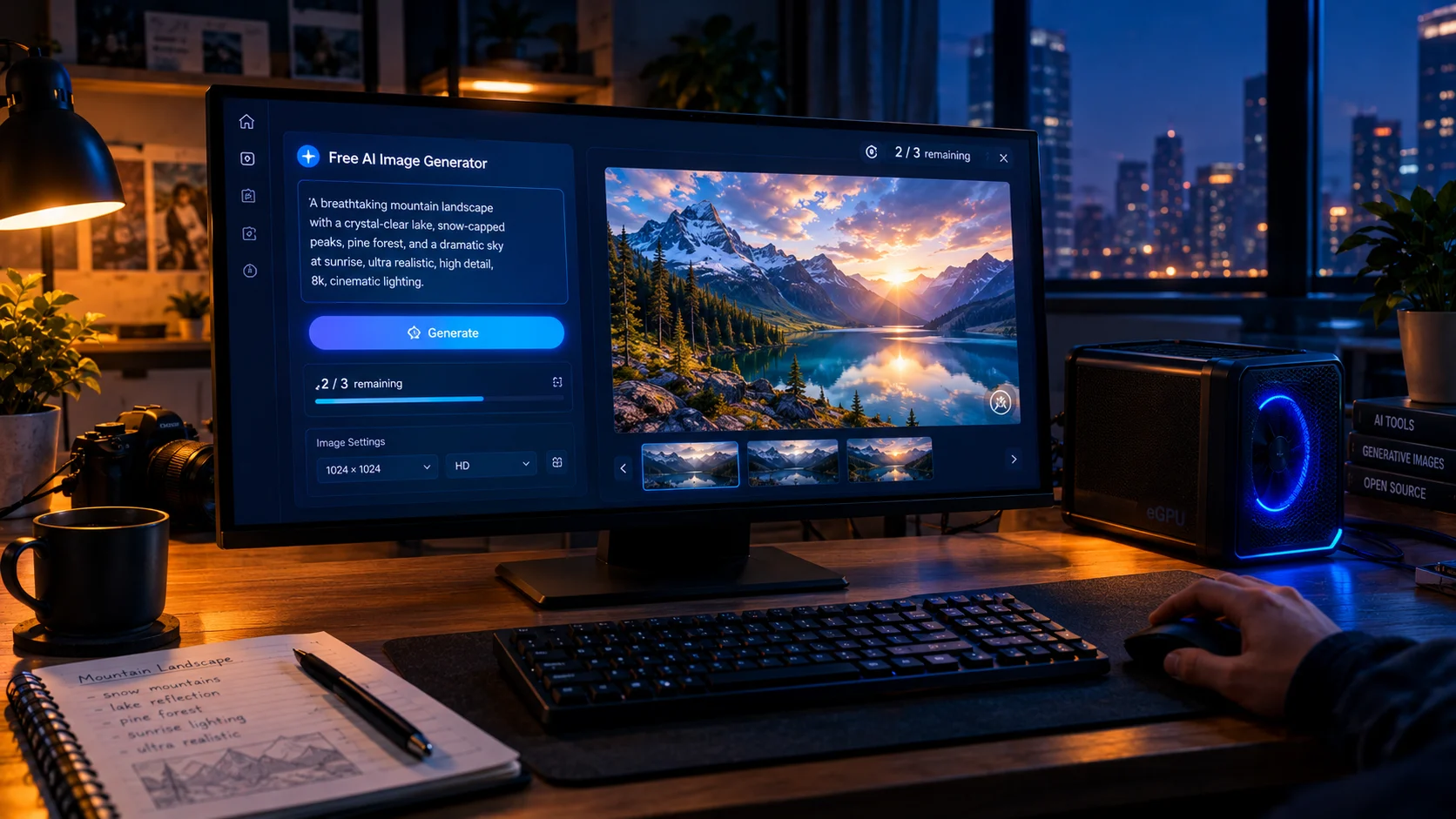
A free AI photo generator lets you create images from text prompts without paying upfront. In 2026, free tiers range from roughly 2 to 150 images per day depending on the platform, with commercial rights, watermarks, and output ownership varying dramatically between tools .
At-a-Glance Box
- Free does not mean unrestricted. ChatGPT gives 2 to 3 images daily, Leonardo.AI offers 150 tokens per day, and Google ImageFX hovers around 10 to 15 daily generations .
- Commercial rights are the hidden divide. ChatGPT and Google Gemini permit commercial use on free tiers. Microsoft Designer prohibits it. Recraft retains ownership of free output .
- Watermarks split the field. Gemini applies a visible logo on app-generated images. ChatGPT uses invisible C2PA markers. Recraft makes free images public by default .
- Leonardo.AI offers the most usable recurring allowance. 150 daily tokens support genuine iteration, not just a product demo .
- Google ImageFX leads on free output quality. Imagen 4 delivers sharp, photorealistic results with no visible watermark .
- Local open-source models remain the only unrestricted path. Stable Diffusion and similar models run without credit limits, but require GPU hardware and setup time.
What “Free” Actually Means for AI Photo Generators
The search for a free AI photo generator usually starts with good intentions. You want to test a concept, create a social graphic, or illustrate a blog post without committing to a subscription. The results page offers dozens of options, most promising “free AI image generation” without explaining what that phrase actually includes.
The reality is messier. Every free tier imposes three constraints: a generation cap, a rights restriction, and often a visibility penalty. Some platforms watermark your output. Others claim ownership of what you create. A few prohibit commercial use entirely. Understanding these boundaries before you invest time in a tool is the difference between a useful creative session and a frustrating dead end.
This guide cuts through the marketing language. It covers what each major free tier delivers, what it quietly withholds, and which tools match which use cases.
How Free Tiers Actually Work
The Credit and Quota Landscape
Free allowances fall into three models. Daily refills reset each day and never accumulate. Monthly credits arrive once and vanish if unused. One-time grants appear at signup and never return.
Leonardo.AI provides 150 tokens per day, a renewable allowance that supports genuine creative iteration . Google ImageFX offers roughly 10 to 15 images daily, though Google does not publish an official cap, leaving users to discover soft limits mid-session . ChatGPT on the free plan produces just 2 to 3 images per 24 hours, enough for occasional needs but useless for volume .
Ideogram distributes free credits weekly in a slow queue, with the exact amount unpublished and subject to change . Adobe Firefly grants 25 monthly credits on a free account, and those credits do not roll over . Recraft offers 30 daily credits, but attaches a significant condition: all free-tier images become publicly visible in the community gallery .
The practical math matters more than the headline number. Leonardo’s 150 daily tokens support perhaps 20 to 30 generations depending on settings . ChatGPT’s 2 to 3 daily images disappear in a single brainstorming session.
Watermarks and Visibility
Visible watermarks serve two purposes: brand advertising and cost recovery. Every watermarked image posted publicly recruits new users for the platform that made it.
Google Gemini applies a visible Gemini logo to images generated within its application, regardless of subscription tier. Only API outputs escape the branding . Microsoft Designer does not apply a visible mark, but restricts usage to personal projects . ChatGPT applies no visible watermark, instead embedding invisible C2PA metadata that tracks AI provenance .
The watermark question matters most for client-facing work. A visible logo disqualifies an image from professional use regardless of resolution or quality.
Commercial Rights and Ownership
This is where free tiers diverge most sharply, and where reading the terms of service becomes essential.
ChatGPT grants users ownership of generated images, including commercial use, on the free plan . Google Gemini permits commercial use under its content policies, though the visible watermark limits practical application . Microsoft Designer explicitly prohibits commercial use on the free tier; the documentation states that Designer is licensed for personal, non-commercial projects only .
Recraft retains ownership of free-tier images, which remain public and available in the community gallery . Leonardo.AI and Ideogram restrict commercial rights to paid plans; using free-tier output commercially violates their terms . Adobe Firefly permits commercial use on the free tier but withholds the IP indemnification that paid plans include, meaning legal protection against copyright claims is not part of the free offering .
The distinction between “commercial use permitted” and “IP indemnification included” matters for professional work. A platform can allow you to sell an image while offering no legal defense if a third party claims the image infringes their rights.
Platform-by-Platform Breakdown
ChatGPT: Clean Output, Tiny Quota
ChatGPT’s free tier produces the cleanest commercial-ready output among free options. Images carry no visible watermark, only invisible C2PA metadata . OpenAI attributes ownership to the user, and commercial use is permitted .
The limitation is volume. Two to three images per day barely covers a single project, let alone iterative design work. Generation also runs slower than diffusion-based competitors, and ChatGPT produces one image at a time rather than a batch of variations . For a single hero image or a quick concept test, the free tier works. For anything resembling production work, it does not.
Google’s Two Free Paths: Gemini and ImageFX
Google offers two distinct free entry points, each with different tradeoffs.
Gemini, powered by the Nano Banana model, generates roughly 20 images daily depending on server load . Commercial use is permitted under Google’s terms, and Google does not claim ownership of output. The catch is visible: every image generated in the Gemini app carries a Gemini logo, plus an invisible SynthID watermark. Only API outputs avoid the visible branding .
Google ImageFX, built on Imagen 4, produces some of the highest-quality free output available. Images are sharp, photorealistic, and carry no visible watermark . The daily limit hovers around 10 to 15 images, but Google does not publish an official cap, meaning users can hit soft limits without warning . Commercial use terms are restricted compared to Gemini, so checking the current policy before monetization is essential.
For quality-first free generation, ImageFX is the stronger choice. For commercial flexibility, Gemini’s ownership terms are clearer, provided you can work around the logo.
Leonardo.AI: The Most Usable Daily Allowance
Leonardo.AI provides 150 tokens per day on its free tier, a renewable budget that supports real creative exploration . The platform includes model selection, image guidance, and upscaling in one interface, making it feel like a working tool rather than a demo.
Two restrictions limit professional use. Free-tier images become public, and commercial rights are reserved for paid plans . For hobbyists, students, and creators testing concepts before committing to a subscription, Leonardo offers the best daily allowance among hosted tools. For anyone planning to monetize output, the free tier is a sandbox, not a workspace.
Adobe Firefly: Legal Safety, Limited Free Access
Firefly’s differentiator is its training data. Adobe trained the model on licensed Adobe Stock content and public domain works, an approach designed to reduce copyright risk . The free tier permits commercial use, but withholds the IP indemnification that paid plans include .
The free allowance is 25 monthly credits, which expire at the end of each billing cycle . That supports perhaps a dozen standard generations, enough to evaluate the model’s aesthetic but not enough to integrate into any recurring workflow. Firefly suits users who prioritize legal provenance and are willing to pay for production access once the free credits run out.
Microsoft Designer: Free but Not for Business
Microsoft Designer and Copilot offer free image generation through a priority queue system, followed by slower processing for additional requests . Output quality is competitive, drawing on multiple models including GPT Image.
The critical limitation is licensing. Microsoft’s documentation states that Designer is licensed for personal, non-commercial use only . For client work, business marketing, or any monetized application, the free tier is off-limits. Users needing commercial rights must upgrade to a paid Copilot plan. This is one of the clearest free-tier restrictions in the market, and one of the most frequently overlooked.
Recraft and Ideogram: Specialized Strengths, Ownership Traps
Recraft stands alone in offering native SVG output on its free tier, making it valuable for logo and icon design that requires vector editing in Illustrator or Figma . The tradeoff is severe: free-tier images are public, and Recraft retains ownership. Commercial use is prohibited without a subscription .
Ideogram excels at rendering text within images, a capability that most competitors struggle with . Free credits arrive weekly in a slow queue, with the amount unpublished and subject to change. Images are public by default, and commercial rights require the Plus plan at $20 monthly . For occasional text-heavy graphics, the free tier works as a proof of concept. For anything client-facing, the paid step is unavoidable.
When Free Is Not Enough: The Open-Source Path
The only structurally free AI photo generation comes from open-source models running on your own hardware. No platform policy governs output, no watermark applies, and no credit system limits iteration.
Stable Diffusion and its derivatives remain the most accessible entry point. The tradeoff is hardware. A capable GPU, setup time, and familiarity with interfaces like ComfyUI or Automatic1111 are prerequisites. Cloud GPU rentals offer a middle path, typically $0.50 to $2 per hour depending on the provider, but that is not free either.
For users with the hardware and technical comfort, local generation eliminates every restriction described above. For everyone else, the hosted free tiers remain the practical starting point.
Privacy and Data Considerations
Free tiers rarely offer meaningful privacy guarantees. Data retention policies vary by platform and change without notice. No major free AI photo generator publicly commits to Zero Data Retention on free accounts.
Recraft’s public gallery makes this explicit: your generated images are visible to other users by default . Leonardo.AI’s free tier also produces public images . Ideogram publishes images by default as well . If your prompts or outputs contain sensitive information, the free tier is the wrong environment.
SOC 2 certification, where present, addresses organizational controls rather than the specific question of whether your prompts and images are retained for training or analysis. Assume free-tier inputs are stored and potentially used for model improvement unless the terms explicitly state otherwise.
Common Mistakes With Free AI Photo Generators
Burning the daily quota on failed prompts. Iterate at the lowest quality setting and shortest generation time first. A prompt that works at draft quality transfers upward; the reverse wastes limited credits.
Assuming “free” means “commercial.” Microsoft Designer prohibits commercial use outright. Recraft retains ownership. Leonardo and Ideogram restrict commercial rights to paid plans. The absence of a watermark does not imply commercial permission.
Overlooking public visibility. Recraft, Leonardo, and Ideogram all publish free-tier images by default. If the image is client work, a personal photo transformation, or anything confidential, the free tier exposes it.
Planning workflows around unpublished limits. Google ImageFX does not publish its daily cap. Ideogram does not disclose its weekly credit amount. Building a process around a quota that can change without notice invites disruption.
Expecting IP protection from free plans. Adobe Firefly’s indemnification applies to paid tiers. Commercial use on the free tier is permitted, but legal defense is not included .
Who Should Use a Free AI Photo Generator
Casual creators testing concepts benefit from ChatGPT’s clean output or Google ImageFX’s quality. Two to fifteen daily images suit occasional needs without financial commitment.
Hobbyists learning prompt structure should use Leonardo.AI’s 150 daily tokens. The generous allowance supports experimentation and iteration without the anxiety of a vanishing quota.
Designers evaluating tools before subscribing can use Firefly’s 25 monthly credits to assess output quality, then upgrade for commercial rights and indemnification.
Anyone needing commercial output should skip free tiers that prohibit it. Microsoft Designer, Recraft, and the free tiers of Leonardo and Ideogram are not viable paths for monetized work.
Developers and technical users with GPU access should explore Stable Diffusion locally. The setup cost pays for itself in unrestricted generation.
Latest Developments Worth Watching
Free tier terms shift frequently. Ideogram has cut free credits before, and Leonardo has renamed its plans multiple times . Adobe’s Firefly free allowance remains at 25 monthly credits as of late 2026, but Adobe has adjusted credit structures in the past .
Google’s integration of ImageFX into its broader Flow workspace, alongside Whisk, signals a consolidation of free creative tools under one interface . The practical effect for users is unclear, but the standalone ImageFX URL remains available as of this writing.
The broader trend is toward tighter free tiers. As inference costs remain significant for image models, platforms face pressure to convert free users into paying customers. The generous allowances available in 2026 may not persist indefinitely.
Conclusion
A free AI photo generator is a constrained tool, not a hidden bargain. The free tiers from ChatGPT, Google, Leonardo, Adobe, and Microsoft provide genuine access to capable models, but each imposes limits on volume, rights, or visibility that determine what you can actually do with the output.
What matters most is matching the tool to your intent. If you need clean, commercially usable images and can work within a tiny daily quota, ChatGPT’s free tier delivers. If you prioritize output quality and can accept restricted commercial terms, Google ImageFX leads. If you want the most generous daily allowance for learning and experimentation, Leonardo.AI’s 150 tokens stand apart. And if you need unrestricted generation without platform oversight, local open-source models are the only honest answer.
Before committing to any free tier, verify three things directly on the platform: the current daily or monthly allowance, the commercial-use policy for free accounts, and whether your generated images are public by default. These details change frequently, and the free tier described in any review may not match the one you encounter at signup.