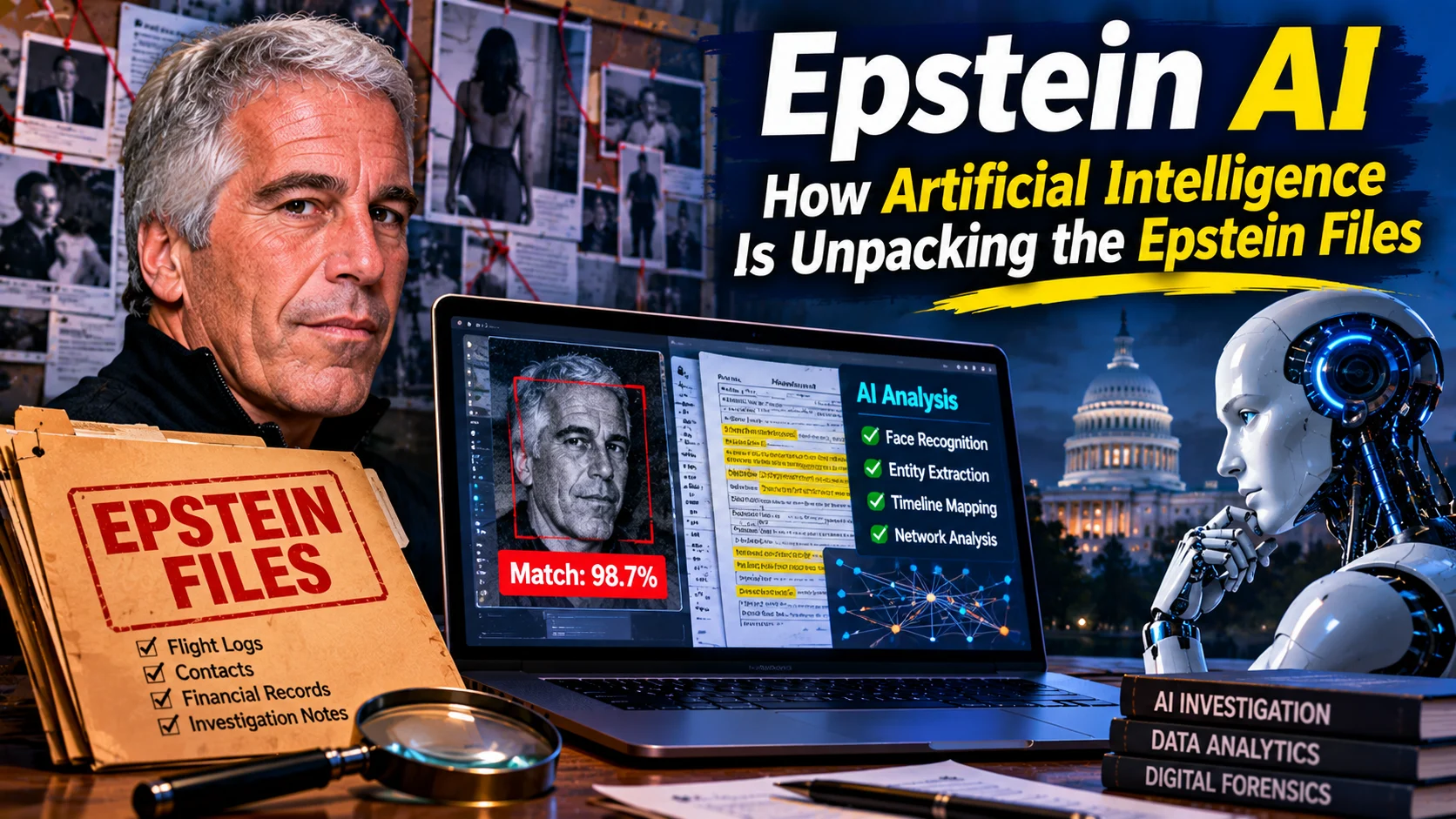
“Epstein AI” refers to AI-powered search and analysis tools built to process the millions of documents released from the Jeffrey Epstein investigation. These tools range from Jmail, which reformats emails into a searchable inbox interface, to the New York Times’ internal “Epstein Files Engine,” which helps reporters surface leads in minutes rather than months.
At-a-Glance: Key Takeaways
- The DOJ has released approximately 3.5 million pages of Epstein-related documents, alongside 2,000 videos and 180,000 images .
- Newsrooms built bespoke AI tools to handle the volume. The New York Times developed an “Epstein Files Engine” that generates citation-rich reports from reporter queries .
- Public-facing projects like Jmail reformat Epstein’s emails into a searchable interface mimicking Gmail, attracting over 150 million users .
- Redaction failures forced the DOJ to withdraw thousands of documents after victim-identifying information was exposed .
- AI “unblurring” of victim photos does not work. Experts confirm image generation models cannot recover actual faces from blurred images; they invent new ones .
- Jikipedia uses AI to generate encyclopedia-style entries about individuals mentioned in the files, though developers acknowledge inaccuracies may exist .
What Is Epstein AI?
Epstein AI is not a single product or company. It is a category term for the artificial intelligence tools and projects developed to process, search, and analyze the massive document releases from the Jeffrey Epstein investigation.
The scale of the problem created the need. The U.S. Department of Justice released approximately 3.5 million pages of investigative materials, including emails, flight logs, court documents, photographs, and videos . As one investigative reporter noted, even 50 reporters reading 500 documents per day would need four months just to get through the material .
These AI tools fall into three categories: newsroom-built internal systems for investigative journalism, public-facing search interfaces for citizen researchers, and experimental projects that repurpose the documents into novel formats.
How Epstein AI Tools Work
The Core Technical Challenge
Epstein document analysis presents a specific set of technical problems. The corpus is enormous, the document quality varies wildly, and much of the material exists as scanned PDFs or photocopies of printouts .
Standard search fails here. A keyword search for a name returns thousands of hits across millions of pages with no way to assess relevance. The AI tools address this through a combination of optical character recognition, semantic search, and large language models.
Document Processing Pipeline
The processing pipeline typically involves several stages. First, OCR converts scanned documents into machine-readable text. The New York Times built a custom image detection model to extract photographs and screenshots embedded within PDF pages, then used a vision-language model to generate tags and captions .
Next, deduplication identifies repeated material. The Times developed a “Diff” mechanism that represents each page as a composite vector combining text embeddings and perceptual hashes, allowing it to match duplicate pages across releases even when image quality varies .
Finally, the processed corpus becomes queryable. Some tools use retrieval-augmented generation, where a language model generates SQL queries or searches across indexed documents rather than attempting to answer from memory .
The Query Planning Approach
The New York Times’ Epstein Files Engine takes a distinctive approach. Rather than generating an authoritative answer, it functions as a query planner. An LLM translates a reporter’s question into SQL queries executed across three corpora: the DOJ document release, the Times’ own reporting archive, and a feed of external headlines mentioning Epstein .
This design keeps primary documents at the center. The Engine assembles returned records into a citation-rich report, allowing reporters to verify findings against the source material .
Major Epstein AI Projects
Jmail and the J-Suite
Jmail is the most prominent public-facing Epstein AI project. Created by Luke Igel and Riley Walz, it reformats Epstein’s emails into a searchable interface that mimics Gmail . The platform has attracted over 150 million users .
The technical implementation involved processing thousands of scanned PDFs of emails. The team initially used Cursor, a Claude-based AI product, but routine errors pushed them to Reducto AI for PDF extraction. Reducto identifies subject lines, senders, and email bodies, which the engineers then use to populate the Jmail interface .
The project expanded into a suite of applications: JPhotos for images, JFlights for flight logs, and Jikipedia, an AI-generated encyclopedia of individuals mentioned in the documents .
The New York Times’ Epstein Files Engine
The Times built an internal AI toolkit for its investigative team. The centerpiece is “Cheatsheet,” an internal web app that looks like a spreadsheet but is powered by vetted AI workflows. Reporters chain “recipes” for quote extraction, summarization, translation, and classification .
The Epstein Files Engine specifically responds to any reporter question about the corpus. It contextualizes findings with what the Times already knows and reported, delivering citation-rich leads about key individuals and storylines in minutes .
Courier and Google Pinpoint
Camaron Stevenson, a journalist at Courier, built public searchable databases using Google Pinpoint, a free AI research tool for journalists. Pinpoint uses OCR to make text machine-readable and Gemini models to transcribe audio .
Stevenson published the databases on the Courier site and social media, asking readers to flag documents of interest. This crowdsourced approach returned hundreds of tips that fueled investigative reporting, including coverage of Epstein’s ties to former J.P. Morgan executive Jes Staley .
Open-Source and Community Projects
The developer community has contributed several open-source tools. A GitHub repository called “nia-epstein-ai” indexes over 100 million words of Epstein sources using the Nia API, providing an AI agent that searches across both archive documents and biographical information .
Another project, “epstein-rag-abliterated-llm,” implements a retrieval-augmented generation system over 25,303 Epstein legal documents using an “abliterated” Mistral-Nemo-12B model. The term “abliterated” refers to removing safety layers that normally prevent harmful outputs .
Key Features of Epstein AI Tools
Semantic Search Across Millions of Pages
Traditional keyword search cannot handle the scale. Semantic search uses embeddings to find conceptually related content, not just exact matches. The Times’ Engine can understand that a reporter asking about a name wants “what is actually new about it,” proxied by what the Times and other outlets have already reported .
Citation-Rich Output
The most useful Epstein AI tools prioritize traceability. The Times’ Engine generates reports with source citations rather than authoritative final answers . Jikipedia entries reference source documents, and the developers added a feature for users to mark inaccuracies .
Multi-Format Processing
The corpus includes text, images, video, and audio. AI tools must handle all formats. The Times extracted embedded images and generated captions with vision-language models . Google Pinpoint transcribed audio files .
Deduplication
The same documents appear across multiple releases with new Bates numbers. Scanned duplicates may differ in image noise and tilt angle. The Times’ Diff mechanism achieves page-level matching by combining text embeddings with perceptual hashes .
Limitations and Ethical Concerns
AI Cannot “Unblur” Victim Photos
A significant misinformation trend emerged on social media. Users asked Grok and other AI image tools to “unblur” photos of victims whose faces were redacted. The Verifiers team at TF1 identified over 2,400 such requests generating more than one billion impressions .
Experts confirm this is technically impossible. AI image generation models cannot recover actual faces from blurred images. As one AI consultant stated, “There is no sense in asking an AI to ‘unblur’ an image. Image generation models cannot precisely guess what is behind a blur” .
Grok reconstructs images from scratch using the source as a guide. It invents faces without any basis in reality. The same photo processed twice produces different results. User prompts influence the output, introducing bias .
Redaction Failures and Victim Privacy
The DOJ withdrew thousands of documents after victims complained that redaction failures exposed personal information. The department acknowledged “technical or human error” contributed to the release of victim-identifying information .
Lawyers for victims stated that the lives of nearly 100 survivors “have been turned upside down by the DOJ’s latest release” . This creates a tension: AI tools designed to improve transparency must also respect privacy protections that exist for good reason.
Accuracy Concerns
Jikipedia’s developers acknowledged that inaccuracies may be present in the AI-generated encyclopedia entries. They stated that “users will be able to request changes, mark inaccuracies, and verify that an entire article is correct soon” .
The abliterated RAG project explicitly removes safety layers from its language model. While this may improve directness in document analysis, it raises questions about responsible deployment .
Access and Equity
Google Pinpoint has a cap of 250,000 documents. The most recent DOJ dump exceeded that by tenfold. Stevenson, the Courier journalist, noted that “a free tool from Google is not going to cut it anymore” and has been working with engineers to build a custom alternative .
Who Should Use Epstein AI Tools?
Journalists and researchers benefit from tools like the New York Times’ Engine and Google Pinpoint, which accelerate document analysis and surface leads that would take months to find manually .
The general public can use Jmail and similar interfaces to search the documents themselves. This restores a sense of agency in a news cycle that often leaves people feeling powerless .
Developers and data scientists may find the open-source projects useful for learning about RAG systems, OCR pipelines, and deduplication techniques .
Users seeking to identify redacted victims should understand that AI cannot recover this information. Attempts to do so invade privacy and produce fabricated results .
Frequently Asked Questions
What is Epstein AI?
Epstein AI refers to AI-powered search and analysis tools built to process the millions of documents released from the Jeffrey Epstein investigation. These include the New York Times’ Epstein Files Engine, the public Jmail interface, and various open-source projects .
Can AI unblur redacted victim photos in the Epstein files?
No. Image generation models cannot recover actual faces from blurred images. They generate new, invented faces using the blurred image as a guide. The results are not reliable and should not be treated as real .
How many Epstein documents have been released?
The DOJ has released approximately 3.5 million pages, including over 2,000 videos and 180,000 images. However, roughly 2.5 million additional pages remain withheld, primarily to protect victim identities .
Is Jmail safe to use?
Jmail is a public interface that reformats already-released documents. It does not expose new information. Users should understand that the underlying documents contain sensitive material, and the platform does not provide context or verification for what appears .
What is the best AI tool for searching Epstein files?
Different tools serve different purposes. Jmail offers an intuitive email-style interface. The New York Times’ Engine is internal only. Google Pinpoint was used for public databases but has document caps. The “best” tool depends on whether you need casual search or investigative depth .
Conclusion
Epstein AI describes a diverse ecosystem of tools built to solve a specific problem: how to make sense of millions of documents released from a sprawling criminal investigation. These tools range from newsroom-built systems that surface leads in minutes to public interfaces that let anyone search Epstein’s emails.
What matters most is understanding their limits. AI can accelerate document analysis, but it cannot recover redacted faces or verify claims automatically. The tools produce leads, not verdicts. Human judgment remains essential, particularly for a case where false accusations carry serious consequences.
These tools may suit journalists, researchers, and citizens who want to engage with the primary source material rather than relying on summaries. They may not suit users seeking definitive answers or attempting to identify individuals behind redactions.
Before using any Epstein AI tool, evaluate whether it cites its sources, whether it acknowledges uncertainty, and whether it respects the privacy protections that exist for victims. The technology is a means to an end. The end remains accountability, and that requires human judgment.