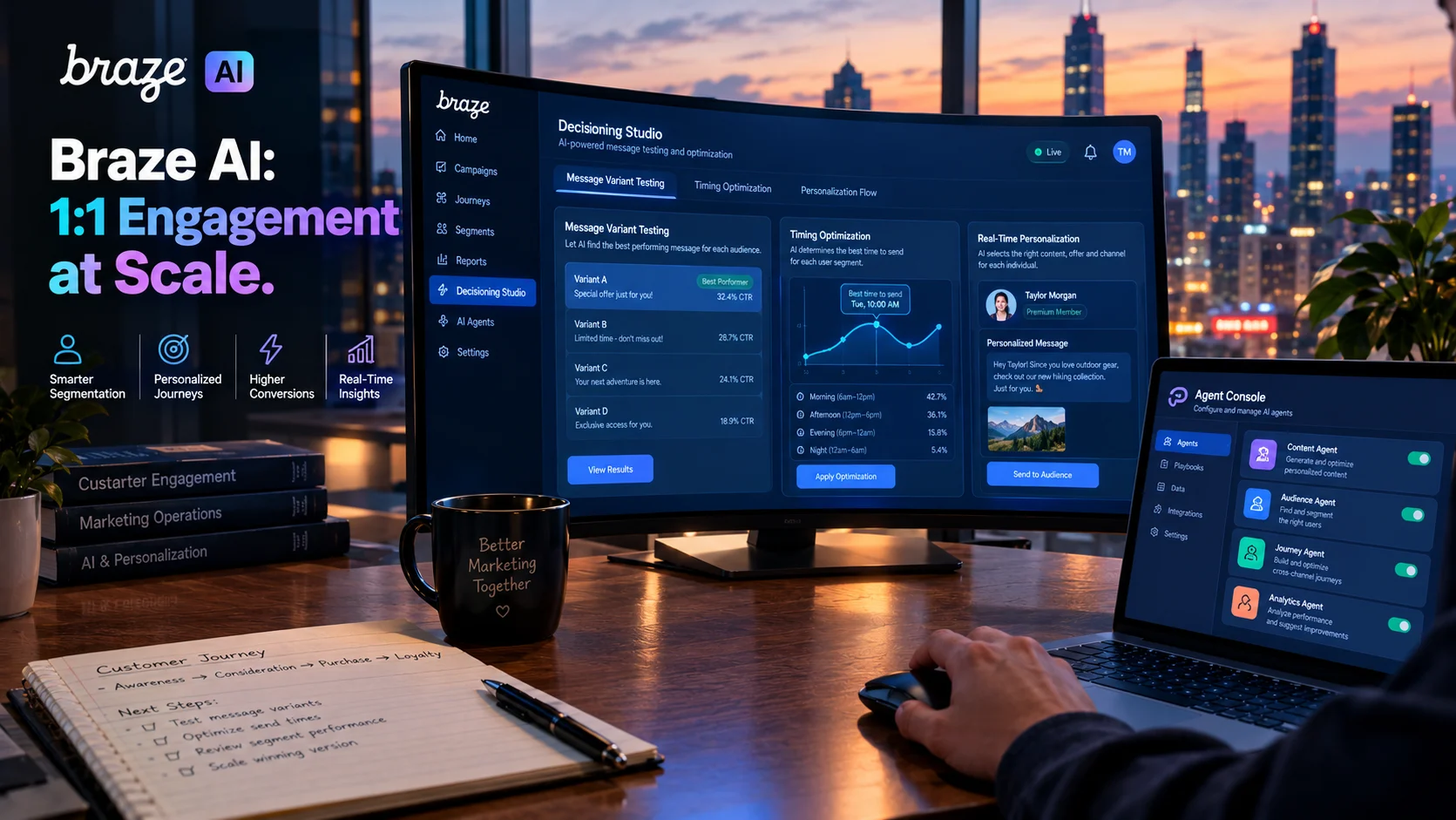
Braze AI is the artificial intelligence layer within Braze (Nasdaq: BRZE), a customer engagement platform that processes 25.8 trillion data points annually and supports over 7.8 billion monthly active users. Its portfolio includes Decisioning Studio, Agent Console, Operator, and new agentic tools that automate campaign QA, deliver cross-channel conversations, and embed Braze intelligence directly into tools like ChatGPT and Claude .
At-a-Glance: Key Takeaways
- BrazeAI Decisioning Studio Go is a self-service solution launching October 2026 that lets marketers deploy AI decisioning agents in minutes, testing over one billion message combinations simultaneously .
- Agentic Standards automates campaign quality assurance, checking setup, copy, links, and compliance against brand rules written once in plain language .
- Operator Connect embeds Braze intelligence directly into Claude, ChatGPT, Microsoft Copilot, and other MCP-compatible tools, enabling headless workflows .
- Data privacy varies by cluster. Only US-02 HIPAA customers receive Zero Data Retention (ZDR) from OpenAI; all other clusters retain data for 30 days for abuse monitoring .
- Pricing is custom and enterprise-focused, scaling with Monthly Active Users and Action Credits that work across channels and AI products .
- AWS strategic collaboration integrates Amazon Bedrock into Agent Console and expands regional infrastructure, with Braze now available in AWS Asia Pacific regions .
What Is Braze AI?
Braze AI is not a standalone product. It is the collective artificial intelligence capability embedded throughout Braze, a customer engagement platform used by enterprise brands to orchestrate personalized messaging across email, push notifications, SMS, WhatsApp, in-app messages, and other channels .
The company, founded in 2011 and publicly traded on Nasdaq under BRZE, processed 25.8 trillion data points and 10.2 trillion API calls in calendar year 2025 alone . Its platform supports over 7.8 billion monthly active users across its customer base, making it one of the largest engagement infrastructure providers in the market.
BrazeAI represents the company’s strategic bet that AI will transform how brands interact with customers. Rather than treating AI as a feature bolted onto an existing product, Braze has built an integrated AI portfolio that spans decisioning, content generation, quality assurance, and conversational engagement .
How Braze AI Works
The Composable Intelligence Philosophy
Braze approaches AI through what it calls “composable intelligence.” This means AI agents can be deployed at every layer of the platform, combined in flexible ways, and customized to brand-specific goals and guardrails .
The architecture separates concerns. Decisioning agents handle personalization at scale, determining what message, offer, and timing will best engage each individual. Content agents generate copy and creative. QA agents verify compliance. Conversational agents handle two-way dialogue. Each agent type can operate independently or be chained together in Canvas workflows .
The Decisioning Engine
The BrazeAI Decisioning Studio uses reinforcement learning to optimize customer journeys autonomously. Unlike traditional A/B testing, which compares a limited set of predefined options, decisioning agents continuously experiment across millions of combinations, learning from each customer interaction .
Brands set guardrails, such as frequency caps, brand guidelines, and business objectives. The AI then operates within those constraints, making individual-level choices about message variant, time of day, day of the week, and delivery frequency. A single agent can test more than one billion combinations simultaneously .
Kayo Sports, an Australian streaming service, reported increasing its potential customer actions from 300 to 1.2 million after deploying Decisioning Studio .
The Agent Console and Operator
The BrazeAI Agent Console allows marketers to create, configure, and deploy custom AI agents without engineering support. Agents can be embedded in Braze Canvases and Catalogs to perform tasks like lead scoring, localization, profile enrichment, and content selection .
The BrazeAI Operator serves as an in-dashboard assistant. It can take direct action in Braze, building content, writing HTML or Liquid personalization, or creating entire user journeys. The Operator can also generate agents that populate the Agent Console, creating a workflow where AI helps build the tools that automate further work .
Braze AI Features
Decisioning Studio Go (Beta, GA October 2026)
Decisioning Studio Go brings the reinforcement learning approach of the enterprise Pro tier to a self-service package. Marketers can deploy an AI decisioning agent in minutes, without technical teams or professional services. The agent tests message variants, timing, day, and frequency simultaneously, continuously learning and optimizing .
This launch extends 1:1 decisioning to more customer journeys. The previous Pro offering was customizable but required implementation effort. Go removes that barrier .
Agentic Standards (Beta, GA October 2026)
Agentic Standards automates campaign quality assurance. Marketers write their QA rules once in Braze, defining brand guidelines, required disclaimers, tagging conventions, and compliance requirements. Before launch, the AI assesses every campaign and Canvas against those rules, flagging pass, warning, or fail issues .
The system can also implement fixes through the Operator, with human sign-off where desired. Each check and fix is logged for audit. Sportsbet, a highly regulated Australian betting company, reported that Agentic Standards caught missing unsubscribe links and eligibility segments that manual review had missed .
Conversational Agents (Beta)
Conversational Agents replace basic keyword matching with intelligent dialogue across WhatsApp, SMS, RCS, and web. These agents interpret inbound messages, clarify user intent, and respond with context-aware content informed by brand guidelines, knowledge sources, and live customer profiles .
A retail brand could deploy a conversational agent to deliver a concierge-style shopping experience, answering product questions and recommending items based on purchase history and stated preferences, all within the message thread .
Operator Connect
Operator Connect makes Braze headless, embedding its intelligence and capabilities directly into AI tools marketers already use, including Claude, ChatGPT, Microsoft Copilot, and Snowflake Cortex Code. Teams can develop campaigns, generate content, and build AI agents that take action in Braze without leaving their preferred environment .
Message Prioritization and Observability
Message Prioritization allows teams to rank message categories once, and Braze automatically enforces that order across all campaigns. Lower-priority messages are rescheduled when conflicts occur. The Messaging Observability Dashboard shows why messages were sent, held, or dropped .
Braze AI Pricing
Braze does not publish self-serve monthly pricing. The platform uses custom enterprise contracts built around three variables: platform edition, Monthly Active Users (MAU), and Action Credits .
Platform Editions
Braze offers four editions, each building on the previous tier :
- Braze Go: Core features for early-stage growth teams launching cross-channel messaging.
- Braze Select: Adds increased orchestration, enhanced security, and user provisioning.
- Braze Pro: Adds predictive AI capabilities and AI personalized recommendations.
- Braze Enterprise: Full enterprise-grade orchestration, infrastructure, governance, and BrazeAI Agent Console access.
Action Credits
Action Credits provide a flexible currency that works across channels and certain BrazeAI products. Credits can be used for email, SMS, in-app messaging, Agent Console actions, and more, allowing teams to shift spend as strategy evolves .
MAU-Based Scaling
Pricing scales with Monthly Active Users, defined as customers who actively interact with the brand across digital experiences. Braze stores full audience profiles but charges based on active users, so brands do not pay for dormant profiles .
Independent analysis: Sequenzy notes that Braze is “overbuilt for simple email lifecycle programs” and can be “too heavy when email lifecycle campaigns are the main job.” The platform delivers value when cross-channel orchestration across mobile, web, email, push, in-app, and experimentation is the core requirement .
Data Privacy and Security
Braze AI’s data handling practices vary significantly by deployment configuration, and this distinction matters for compliance-conscious organizations.
The Operator’s Data Flow
BrazeAI Operator integrates with OpenAI. When a user interacts with the Operator, each message or navigation event triggers a discrete HTTP request to OpenAI. There is no persistent data feed or standing connection. OpenAI receives only the specific payload associated with the active request, not the full Braze user table .
Request payloads may include system metadata, the user’s typed message, tool outputs containing names and IDs, scraped page content truncated to approximately 4,000 characters, and page context strings .
Data Retention by Cluster
This is critical: retention depends on which Braze cluster the customer uses .
| US-02 (HIPAA) | Zero Data Retention (ZDR). Data is not stored by OpenAI after processing. |
| All other clusters | 30 days for abuse monitoring (industry standard imposed by OpenAI). |
Important distinction: SOC 2 certification does not automatically mean Zero Data Retention. Braze’s HIPAA-compliant cluster receives ZDR, but other clusters do not. Organizations should confirm their cluster configuration if ZDR is a requirement.
PII Handling
There is no automated PII redaction layer in the Operator pipeline. Data is sent raw to OpenAI and is not anonymized before transmission. Braze provides guidance for minimizing exposure: disable the View PII setting for Operator users, avoid opening Operator on user profile pages, and do not type PII directly into prompts .
Model Training
Data sent to OpenAI’s API through Braze is not used to train or improve OpenAI models. This is governed by contractual agreements and OpenAI’s API platform commitments. Output is the customer’s intellectual property, and Braze asserts no copyright claims .
EU Data Routing
EU data routing is not currently implemented for the Operator, and Braze states there are no current plans to implement it . European customers with data residency requirements should evaluate this limitation.
Braze AI Alternatives
Gartner Peer Insights analysis: Reviewers rated Braze higher than Salesforce in service and support, higher than Upland Localytics and Adobe in ease of integration and deployment, and higher than CleverTap and Oracle in evaluation and contracting .
Who Should Use Braze AI
Enterprise B2C brands running cross-channel engagement at scale are the primary audience. The platform processes trillions of data points and supports billions of monthly active users, making it suitable for organizations with mature mobile, web, email, and push programs .
Marketing teams seeking 1:1 personalization benefit from Decisioning Studio’s reinforcement learning approach. The ability to test over one billion combinations simultaneously and optimize at the individual level represents a meaningful advance over manual A/B testing .
Regulated industries can leverage Agentic Standards for automated compliance checking. Sportsbet’s experience demonstrates the value for highly regulated sectors where QA failures carry significant risk .
Teams with data residency requirements should carefully evaluate Braze’s EU data routing status. The Operator does not currently support EU routing, which may be a limitation for European organizations with strict residency obligations .
Small businesses or email-only senders may find Braze overbuilt and overpriced for their needs. Independent analysis suggests alternative platforms when email lifecycle campaigns are the primary requirement .
Common Mistakes and Cautions
Underestimating implementation complexity. Braze is an enterprise platform. Successful deployment requires data infrastructure, clean event tracking, and organizational readiness. Gartner reviewer feedback notes that some features like historic event property data for personalization have workarounds that “feel cumbersome” .
Assuming ZDR across all clusters. Only the US-02 HIPAA cluster receives Zero Data Retention. Other clusters have 30-day retention. Organizations requiring ZDR must confirm their cluster configuration .
Ignoring timezone limitations. One Gartner reviewer noted their instance is “locked to Central European Time,” requiring manual adjustments for scheduling campaigns in other regions. Another reviewer reported a campaign was scheduled for a past time without warning, resulting in a missed send .
Overlooking the MAU-based cost model. Braze charges based on active users, not total stored profiles. This benefits brands with large dormant audiences but requires careful modeling of active user growth .
Confusing AI availability by tier. Some BrazeAI features, like the Agent Console, are only available in the Enterprise edition. Other AI features are included across all tiers but may have usage limits tied to Action Credits .
Latest Developments
Decisioning Studio Go (September 2026). Self-service AI decisioning launching October 2026, enabling marketers to deploy 1:1 optimization agents in minutes without technical support .
Agentic Standards (September 2026). Automated campaign QA that checks setup, copy, links, personalization, and compliance against brand rules written once in Braze .
Operator Connect (September 2026). Integration that embeds Braze intelligence into Claude, ChatGPT, Microsoft Copilot, and other MCP-compatible tools .
Conversational Agents (September 2026). Intelligent two-way dialogue across WhatsApp, SMS, RCS, and web, replacing keyword matching with context-aware responses .
AWS Strategic Collaboration (September 2026). Integration of Amazon Bedrock into Agent Console, expansion into AWS Asia Pacific regions, and 80% year-over-year growth in AWS Marketplace procurement .
Q2 FY2026 Earnings. Braze reported 26% year-over-year revenue growth to $227 million and 112% large-customer net retention, though shares declined 27% year-to-date .
Frequently Asked Questions
What is Braze AI?
Braze AI is the artificial intelligence portfolio within Braze, a customer engagement platform used by enterprise brands. It includes Decisioning Studio for autonomous personalization, Agent Console for custom AI agents, Operator for in-dashboard assistance, and new agentic tools for QA automation and conversational engagement .
How much does Braze AI cost?
Braze does not publish self-serve pricing. Costs are custom and scale with Monthly Active Users and Action Credits consumed. Pricing depends on platform edition (Go, Select, Pro, Enterprise) and contract scope. Contact Braze sales for a quote .
Is Braze AI secure and private?
Braze AI data handling varies by cluster. Only the US-02 HIPAA cluster receives Zero Data Retention from OpenAI. All other clusters have 30-day retention for abuse monitoring. There is no automated PII redaction, and EU data routing is not currently implemented for the Operator .
What are the main Braze AI features?
Key features include Decisioning Studio (reinforcement learning for 1:1 personalization), Agent Console (custom AI agents in Canvas and Catalogs), Operator (in-dashboard AI assistant), Agentic Standards (automated QA), Conversational Agents (two-way messaging), and Operator Connect (integration with external AI tools) .
What are the best Braze alternatives?
Alternatives include Salesforce Marketing Cloud, MoEngage, Klaviyo, Insider One, Iterable, and CleverTap. Gartner reviewers rated Braze higher than Salesforce, Adobe, and CleverTap in categories including service and support, ease of integration, and evaluation and contracting .
Conclusion
Braze AI represents a significant bet that customer engagement will be transformed by autonomous, agentic systems. The platform’s new features, Decisioning Studio Go, Agentic Standards, Operator Connect, and Conversational Agents, push the boundaries of what marketers can automate without engineering support.
What matters most is fit. Braze is enterprise infrastructure. It processes trillions of data points and supports billions of users. Its AI portfolio is designed for brands with mature cross-channel programs and the data foundation to support them. For organizations running simple email lifecycle campaigns, the platform is likely overbuilt and overpriced.
Braze AI may suit large B2C brands seeking 1:1 personalization at scale, regulated industries needing automated compliance checks, and teams wanting to embed engagement intelligence into their existing AI tools. It may not suit small businesses, email-only senders, or organizations with strict EU data residency requirements that cannot accommodate the Operator’s current architecture.
Before evaluating Braze, confirm your cluster configuration if Zero Data Retention is a requirement. Model MAU growth and Action Credit consumption carefully. Review Gartner Peer Insights for candid user feedback on integration complexity and timezone limitations. And consider whether your team has the data infrastructure to unlock the platform’s AI capabilities. Braze AI is powerful, but it requires investment to deliver value.