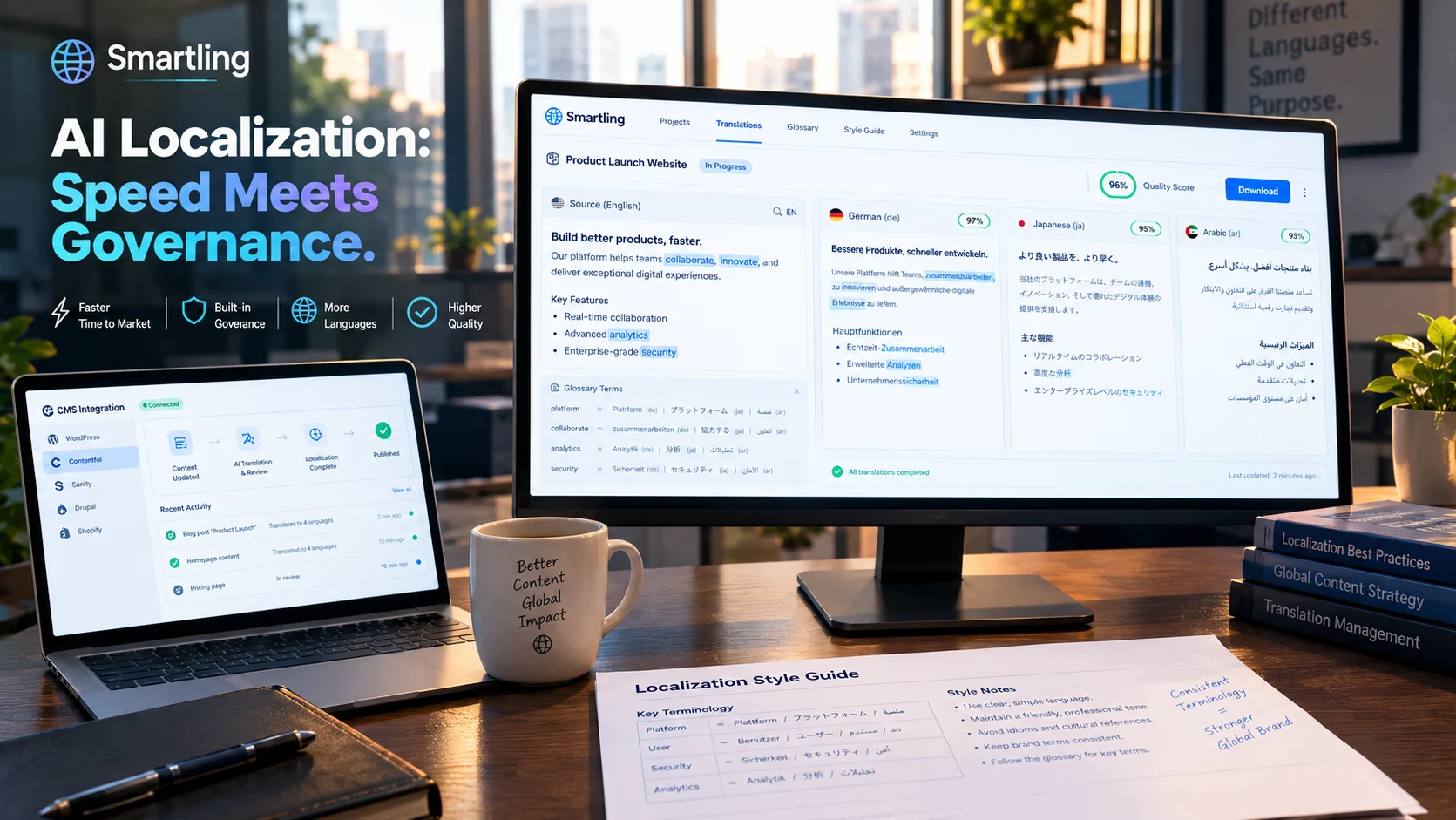
AI localization is the use of artificial intelligence, machine translation, and large language models to translate and adapt content across languages and markets at scale. It combines automated translation with human review in a governed workflow that preserves brand voice and handles cultural nuance, rather than simply converting words from one language to another .
At-a-Glance: Key Takeaways
- AI localization goes beyond translation. It adapts meaning, tone, formatting, and cultural context for specific locales, not just words .
- The best workflows are human-in-the-loop. AI handles volume and speed, while human reviewers manage brand-critical and high-risk content .
- Quality varies dramatically by language and model. Low-resource languages see significant performance drops, and LLM safeguards degrade outside English .
- Data security is the top enterprise concern. Public AI tools introduce risks that enterprise-grade systems with data isolation controls address .
- Content risk determines workflow. Internal documents can be lightly reviewed, while legal and medical content requires certified human translation .
- AI localization is not a switch to flip. Organizations that treat it as a set-and-forget solution quickly erode brand trust .
What Is AI Localization?
AI localization is the practice of using artificial intelligence to adapt content for different languages and cultural contexts. The key word is “adapt.” Translation converts words. Localization transforms meaning, tone, currency, date formats, and cultural references so content feels native to each market .
The distinction matters because raw machine translation produces technically correct text that often fails in-market. A phrase that lands well in English may sound awkward, offensive, or simply wrong in German or Japanese. AI localization wraps translation capability in your brand’s terminology, style guide, and translation memory, then adds human review where accuracy carries consequences .
The market has shifted rapidly. Localization no longer lives in a few interfaces and marketing pages handled by specialist teams. AI-powered translation now appears across websites, apps, support flows, and internal tools, often triggered automatically . This accessibility is both the opportunity and the risk.
How AI Localization Works
The Core Technology Stack
AI localization combines several technologies. Neural machine translation (NMT) provides the foundation, trained on vast parallel corpora to produce fluent output . Large language models (LLMs) add context-awareness, tone adaptation, and the ability to follow complex instructions through prompt engineering .
Retrieval-augmented generation (RAG) connects these models to your organization’s translation memory and terminology glossary. Instead of generating generic output from training data alone, the model draws on your previously approved translations as context. This ensures product names, brand phrases, and technical terms remain consistent .
The Human-in-the-Loop Pipeline
A mature AI localization workflow is a pipeline, not a single button. Content flows through connected stages, each designed to improve the next iteration .
- Connect and detect: CMS integrations or repository connections pull new and changed content automatically.
- Draft with context: NMT or an LLM produces a first draft, conditioned on translation memory and glossary.
- Estimate and route: Automated quality estimation decides what can publish on machine confidence and what needs human review.
- Review and post-edit: Professional linguists refine accuracy, tone, and cultural fit for brand-critical or regulated content.
- Publish and learn: Approved content flows back, enriching translation memory for future work .
The compounding asset is translation memory. Every approved segment lowers future cost and raises consistency. Teams that treat TM as an afterthought never see the savings AI promises .
The Role of Prompt Engineering
For LLM-based localization, prompt design is not a minor detail. A well-engineered prompt includes role definition, system instructions, examples, and relevant context. Microsoft’s localization guidance notes that prompt translation is akin to transcreation, and translating a prompt does not guarantee equivalent behavior in the target language .
Globalized prompts avoid idioms, cultural references, and ambiguous instructions. They must also account for how LLMs behave differently across languages, with performance and safety degrading in low-resource languages .
Where AI Localization Excels
High-Volume, Lower-Risk Content
AI localization delivers the clearest returns on content where occasional imperfection carries minimal consequence. Internal documentation, help center articles, user-generated content, and release notes benefit from the speed and cost savings AI provides .
A Search Engine Journal study found that post-edited AI workflows achieved near-parity with professional human translation for SEO content. The gap between the best AI workflow and human professionals was only 2.8 points on a 100-point scale. Post-edited Google Machine Translation scored 66.7, ahead of every raw model tested .
Speed and Scale
AI can translate an entire novel in under two minutes. For organizations managing dozens of languages and constant content updates, this speed is transformative. Continuous localization replaces quarterly batches .
Consistency Through Terminology Management
AI systems conditioned on your glossary and translation memory maintain product terminology and brand phrases more consistently than ad-hoc human translation. Every approved segment reinforces the pattern .
Where AI Localization Fails
Low-Resource Languages
AI performance drops sharply in languages with less training data. A 2026 study on Korean-to-Lao translation found AI models scored notably low on cultural appropriateness, failing to render culturally embedded elements like “rice field bank” and “ancestral rites.” The study concluded that literary translation remains an artistic practice requiring creative recontextualization .
Forrester research confirms that LLM safeguards don’t reliably carry over beyond English, disproportionately impacting growth markets .
The “Quiet Failure” Problem
The most dangerous AI localization errors are the ones that look fluent. A hallucinated product specification, an outdated price, or a mistranslated safety instruction reads smoothly in the target language. Users have no way to know the information is wrong .
This matters more as search behavior shifts. When AI systems synthesize answers from multilingual content, users may never see the source page. They only see the AI’s interpretation of your brand .
Cultural Nuance and Brand Voice
AI models can produce grammatically correct text that misses brand voice entirely. The Lokalise blog notes that raw AI output “can still feel generic and unmistakably machine-made, missing the brand voice, the cultural nuance, and the regulatory precision that enterprise businesses can’t afford to get wrong” .
Human translators remain essential for marketing campaigns, legal agreements, and any content where tone and cultural resonance drive results .
Cross-Language Brand Visibility
A 2026 Search Engine Journal study found that brand recommendations vary dramatically by language. In the headphones category, Sony scored 50% in English but 100% in Russian. Zoho CRM dominated across all languages while HubSpot’s visibility dropped in Arabic and Persian. Single-language testing provides a completely inaccurate picture of global brand performance .
Privacy and Data Security Considerations
The Public vs. Enterprise AI Distinction
Enterprise localization content includes product documentation, legal contracts, regulatory disclosures, and internal communications. Processing this through public AI systems introduces serious data risks .
Public AI platforms operate on shared infrastructure where inputs may be processed alongside data from other organizations. Enterprise AI systems operate within controlled environments with data isolation, security standards, and contractual governance over model training and data usage .
Shadow AI: The Hidden Risk
Shadow AI refers to employees using unapproved AI tools outside enterprise security controls. A regional team facing a tight deadline may paste sensitive strategy documents into a public LLM for quick translation. This exposes unreleased product information, internal pricing, or customer data, and removes the audit trail compliance teams need .
The answer is not bans alone. Organizations need approved workflows that are fast enough to use, secure enough to govern, and clear enough to audit .
Data Handling Commitments
For enterprise-grade AI localization, ask specific questions: Where is data processed and stored? Which models power the workflow? How are outputs validated? What prevents enterprise data from training external models?
Lokalise, for example, documents that its OpenAI API connection uses TLS encryption, complies with ISO 27001 and SOC 2 Type II, and that OpenAI will not use customer data for training unless explicitly opted in. Abuse monitoring data may be retained for up to 30 days .
Important distinction: SOC 2 certification does not automatically mean zero data retention. Verify specific retention policies for your use case.
AI Localization Platforms Compared
Who Should Use AI Localization?
Enterprise localization teams with established translation memory, glossaries, and governance frameworks benefit from AI’s speed and consistency. The translation memory becomes a compounding asset .
Growing companies entering new markets can use AI localization to validate demand before investing in full human translation. A tiered approach lets you test markets with automated content, then scale human review where conversion data supports it .
Developers and product teams can automate UI string localization through CI/CD integrations. Tools like ai-translate run in GitHub Actions, caching translations across projects and blocking PRs when strings are missing .
Organizations with strict data requirements should prioritize enterprise-grade platforms with data isolation controls, audit logging, and clear data handling commitments. Public AI tools are not appropriate for sensitive content .
Common Mistakes and Cautions
Shipping raw machine translation for brand-critical content. AI output that looks fluent may contain quiet failures. Marketing copy, legal agreements, and safety instructions require human review .
Assuming one model works everywhere. Model performance varies dramatically by language pair and content type. A 2026 benchmark found a 22.3-point spread among Chinese LLMs on technical content. The “best” model depends on your specific needs .
Ignoring internationalization fundamentals. AI localization cannot fix broken i18n. Placeholders, pluralization rules, and string keys must be engineered correctly before translation .
Treating localization as a one-time project. Content changes continuously. Localization workflows must trigger on updates and flow through the same governed pipeline .
Underestimating cultural context. AI can translate words but struggles with cultural embeddedness. Terms like “rice field bank” or “ancestral rites” require human understanding of the source culture .
Testing brand visibility in one language. AI recommendations vary by language. What works in English may not work in Arabic, Russian, or Chinese .
Latest Developments
Custom AI Profiles with RAG (Lokalise, 2026). The platform introduced AI Profiles that draw on translation memory and past approved translations as context, reducing post-editing effort by up to 80% .
Enterprise AI governance focus (Acolad webinar, 2026). The conversation has shifted from “can AI translate?” to “how do we scale AI translation without losing control of quality, data, and compliance?” .
Multilingual AEO research (SEJ, 2026). Studies confirm that brand visibility in AI answer engines varies dramatically by language, making multilingual content strategy essential for global brands .
Low-resource language gaps (KCI study, 2026). Research on Korean-to-Lao translation quantifies AI’s limitations in languages with limited training data, reinforcing the need for human collaboration .
CI/CD translation automation (ai-translate, 2026). Open-source tools now integrate translation directly into development workflows with cross-project caching, reducing API costs as common strings are reused .
Frequently Asked Questions
What is AI localization?
AI localization is the use of artificial intelligence to translate and adapt content for different languages and cultural contexts. It combines machine translation and large language models with human review in a governed workflow that preserves brand voice and handles cultural nuance, rather than simply converting words .
Is AI localization as good as human translation?
For high-volume, lower-risk content, post-edited AI can approach human quality. A 2026 benchmark found the gap on SEO content was only 2.8 points . For brand-critical, legal, or culturally sensitive content, human translation remains essential. The best results come from hybrid workflows .
What are the security risks of AI localization?
Public AI tools process data on shared infrastructure, creating risks for sensitive enterprise content. Shadow AI occurs when employees use unapproved tools for quick translations. Enterprise-grade platforms offer data isolation, audit logging, and contractual governance .
Which content types should use AI localization?
Internal documentation, help center articles, release notes, and user-generated content are well-suited to AI localization with light review. Marketing campaigns, legal agreements, medical content, and safety instructions require full human post-editing or certified translation .
How do I choose an AI localization platform?
Evaluate data security and governance, the distinction between public and enterprise AI, human-in-the-loop workflow design, terminology and translation memory management, and integration capabilities. Ask specific questions about data processing locations, model training, and review thresholds .
Conclusion
AI localization has moved from experimentation to enterprise necessity. The technology can dramatically accelerate multilingual content production, reduce costs, and maintain consistency across markets. The best workflows combine AI speed with human judgment, routing content based on risk and impact.
What matters most is understanding the limits. AI struggles with low-resource languages, cultural nuance, and quiet failures that look fluent but contain errors. Data security risks are real, particularly when sensitive content moves through public AI tools. And brand visibility varies by language, making multilingual strategy essential.
AI localization may suit enterprises with established translation memory and governance frameworks, growing companies testing new markets, and developer teams automating product localization. It may not suit organizations without i18n fundamentals, those handling highly sensitive legal or medical content without human review, or teams expecting a set-and-forget solution.
Before adopting any AI localization workflow, evaluate your content risk profile. Secure enterprise-grade tools for sensitive material. Build translation memory as a compounding asset. And remember that AI accelerates localization, but it does not replace the human judgment required to ensure content resonates in every mark