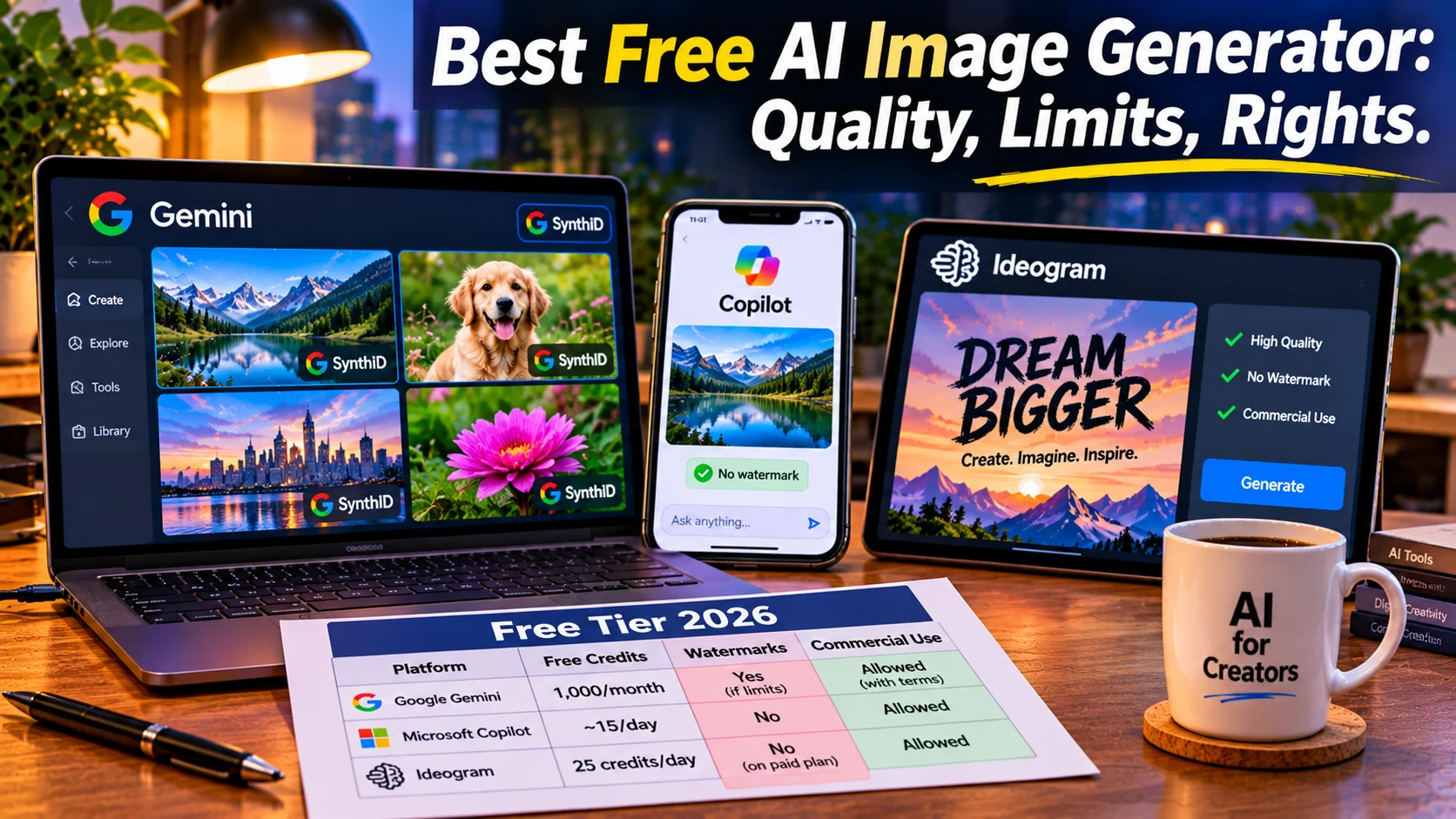
The best free AI image generator depends on your priority. Google Gemini offers the strongest overall quality with roughly 20 daily images on Nano Banana models, Microsoft Copilot provides DALL-E 3 with no visible watermark and commercial use under standard terms, and Ideogram leads on text rendering with 30 weekly credits. Leonardo gives 150 daily tokens but retains ownership of free outputs.
At-a-Glance: Key Takeaways
- Gemini leads on quality and daily allowance, offering roughly 20 free images per day on standard models, though every output carries a visible Gemini logo and invisible SynthID watermark .
- Copilot runs DALL-E 3 with no visible watermark and permits commercial use under standard Microsoft terms, though free-tier inputs may be used for training .
- Ideogram is best for text rendering, with 30 weekly credits for Google, Apple, or Microsoft sign-ins. Free outputs are public .
- Leonardo offers 150 daily tokens but free outputs are public and Leonardo retains ownership. Commercial rights require a paid plan .
- Adobe Firefly’s free tier is opaque: Adobe does not publish daily counts, watermark policies, or commercial terms for the free plan .
- Stable Diffusion is the only truly free forever option if you own a GPU. SD 1.5 and SDXL are royalty-free with no revenue cap .
What Makes a Free AI Image Generator “Best”?
The “best” free AI image generator depends on three variables that matter more than raw image quality: how many images you get, whether you can use them commercially, and whether the output carries watermarks.
A tool that produces stunning images but watermarks every export is useless for client work. A tool with unlimited generations but retains ownership of your output is a trap for anyone building a brand. A tool with generous daily limits but a visible logo in the corner is fine for brainstorming, not for publishing.
This guide evaluates each free tier against those criteria, using verified information from vendor documentation and independent testing.
The Major Free AI Image Generators Compared
Gemini: Best Overall Quality and Daily Allowance
Google’s Gemini app offers the most usable free tier for most people. Free users get roughly 20 images per day on standard Nano Banana models, with some variance based on server load .
What Free Includes
Gemini’s free tier provides access to Nano Banana 2 for about 20 daily images, with Nano Banana Pro limited to roughly 2 per day on the free plan . Google does not claim ownership of generated images, and commercial use is permitted under its content rules .
Where the Limits Hit
Every image generated in the Gemini app carries a visible Gemini logo, regardless of plan. An invisible SynthID watermark is also applied. Only outputs generated through the API escape the visible logo . For client work, the logo is a dealbreaker unless you crop it out, which may violate terms.
Editorial interpretation: Gemini is the best free option for brainstorming, concepting, and personal projects. The visible logo makes it unsuitable for client deliverables without a paid plan or API access.
Copilot: DALL-E 3 Without the Watermark
Microsoft Copilot offers a different trade-off: older model technology, but no visible watermark and a clear commercial-use position.
What Free Includes
Copilot runs DALL-E 3 under the hood. Free users get boosted generations that refresh periodically, and once boosts run out, generation slows but does not stop . Microsoft does not claim ownership of generated content, and commercial use is permitted under standard Microsoft terms .
Where the Limits Hit
Microsoft’s Q&A documentation states that images created with the free version “are not authorized for commercial purposes and should only be used for personal, social or other non-commercial projects” . This directly contradicts other interpretations of Microsoft’s terms, creating ambiguity. For business-critical work, Microsoft recommends a paid Microsoft 365 Copilot license with copyright commitment .
Free-tier inputs and outputs may also be used for AI training. Microsoft’s enterprise data protection, which prevents training on your data, applies only to paid business plans .
Editorial interpretation: Copilot is the best free option for personal and social content where no visible watermark is required. The commercial-use ambiguity means businesses should verify terms independently before publishing.
Ideogram: Best for Text Rendering
Ideogram’s free tier is smaller than Gemini’s, but the tool excels at rendering legible text inside images, a task most models fail at.
What Free Includes
Free accounts created with Google, Apple, or Microsoft sign-in receive 30 credits per week. Accounts created with email and password do not receive free credits . Outputs carry no visible watermark .
Where the Limits Hit
Everything you generate on the free plan is public . Commercial use depends on Ideogram’s Terms of Service, which places responsibility on the user to ensure the content does not violate laws or third-party rights . The free tier is sufficient for testing text rendering and occasional graphics, not for volume work.
Editorial interpretation: Ideogram is the best free option if your primary need is legible text in images. The public-output requirement and low weekly credit allowance limit it to experimentation and small projects.
Leonardo: Generous Tokens, Restricted Rights
Leonardo offers the most daily generations among dedicated image platforms, but the free tier comes with ownership restrictions.
What Free Includes
Leonardo provides 150 tokens per day, which translates to roughly 20-30 images depending on settings. Free generations are public and visible to other users. No credit card is required .
Where the Limits Hit
Leonardo retains ownership of free-tier outputs. Paid subscribers own their outputs; free users get a commercial license while Leonardo keeps ownership and a broad license over public content, including model training. Commercial rights are restricted to paid plans .
Editorial interpretation: Leonardo is the best free option for high-volume personal experimentation and concept art. It is not suitable for commercial work or anything requiring private output.
Adobe Firefly: The Opacity Problem
Adobe’s free tier is the least transparent of the major tools. Adobe does not publish daily generation counts, watermark policies for the free plan, or whether free outputs can be used commercially .
What Free Includes
Adobe states that no plan is needed for free daily generations across image, video, and audio, and that limits refresh daily. The count is unpublished .
Where the Limits Hit
The commercial-use FAQ covers Firefly outputs generally but does not distinguish between free and paid plans. Watermark policy for free outputs is not stated. The cheapest paid tier starts at $9.99/month for 2,000 credits .
Editorial interpretation: Firefly’s free tier is a trial, not a workflow. For commercial work, the paid tier provides clearer terms and IP indemnification .
Stable Diffusion: The Only “Free Forever” Option
If you own a capable GPU, Stable Diffusion is the only truly free option with no caps, no watermarks, and no ownership restrictions.
What Free Includes
SD 1.5 and SDXL use CreativeML OpenRAIL licenses that are royalty-free with no revenue condition and allow commercial use. SD 3 and SD 3.5 are free for individuals and organizations under $1M annual revenue .
Where the Limits Hit
You need a GPU. Local SD 1.5 or SDXL runs at roughly $0 per image on hardware you own, but the upfront cost of a capable GPU is significant. Setup requires technical knowledge .
Editorial interpretation: Stable Diffusion is the best option for developers and technical users who want complete control and no platform restrictions. It is not accessible to casual users.
Who Should Use Which Free Generator
Casual users and personal projects should use Copilot for no visible watermark, or Gemini for higher quality with a visible logo.
Content creators needing text in images should use Ideogram, accepting the public-output requirement and low weekly credits.
High-volume experimentation and concept art should use Leonardo’s 150 daily tokens, understanding that outputs are public and Leonardo owns them.
Commercial work requiring legal safety should use Adobe Firefly’s paid tier for indemnification, or verify Copilot’s terms independently.
Developers and technical users should run Stable Diffusion locally for unlimited, unrestricted output.
Common Mistakes and Cautions
Assuming “free” means “commercial.” Copilot’s free tier is explicitly non-commercial per Microsoft Q&A . Leonardo prohibits commercial use on free . Gemini permits it under terms . Always verify.
Overlooking visible watermarks. Gemini’s app outputs carry a visible logo on all plans . Copilot’s do not . This matters for client deliverables.
Ignoring ownership terms. Leonardo retains ownership of free outputs . Google and Microsoft do not claim ownership . Read the terms for the tool you use.
Forgetting that free tiers change. The allowances listed here are verified as of publication. Vendors adjust limits without notice.
Frequently Asked Questions
What is the best free AI image generator overall?
Google Gemini offers the best overall quality and daily allowance with roughly 20 free images per day. However, every output carries a visible Gemini logo. Copilot offers no visible watermark but commercial-use ambiguity. The “best” depends on whether quality or clean output matters more .
Can I use free AI images commercially?
It depends on the tool. Gemini permits commercial use under terms . Copilot’s free tier is explicitly non-commercial per Microsoft Q&A . Leonardo prohibits it . Adobe Firefly’s terms are unclear for free outputs . Verify before publishing.
Which free AI image generator has no watermark?
Copilot and Ideogram produce clean, watermark-free output on free tiers . Gemini’s app outputs carry a visible logo on all plans . Leonardo’s free outputs are watermark-free but public .
What is the best free AI image generator for text?
Ideogram is the best free option for rendering legible text within images. Its 30 weekly credits limit volume, but the text-rendering quality is superior to general-purpose models .
Is Stable Diffusion really free?
Yes, the model weights are free to download. SD 1.5 and SDXL are royalty-free with no revenue cap. SD 3.5 is free under $1M revenue. Running it locally requires a GPU, but there are no per-image costs .
Conclusion
The best free AI image generator in 2026 depends on what you value. Gemini offers the highest quality and most generous daily allowance, but watermarks every output. Copilot provides DALL-E 3 with no visible watermark but ambiguous commercial terms. Ideogram excels at text rendering with a small weekly credit allowance. Leonardo gives the most daily generations but retains ownership of free outputs. Adobe Firefly is a trial with unclear terms.