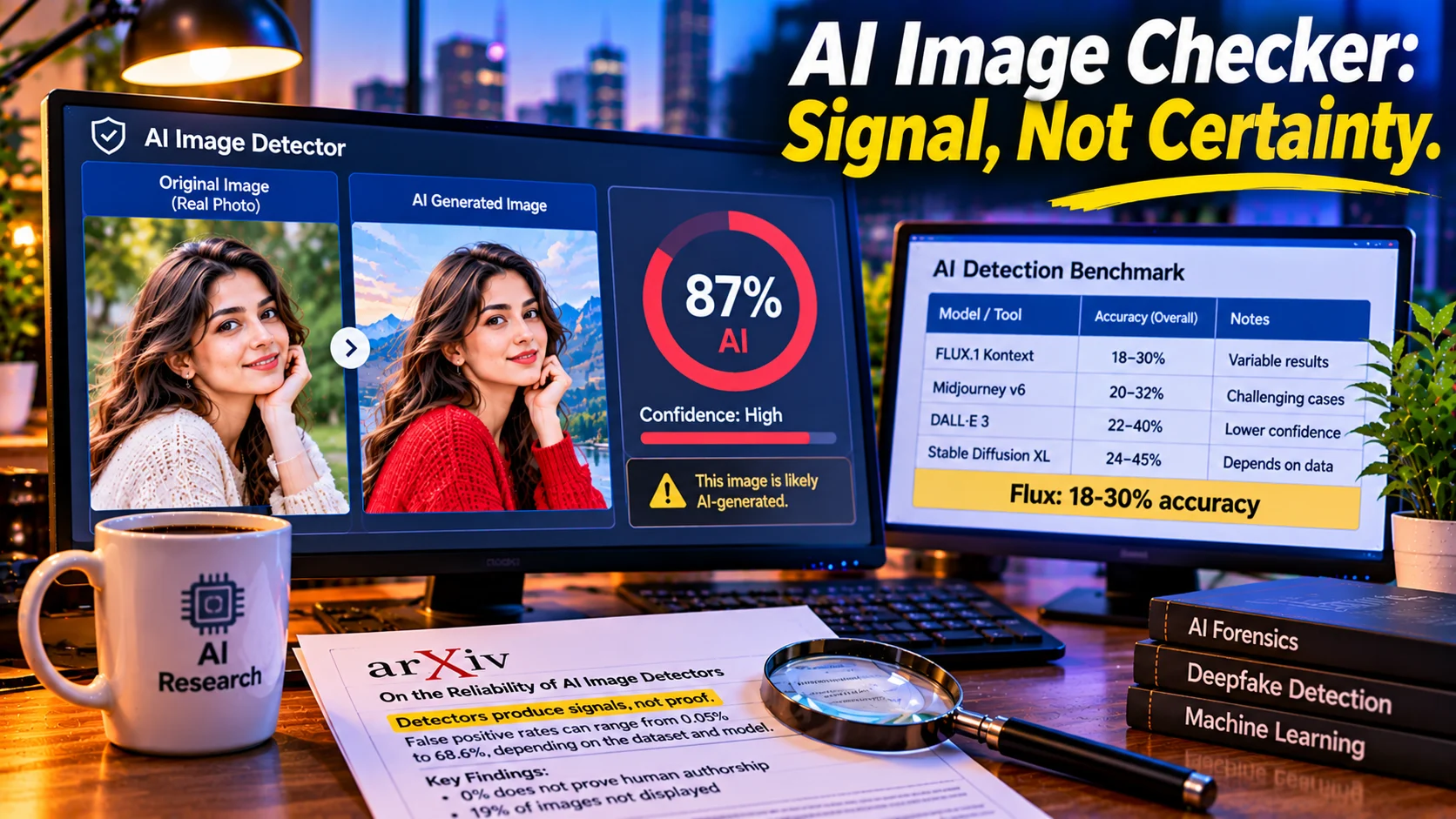
An AI image checker estimates whether a picture was generated by artificial intelligence, but independent research shows detection is unreliable in real-world conditions. A 2026 benchmark of 23 detectors found no universal winner, with modern generators like Flux, Firefly v4, and Midjourney v7 defeating most tools at 18-30% average accuracy . The best detectors are a signal for human review, not proof of authenticity.
At-a-Glance: Key Takeaways
- No single detector wins across datasets. A comprehensive 2026 benchmark found detector rankings were unstable, with a 37 percentage-point gap between the best (75% mean accuracy) and worst (37.5%) tools .
- Modern generators defeat most detectors. Flux Dev, Firefly v4, and Midjourney v7 achieved only 18-30% average detection accuracy, meaning most tools miss them entirely .
- Real-world conditions break detectors. A study on social media images found that naively scaling pre-training or adding more data does not always improve detection. Pipeline design matters more than model size .
- Text-rich images are a blind spot. No detector exceeded 80% accuracy on fabricated screenshots, documents, or news pages, with some dropping over 60% from natural-image benchmarks .
- Vision-language models are catching up. GPT-5.6 and Claude Fable 5 now match or exceed young adults at detecting AI portraits, but their calibration remains poor .
- Consumer tools offer free tiers but limited depth. Illuminarty, Is It AI, and AI or Not provide accessible entry points, while Hive and Optic target developers and enterprises .
What Is an AI Image Checker?
An AI image checker is a tool that analyzes a picture and estimates the likelihood that it was generated by artificial intelligence. The category spans consumer web apps, developer APIs, and integrated features within larger platforms.
The technology differs fundamentally from text-based AI detection. Images contain low-level signals—pixel noise patterns, frequency artifacts, compression inconsistencies—that generative models often leave behind. Detectors attempt to identify these traces.
But the problem is harder than it looks. Modern generators have learned to suppress the artifacts that older detectors relied on. A 2026 benchmark of 23 open-source detectors found that “modern commercial generators (Flux Dev, Firefly v4, Midjourney v7) defeat most detectors, achieving only 18-30% average accuracy” . The tools that work on older models fail on newer ones.
How AI Image Checkers Work
The Detection Pipeline
Most image checkers use convolutional neural networks (CNNs), vision transformers (ViTs), or hybrid architectures. The model processes the image and outputs a probability score indicating AI generation.
Some detectors focus on frequency-domain artifacts. Generative models produce subtle spectral patterns that differ from camera-captured images. FANB-Net, a 2026 framework, integrates global and local frequency cues, achieving 97.4% AP on diffusion-generated images .
Others analyze spatial artifacts: unnatural smoothness, inconsistent lighting, or anatomical errors. The strongest detectors combine both approaches.
The Real-World Failure
The gap between benchmark performance and deployment reality is the defining problem. A study published at the ACM Multimedia AI against Disinformation workshop found that detectors performing “exceptionally well on controlled benchmark datasets” struggle significantly with real-world cases from social media .
The study introduced the ITW-SM dataset from major social platforms and found that “naively scaling the pre-training stage or opting for more training data does not always lead to better detection performance.” Instead, the design of the processing pipeline matters more than raw scale .
The Text-Rich Blind Spot
A separate 2026 benchmark, TextFake, tested detectors on fabricated screenshots, documents, and news pages. The results were stark: “no method exceeds 80% accuracy, with some dropping over 60% from natural-image benchmarks” .
The failure modes are specific: dense text overwhelms low-level detectors, stronger text rendering suppresses generative artifacts, and routine perturbations drive detectors toward chance-level performance .
The Major AI Image Checkers Compared
The Accuracy Problem in Numbers
The Benchmark Instability
The 2026 comprehensive benchmark evaluated 23 detector variants across 12 datasets and 291 generators. The findings were unambiguous: “no universal winner exists, with detector rankings exhibiting substantial instability” .
The gap between the best and worst detectors was 37 percentage points. Training data alignment caused up to 20-60% performance variance within architecturally identical detector families .
The Modern Generator Problem
The same benchmark found that Flux Dev, Firefly v4, and Midjourney v7 defeat most detectors. Average accuracy on these generators was just 18-30% .
This is not a marginal failure. It means that for the generators most people are using in 2026, the majority of detectors are wrong most of the time.
The Vision-Language Model Alternative
A 2026 ArXiv paper benchmarked 19 vision-language models against human adults on detecting AI-generated portraits. The results were surprising: “gpt-5.6-sol reached 92.8% balanced accuracy, clearly above adults in their 20s (88.5%), and claude-fable-5 detected every AI image” .
But the paper also found that “what has not been overtaken is human calibration.” Model criteria spread widely while humans sit near zero, and “both new leaders are biased” . VLMs are more sensitive but less balanced than humans.
Who Should Use Which Checker
Casual users should start with Is It AI? for its no-signup trial or Illuminarty’s free tier. Both provide quick probability estimates without commitment .
Researchers and journalists should use multiple tools and cross-reference results. The New York Times’ testing found that no single service reliably detects all AI images, and many failed on Gemini-generated images . Combining AI or Not, Hive Detect, and reverse image search provides better coverage.
Developers building detection into applications should use Hive’s API ($6 per 1,000 images) or Optic AI or Not’s freemium tier. Both offer programmatic access, though accuracy on modern generators remains a concern .
Enterprises with high-stakes verification needs should not rely on any single detector. The research is clear: no tool provides reliable, calibrated detection across all generators . Human review and corroborating evidence remain essential.
Common Mistakes and Cautions
Assuming a high score means the image is definitely AI. Detectors produce false positives. The Radial Residual Frequency paper found that removing frequency branches “more than doubles the false-positive rate at unchanged recall” . Calibration matters.
Testing only on older generators. Detectors trained on Stable Diffusion 1.5 may fail on Flux or Midjourney v7. The 18-30% accuracy on modern generators is a documented problem .
Ignoring the text-rich failure mode. If the image contains screenshots, documents, or news pages, no detector exceeds 80% accuracy .
Trusting vendor benchmarks without independent verification. The New York Times found that many services failed on images they should have caught, and even ChatGPT could not identify its own output .
Overlooking privacy. Uploading images to cloud checkers sends them to third-party servers. For sensitive content, consider local analysis or avoid uploading entirely.
Frequently Asked Questions
What is the best AI image checker?
There is no universal best. Illuminarty and Is It AI? offer accessible free tiers. AI or Not and Optic provide established APIs. Hive offers enterprise-scale detection. But the 2026 benchmark found no detector reliably handles modern generators like Flux and Midjourney v7 .
How accurate are AI image checkers?
Accuracy varies widely. The best detector achieved 75% mean accuracy across the benchmark; the worst achieved 37.5%. On modern generators, average accuracy dropped to 18-30% . No tool is reliable enough for high-stakes decisions without corroboration.
Can AI image checkers detect Midjourney or Flux?
Most cannot. The 2026 benchmark found that Flux Dev, Firefly v4, and Midjourney v7 defeat most detectors at 18-30% average accuracy . Some tools perform better on specific generators, but no universal solution exists.
Are free AI image checkers reliable?
Free tiers are useful for quick checks but have limitations. Illuminarty’s free tier covers basic classification only. Is It AI? offers 5 checks monthly with an account. Free tools generally use the same underlying models as paid tiers, but with lower quotas .
Can AI image checkers detect deepfakes?
Some can, with caveats. A 2026 face-deepfake detector achieved 94.2% accuracy on a held-out test set . But performance drops on new generators and real-world conditions. Deepfake detection remains an active research problem, not a solved one.
Conclusion
AI image checkers are probabilistic tools for a problem that resists certainty. The research is clear: no detector reliably handles modern generators, real-world social media conditions, or text-rich images. The best tools achieve 75% accuracy on benchmarks; the worst fall below 40% .