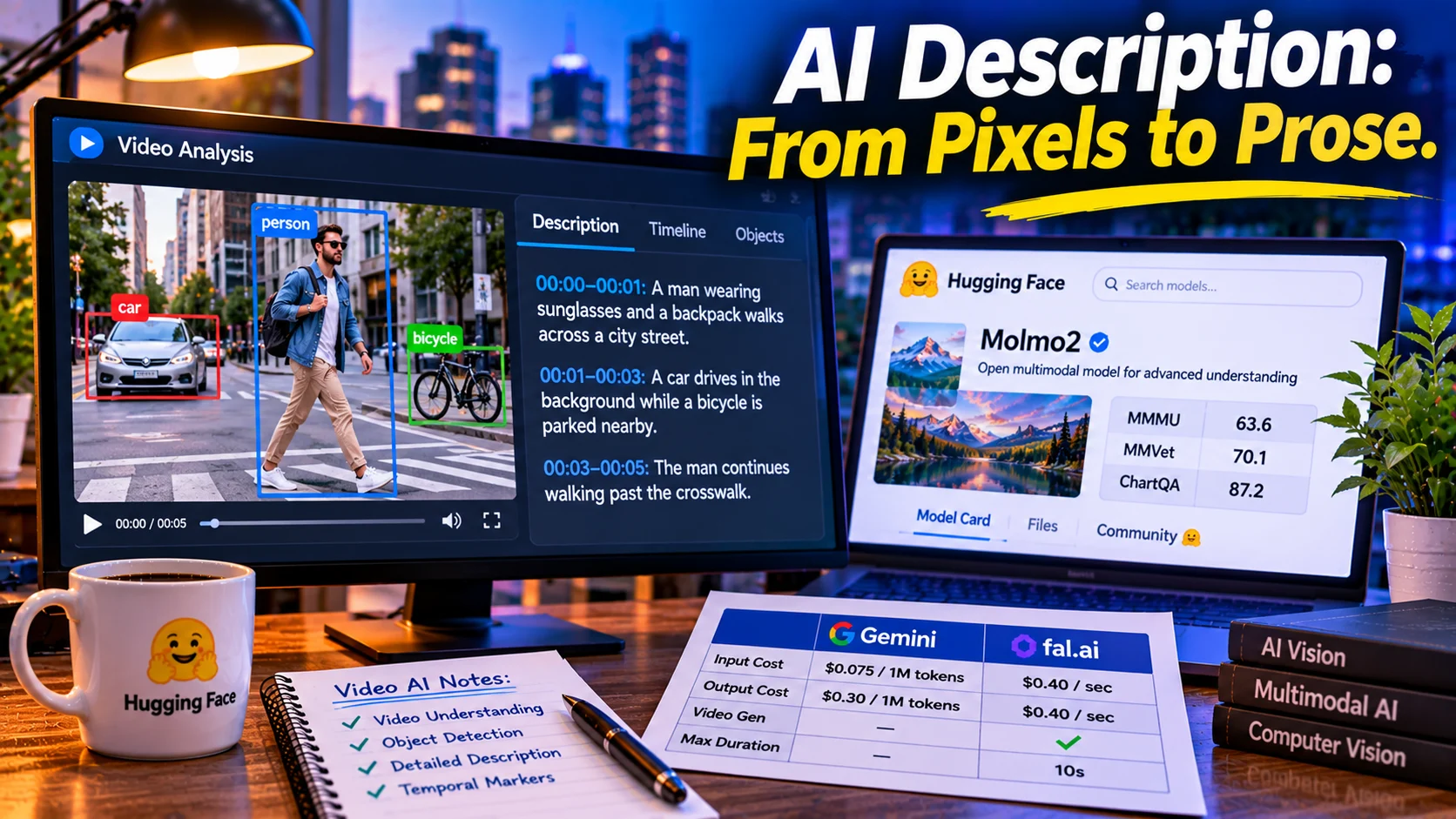
AI image video description generation uses vision-language models to convert visual content into written text. The field has advanced significantly with open-weight models like Molmo2, which outperforms proprietary models on some video grounding tasks, while Google’s Gemini charges roughly $0.04 per 1,000 output images and cloud APIs like fal.ai offer per-second video pricing for developers building captioning pipelines.
At a Glance: Key Takeaways
- Open-weight models have caught up. Molmo2, AllenAI’s 8B vision-language model, outperforms Gemini 3 Pro on some video pointing tasks and significantly beats Qwen3-VL on video counting .
- Temporal modeling is the key differentiator. Research shows that BLIP-based models with temporal architecture achieve the highest performance on video captioning metrics by modeling relationships between frames .
- Google Gemini offers per-token pricing for image and video inputs, with image output costing $30 per million tokens and video input at 258 tokens per second .
- fal.ai provides per-second video pricing for developers, with Wan 2.5 at $0.05 per video second and Veo 3 at $0.40 per video second .
- Detailed localized captioning remains hard. Models like Describe Anything Model (DAM) surpass GPT-4o on regional captioning benchmarks, but off-the-shelf VLMs still struggle to describe specific regions accurately .
- The market is growing rapidly. The multimodal content generation system market was valued at $873 million in 2025 and is projected to reach $3.06 billion by 2032 .
What Is AI Image Video Description Generation?
AI image video description generation is the process of using artificial intelligence to produce textual descriptions of visual content. It spans two related but distinct tasks: image captioning, which describes a single static frame, and video captioning, which must account for motion, temporal relationships, and changes across frames.
The technology sits at the intersection of computer vision and natural language processing. A vision encoder extracts features from the visual input, and a language model generates text that describes what it sees. For video, the model must also model how objects move and interact over time.
The search intent is primarily informational with commercial investigation. Developers want to understand which models perform best, how much they cost, and what limitations to expect. Content creators and accessibility professionals want to know which tools can generate usable alt text or scene descriptions.
How It Works
The Vision-Language Pipeline
Most modern description generation systems use a vision-language model (VLM). The architecture typically combines a Vision Transformer (ViT) for image processing with an adapter layer that connects visual features to a text decoder .
For video, temporal information must be integrated. A 2026 IEEE paper compared architectures for behavioral video captioning and found that BLIP-based models with temporal modeling achieved the highest performance on CIDEr, ROUGE-L, METEOR, and BERTScore metrics. The temporal component enabled more accurate representation of crowd behaviors and interactions .
The Localized Captioning Challenge
Describing an entire image is one task. Describing a specific region within an image or video is harder. Off-the-shelf VLMs like GPT-4o and LLaVA “only take in RGB images along with text prompts and do not allow users to accurately specify regions of interest” .
The Describe Anything Model (DAM) addresses this with a focal prompt that integrates local crops with cross-attention, achieving 67.3% accuracy on regional captioning without increasing sequence length. DAM surpasses GPT-4o and o1 on detailed localized captioning benchmarks .
The Major Models and Pricing Compared
Molmo2: The Open-Weight Leader
Molmo2 is a family of open-weight vision-language models from AllenAI. The best-in-class 8B model “outperforms others in the class of open weight and data models on short videos, counting, and captioning, and is competitive on long-videos” .
Critically, Molmo2 was trained without using closed VLMs for data generation. The team collected 7 new video datasets and 2 multi-image datasets, including detailed video captions and object tracking data. This makes it a foundation the open-source community can build on rather than a distillation of proprietary models .
On video grounding, Molmo2 achieves 38.4 F1 on video pointing versus Gemini 3 Pro’s 20.0, and 56.2 J&F on video tracking versus Gemini’s 41.1 .
Google Gemini: Per-Token Pricing
Google’s Gemini models offer vision capabilities through the Vertex AI API. Pricing is token-based: a 1024×1024 image consumes 1,290 tokens, and output images cost $30 per million tokens (roughly $0.039 per 1,000 images). Video input consumes 258 tokens per second at a sample rate of one frame per second .
This pricing structure suits applications where image and video inputs are interleaved with text prompts in a single API call.
fal.ai: Per-Second Video Pricing
fal.ai provides serverless access to over 1,000 generative media models. For video, Wan 2.5 costs $0.05 per video second and Veo 3 costs $0.40 per video second. For image generation, Seedream V4 costs $0.03 per image, Flux Kontext Pro costs $0.04 per image, and Qwen Image costs $0.02 per megapixel .
The platform offers a pay-as-you-go model with no base fee, plus monthly credit plans starting at $50. Unused credits roll over .
Where Description Generation Still Fails
Temporal Understanding
While Molmo2 and BLIP-based models have improved video understanding, the gap between image and video captioning remains. The IEEE study noted that “the vast majority of existing studies evaluate only individual images and do not consider temporal information” . Video-based approaches are more challenging but necessary for accurate behavioral description.
Hallucination in Localized Captioning
DAM’s analysis found that the model “often predicts correct details not present in the reference caption,” suggesting that lower benchmark scores may reflect missing details in the reference rather than model hallucination . This means evaluation itself is imperfect.
Commercial vs. Research Gap
The best-performing research models (BLIP + Temporal, DAM) are not commercially available as APIs. Developers building production systems must choose between open-weight models they self-host (Molmo2) or proprietary APIs (Gemini) that may not match research benchmarks on specialized tasks.
Who Should Use Which Approach
Developers needing video grounding and tracking should use Molmo2. It outperforms proprietary models on video pointing and tracking tasks, and the open weights allow fine-tuning for specific domains .
Applications with mixed text and visual inputs should use Gemini’s API. The per-token pricing handles interleaved text, image, and video naturally, and the grounding feature supports search-backed descriptions .
Budget-sensitive video generation should use fal.ai’s Wan 2.5 at $0.05 per video second. The platform also offers serverless GPU access for custom model deployment .
Accessibility and alt-text generation can use commercial tools like those listed in AI tool directories, which offer image captioning and description generation at various price points .
Researchers needing localized regional descriptions should study DAM’s approach, though it is not commercially available. The focal prompt and localized vision backbone are documented in the arXiv paper .
Common Mistakes and Cautions
Assuming all VLMs handle video equally. Models trained only on images lack temporal understanding. Video captioning requires architectures that model frame relationships .
Ignoring the localized captioning gap. General VLMs describe the whole image. Describing a specific region requires specialized models or prompting strategies that most APIs do not support .
Overlooking token costs for video. Video input consumes 258 tokens per second in Gemini, making long videos expensive to process . Budget accordingly.
Expecting research benchmarks from commercial APIs. The best academic models are not always available as products. Production systems trade benchmark performance for reliability and support.
Forgetting that description quality varies by content type. A model that excels at crowd scenes may struggle with product photography or medical images. Test on your actual domain.
Frequently Asked Questions
What is AI image video description generation?
AI image video description generation is the use of vision-language models to produce textual descriptions of visual content. It spans image captioning (describing a static frame) and video captioning (describing motion and temporal relationships across frames).
What is the best open-weight model for video description?
Molmo2 from AllenAI is the strongest open-weight option. Its 8B model outperforms other open-weight models on short video captioning and counting, and surpasses Gemini 3 Pro on some video grounding tasks. It is available on Hugging Face .
How much does Google Gemini charge for image and video input?
Gemini charges per token. A 1024×1024 image consumes 1,290 tokens, and video input consumes 258 tokens per second. Output images cost $30 per million tokens, roughly $0.039 per 1,000 images .
What is the hardest problem in video description generation?
Temporal understanding and localized captioning are the hardest problems. Most models are trained on individual images and lack the temporal modeling needed to describe motion and interactions. Describing specific regions within a video is even harder .
What is fal.ai and how does its pricing work?
fal.ai is a serverless platform providing access to over 1,000 generative media models. Pricing is pay-as-you-go with no base fee. Video generation costs range from $0.05 per second (Wan 2.5) to $0.40 per second (Veo 3). Monthly credit plans start at $50 .
Conclusion
AI image video description generation has advanced rapidly. Open-weight models like Molmo2 now outperform proprietary systems on specific video grounding tasks. Google’s Gemini offers flexible per-token pricing for mixed multimodal inputs. fal.ai provides per-second video pricing for developers building pipelines.