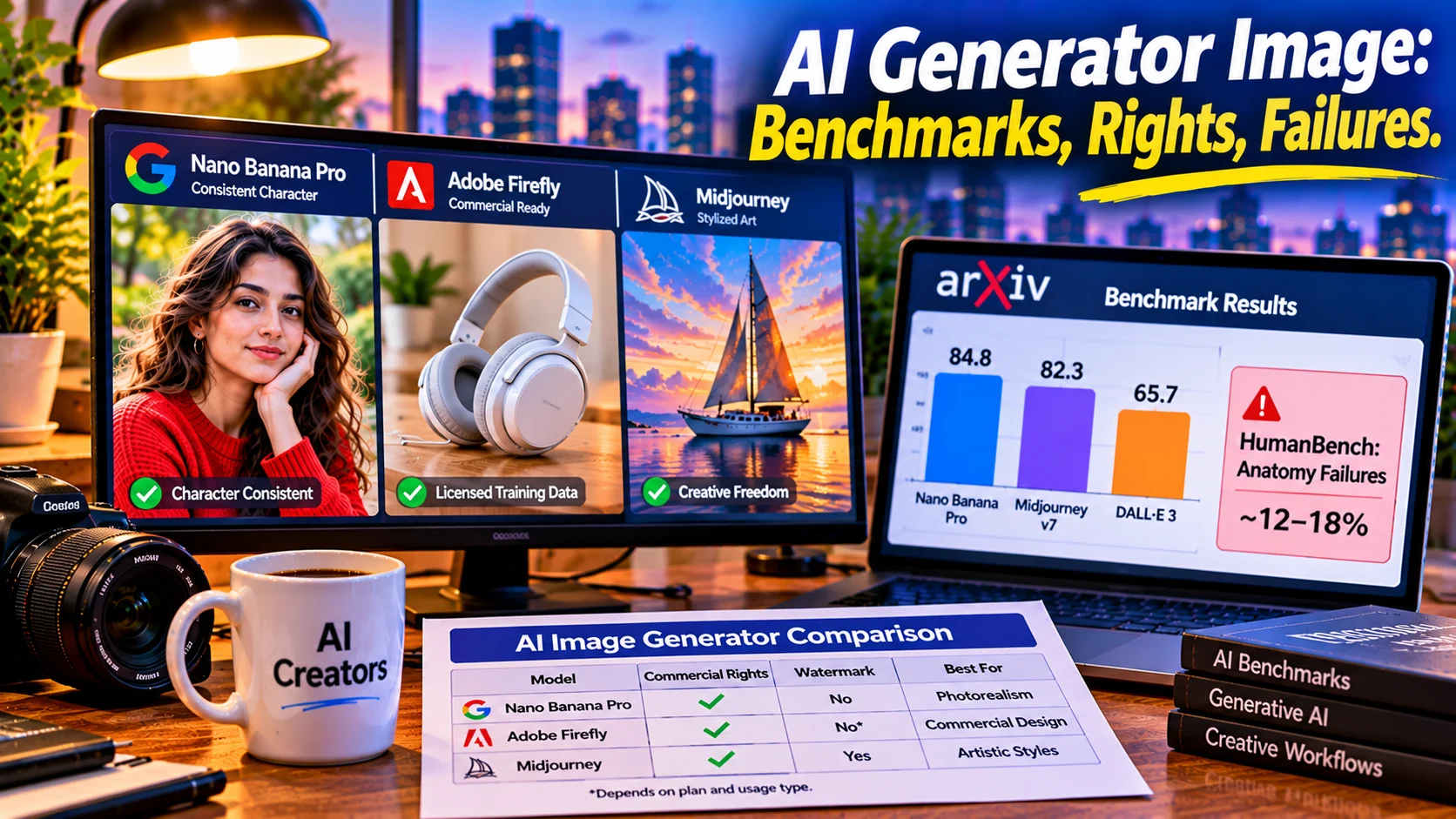
An AI generator image tool creates pictures from text prompts, and the best choice depends on your priority. Google’s Nano Banana Pro leads independent benchmarks at 84.8/100 for compositional accuracy and scores highest in CNET’s testing at 8.5/10 . Adobe Firefly offers the strongest legal safety for commercial work, while Midjourney remains the benchmark for distinctive creative output.
At-a-Glance: Key Takeaways
- Nano Banana Pro leads on composition. An August 2026 ArXiv benchmark of the hardest prompts ranked Gemini 3 Pro Image first at 84.8/100, ahead of FLUX.2 at 82.3 and Ideogram 3.0 at 65.7 .
- CNET’s testing gives Nano Banana the top score at 8.5/10, praising character consistency and realism, followed by Adobe Firefly at 8.0 .
- “Free” rarely means commercially usable. Microsoft Designer prohibits commercial use on its free tier. Recraft’s free tier keeps images public and retains ownership .
- Anatomy and text remain systemic failures. HumanBench found persistent disfigurements and counting errors across Midjourney, Stable Diffusion, and FLUX, with prompt-image consistency declining as complexity rises .
- The market was valued at $448 million in 2025, with North America holding 42.2% share and software growing at 18.1% CAGR .
What Is an AI Generator Image Tool?
An AI generator image tool is software that creates visual content from text descriptions. The dominant architectures are diffusion models, which learn to reverse a noise-adding process, and transformer-based systems that treat images as token sequences.
The category has fragmented into distinct use cases. Some tools optimize for photorealism and character consistency, like Nano Banana Pro. Others prioritize legal safety, like Adobe Firefly with its licensed training data. Some chase aesthetic distinctiveness, like Midjourney. And open-source options like Stable Diffusion offer local control at the cost of technical setup .
The search intent is commercial investigation. Users want to know which tool produces usable output for their specific task, what the real limitations are, and whether the free tier is sufficient.
How AI Generator Image Tools Work
The Diffusion Pipeline
Diffusion models start with random noise and iteratively denoise it into a coherent image. The model learns this by training on millions of image-text pairs: it takes a real image, adds noise, and learns to predict the noise that was added. At inference time, it reverses the process.
The efficiency frontier has moved dramatically. Mage-Flow’s Turbo variant generates a 1024×1024 image in 0.59 seconds on a single NVIDIA A100 GPU, using a compact 4B-scale model with native-resolution packing. The implication is that high-quality generation is becoming faster and cheaper, not just better.
The Token and Credit Economies
Pricing structures vary widely. Some tools use per-image flat rates, others use token-based billing tied to resolution and complexity, and many use credit systems that reset monthly or annually.
The credit model creates budgeting challenges. Without understanding the per-generation cost, users cannot predict whether their allowance will cover their actual workflow. The safest approach is to test a single project end-to-end before committing to a paid tier.
The Major Tools Compared
What the Benchmarks Actually Show
The ArXiv Compositional Benchmark
The August 2026 study tested four production systems on the 48 hardest prompts from the DSD dataset, focusing on precise object counts, multi-object attribute binding, legible embedded text, and spatial constraints .
Gemini 3 Pro Image (Nano Banana Pro) scored 84.8/100. FLUX.2 followed at 82.3. Ideogram 3.0 and Hunyuan 3.0 trailed at 65.7 and 63.3 .
The failure analysis is more instructive than the rankings. The leading systems lost points primarily through object miscounting and geometric artifacts. The trailing systems more frequently produced garbled text or omitted requested elements entirely .
The HumanBench Reality Check
An IEEE conference paper published in May 2026 tested Midjourney, Stable Diffusion, and FLUX on human generation. The findings were blunt: “persistent failures, including disfigurements, species leakage, and counting errors” .
The paper documented specific failures including humans with two heads and missing legs, misplaced limbs, and animals generated instead of humans. Prompt-image consistency declined monotonically as complexity increased .
The implication is that no current model reliably generates anatomically coherent humans in complex scenes. For professional work involving people, plan for iteration and post-generation correction.
The Qwen Benchmark
A Hugging Face benchmark of 18 models found that basic image quality has become table stakes. Creative Generation variance was over 11 times that of Quality, meaning the differentiation between models now lies in creative tasks, not baseline realism .
The benchmark also identified systemic ceilings: Physical Logic, Anatomical Fidelity, and Animals remain uniformly weak across all 18 models. These are not model-specific weaknesses but limitations of current text-to-image technology .
Where AI Generator Image Tools Still Fail
Anatomy and Human Figures
The HumanBench findings are consistent with broader industry experience. AI generators struggle with hands, faces, and full-body coherence. Eyes and teeth are the strongest indicators that an image is AI-generated, according to Yahoo’s testing .
The practical workaround is to reduce the number of people in the prompt and use post-generation editing tools to fix specific areas. Asking for one person rather than five improves the odds of a usable result .
Text Rendering
Most models still cannot render legible text reliably. Ideogram has focused on typography since launch, and its 4.0 version allows users to mark out where each element goes, holding positions whether exporting a social tile or a poster . But even Ideogram trails on the hardest compositional benchmarks .
The general rule remains: if the image needs readable text, plan to add it in post-production.
Consistency Across Assets
Holding a character’s face or a product’s geometry across multiple generations is unsolved. Each generation is a fresh sample from the model’s distribution. Nano Banana Pro’s character consistency is praised by CNET , but professional campaigns requiring twelve variations of the same product will still face drift.
Commercial Rights and the “Free” Trap
The most consequential distinction across AI generator image tools is commercial licensing.
Adobe Firefly is the safest commercial option. Its models are trained on licensed Adobe Stock content and public domain material. Paid plans include IP indemnification, meaning Adobe will defend you if the output is challenged. The free tier permits commercial use but does not include indemnification .
Microsoft Designer and Copilot explicitly prohibit commercial use on their free tiers. The official documentation states Designer is licensed for personal, non-commercial use. A client deliverable requires a paid Copilot subscription .
Recraft offers SVG output on its free tier, a unique capability. But free images are public and remain the property of Recraft, excluding clean professional use without a subscription .
ChatGPT grants ownership to users and permits commercial use, but the free tier produces very few images per day .
Gemini permits commercial use, but app-generated images carry a visible Gemini logo. Only API outputs escape the logo .
The pattern is clear: free access and commercial safety are different things. For client work, the cost of a paid plan is the cost of legal protection.
Who Should Use Which Tool
Enterprise teams and agencies should use Adobe Firefly. The licensed training data and IP indemnification on paid plans reduce legal exposure for branded and client work .
Creative studios and art directors should use Midjourney for distinctive, stylized output, or Nano Banana Pro for character consistency and realism .
Developers building applications should use API access from Google, OpenAI, or Black Forest Labs. The models are designed for programmatic access, and per-token pricing scales with usage.
Privacy-sensitive users and tinkerers should use Stable Diffusion locally. It runs on consumer hardware and is free for commercial use up to $1M annual revenue .
Anyone needing vector output should use Recraft on a paid plan. It draws vector directly rather than tracing a finished raster, producing print-ready logos and icons .
Common Mistakes and Cautions
Assuming free means commercially usable. Microsoft Designer prohibits it. Recraft’s free images are public and owned by Recraft. Gemini’s app outputs carry a visible logo .
Expecting reliable anatomy. HumanBench found persistent disfigurements across Midjourney, Stable Diffusion, and FLUX. Hands, faces, and full-body coherence remain weak points .
Ignoring the public gallery default. Midjourney images are public unless you are on a paid plan with stealth mode. Confidential work should not be generated on lower tiers .
Overlooking text rendering limitations. Even Ideogram, which focuses on typography, trails on the hardest compositional benchmarks. Plan to add text in post-production .
Treating benchmark rankings as universal. The ArXiv benchmark tested the hardest prompts. A tool that wins on composition may lose on aesthetics or speed. Match the tool to your specific task .
Frequently Asked Questions
What is the best AI generator image tool overall?
Nano Banana Pro leads CNET’s testing at 8.5/10 and the ArXiv compositional benchmark at 84.8/100. It excels at character consistency and realism. Adobe Firefly is the better choice for commercial work requiring legal safety .
Are free AI image generators safe for commercial use?
Not always. Microsoft Designer prohibits commercial use on its free tier. Recraft’s free images are public and owned by Recraft. Adobe Firefly’s free tier permits commercial use but lacks the IP indemnification of paid plans. Always verify the specific tool’s terms .
Why do AI-generated images have bad hands and faces?
HumanBench found persistent disfigurements, including two-headed figures and missing limbs, across Midjourney, Stable Diffusion, and FLUX. Prompt-image consistency declines as complexity rises. Reducing the number of people in the prompt and using post-generation editing tools improves results .
What is the best AI image generator for text?
Ideogram has focused on typography since launch, and version 4.0 allows precise element placement. However, even Ideogram trails on the hardest compositional benchmarks. No current model renders text reliably enough for professional use without correction .
How big is the AI image generator market?
The market was valued at $448.30 million in 2025 and is projected to reach $526.30 million in 2026. Software is growing at 18.1% CAGR, and North America holds 42.2% share. Media and entertainment accounts for 28.4% of the market .
Conclusion
The best AI generator image tool depends entirely on what you need it to do. Nano Banana Pro leads on compositional accuracy and character consistency. Adobe Firefly wins on legal safety. Midjourney remains the benchmark for creative, stylized output.