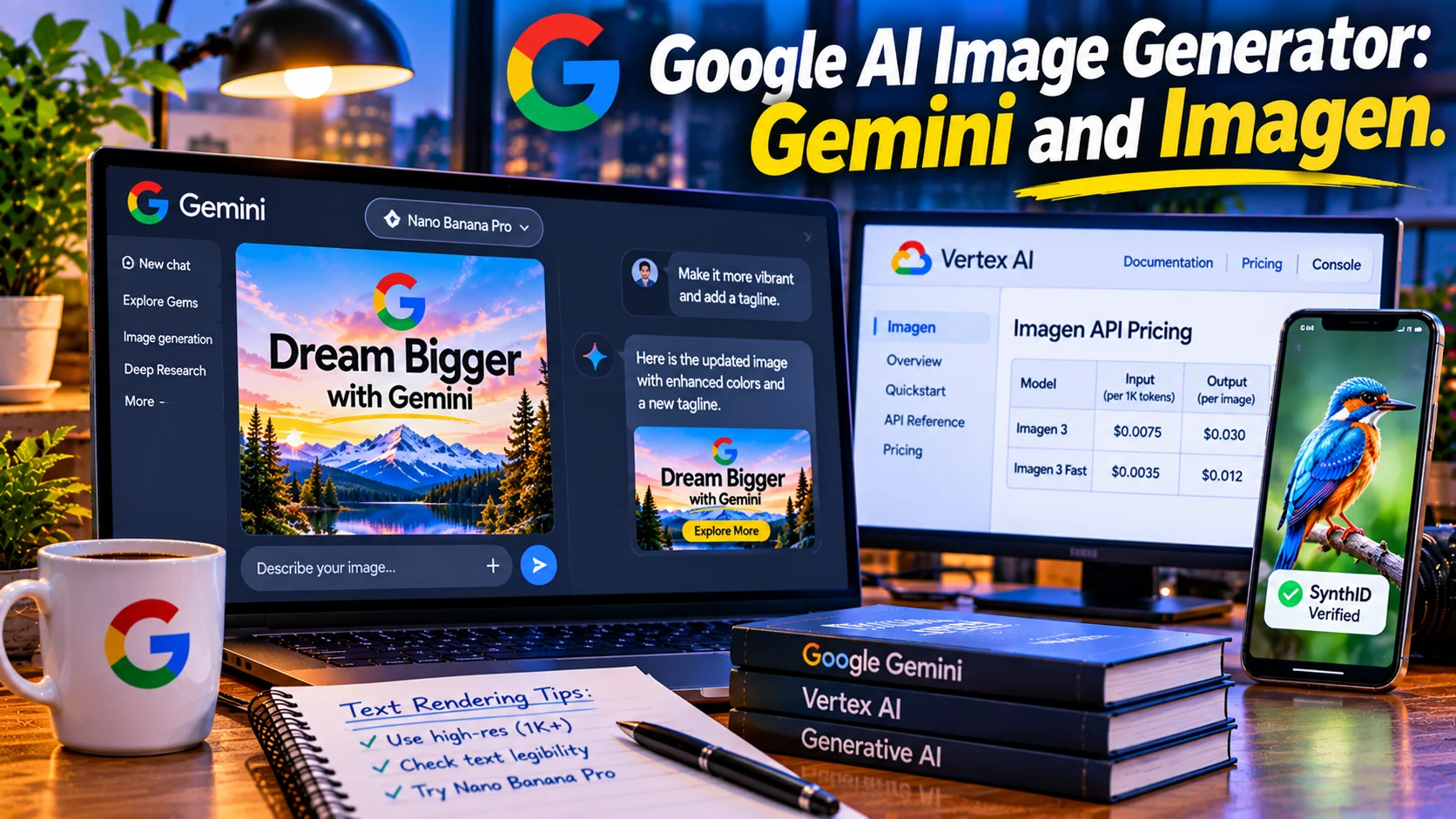
Google offers two distinct AI image generation paths: Nano Banana Pro inside the Gemini app for conversational editing and text rendering, and Imagen on Vertex AI for developer API access. Nano Banana Pro is available on the free Gemini tier with usage limits, while Imagen charges per image through Google Cloud. Every Google-generated image carries an invisible SynthID watermark.
At-a-Glance: Key Takeaways
- Google has two separate image generation products, not one. Nano Banana Pro lives in Gemini for consumers. Imagen lives on Vertex AI for developers.
- Nano Banana Pro excels at text rendering and conversational editing, two areas where most competitors struggle.
- The free Gemini tier includes Nano Banana Pro with daily limits that reset, making it one of the most capable free options available.
- Imagen API pricing is per-image, with costs varying by resolution and model version. Developers pay through Google Cloud.
- SynthID watermarking is applied to every output, an invisible digital signature that survives editing and cropping.
- Commercial use is permitted under Google’s terms, but the same legal caveats apply as with any AI-generated content.
What Is the Google AI Image Generator?
Google’s AI image generation strategy is split across two products that serve different audiences. Confusing them is the most common mistake people make when searching for “Google AI image generator.”
Nano Banana Pro is the consumer-facing model inside the Gemini app. It is designed for conversational image creation and editing. You describe what you want in plain language, and the model generates or modifies images in the chat interface. Its standout capability is rendering legible text within images, a problem most models still cannot solve.
Imagen is the developer-facing model on Google Cloud’s Vertex AI platform. It is accessed through an API, priced per image, and designed for programmatic integration into applications and workflows.
The distinction matters because the pricing, access, and capabilities differ entirely. A user searching for a free tool wants Gemini. A developer building an app wants Imagen.
How Google’s Image Generators Work
Nano Banana Pro in Gemini
Nano Banana Pro operates conversationally. You can ask it to generate an image from scratch, edit an existing image, or combine multiple reference images. The model maintains context across the conversation, allowing iterative refinement without starting over.
The model’s architecture is a diffusion-based system with a focus on text and layout understanding. This is why it can render signs, posters, and infographics with legible lettering. The model has learned to associate specific words with precise spatial arrangements, not just visual features.
Imagen on Vertex AI
Imagen is a text-to-image diffusion model exposed through a REST API. Developers send a prompt, specify parameters like aspect ratio and resolution, and receive generated images. The API supports batch generation, safety filters, and integration with other Google Cloud services.
Imagen is designed for scale. It is not a conversational tool. It is infrastructure that applications call programmatically.
The SynthID Layer
Every image Google generates carries SynthID, an invisible digital watermark. SynthID embeds a pattern into the pixels that survives editing, cropping, and compression. Google provides a detector that can identify SynthID-marked images.
This is a provenance mechanism, not a content restriction. It allows Google and others to identify AI-generated images even after they have been modified. It does not prevent generation or limit what you can create.
Key Features and Capabilities
Text Rendering
Nano Banana Pro’s most significant differentiator is its ability to render legible text. Most image models produce garbled letterforms when asked to include words. Nano Banana Pro handles signs, labels, and typographic elements with surprising accuracy.
This makes it useful for mockups, social graphics, and any image where text must be readable. It does not replace a design tool, but it reduces the need for post-production text overlay.
Conversational Editing
Gemini’s interface allows iterative editing in plain language. You can ask to “change the background to a beach” or “make the person wear a red jacket” without re-prompting from scratch. The model preserves what you want to keep and modifies what you specify.
This conversational workflow is more accessible than node-based tools or API calls. It suits users who want to think through an image rather than engineer a prompt.
Imagen’s API Features
Imagen on Vertex AI offers parameters that consumer tools hide: aspect ratio control, negative prompts, seed values for reproducibility, and safety filter configuration. Developers can generate multiple images in a single request, upscale outputs, and integrate results into downstream pipelines.
Integration with Google’s Ecosystem
Nano Banana Pro is embedded in Gemini, which integrates with Google Workspace. Images can be generated in the context of a document, presentation, or email. The model can also reference files you have uploaded to the conversation.
Pricing and Access
| Nano Banana Pro | Gemini app (web, mobile) | Free tier with limits; Google AI Pro/Ultra for higher limits | Yes, daily generation limits reset |
| Imagen | Vertex AI API | Per-image pricing through Google Cloud | No free tier; pay-as-you-go |
Nano Banana Pro is available on the free Gemini tier. The daily limits are not publicly documented in precise numbers, but they reset every 24 hours. Google AI Pro and Ultra subscribers receive higher limits and faster generation.
Imagen pricing is set by Google Cloud. It is charged per image, with rates varying by model version and resolution. Developers pay through their Cloud billing account. There is no free tier for Imagen.
Privacy and Security Considerations
Google processes prompts and generated images on its servers. The privacy implications depend on which product you use.
Nano Banana Pro in Gemini: Conversations and generated images are subject to Google’s Gemini privacy policy. Google may use your interactions to improve its models unless you disable activity history in settings. The SynthID watermark persists in the output.
Imagen on Vertex AI: Google Cloud’s enterprise data processing terms apply. Vertex AI customers have access to data processing agreements, audit logs, and regional data residency options. Google states that Imagen prompts are not used to train models without explicit consent.
SynthID: The watermark is designed to be robust to editing and cropping. It is a provenance tool, not a privacy tool. It identifies the image as AI-generated; it does not expose the prompt or the user.
Important distinction: No SOC 2 or ISO 27001 certification is referenced for the consumer Gemini app. Vertex AI operates under Google Cloud’s compliance certifications, which are extensive but should be verified for specific use cases.
How Google Compares to Other Image Generators
| Nano Banana Pro | Conversational editing, text | Yes, daily limits | Strong | SynthID (invisible) |
| Midjourney v7 | Aesthetic quality | No | Weak | None |
| Adobe Firefly | Commercial indemnification | Limited credits | Moderate | None |
| Ideogram | Text rendering | Daily credits | Strong | None |
| FLUX (local) | No restrictions | Free (self-hosted) | Moderate | None |
Editorial interpretation: Nano Banana Pro’s combination of free access, conversational editing, and text rendering makes it the strongest general-purpose option for most users. Midjourney still wins on raw aesthetics. Firefly wins on legal safety. Local FLUX wins on freedom.
Who Should Use Google’s AI Image Generator
Casual users and creators should start with Nano Banana Pro in Gemini. It is free, capable, and accessible through an interface most people already use.
Developers building applications should use Imagen on Vertex AI. The API provides control, scale, and integration with Google Cloud infrastructure.
Teams already using Google Workspace benefit from Gemini’s integration with Docs, Slides, and Gmail. The image generator is embedded in workflows rather than requiring a separate tool.
Users needing commercial safety should verify Google’s terms for their specific use case. Google permits commercial use of generated images, but the same caveats apply as with any AI output: ownership and copyright are unsettled.
Users needing zero restrictions should look elsewhere. Google enforces content policies and applies SynthID watermarking to every output.
Common Mistakes and Cautions
Confusing Nano Banana Pro with Imagen. They are different products with different access paths and pricing. Nano Banana Pro is in Gemini. Imagen is on Vertex AI.
Assuming the free tier is unlimited. Gemini’s free tier has daily limits that reset. Heavy users will hit them and need a paid plan.
Overlooking SynthID. Every Google-generated image carries an invisible watermark. If you need an unwatermarked image for a specific reason, Google is not the right tool.
Expecting Imagen to have a free tier. It does not. Imagen charges per image through Google Cloud.
Assuming “commercial use permitted” means full copyright ownership. Google’s terms allow commercial use, but AI-generated images exist in a legal gray zone. The same uncertainty that applies to other tools applies here.
Frequently Asked Questions
What is Google’s AI image generator called?
Google has two: Nano Banana Pro (inside the Gemini app) and Imagen (on Vertex AI). They serve different audiences and have different pricing and access.
Is Google’s AI image generator free?
Nano Banana Pro is available on the free Gemini tier with daily generation limits that reset. Imagen on Vertex AI has no free tier and charges per image through Google Cloud.
Can I use Google AI images commercially?
Google’s terms permit commercial use of generated images. However, the same legal caveats apply as with any AI-generated content. Ownership and copyright of AI output remain unsettled in many jurisdictions.
What is SynthID?
SynthID is an invisible digital watermark that Google embeds in every AI-generated image. It survives editing, cropping, and compression, and can be detected by Google’s tools. It is a provenance mechanism, not a content restriction.
Does Google’s AI image generator render text well?
Nano Banana Pro is particularly strong at rendering legible text within images. It handles signs, labels, and typographic elements better than most competitors. Ideogram is the closest consumer alternative for text rendering.
Conclusion
Google’s AI image generation strategy is split between a consumer product and a developer API. Nano Banana Pro in Gemini offers free, conversational image generation with strong text rendering and daily limits. Imagen on Vertex AI offers programmatic access, per-image pricing, and enterprise integration.