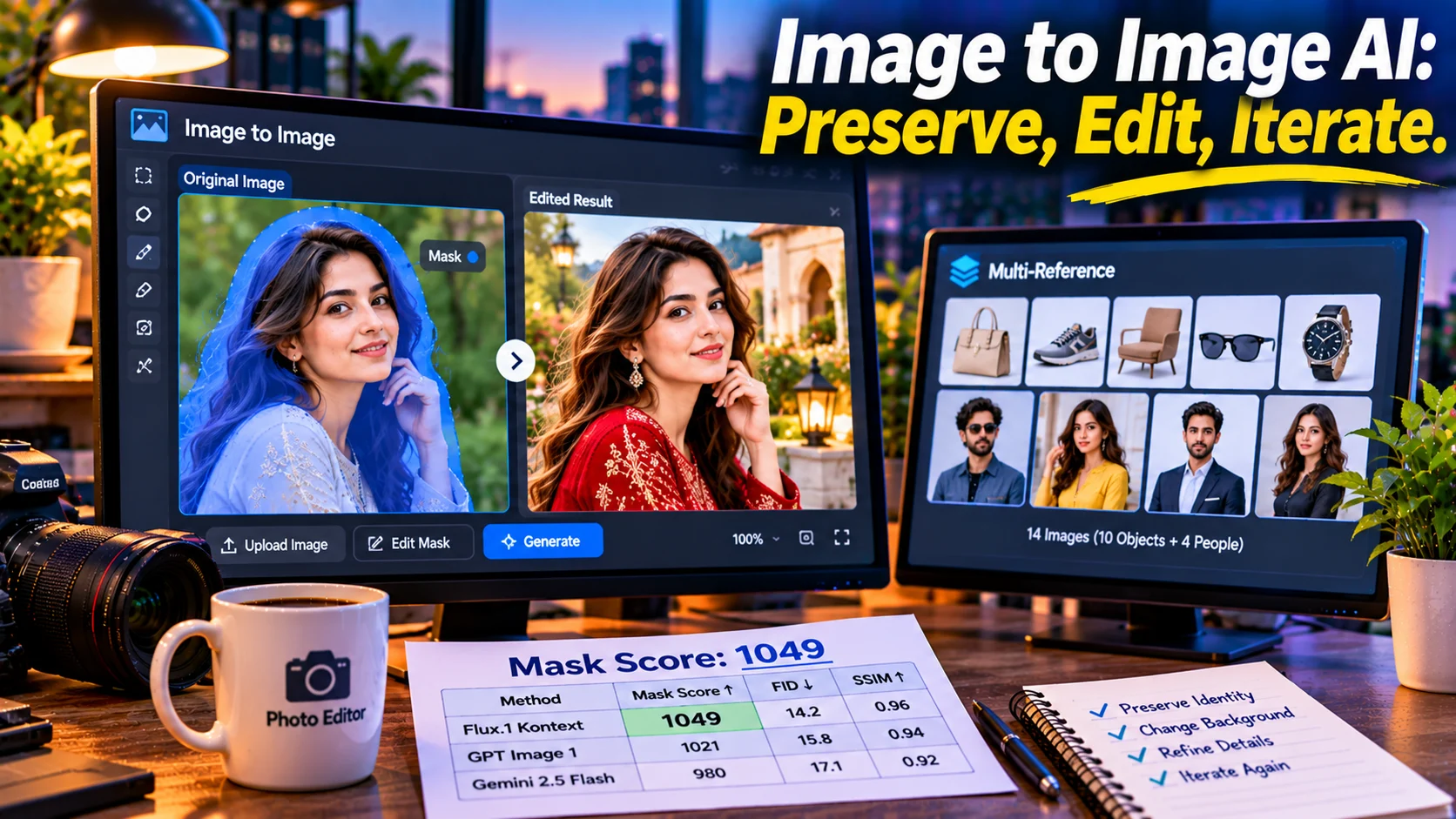
Image to image AI transforms an existing image based on a text instruction, a mask, or a reference photo. Google’s Nano Banana 2.1 leads on price and speed at $0.034 per 1K image with mask-based local editing, while OpenAI’s GPT Image 2.5 leads on precision at $0.069. Open-source models like FLUX offer local, unrestricted editing for users with capable GPUs.
At-a-Glance: Key Takeaways
- Image to image is fundamentally different from text to image. It starts with an existing visual, which means the model must preserve structure while changing content. This requires different architectures and evaluation methods.
- Masking is the core control mechanism. Nano Banana 2.1 scores 1049 on mask-based editing, beating its own Pro tier by 122 points .
- Subject consistency is the new battleground. Nano Banana 2.1 allows up to 14 reference images (10 objects, 4 people) to prevent “face drift” across edits .
- Price war is real. Nano Banana 2.1 cut 1K image cost to $0.034, half of Nano Banana 2, while GPT Image 2.5 charges $0.069 per image .
- Speed matters for iteration. Nano Banana 2.1 generates in 11 seconds; GPT Image 2.5 takes 50 seconds for the same task .
- Local options exist for unrestricted editing. FLUX and Stable Diffusion run locally, bypassing content policies but requiring hardware and setup.
What Is Image to Image AI?
Image to image AI is a class of generative models that transform an existing image rather than creating one from scratch. You provide a source image and an instruction, and the model produces a modified version that preserves selected elements while changing others.
The instruction can take several forms. A text prompt describes the desired change (“make it sunset,” “add a hat”). A mask defines the exact region to edit, leaving the rest untouched. A reference image supplies style, subject, or composition cues.
This distinction matters because image to image is not simply “text to image with an input.” The model must understand the original image’s structure, lighting, and content, then apply changes without destroying what should stay the same.
The search intent for “image to image ai” is primarily informational with commercial investigation. Users want to understand the technology, compare tools, and know which model handles their specific editing task.
How Image to Image AI Works
The Editing Pipeline
Modern image to image models use diffusion or transformer architectures conditioned on the source image. The source is encoded into a latent representation. The model then denoises a new latent that is guided by both the source encoding and the text instruction or mask.
The key technical challenge is locality. A good editing model changes only what you ask it to change. It does not alter the background when you ask for a new shirt, and it does not change the face when you ask for a different pose.
Mask-Based Editing
Masking is the most precise control method. You draw a region around the area to edit, and the model operates only within that boundary. Everything outside the mask remains pixel-identical to the original.
Google’s Nano Banana 2.1 scores 1049 on mask-based editing, a significant improvement over its predecessor (965) and its own Pro tier (927) . The model card positions this as “professional-grade precision and control” for local edits.
Subject Consistency
The hardest problem in image to image is maintaining consistency across multiple edits. If you change a character’s outfit, does their face stay the same? If you generate a product from a new angle, does the logo stay legible?
Nano Banana 2.1 addresses this with multi-reference support. Developers can feed up to 10 object references and 4 people references into the model, which uses them to anchor identity across generations . The multi-person consistency score reached 1106, up 128 points from Nano Banana 2 .
The Speed and Cost Trade-off
Iteration speed determines workflow viability. Nano Banana 2.1 generates a 1K image in 11 seconds at $0.044. GPT Image 2.5 takes 50 seconds at $0.069 for the same output . For four images, Nano Banana 2.1 costs $0.178 versus $0.284 for GPT Image 2.5 .
The pricing structure has shifted. Google cut image output cost in half but tripled input token cost (from $0.5 to $1.5 per million) and raised text/thinking output from $3 to $7.5 per million . The company is moving money from “drawing” to “thinking.”
The Major Image to Image Models Compared
Key Use Cases for Image to Image AI
Product Photography and Mockups
Brands use image to image to place products in new contexts without reshooting. A shoe photographed on white can be placed on a model’s foot, on a street, or in a lifestyle scene. Subject consistency ensures the product’s geometry and branding remain accurate.
Character and Portrait Editing
Portrait retouching, expression changes, and outfit swaps are common use cases. The challenge is preserving identity. Multi-reference models like Nano Banana 2.1 reduce “face drift” by anchoring to supplied references .
Style Transfer and Artistic Interpretation
Image to image can apply artistic styles to photos, turning a portrait into an oil painting or a landscape into a watercolor. This is the least consistency-sensitive use case, as identity preservation matters less than aesthetic output.
Background Replacement and Object Removal
Mask-based editing excels here. You draw a mask around the object to remove, and the model fills the space with plausible content. Nano Banana 2.1’s mask scoring suggests it handles this task well .
Who Should Use Which Model
Developers and API users should use Nano Banana 2.1 for cost-sensitive, high-volume editing. The $0.034 per image and 11-second generation make it the most efficient option for batch processing .
Users needing maximum precision should use GPT Image 2.5. The higher cost and slower speed reflect a model optimized for instruction adherence and detail preservation .
Privacy-sensitive users and tinkerers should use FLUX or Stable Diffusion locally. The trade-off is hardware cost and setup time, but the benefit is no content filters and no data leaving your device.
Enterprise teams needing legal safety should verify the commercial terms of their chosen API. Google and OpenAI both permit commercial use within their terms, but indemnification varies.
Common Mistakes and Cautions
Assuming image to image is just “text to image with an input.” The model must preserve structure while changing content. Poorly designed workflows can destroy the original image’s integrity.
Ignoring mask precision. A loose mask leads to unintended changes outside the intended region. Tight, well-drawn masks produce better results.
Expecting perfect consistency without references. If you need a character’s face to stay the same across edits, supply reference images. The model cannot infer identity from a text prompt alone.
Overlooking the cost shift. Google cut image output prices but raised input and thinking costs . Workflows that involve heavy prompt engineering or long instructions may cost more than expected.
Forgetting that local models have licenses. FLUX.1-schnell is Apache 2.0 (commercial use permitted). FLUX.1-dev is non-commercial only. Check the license before using local models for client work.
Frequently Asked Questions
What is image to image AI?
Image to image AI transforms an existing image based on a text instruction, mask, or reference photo. It differs from text to image because the model must preserve selected elements of the source while changing others. Mask-based editing is the most precise control method.
What is the best image to image model in 2026?
Nano Banana 2.1 leads on price and speed at $0.034 per 1K image and 11-second generation. GPT Image 2.5 leads on precision and instruction following at $0.069 per image and 50 seconds . The best choice depends on whether you prioritize cost or accuracy.
Can image to image AI keep a character consistent?
Yes, with the right model and references. Nano Banana 2.1 allows up to 14 reference images (10 objects, 4 people) to anchor identity across edits, scoring 1106 on multi-person consistency . Without references, consistency degrades.
What is mask-based editing?
Mask-based editing lets you draw a region around the area you want to change. The model operates only within that mask, leaving everything else pixel-identical. Nano Banana 2.1 scores 1049 on this task, beating its own Pro tier .
Is local image to image AI better than cloud?
Local models offer no content filters and no data transmission. Cloud models offer speed, convenience, and no hardware requirements. FLUX and Stable Diffusion are the leading local options, but they require a capable GPU and setup time.
Conclusion
Image to image AI has matured from a novelty to a production tool. The models are faster, cheaper, and more controllable than they were a year ago. Nano Banana 2.1 delivers mask-based editing and multi-reference consistency at $0.034 per image .