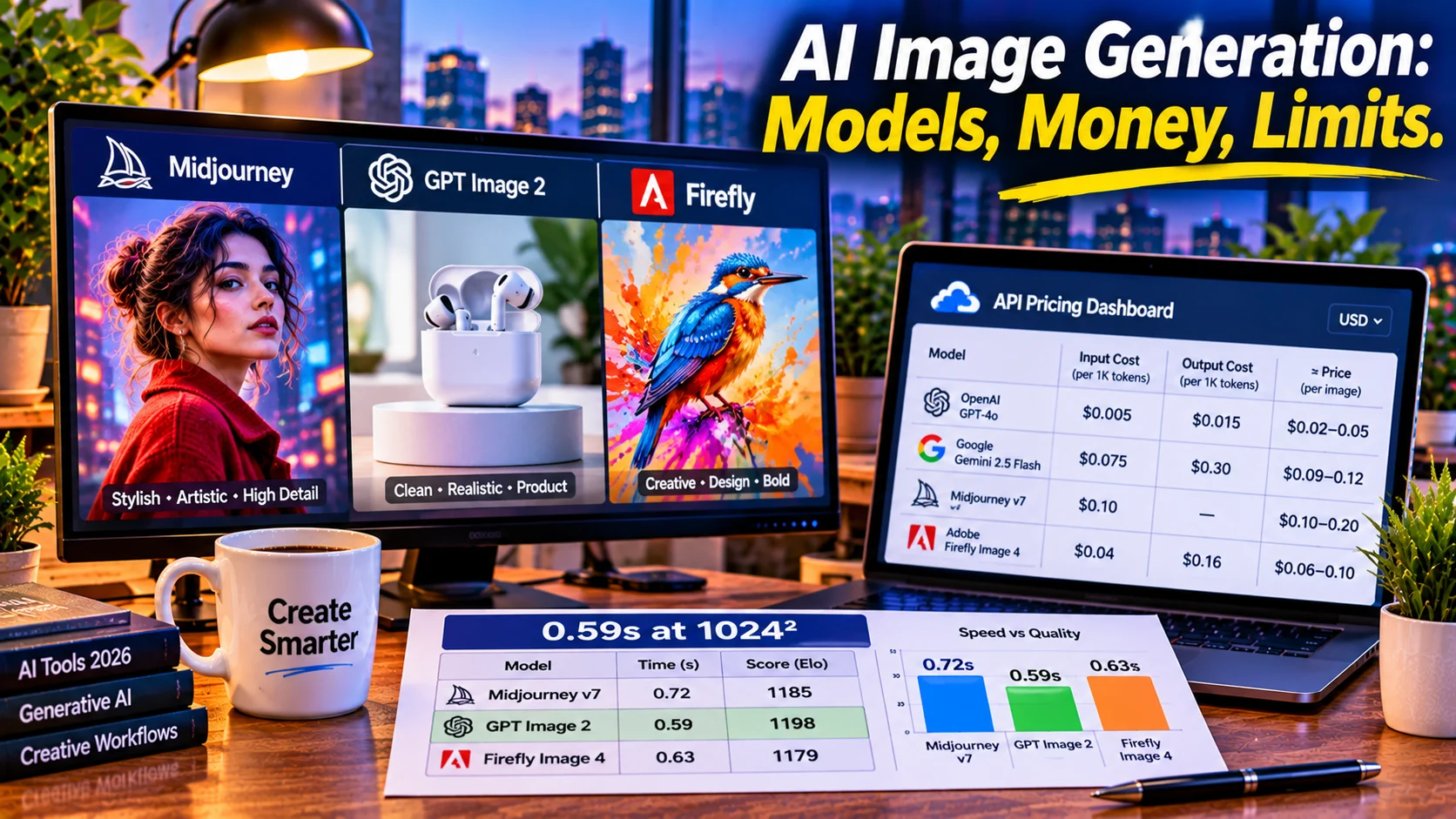
AI image generation creates pictures from text prompts using diffusion or transformer models. The market was valued at $448 million in 2025 and is growing at roughly 18% annually . OpenAI’s GPT Image 2 leads API access at token-based pricing, Midjourney v7 remains the aesthetic benchmark at $10-$120/month, and Adobe Firefly offers commercial safety with 2,000-50,000 monthly credits .
At a Glance: Key Takeaways
- The market is growing fast but remains concentrated. North America holds 42.2% share, and Adobe, OpenAI, Google, Microsoft, and NVIDIA collectively account for 45-50% of the market .
- API pricing has collapsed to fractions of a cent. Google’s Imagen 3.0 costs $0.03 per image, DALL-E 3 costs $0.04, and GPT Image 2.5 Flare charges $30 per million output tokens .
- Midjourney still has no public API. Generation happens only through Discord or the web app, and commercial rights depend on company revenue and plan tier .
- Adobe Firefly is the safest commercial option. Paid plans include unlimited standard generations and IP indemnification, with premium credits for video and advanced features .
- Open-source models have closed the gap. Stable Diffusion 3.5 runs on consumer hardware and is free for commercial use up to $1M annual revenue .
- Text rendering and consistency remain unsolved. Most models still garble text, and holding a character or product across multiple generations requires manual effort.
What Is AI Image Generation?
AI image generation is the process of creating visual content from text descriptions using machine learning. The dominant architectures are diffusion models, which learn to reverse a noise-adding process to produce coherent images, and transformer-based models that treat images as sequences of tokens.
The category has matured beyond novelty. It is now embedded in creative workflows across media, gaming, advertising, and product design. The media and entertainment segment accounted for 28.4% of market share in 2025, while gaming is the fastest-growing segment at 19.6% CAGR .
The search intent for “AI image generation” is primarily informational with commercial investigation. Users want to understand the technology, compare tools, and know the limitations before committing budget or workflow changes.
How AI Image Generation Works
The Diffusion Pipeline
Diffusion models start with random noise and iteratively denoise it into an image. The model learns this by training on millions of image-text pairs: it takes a real image, adds noise, and learns to predict the noise that was added. At inference time, it reverses the process.
Mage-Flow, a 2026 ArXiv paper, demonstrates the efficiency frontier. Its Turbo variant generates a 1024×1024 image in 0.59 seconds on a single NVIDIA A100 GPU, using a compact 4B-scale model with a lightweight VAE and native-resolution packing . The implication is that high-quality generation is becoming cheaper and faster, not just better.
The Token-Based Cost Structure
API pricing has shifted from per-image to per-token for newer models. GPT Image 2.5 Flare charges $8 per million input image tokens and $30 per million output image tokens, with a batch discount to $15 . For comparison, Google’s Imagen 3.0 charges a flat $0.03 per image and DALL-E 3 charges $0.04 .
The token model aligns cost with resolution and complexity, but it makes budgeting less predictable than a flat per-image rate.
The Aesthetic Factor
Technical quality and aesthetic quality are different things. Midjourney v7 remains the benchmark for distinctive, art-directed output. A Krea analysis notes that “for refined art direction, Midjourney still wins,” and its Standard plan at $30/month unlocks unlimited Relax mode generation if you can wait 5-10 minutes per result .
The Major Models Compared
Where AI Image Generation Still Fails
Text Rendering
Most models still cannot render legible text reliably. A prompt asking for a sign with specific words produces garbled letterforms. This is a structural limitation of how diffusion models handle spatial precision.
Some models have improved. But the general rule remains: if the image needs readable text, plan to add it in post-production or use a specialized tool.
Character and Product Consistency
Holding a character’s face or a product’s geometry across multiple generations is unsolved. Each generation is a fresh sample from the model’s distribution. Professional workflows that need consistency require reference images, fine-tuning, or manual retouching.
The Copyright Question
AI-generated images exist in a legal gray zone. Midjourney’s terms grant ownership to users, but the company retains a perpetual license over prompts and outputs . Adobe Firefly offers IP indemnification, meaning Adobe will defend you if the output is challenged. Stable Diffusion 3.5 permits commercial use up to $1M revenue under its Community License .
The safest path for commercial work is a tool that explicitly indemnifies, like Firefly. The riskiest is a tool that grants ownership without indemnification, leaving you to defend yourself.
Who Should Use Which Tool
Enterprise teams needing legal safety should use Adobe Firefly. The IP indemnification and integration with Creative Cloud make it the lowest-risk option for client work and branded content .
Art directors and creative studios should use Midjourney v7. The aesthetic quality remains unmatched, and the $30/month Standard plan with unlimited Relax mode is the value sweet spot .
Developers building applications should use GPT Image 2 or Imagen 3.0 via API. The token-based pricing scales with usage, and the models are designed for programmatic access .
Privacy-sensitive users and tinkerers should use Stable Diffusion 3.5. It runs locally, requires no cloud transmission, and is free for commercial use under the revenue threshold .
Anyone needing text in images should plan for post-production. No current model renders text reliably enough for professional use without manual correction.
Common Mistakes and Cautions
Assuming per-image pricing is stable. Token-based models like GPT Image 2.5 make cost prediction harder. A high-resolution batch can cost significantly more than a flat-rate estimate .
Ignoring the commercial threshold on Midjourney. Companies with over $1M annual revenue must subscribe to Pro or Mega to own their assets . Using Basic or Standard for commercial work above that threshold violates the terms.
Expecting consistency without effort. Each generation is independent. Holding a character or product across assets requires reference images, fine-tuning, or manual work.
Overlooking the public gallery default. Midjourney images are public unless you are on Pro or Mega with Stealth Mode . Confidential or client work should not be generated on lower tiers.
Treating “free” open-source as zero cost. Stable Diffusion is free to download, but running it requires a capable GPU and technical setup. The cost shifts from subscription to hardware and time .
Frequently Asked Questions
What is AI image generation?
AI image generation is the use of machine learning to create images from text prompts. The dominant architectures are diffusion models, which iteratively denoise random noise into coherent pictures. The market was valued at $448 million in 2025 and is growing at roughly 18% annually .
How much does AI image generation cost?
Costs range from free (open-source Stable Diffusion) to $120/month (Midjourney Mega). API pricing is per-token or per-image: GPT Image 2.5 Flare charges $30 per million output tokens, Imagen 3.0 charges $0.03 per image, and DALL-E 3 charges $0.04 .
Can I use AI-generated images commercially?
It depends on the tool. Adobe Firefly offers IP indemnification. Midjourney grants ownership but requires Pro or Mega for companies over $1M revenue . Stable Diffusion 3.5 permits commercial use up to $1M revenue under its Community License .
What is the best AI image generator for text?
No current model renders text reliably enough for professional use without correction. Some models have improved, but the general rule is to add text in post-production. Ideogram is the strongest consumer tool for text rendering.
Is Midjourney free?
No. As of September 2026, the only free route is a limited trial in the niji·journey mobile app. The cheapest paid plan is Basic at $10/month .
Conclusion
AI image generation has matured from a novelty to infrastructure. The models are faster, cheaper, and more capable than they were a year ago. Mage-Flow generates a high-resolution image in under a second . API pricing has collapsed to fractions of a cent. Open-source models run on consumer hardware.