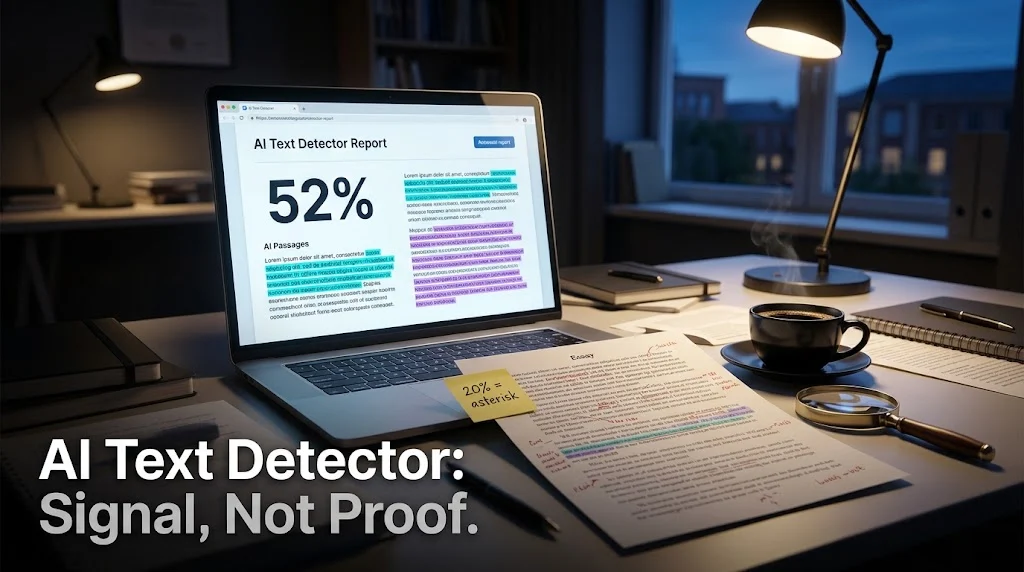
An AI text detector is a tool that estimates whether a piece of writing was generated by artificial intelligence, typically producing a percentage score. Independent research shows accuracy varies dramatically across tools, false positive rates range from 15% to 30% in academic settings, and detectors struggle with hybrid texts, non-native English writers, and structured prose that resembles AI patterns.
At-a-Glance: Key Takeaways
- False positive rates in academic testing range from 15.6% to 30.6%, according to a 2026 IEEE study of five major detectors including Turnitin, GPTZero, and Copyleaks .
- Hybrid texts are the weakest point. All tested tools dropped to 54.2%–70.8% accuracy on documents combining human and AI writing .
- Turnitin suppresses scores below 20% because that range has a higher incidence of false positives, displaying an asterisk instead of a percentage .
- Non-native English writers are disproportionately flagged. A University of Melbourne tutor noted that formulaic, structured writing—often taught to international students—triggers detection .
- GPTZero performs well on longer texts but shows higher false positive rates on short samples (6% at 50-200 words) .
- No detector score should be the sole basis for misconduct. Researchers, universities, and the vendors themselves agree on this point .
What Is an AI Text Detector?
An AI text detector is a software tool that analyzes written content and estimates the likelihood that it was generated by a large language model. The output is typically a percentage, a classification (human, AI, or mixed), or a color-coded highlight showing which passages the model believes are machine-generated.
The category includes tools sold to educational institutions (Turnitin, Copyleaks), individual plans for writers and editors (Originality.ai, GPTZero), and free web tools with limited accuracy. The search intent is commercial investigation: users want to know which detectors are reliable, how they work, and whether the scores can be trusted.
The honest answer is that AI text detectors are probabilistic tools with documented limitations. They produce signals, not verdicts.
How AI Text Detectors Work
The Statistical Approach
Most modern detectors use transformer-based models trained on large corpora of human and AI-generated text. The model learns statistical patterns that distinguish machine writing from human writing: variations in sentence length, vocabulary distribution, syntactic complexity, and predictability.
When you submit text, the detector segments it, scores each segment for AI likelihood, and aggregates the results. Some tools highlight specific sentences, while others provide an overall percentage.
What Detectors Measure (and Miss)
A 2026 GitHub benchmark tested detectors against matched human and AI scripts on the same topics. The finding was stark: detectors responded to register, not authorship. Structured investigative prose was flagged as AI regardless of who wrote it, while conversational prose passed as human regardless of origin .
This means detectors are not measuring authorship. They are measuring style. And style overlaps heavily between careful human writers and AI models trained on human writing.
The 20% Threshold
Turnitin, the most widely used academic detector, suppresses scores in the 1-19% range. When AI is detected below 20%, the report displays an asterisk instead of a percentage. The company states this is to avoid false positives, which are significantly higher in that range .
A 0% score does not prove that a text was written by a human. Scores below 20% are not displayed, while scores of 20% or higher indicate that the text may warrant further review—not that AI authorship has been confirmed.
A 0% score does not prove that a text was written by a human. Scores below 20% are not displayed, while scores of 20% or higher indicate that the text may warrant further review—not that AI authorship has been confirmed.
A 0% score does not prove that a text was written by a human. Scores below 20% are not displayed, while scores of 20% or higher indicate that the text may warrant further review—not that AI authorship has been confirmed
The Major AI Text Detectors Compared
| Turnitin | Educational institutions | “Low false positive rate” | IEEE study: 15.6%–30.6% false positives across tools; Turnitin among those tested | Institutional site license; opaque |
| GPTZero | Educators, individuals | High accuracy | GitHub benchmark: 98.7% accuracy overall, but 6% false positives on short texts | Free tier (10k words/month); paid plans |
| Copyleaks | Education, enterprise | 99% effectiveness | Global 100: 94.7% accuracy; 3.8% false positive rate | $16.99/mo Personal; $13.99/mo annual |
| Originality.ai | Publishers, agencies | High accuracy | IEEE study: highest overall accuracy at 84.4% | $14.95/mo; no free tier |
| ZeroGPT | General users | “>98% internal” | Global 100: 90.3% accuracy; IEEE: lowest at 69.4% | Free tier; paid plans |
The Accuracy Problem
False Positives in Academic Settings
The 2026 IEEE study evaluated five detectors against 180 academic writing samples. False positive rates ranged from 15.6% to 30.6%. For an institution processing thousands of submissions, that translates to hundreds of students falsely flagged per semester .
The study also found that all tools performed poorly on hybrid texts, with accuracy dropping to 54.2%–70.8%. A student who uses AI for brainstorming but writes the final draft themselves may produce text the detector cannot categorize.
The Melbourne Case
A University of Melbourne student submitted an essay while dealing with medical issues. Four months later, they received a misconduct allegation based on a Turnitin report claiming the essay was more than 50% AI-generated. At the hearing, they were asked one question, then told by the panel that the detection technology is unreliable. The allegation was dropped the following week .
The student described feeling “incredibly stressed, distraught and confused” .
Bias Against Non-Native Writers
A University of Melbourne tutor described the pattern directly: “Students who write relatively formulaically, particularly students who don’t have English as a first language and have been taught how to put sentences together in this highly structured manner—they’re the ones who tend to get flagged” .
Turnitin disputes this, stating its own testing found false positive rates of 0.014 for ELL writers and 0.013 for native English writers, with no statistically significant bias . Independent research, however, continues to document disparate impact.
The Hybrid Text Gap
A Springer study of dentistry texts found Turnitin’s sensitivity was only 0.27, meaning it missed 73% of AI-generated texts at a 60% threshold . This contrasts with vendor claims of high accuracy and suggests performance varies dramatically by domain and text type.
Real-World Consequences
The gap between what vendors say (detectors are one signal) and what happens in practice (scores trigger investigations) has caused documented harm.
Universities Disabling the Tool
Vanderbilt University disabled Turnitin’s AI detector in 2023. Curtin University in Australia announced it would switch off the feature from January 2026. The UK’s Office of the Independent Adjudicator has urged institutions to base misconduct decisions on robust evidence, not detection scores .
The Investigation Burden
When a detector flags a student, the burden shifts to the student to prove their innocence. The Melbourne case involved a four-month delay before the allegation was dropped. Students describe panic, delayed investigations, and stress .
The Vendor’s Own Caution
Turnitin states clearly: “Our AI writing detection model may not always be accurate (it may misidentify human-written, AI-generated, and AI-paraphrased text), so it should not be used as the sole basis for adverse actions against a student” .
The company also emphasizes that false positives are higher below 20%, which is why it suppresses scores in that range .
Privacy and Security Considerations
AI text detectors process submitted text on remote servers. For institutional tools like Turnitin, submissions are stored in the institution’s database and may be retained for the duration of the license.
What to check:
- Whether submitted text is used for model training
- How long submissions are retained
- Whether students can access or delete their data
- The institution’s data processing agreement with the vendor
Important distinction: SOC 2 certification or Zero Data Retention guarantees are not uniformly referenced across AI text detectors. Institutions should review their specific vendor agreements.
Who Should Use an AI Text Detector
Institutions with clear policies and trained staff may use detectors as one signal among many. The score should trigger a conversation, not an automatic penalty. Additional evidence—drafts, process notes, student interviews—must be considered.
Educators who understand the limitations can use detectors to start discussions about AI use, not to adjudicate misconduct.
Individual writers and editors can use tools like GPTZero or Originality.ai to check their own work, understanding that false positives are possible and scores are not definitive.
Institutions without the capacity for human review should reconsider using detectors at all. The documented harms suggest the tool creates more problems than it solves when used as a primary trigger.
Students should understand that detector scores can be wrong, that non-native writers face higher risk, and that they have the right to appeal based on process evidence.
Common Mistakes and Cautions
Treating the percentage as a probability of misconduct. A 50% AI score does not mean 50% chance the student cheated. It means the model identified 50% of qualifying prose as likely AI-generated. The model can be wrong.
Ignoring the 20% threshold. Turnitin suppresses scores below 20% precisely because they are unreliable. An asterisk is not a low-level flag; it is a warning that the score cannot be trusted .
Using the score as sole evidence. Turnitin, independent researchers, and student advocacy groups all agree on this point. A score without additional evidence is not sufficient for misconduct proceedings .
Overlooking bias against non-native writers. Formulaic writing patterns, translation tools, and limited vocabulary can trigger false positives. Institutions should actively monitor for disparate impact .
Assuming 0% means clean. The detector has a documented false-negative problem, particularly with newer models. A 0% score means the model did not flag the text, not that the text is human-written.
Frequently Asked Questions
How accurate are AI text detectors?
Accuracy varies dramatically by tool and text type. The 2026 IEEE study found false positive rates of 15.6%–30.6% across five major detectors. GPTZero achieved 98.7% accuracy in one benchmark but showed 6% false positives on short texts. Turnitin’s sensitivity was only 0.27 in a Springer study of dentistry texts, meaning it missed most AI-generated content .
What does a 20% AI score mean?
Turnitin suppresses exact percentages below 20% because that range has a higher incidence of false positives. A score below 20% is indicated with an asterisk and should be treated as unreliable background noise, not evidence of AI use .
Do AI detectors flag non-native English writers more often?
Independent research and tutor accounts suggest yes. Formulaic, structured writing—often taught to international students—triggers detection patterns. Turnitin disputes this, citing its own testing showing no statistically significant bias, but the disparity remains a documented concern .
Can AI detectors detect paraphrased AI text?
Some can, for English submissions. Turnitin’s AI detection includes detection of AI-paraphrased and bypassed text. However, accuracy on hybrid and paraphrased texts is substantially lower across all tools .
Why are universities disabling AI detectors?
Vanderbilt disabled Turnitin’s AI detector in 2023, and Curtin University announced it would switch it off from January 2026. Reasons include reliability concerns, false negatives, opacity for students, and the tool’s inability to distinguish light AI assistance from full generation .
Conclusion
AI text detectors are probabilistic tools that produce signals, not verdicts. They can flag text for review, but they cannot reliably determine authorship. The 2026 IEEE study found false positive rates of 15.6% to 30.6% across major tools, with poor performance on hybrid texts and documented bias against structured, formulaic writing .