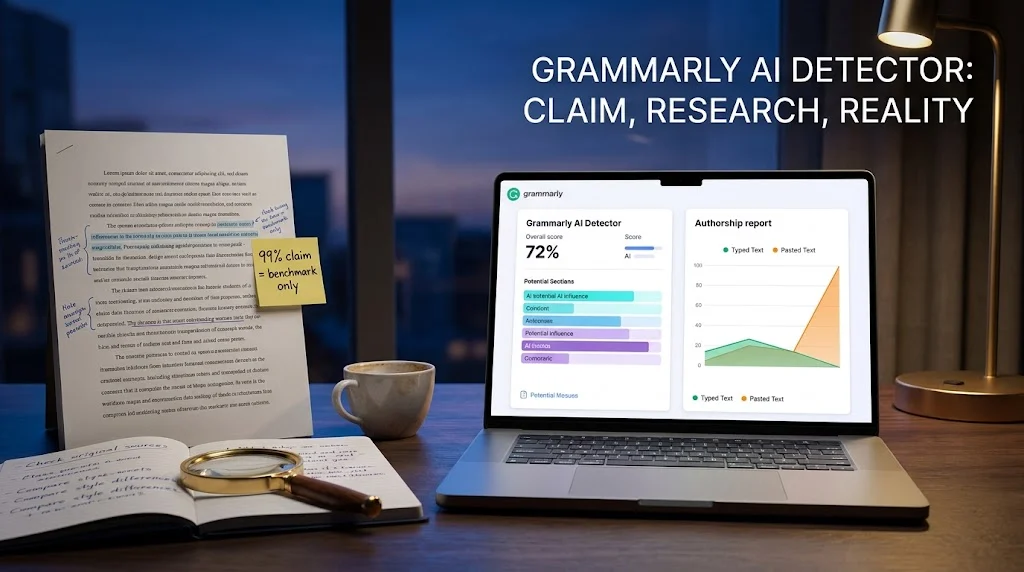
Grammarly’s AI detector is a feature within its writing platform that estimates whether text was generated by AI. Grammarly claims 99% accuracy on an independent benchmark, but independent research shows its reliability drops sharply on paraphrased text, and Curtin University warns its detection is “much more sensitive than TurnItIn and more prone to false positives” .
At-a-Glance: Key Takeaways
- Grammarly claims 99% detection accuracy on RAID’s independent benchmark, but this figure measures a specific dataset, not real-world reliability .
- Curtin University explicitly warns that Grammarly’s AI detection is more sensitive and more prone to false positives than Turnitin .
- Independent research found Grammarly’s accuracy dropped to 19.0% on non-native English speaker-style rewritten text, among the lowest of nine detectors tested .
- Legitimate Grammarly edits can trigger AI flags. A peer-reviewed study found Grammarly’s subtle readability enhancements increase false positives, especially for non-native speakers .
- A free tier offers limited checks, while Grammarly Pro (from roughly $12/month) unlocks full detection and plagiarism features .
- Grammarly Authorship records what you typed versus pasted versus generated, providing evidence that the detector score alone cannot .
What Is Grammarly’s AI Detector?
Grammarly’s AI detector is a feature built into the Grammarly writing assistant that flags text it believes was generated by an AI model. It sits alongside grammar, clarity, and tone suggestions, making it convenient for anyone already using Grammarly for editing .
The detector is part of a broader product suite. Grammarly positions it as a tool for students, professionals, and researchers who want to verify the originality of their work before submission. It provides a percentage score indicating how much of the text appears AI-generated, along with explanations for why specific phrases were flagged and one-click rewrites via AI Rewriter .
The company has been in the writing assistance business since 2009. It describes its detector as “the #1 AI detector from a brand you already trust,” leaning on its long history in text analysis and natural language processing .
How Grammarly’s AI Detector Works
The Machine Learning Foundation
Grammarly’s detector uses machine learning models trained on large datasets containing both human-written and AI-generated text. The models learn patterns that distinguish the two: sentence structure and predictability, repetition and uniformity, and comparisons against known AI outputs .
The company states its detector identifies text from ChatGPT, Gemini, Claude, and other tools “in seconds” . It is designed to work across “any kind of writing,” from essays and research papers to emails and reports .
The Accuracy Claim
Grammarly’s headline claim is 99% detection accuracy on RAID’s independent benchmark . This is a specific, verifiable claim against a specific dataset. It is not a claim that the detector is 99% accurate on all text, all the time.
The distinction matters. Benchmark accuracy measures performance on a curated set of samples. Real-world text includes hybrid writing, paraphrased content, non-native English, and legitimate editing that may confuse the model.
The Grammarly Authorship Layer
A distinguishing feature is Grammarly Authorship, which records where text came from: typed by the user, pasted from a database, or generated by AI. This creates an audit trail that the detector score alone cannot provide .
Curtin University explicitly recommends Authorship as a way for students to demonstrate they have not used generative AI when the detector flags their work .
The Accuracy Problem: What Research Shows
The 19% Accuracy Finding
A 2026 study published in the Journal of Advances in Information Technology evaluated nine AI detection tools, including Grammarly. The study found that while commercial tools like Copyleaks and Originality.ai achieved near-perfect detection rates, free tools including Grammarly performed less reliably. Under obfuscation techniques like paraphrasing and non-native English speaker-style rewriting, Grammarly’s accuracy fell to 19.0%, among the lowest of the tools tested .
This finding is critical for anyone relying on the detector. Paraphrasing tools and NNES writing patterns are exactly the scenarios where detection is most consequential. And those are the scenarios where Grammarly performs worst.
The False Positive Problem with Grammarly Edits
A peer-reviewed study published in the International Journal of Educational Technology in Higher Education examined how common writing aids affect AI detection. The researchers found that tools like Grammarly, which subtly enhance readability, “also trigger detection and increase false positives, especially for non-native speakers” .
The irony is direct. Using Grammarly to improve your writing may increase the likelihood that Grammarly’s own detector flags your work as AI-generated. The tool’s enhancements, designed to make writing clearer and more professional, produce patterns that its detector associates with machine generation.
The Turnitin Comparison
Curtin University’s student FAQ is blunt: “From our experience, Grammarly’s AI detection is much more sensitive than TurnItIn and more prone to false positives” .
This matters because sensitivity and accuracy are different things. A detector that flags everything is highly sensitive but useless. Grammarly’s detector appears tuned toward caution, which produces more false positives.
A comparative benchmark published on Zenodo found that while all evaluated systems achieved perfect discrimination under conventional classification thresholds on their dataset, substantial differences emerged in confidence magnitude, calibration, and scoring consistency . The headline accuracy numbers mask significant variation in how detectors behave in practice.
The Real-World Consequence: Grammarly Users Flagged
The most documented case involves Marley Stevens, a University of North Georgia student placed on academic probation after Turnitin flagged a paper she says was only polished with Grammarly, a tool her university promoted. The case illustrates the core problem: institutions punish students for using software the institution itself distributes, without a policy defining where assistance ends and misconduct begins .
The Curtin University FAQ addresses this directly. Students who have not used AI but are flagged by Grammarly’s detector are advised to use Authorship to demonstrate their process . This places the burden of proof on the student, even when the detector is the source of the accusation.
Editorial interpretation: The pattern is consistent across detectors, but Grammarly’s sensitivity makes it particularly prone to flagging legitimate work. The company’s own tool for improving writing can trigger its own detector.
Pricing and Access
Grammarly’s AI detector is available across its tiers, with significant limitations on the free plan.
| Free | $0 | Limited checks | Basic features; full detection requires Pro |
| Pro | From ~$12/month | Full AI detection and plagiarism | Unlocks full feature set |
| Enterprise | Custom | Full detection, SOC 2, DPA | Product-improvement setting off by default |
Testing by Yahoo found the free tier offers three AI checks per day, with paid plans starting at $12 per month for higher limits . Tech & Learning notes the free detector allows a generous 1,500-word limit for initial scans .
The Grammarly plans page lists “Detect AI generated text” as a Pro feature, though a limited free version exists on the AI Detector page itself .
Important distinction: SOC 2 certification or Zero Data Retention guarantees are not uniformly applied across tiers. Sanitized.ai reports that free and individual accounts have a product-improvement setting on by default, while Enterprise and Education accounts have it off by default with SOC 2 and DPA coverage .
Who Should Use Grammarly’s AI Detector
Users already in the Grammarly ecosystem can use the detector as a convenience feature alongside grammar and plagiarism checks. The integration with Authorship provides a useful audit trail.
Students who need to demonstrate their process should use Grammarly Authorship rather than relying on the detector score alone. Curtin University recommends this explicitly .
Institutions evaluating detection tools should note that Grammarly’s own research and independent studies both show significant false positive risks, particularly for non-native English speakers and users of Grammarly’s own editing features .
Anyone using the score as sole evidence of misconduct should reconsider. Grammarly itself states that no AI detector is 100% accurate and results should not be the sole basis for determining AI use .
Users outside the Grammarly ecosystem may find dedicated detectors like GPTZero or Originality.ai more appropriate, depending on their specific needs and budget.
Common Mistakes and Cautions
Treating the 99% claim as universal accuracy. The claim is against a specific benchmark. Real-world performance varies by text type, editing history, and obfuscation .
Ignoring the Grammarly-editing paradox. Using Grammarly to improve your writing may increase the likelihood of being flagged by Grammarly’s detector .
Assuming the free tier is sufficient. The free plan has limited checks. Full detection requires Pro, starting around $12/month .
Overlooking Authorship. The detector score alone is weaker evidence than the Authorship record. Curtin explicitly recommends it for students facing false flags .
Treating the score as proof. Grammarly’s own documentation states that no detector is 100% accurate and results should not be the sole basis for determining AI use .
Frequently Asked Questions
How accurate is Grammarly’s AI detector?
Grammarly claims 99% accuracy on RAID’s benchmark, but independent research shows accuracy drops to 19.0% on paraphrased and non-native English speaker-style text. Curtin University warns it is more prone to false positives than Turnitin .
Does Grammarly’s AI detector flag human writing?
Yes. A peer-reviewed study found that Grammarly’s readability enhancements trigger false positives, especially for non-native speakers. Curtin University confirms its detection is “much more sensitive” than Turnitin .
Is Grammarly’s AI detector free?
A limited free version exists on the AI Detector page. The full feature is part of Grammarly Pro, starting around $12/month. Free users get limited checks, while Pro unlocks full detection and plagiarism features .
What is Grammarly Authorship?
Grammarly Authorship records where text came from: typed, pasted, or AI-generated. It provides an audit trail that the detector score alone cannot. Curtin University recommends it for students facing false flags .
Can I use Grammarly’s AI detector for academic work?
You can use it, but you should not rely on the score as proof of anything. Grammarly itself states no detector is 100% accurate. Use Authorship to document your process and discuss any flags with your instructor .
Conclusion
Grammarly’s AI detector is a convenient feature within a widely used writing platform. It offers a percentage score, explanations for flagged phrases, and integration with Authorship, which records the provenance of text in ways the detector alone cannot.