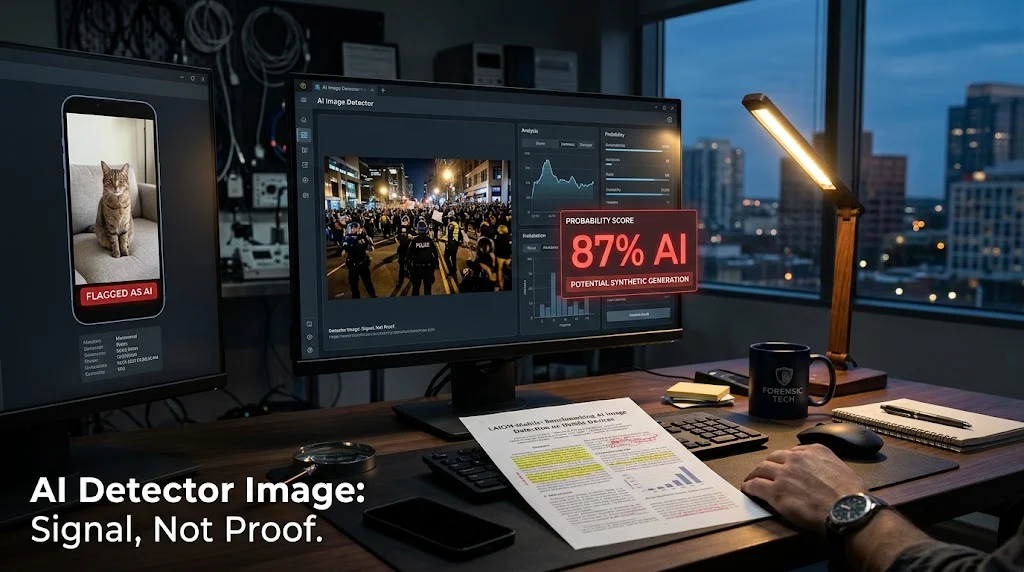
An AI image detector is a tool that analyzes an image’s pixels and metadata to estimate whether it was generated by artificial intelligence. Research shows these detectors are fundamentally unreliable: a 2026 study found no detector exceeded chance performance on modern AI content, while the same tools flagged 17% to 91% of real smartphone photos as fake when thresholds were calibrated for modern generators.
At-a-Glance: Key Takeaways
- No detector reliably identifies modern AI images. A LAION-Mobile study testing twelve state-of-the-art detectors found none exceeded an AUC of 0.624 on modern AI content, and five performed below chance .
- Real photos are frequently flagged as fake. False-alarm rates on genuine smartphone photos ranged from 17% to 91% after threshold recalibration .
- Open-source detectors perform poorly out of the box. A benchmark of 23 pretrained variants found a 37 percentage-point gap between the best and worst, with modern generators like Flux and Midjourney defeating most detectors at 18-30% accuracy .
- Commercial tools also fail. A NewsGuard audit found five leading detectors collectively declared authentic images AI-generated 13.33% of the time, with ScamAI misidentifying 40% of real photos .
- The best research systems are narrow. FUSE achieves 91.36% on the GenImage benchmark, but benchmarks do not reflect real-world conditions .
- Detection is shifting toward provenance. Watermarking and C2PA Content Credentials are emerging as more reliable than pixel-based classifiers .
What Is an AI Detector Image Tool?
An AI image detector is software that estimates whether a digital image was created by a generative AI model rather than captured by a camera. The tools analyze pixel patterns, frequency artifacts, metadata, and increasingly semantic features to produce a probability score.
The search intent is primarily commercial investigation. Users want to know whether these tools work, which ones are trustworthy, and how to interpret their output. The answer is uncomfortable: the technology is not reliable enough for high-stakes decisions, and the tools that claim high accuracy often fail on real-world images.
The market spans consumer web tools (ZeroGPT, AI or Not, Hive), developer APIs (Sightengine, Reality Defender, Apify actors), and open-source research models. Each has different strengths and failure modes, but the fundamental limitation is shared: detecting AI images is an adversarial problem where generators evolve faster than detectors.
Why AI Image Detection Is Fundamentally Hard
The Computational Photography Problem
Modern smartphones do not simply capture light. They use neural image-signal processing pipelines that fuse multiple sensors, suppress noise, sharpen edges, and apply computational photography. The LAION-Mobile paper argues this shifts devices from recording photos to generating them .
The consequence is that detectors trained to distinguish “camera output” from “AI output” may be learning to distinguish older camera processing from newer AI processing. When confronted with a modern smartphone photo, the detector sees patterns it associates with AI generation and flags it as fake.
The Generalization Collapse
A detector trained on Stable Diffusion may fail completely on Midjourney v7 or Flux. The cross-generator study found that a spectral detector scoring 0.795 in-distribution dropped to 0.523 (chance) on unseen generators. A fine-tuned CNN fell to chance on its worst unseen generator, and a hand-crafted physics detector went below chance (0.258), meaning it was systematically wrong .
The open-source benchmark confirmed this: modern commercial generators (Flux Dev, Firefly v4, Midjourney v7) defeated most detectors, achieving only 18-30% average accuracy .
The Threshold Calibration Trap
Detectors output probability scores. To make a binary decision (real or fake), you need a threshold. The LAION-Mobile study found that thresholds fitted on legacy GAN data made detectors look deployable, with false-positive rates below 11%. But when the same threshold was refitted on modern content, false-positive rates jumped to 17-91% .
This means a detector’s published accuracy often reflects a threshold chosen to minimize false positives on its training data, not a threshold that works in production.
The Evidence: How Badly Do These Tools Fail?
The NewsGuard Audit
NewsGuard tested 15 authentic photos from credible news outlets covering the U.S.-Iran war. The tools were Hive, AI or Not, ZeroGPT, Sightengine, and ScamAI. Collectively, they declared authentic images AI-generated 13.33% of the time. ScamAI, which markets “industry-leading accuracy,” misidentified 40% of the real photos .
ScamAI’s co-founder acknowledged false positives can happen, noting that detection tools generally require high resolution and pixel levels. ZeroGPT’s CEO noted that image resizing, compression, and conflict-zone visual characteristics like unusual lighting and high contrast can trigger incorrect results .
The Silent Failure on Modern AI
The more concerning finding is not false positives but false negatives. The LAION-Mobile study found no detector exceeded chance on modern AI content. Five of twelve were below chance, meaning they were worse than random guessing .
A detector that flags everything as real would have an AUC of 0.5 (chance). A detector below chance is systematically wrong: it flags real images as fake and fake images as real.
What Actually Works (and What Doesn’t)
Research Systems with Narrow Claims
FUSE, a hybrid system combining spectral features with CLIP semantic features, achieves 91.36% mean accuracy on the GenImage dataset and 88.71% across all tested generators . DINOv2-based approaches report up to 99% accuracy on AI-generated artwork detection .
These results are meaningful for research. They are not evidence of real-world reliability. Benchmarks like GenImage contain curated images that may not reflect the compression, resizing, and screenshotting that real images undergo.
Frozen Foundation Features
The cross-generator study found that only frozen foundation features generalize. A frozen-CLIP probe achieved 0.917 across generators, compared to 0.523 for a spectral detector. Simple 5-crop test-time aggregation improved accuracy to 0.949 .
This suggests that models pretrained on vast diverse data learn more generalizable features than models trained specifically for detection. But even the best frozen-CLIP probe is a research result, not a deployed product.
Provenance and Watermarking
OpenAI’s DALL-E 3 classifier is research-access only and scoped to DALL-E 3 . The broader industry direction is provenance: C2PA Content Credentials and SynthID watermarking attach metadata to generated images at creation time, providing verifiable signals that pixel-based detection cannot match .
For organizations building long-term systems, reading C2PA credentials and watermark signals is more reliable than relying on classifier probability scores.
Who Should Use an AI Image Detector
Researchers studying detection methods can use open-source benchmarks and the LAION-Mobile dataset to evaluate new approaches. The field needs better methods, and the failure modes are well-documented .
Developers building moderation pipelines should use detection as one signal among many, never as sole evidence. The Apify actors offer pay-per-detection APIs at $5-$10 per 1,000 images, with continuous probability scores rather than binary verdicts .
Journalists and fact-checkers should treat detection scores as tips, not proof. A 40% false-positive rate on real news photos means a flag is not evidence of manipulation .
Anyone making high-stakes decisions (legal, academic, employment) should not rely on AI image detectors. The technology is not reliable enough for adverse actions.
Organizations concerned with provenance should prioritize C2PA and watermark verification over pixel-based detection.
Common Mistakes and Cautions
Trusting vendor accuracy claims. ScamAI markets “industry-leading accuracy” while misidentifying 40% of real photos . AI or Not claims 98.9% accuracy on a public dataset, but real-world performance differs .
Assuming a high score means AI. A 90% AI probability does not mean 90% chance the image is fake. It means the model’s output crossed a threshold, and that threshold may be miscalibrated for your images.
Ignoring the base rate. If 99% of images in your pipeline are real, a detector with a 10% false-positive rate will flag 10 real images for every fake one it catches. The base rate matters more than the accuracy.
Using detection as sole evidence. NewsGuard’s audit shows tools flag authentic conflict-zone photos. Accusing someone of faking an image based on a detector score is irresponsible.
Forgetting about compression and resizing. ZeroGPT’s CEO noted that resizing and compression can cause real images to be flagged. Any image that has been through social media processing is harder to assess accurately .
Frequently Asked Questions
How accurate are AI image detectors?
They are not accurate enough for reliable real-world use. The LAION-Mobile study found no detector exceeded chance on modern AI content, with false-alarm rates on real photos ranging from 17% to 91%. NewsGuard’s audit found commercial tools collectively flagged 13.33% of authentic images as fake .
Why do AI detectors flag real photos as fake?
Modern smartphone photos use computational photography that generates pixels rather than simply recording them. Detectors trained to distinguish camera output from AI output may interpret smartphone processing as AI generation. Compression, resizing, and unusual lighting also trigger false positives .
Can AI image detectors identify Midjourney or DALL-E images?
Some can, but not reliably. Modern generators like Flux, Firefly v4, and Midjourney v7 defeat most detectors, achieving only 18-30% average accuracy in open-source benchmarks. Detectors trained on older models often fail on newer ones .
What is the best AI image detector?
No detector is reliable across all generators and real-world conditions. For research purposes, frozen-CLIP probes show the best generalization . For commercial use, treat any detector as a signal, not a verdict, and never use it as sole evidence.
What is C2PA and why does it matter?
C2PA (Coalition for Content Provenance and Authenticity) is a standard for attaching verifiable metadata to images at creation time. It provides a more reliable signal than pixel-based detection because it records provenance rather than guessing from appearance. OpenAI and others are moving toward C2PA and watermarking as long-term solutions .
Conclusion
AI image detectors are not reliable. The research is consistent across independent studies: modern AI images evade detection, real photos are frequently flagged as fake, and the tools that claim high accuracy fail on real-world data.