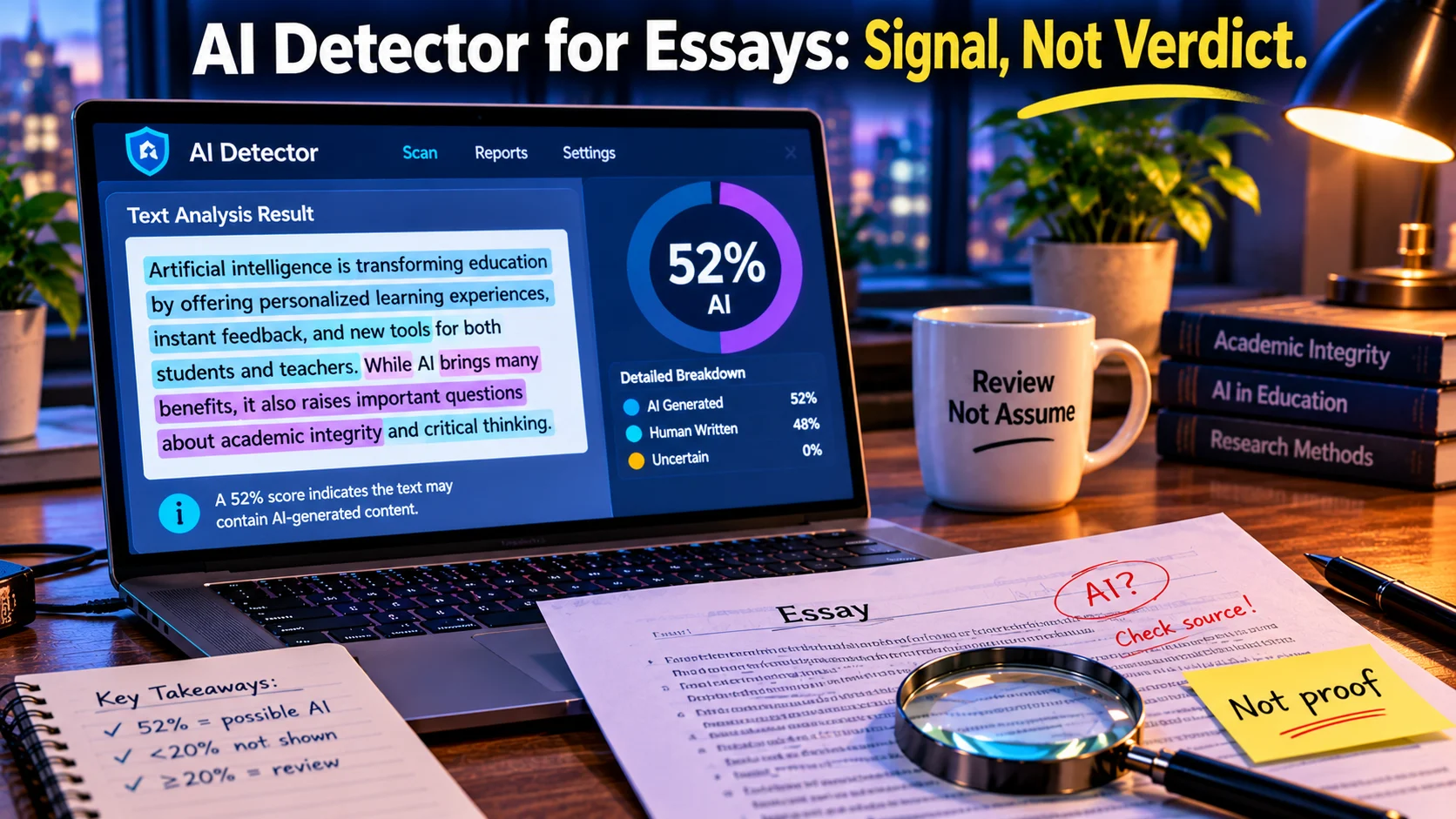
An AI detector for essays is a tool that estimates whether text was generated by a large language model, producing a percentage score and highlighted passages. Research consistently shows these tools are unreliable for high-stakes decisions, with false-positive rates ranging from 15.6% to 30.6% across popular detectors, and documented bias against non-native English writers and formulaic academic styles.
At-a-Glance: Key Takeaways
- False-positive rates are substantial. A 2026 IEEE study found rates of 15.6% to 30.6% across five major detectors, raising “substantial concerns for equitable academic integrity enforcement” .
- Hybrid texts break detection. All tools performed poorly on essays mixing human and AI writing, with accuracy dropping to 54.2%–70.8% .
- Bias against non-native writers is documented. A 2026 IEEE study found essays by Iranian and Chinese writers were “more likely to be classified as AI-generated” due to structured writing styles .
- Turnitin has a false-negative problem. A De Gruyter study replicated Turnitin’s low false-positive rate but found its false-negative rate was “substantially higher,” especially for GPT-5 .
- Winston AI and Originality.ai lead some benchmarks, but results vary by dataset. A peer-reviewed study ranked Winston at 99% and Originality at 98% on 24 texts .
- Institutions are advised against sole reliance. Multiple studies conclude detectors “should not be used as sole evidence in high-stakes decision-making” .
What Is an AI Detector for Essays?
An AI detector for essays is a software tool that analyzes written text and estimates the likelihood it was generated by a large language model like ChatGPT, Claude, or Gemini. It typically produces a percentage score and highlights specific passages the model suspects were machine-generated.
The category includes standalone detectors (GPTZero, Originality.ai, Winston AI), plagiarism checkers with AI detection added (Turnitin, Copyleaks), and writing assistants with detection features (Grammarly) . The tools serve educators, admissions officers, publishers, and content managers who need to assess text authenticity.
The search intent is commercial investigation. Users want to know which detectors are accurate, what the scores mean, and whether they can be trusted for consequential decisions. The research answer is uncomfortable: none of them are reliable enough for high-stakes use without substantial human oversight.
The Major AI Detectors for Essays Compared
Important caveat: Accuracy figures come from different datasets and methodologies. They are not directly comparable. A detector that performs well on one benchmark may fail on another.
How AI Detectors Work (and Why They Fail)
Detectors analyze statistical patterns in text: sentence length variation (burstiness), vocabulary distribution, perplexity, and syntactic uniformity. AI models tend to produce more predictable, uniform prose than humans. Detectors learn these patterns from training data.
The problem is that human writing also varies enormously. A student who writes in a structured, formal style — common in academic writing instruction, especially for non-native English speakers — may produce text that looks statistically similar to AI output. The detector flags pattern similarity, not authorship .
The Hybrid Text Problem
A significant limitation is hybrid writing: essays where students use AI for brainstorming, outlining, or editing, but write the final draft themselves. A 2026 IEEE paper introduced HybridDetect specifically to address this gap, noting that existing detectors “operate as binary classifiers” and “fail to address the increasingly common scenario where students partially incorporate AI-generated content” .
The same IEEE benchmarking study found all tools performed poorly on hybrid texts, with accuracy dropping to 54.2%–70.8% . This means the detector may miss partial AI use entirely, or flag legitimate human writing as AI.
The False-Negative Problem
While much attention focuses on false positives (flagging human writing as AI), false negatives (missing AI writing) are equally problematic. A De Gruyter study replicated Turnitin’s low false-positive rate but found its false-negative rate was “substantially higher, and even more so for the latest ChatGPT model (GPT-5)” .
A VUB study comparing GPTZero, Pangram, Copyleaks, and Turnitin found that “the other tools significantly underestimated GenAI content, particularly for texts generated with the most advanced model” . Only Pangram consistently performed well across fully AI, hybrid, and humanised texts.
Editorial interpretation: A detector that misses AI writing creates a false sense of security. Students who use AI without detection are not caught, while students who write honestly but in a structured style may be flagged. The tool’s errors are not random; they disadvantage certain writers.
The Bias Against Non-Native English Writers
The most documented fairness concern is bias against second-language writers. A 2026 IEEE study built detection models and tested them on essays by Iranian and Chinese writers. Despite precautions against overfitting, “the essays written by those two international groups of writers were still more likely to be classified as AI-generated” .
The reason is straightforward. Non-native writers often rely on learned patterns, textbook structures, and lower linguistic variability. These are the same features detectors associate with AI generation. The result is a false positive rate that is not evenly distributed across the student population.
A ScienceDirect paper on Turnitin’s multilingual detection noted that the tool “may function as a culturally narrow gatekeeper” in contexts where second-language writers are already disadvantaged . The opacity of the score — a percentage with no explanation of which features triggered it — compounds the problem.
Real-World Consequences
The gap between what detector vendors say (it is one signal) and what institutions do (treat it as evidence) has caused documented harm.
The Turnitin Case
A University of Melbourne student received a misconduct allegation based on a Turnitin report claiming their essay was more than 50% AI-generated. At the hearing, the panel acknowledged “how unreliable the detection technology is.” The allegation was dropped a week later, but only after four months of stress .
Turnitin itself states that its AI writing detection “may not always be accurate” and “should not be used as the sole basis for adverse actions against a student” . The tool’s own documentation warns against the use that triggered the investigation.
Institutional Responses
Some institutions have disabled the tools entirely. Vanderbilt University turned off Turnitin’s AI detector in 2023. Curtin University announced it would switch off the feature from January 2026. The UK’s Office of the Independent Adjudicator has urged providers to base misconduct decisions on “robust evidence rather than detection scores” .
What the Score Actually Means
A detector score is a probability estimate based on pattern matching. It is not a finding of fact. The same text may score differently on different tools, on different days, or after a model update. A score of 50% does not mean a 50% chance the student cheated. It means the model identified 50% of qualifying prose as likely AI-generated — and the model can be wrong.
Who Should Use AI Detectors for Essays
Institutions with clear policies and trained staff may use detectors as one signal among many. Turnitin’s guidance recommends combining the score with process evidence, prior drafts, student conversations, and writing samples. The VUB study concludes detectors “should not be used as sole evidence in high-stakes decision-making but should be implemented in a broader evaluation strategy” .
Educators who understand the limitations can use the tool to start conversations with students, not to trigger automatic penalties. A flagged essay is an opportunity to ask about the writing process, not to accuse.
Institutions without the capacity for human review should reconsider using detectors at all. The documented harms — delayed investigations, stress on students, and dropped allegations — suggest the tool creates more problems than it solves when used as a primary trigger.
Individual users can access GPTZero (free tier), Originality.ai ($14.95/month), and Winston AI, but should interpret scores with the same caution as institutions.
Common Mistakes and Cautions
Treating the percentage as proof. A score is a signal, not evidence. Turnitin, Winston, and Originality all acknowledge their tools are not 100% reliable .
Ignoring the hybrid problem. Most detectors are binary classifiers. They cannot reliably distinguish “wrote with AI help” from “wrote entirely with AI” or “wrote honestly in a structured style” .
Overlooking bias. Non-native English writers and students taught formulaic academic styles face higher false-positive rates . Institutions should monitor for disparate impact.
Assuming 0% means clean. Detectors miss AI text, especially from newer models like GPT-5 . A 0% score means the model did not flag the text, not that it is human-written.
Using a single tool. Different detectors produce different results on the same text. A multi-tool approach with human review is more defensible than reliance on one score.
Frequently Asked Questions
What is the most accurate AI detector for essays?
Accuracy varies by benchmark. A peer-reviewed study ranked Winston AI first at 99% and Originality.ai second at 98% on 24 texts . An IEEE benchmark found Originality.ai highest at 84.4% on its dataset . No single tool is universally accurate.
Why do AI detectors flag human writing?
Detectors look for statistical patterns associated with AI: low burstiness, predictable vocabulary, and structured uniformity. Human writers who produce formal, structured prose — especially non-native English speakers and students taught formulaic academic styles — may match these patterns and be flagged incorrectly .
Can AI detectors detect hybrid essays?
Poorly. A 2026 IEEE paper found all tools performed significantly worse on hybrid texts, with accuracy dropping to 54.2%–70.8% . A separate paper introduced HybridDetect specifically because existing tools “fail to address” partial AI use .
What does a Turnitin AI score of 50% mean?
It means Turnitin’s model identified 50% of the qualifying prose as likely AI-generated. It is not a probability of misconduct. Turnitin suppresses scores below 20% due to higher false-positive rates and states its tool “should not be used as the sole basis for adverse actions.”
Should institutions use AI detectors for essay misconduct cases?
Multiple studies advise against sole reliance. The VUB study concludes detectors “should not be used as sole evidence in high-stakes decision-making” . The UK’s OIA urges robust evidence rather than detection scores. Detectors can start conversations but should not end them.
Conclusion
AI detectors for essays offer a useful signal for starting conversations about writing practices. They do not offer proof of misconduct. The research is consistent: false-positive rates are substantial, hybrid texts defeat binary classifiers, and non-native English writers face documented bias.