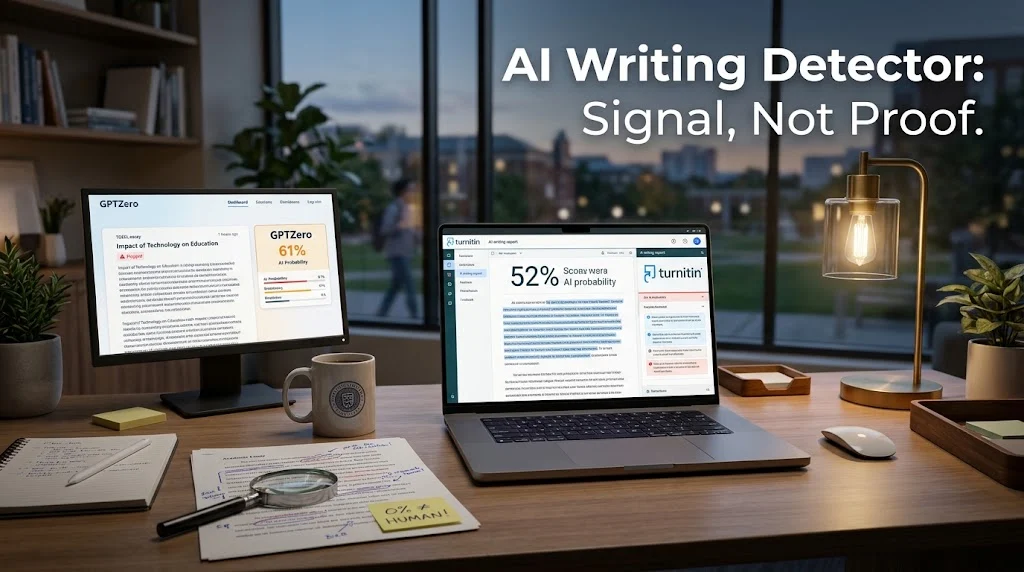
An AI writing detector is a tool that estimates whether text was generated by artificial intelligence, typically producing a percentage score or probability. Independent research shows accuracy is inconsistent, false positives disproportionately affect non-native English writers, and every credible study concludes the output should never be the sole basis for misconduct allegations.
At-a-Glance: Key Takeaways
- Scores are signals, not proof. Turnitin itself states AI detection “should not be the sole basis for any integrity decision” .
- Bias against non-native writers is documented and reproducible. Stanford research found GPTZero flagged 61.3% of TOEFL essays from non-native English writers as AI .
- False negatives are a growing problem. A De Gruyter study found Turnitin’s false-negative rate was substantially higher than its false-positive rate, especially for GPT-5 .
- Turnitin is institution-only. No individual can purchase access. GPTZero offers a free tier (10K words/month); Originality.ai starts at $14.95/month .
- Detection struggles with hybrid and humanized text. Accuracy drops to 54.2%–70.8% on documents mixing human and AI writing .
- Universities are turning it off. Vanderbilt disabled Turnitin’s AI detector in 2023. Curtin University announced it would switch it off from January 2026 .
What Is an AI Writing Detector?
An AI writing detector is a software tool that analyzes text and estimates the likelihood it was machine-generated. It does not check whether the ideas are original, whether sources are cited, or whether the author understands the material. It measures statistical patterns.
The category includes institutional tools bundled into plagiarism platforms (Turnitin, Copyleaks), standalone detectors for educators and publishers (GPTZero, Originality.ai), and consumer-facing checkers of varying reliability. Each produces a score, a percentage, or a highlighted report indicating which passages appear AI-generated.
The critical distinction for anyone using these tools is that a flag is not a finding. It is a prompt for investigation. The research is unambiguous on this point: every credible study concludes detection scores are unreliable as standalone evidence .
How AI Writing Detectors Work
The Statistical Foundation
Modern detectors use machine learning, often transformer-based architectures similar to the models they are trying to detect. They are trained on large datasets of known human writing and known AI-generated writing, learning to classify new text based on patterns learned from both .
Turnitin states explicitly that its model is “not explicitly programmed to evaluate specific signals such as burstiness, perplexity, or other individual metrics.” Instead, it learns statistical patterns from its academic corpus, and its outputs are generated by many learned patterns working together rather than transparent rules .
This is important because it means the detector cannot explain why a passage was flagged. It produces a score without linguistic reasoning. A lecturer sees “45% AI-generated” without knowing which paragraphs triggered the alert or which features were deemed suspicious .
The 20% Threshold
Turnitin suppresses exact percentages below 20% and displays an asterisk instead. The company cautions that false positives are significantly higher in the 1-19% range . A score below 20% should be treated as background noise, not evidence.
A 0% score does not prove human authorship. It means the model did not identify qualifying text as likely AI-generated. False negatives are a documented problem, particularly as models like GPT-5 produce text that detectors struggle to classify .
What Detectors Cannot Do
Detectors cannot distinguish light AI assistance (grammar checking, brainstorming) from full generation. They cannot reliably assess hybrid texts that combine human and AI writing. And they cannot account for the legitimate writing styles that resemble AI output: formulaic academic prose, structured arguments, and the predictable patterns taught to second-language learners .
The Major Detectors Compared
Turnitin is the dominant institutional tool because it is bundled into plagiarism platforms thousands of universities already use. Its AI detection is integrated into the Similarity Report and is very likely enabled by default for licensed institutions . Individuals cannot purchase access at any price .
GPTZero is built for educators, with LMS integrations and writing reports designed for classroom workflows. Its free tier of 10,000 words monthly makes it accessible for individual teachers .
Originality.ai targets content marketers and publishers. It combines AI detection with plagiarism checking and batch scanning, making it suitable for editorial desks vetting freelance writers. Reviewers note it is “generally reliable” but “not 100% reliable” and that pro plans are expensive .
Copyleaks is API-first and multilingual, making it worth evaluating for institutions with significant non-native English populations. It performs worst precisely where every detector performs worst, but its multilingual approach may be less biased than English-only tools .
The Accuracy Problem
False Positives and Non-Native Writers
The most documented failure mode is bias against writers whose first language is not English. A Stanford study found GPTZero flagged 61.3% of TOEFL essays from non-native English writers as AI-generated . The De Gruyter study on Turnitin notes that non-native English authors “tend to be more predictable and formulaic in their writing style, and as a result, their writing is more likely to be identified as AI-generated” .
Autistic authors face similar risks. Predictable language, less syntactic variety, and repetitive structures are flagged as AI indicators, even when they reflect neurodivergent writing patterns rather than machine generation .
False Negatives and Evolving Models
The De Gruyter study replicated previous findings of a low false-positive rate for Turnitin but found its false-negative rate was “substantially higher,” and even more so for GPT-5. The authors note that their baseline prompting strategy may underestimate real-world false negatives, since refined prompts produce text less likely to be detected .
This creates an uncomfortable asymmetry: the detector misses AI text more often than it falsely accuses humans, but the false accusations carry severe consequences.
Hybrid and Humanized Text
A 2026 IEEE study found all detectors performed poorly on hybrid texts, with accuracy dropping to 54.2%–70.8% . Turnitin has acknowledged this by consolidating its two-color highlighting (AI-generated vs. AI-modified) into a single blue highlight, reducing the risk of overinterpretation as AI refinement tools blur the distinction .
Real-World Consequences
The University of Melbourne Case
A student submitted an essay while dealing with medical issues. Four months later, they received a formal misconduct allegation based on a Turnitin report claiming the essay was more than 50% AI-generated. At the hearing, the panel acknowledged the technology’s unreliability. The allegation was dropped the following week .
The student described feeling “incredibly stressed, distraught and confused” .
Algorithmic Gatekeeping in Publishing
A ScienceDirect study on TESOL publishing documented editors declining manuscripts without substantive feedback based solely on detector scores. Authors were not invited to revise or appeal. The study terms this “algorithmic gatekeeping,” where a single score becomes the sole evidentiary basis for an irreversible editorial decision .
Universities Disabling the Tool
Vanderbilt disabled Turnitin’s AI detector in 2023 after testing and consultation. Curtin University announced it would switch off the feature from January 2026. The UK’s Office of the Independent Adjudicator has urged institutions to base misconduct decisions on robust evidence rather than detection scores .
Privacy and Data Handling
Turnitin is sold to institutions, not individuals. Pricing is negotiated and unpublished. GPTZero and Originality.ai offer individual plans with published pricing.
Important distinction: SOC 2 certification or Zero Data Retention guarantees are not referenced in available documentation for these tools. Institutions should review data processing agreements for specifics on retention and training data use.
Who Should Use an AI Writing Detector
Institutions with clear policies and trained staff may use detection as one signal among many. Turnitin’s own guidance recommends combining scores with process evidence: drafts, revision history, notes, and conversations with students .
Individual educators can use GPTZero’s free tier as a conversation starter, not a verdict. The tool is designed for classroom workflows and offers accessible entry .
Content marketers and agencies can use Originality.ai for batch scanning and freelancer vetting, but should treat flags as reasons to request drafts, not withhold payment .
Anyone using a detector as sole evidence is misusing the tool. Every credible study, and the vendors themselves, warn against this.
Common Mistakes and Cautions
Treating the percentage as a probability of misconduct. A 50% score does not mean 50% chance the student cheated. It means the model identified 50% of qualifying prose as likely AI-generated, and the model can be wrong.
Ignoring the 20% threshold. Turnitin suppresses scores below 20% because they are unreliable. An asterisk is a warning, not a low-level flag.
Overlooking documented bias. Non-native English writers, autistic authors, and students taught formulaic writing are disproportionately flagged. Institutions should monitor for disparate impact.
Assuming 0% means clean. False negatives are a growing problem, particularly for newer models. A 0% score means the model did not flag the text, not that the text is human-written.
Using detectors without process evidence. The strongest evidence of authorship is drafts, version history, and notes. A detector score is weaker evidence than a paper trail.
Frequently Asked Questions
How accurate is an AI writing detector?
Accuracy varies by tool, text type, and population. Turnitin shows low false positives but high false negatives, especially for GPT-5 . GPTZero has documented bias against non-native English writers, flagging 61.3% of TOEFL essays as AI . No detector is reliable enough for sole evidence.
What does a 20% AI score mean on Turnitin?
Turnitin suppresses exact percentages below 20% because false positives are higher in that range. A score below 20% is indicated with an asterisk and should be treated as unreliable background noise, not evidence of AI use .
Can AI writing detectors detect paraphrased AI text?
Turnitin can detect AI-paraphrased and bypassed text, but only for English submissions . The feature is not available for Spanish or Japanese. Detection of humanized text is inconsistent across tools.
Why are universities disabling AI writing detectors?
Vanderbilt and Curtin University disabled Turnitin’s detector due to reliability concerns, false negatives, and the harm caused by treating scores as evidence. The UK’s OIA has urged institutions to base misconduct decisions on robust evidence, not detection scores .
What is the best AI writing detector?
There is no single best tool. Turnitin is the institutional standard for universities. GPTZero is best for individual educators with a free tier. Originality.ai is best for content marketers and batch scanning. Copyleaks is worth evaluating for multilingual contexts. The best tool depends on the use case and the population being assessed.
Conclusion
AI writing detectors are tools that flag text for review. They are not lie detectors, plagiarism checkers, or substitutes for human judgment. The vendors themselves state this. The research confirms it. And the documented harms students investigated for months before allegations are dropped, authors declined without appeal illustrate what happens when a score is treated as a verdict.