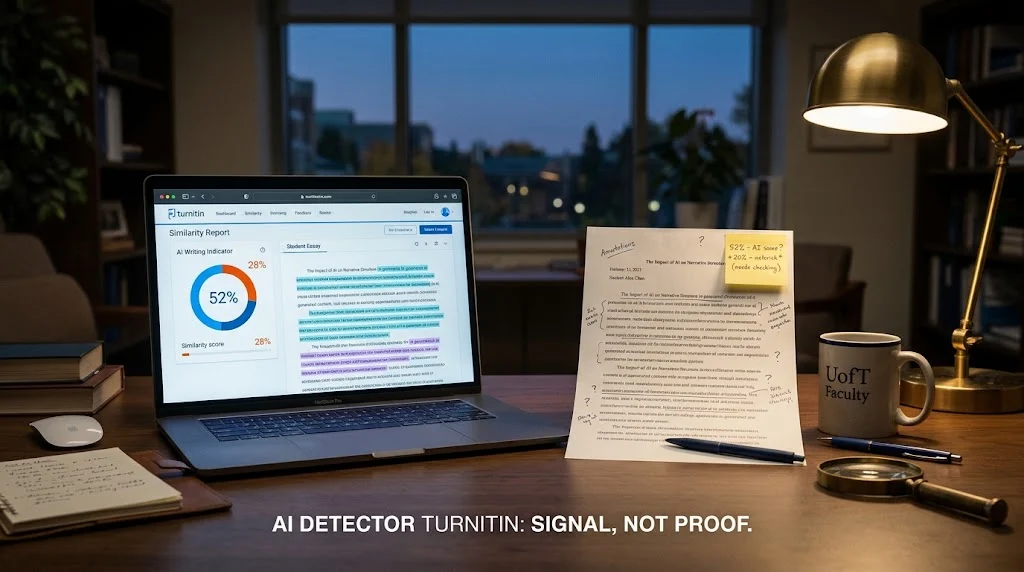
Turnitin’s AI detector is a tool that highlights text likely generated by AI, producing a percentage score within the Similarity Report. Independent research shows its accuracy is inconsistent, false positives are high below 20%, and it cannot reliably distinguish human writing from AI output, which is why some universities have disabled it and why it should never be used as sole evidence of misconduct.
At-a-Glance: Key Takeaways
- Turnitin’s AI score is not proof of misconduct. The company itself states the indicator “may not always be accurate” and should not be the sole basis for adverse action .
- Scores below 20% are unreliable. Turnitin suppresses exact percentages in the 1-19% range and displays an asterisk to warn of higher false-positive incidence .
- Independent research found false-positive rates of 15.6% to 30.6% across detection tools, with Turnitin among those tested .
- The detector struggles with paraphrased text. Turnitin can detect AI-paraphrased content, but only for English submissions .
- Some universities have disabled it. Vanderbilt turned it off in 2023, and Curtin University announced it would switch it off from January 2026 .
- International and non-native English writers are disproportionately flagged. Formulaic writing patterns taught to these students trigger false positives .
What Is Turnitin’s AI Detector?
Turnitin’s AI writing detection is a feature within the Similarity Report that estimates how much of a submitted document was likely generated by AI. It is sold exclusively to educational institutions, not to individual users .
The detector analyzes “qualifying prose” — long-form sentences in paragraphs. It does not reliably assess bullet points, code, poetry, tables, or extremely short submissions. This means the AI percentage may not represent the entire document .
The score appears separately from the similarity score. A high similarity score means text matches existing sources; a high AI score means the model predicts the text was machine-generated. The two numbers are independent and should not be added together .
How Turnitin’s AI Detector Works
Turnitin describes its current system as a transformer-based deep learning model trained on its own corpus of academic data. It does not rely on hand-crafted rules like “burstiness” or “perplexity.” Instead, it learns statistical patterns from training data, and its outputs are generated by many learned patterns working together rather than transparent, human-readable rules .
The model breaks submissions into overlapping segments, scores each for AI likelihood, and aggregates the results into an overall percentage . It also includes detection for AI-paraphrased and bypassed text, though this feature is currently available only for English submissions .
The 20% False-Positive Threshold
Turnitin explicitly cautions that false positives are significantly higher when the AI percentage is below 20%. In response, the platform suppresses exact scores in the 1-19% range and displays an asterisk instead. The asterisk warns that this range has a higher incidence of false positives .
A score of 0% does not prove human authorship. It means the model did not identify qualifying text as likely AI-generated. The detector can miss AI text (false negatives), particularly as models evolve .
The Accuracy Problem
Independent research paints a troubling picture of Turnitin’s reliability.
False Positives and False Negatives
A 2026 IEEE conference paper evaluated five detection tools, including Turnitin, against a corpus of 180 academic samples. It found false-positive rates ranging from 15.6% to 30.6% across tools, and all tools showed substantially reduced accuracy on hybrid texts (54.2% to 70.8%) .
A De Gruyter study replicated previous findings of a low false-positive rate for Turnitin, but found its false-negative rate was “substantially higher,” and even more so for the latest ChatGPT model (GPT-5). The authors emphasised the need for cautious interpretation of AI-detection scores .
The Hybrid Text Problem
The IEEE study found all tools performed poorly on hybrid texts — documents that combine human and AI writing. Accuracy dropped to 54.2%–70.8%, underscoring the limitations of current detection mechanisms .
This matters because hybrid writing is increasingly common. A student who uses AI for brainstorming or editing but writes the final draft themselves may produce text the detector cannot categorize.
Non-Native English Writers
A University of Melbourne tutor described the bias directly: “Students who write relatively formulaically, particularly students who don’t have English as a first language and have been taught how to put sentences together in this highly structured manner—they’re the ones who tend to get flagged” .
The UMSU Advocacy service stated it does “not believe the Turnitin AI detection tool is reliable enough to be used on its own to raise a concern about a potential breach of academic integrity” .
Turnitin itself acknowledges the risk of bias against second-language writers and states it took statistically underrepresented groups into account when building its sample dataset .
Real-World Consequences
The gap between what Turnitin says (it is one signal) and what happens in practice (it triggers investigations) has caused documented harm.
The University of Melbourne Case
A student submitted an essay while dealing with medical issues. Four months later, they received a formal misconduct allegation based on a Turnitin report claiming the essay was more than 50% AI-generated. At the hearing, they were asked one question, then told by the panel, “I know as well as they do how unreliable the detection technology is.” The allegation was dropped the following week .
The student described feeling “incredibly stressed, distraught and confused” .
Universities Disabling the Tool
Vanderbilt University disabled Turnitin’s AI detector in 2023 after testing and consultation, advising staff to focus on clear communication and evidence-based processes rather than machine flags. Curtin University in Australia announced it would switch off Turnitin’s AI writing detection feature from 1 January 2026, framing the move as a trust-building step .
The UK’s Office of the Independent Adjudicator has issued guidance urging providers to ensure misconduct decisions are fair, transparent, and supported by robust evidence rather than detection scores .
What the Score Actually Means
Turnitin states clearly: “Our AI writing detection model may not always be accurate (it may misidentify human-written, AI-generated, and AI-paraphrased text), so it should not be used as the sole basis for adverse actions against a student” .
Privacy and Data Handling
Turnitin is sold to institutions, not individuals. Pricing is opaque and requires custom quotes. Estimates suggest $3-7 per student per year, meaning a university with 10,000 students might pay $30,000-70,000 annually .
AI detection was added at no extra cost to existing subscribers when it launched in 2023 .
Important distinction: SOC 2 certification or Zero Data Retention guarantees are not referenced in available Turnitin documentation. Institutions should review their data processing agreements for specifics on retention and training data use.
Who Should Use Turnitin’s AI Detector
Institutions with clear policies and trained staff may use the detector as one signal among many. Turnitin’s own guidance recommends combining the score with process evidence, prior drafts, student conversations, and writing samples .
Educators who understand the limitations can use the tool to start conversations with students, not to trigger automatic penalties. The University of Wisconsin-Whitewater advises treating the AI score as “a conversation starter, not a verdict” .
Institutions without the capacity for human review should reconsider using the detector at all. The documented harms — delayed investigations, stress on students, and dropped allegations — suggest the tool creates more problems than it solves when used as a primary trigger .
Individual users cannot access Turnitin. Alternatives like GPTZero, Originality.ai, and Winston AI offer individual plans .
Common Mistakes and Cautions
Treating the percentage as a probability of misconduct. A 50% AI score does not mean 50% chance the student cheated. It means the model identified 50% of qualifying prose as likely AI-generated. The model can be wrong .
Ignoring the 20% threshold. Turnitin suppresses scores below 20% precisely because they are unreliable. An asterisk is not a low-level flag; it is a warning that the score cannot be trusted .
Using the score as sole evidence. Turnitin, the University of Melbourne, UMSU Advocacy, and independent researchers all agree on this point. A score without additional evidence is not sufficient for misconduct proceedings .
Overlooking bias against non-native writers. Formulaic writing patterns, translation tools, and limited vocabulary can trigger false positives. Institutions should actively monitor for disparate impact .
Assuming 0% means clean. The detector has a documented false-negative problem, particularly with newer models like GPT-5 . A 0% score means the model did not flag the text, not that the text is human-written.
Frequently Asked Questions
How accurate is Turnitin’s AI detector?
Independent research shows inconsistent accuracy. A 2026 IEEE study found false-positive rates of 15.6% to 30.6% across detection tools including Turnitin, with poor performance on hybrid texts. A De Gruyter study found Turnitin’s false-negative rate was substantially higher than its false-positive rate, particularly for GPT-5 .
What does a 20% AI score mean on Turnitin?
Turnitin suppresses exact percentages below 20% because that range has a higher incidence of false positives. A score below 20% is indicated with an asterisk and should be treated as unreliable background noise, not evidence of AI use .
Can Turnitin detect paraphrased AI text?
Yes, for English submissions. Turnitin’s AI detection includes detection of AI-paraphrased and bypassed text. This feature is currently available only for English, not Spanish or Japanese .
Why are universities disabling Turnitin’s AI detector?
Vanderbilt disabled it in 2023, and Curtin University announced it would switch it off from January 2026. Reasons cited include reliability concerns, false negatives, opacity for students, and the tool’s inability to distinguish light AI assistance from full generation. The UK’s OIA has urged institutions to base misconduct decisions on robust evidence, not detection scores .
Can I use Turnitin as an individual?
No. Turnitin is sold exclusively to educational institutions through site licenses. Individuals cannot purchase access. Alternatives like GPTZero (free tier, 10,000 words/month) and Originality.ai ($14.95/month) offer individual plans .
Conclusion
Turnitin’s AI detector is a tool that flags text for review. It is not a lie detector, a plagiarism checker, or a substitute for human judgment. The company itself states it should not be the sole basis for adverse action. Independent research confirms its accuracy is inconsistent, false positives are high below 20%, and it struggles with hybrid texts and non-native English writers.