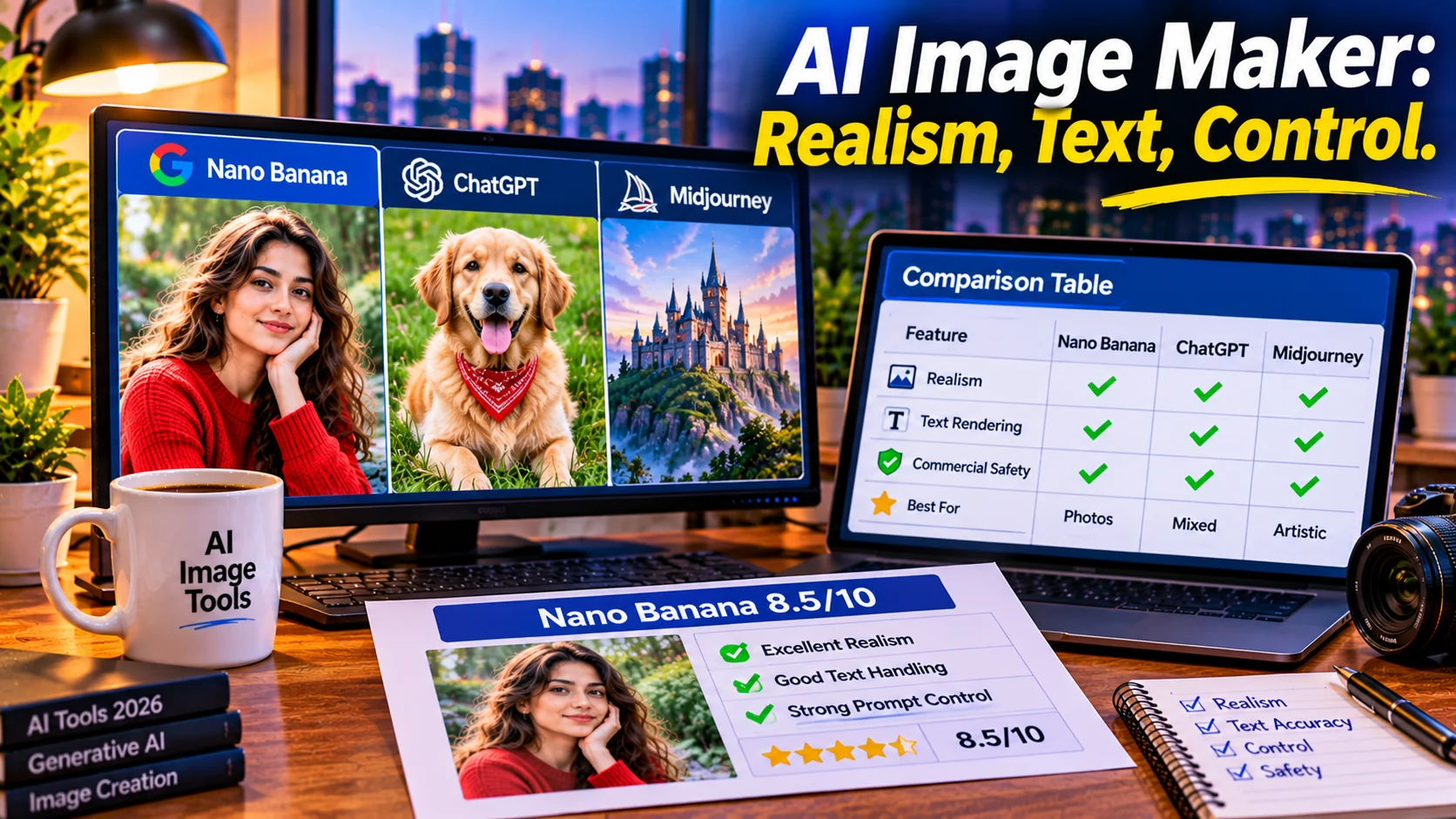
An AI image maker turns text prompts into images, but the best choice depends on your task. Google’s Nano Banana leads on photorealism and instruction-following, ChatGPT’s image generator wins on text rendering and character consistency, Midjourney offers the deepest customization, and Adobe Firefly provides commercial safety with IP indemnification. Most free tiers impose watermarks or daily caps.
At-a-Glance: Key Takeaways
- Nano Banana (Google Gemini) leads on realism in independent testing, winning photorealism and instruction-precision rounds against ChatGPT and Meta AI .
- ChatGPT’s image generator wins on text rendering and character consistency, producing the most usable posters and multi-panel comics with legible typography .
- Midjourney offers the deepest customization but requires a paid plan starting at $10/month and produces public images unless you use stealth mode .
- Free tiers vary dramatically. Gemini offers roughly 20 images daily with a visible watermark, ChatGPT offers only a few per day, and Microsoft Designer prohibits commercial use on its free tier .
- Adobe Firefly is the safest choice for commercial work, trained on licensed content with IP indemnification on paid plans .
- Recraft is the only free tool producing native SVG vector output, useful for logos and icons .
What Is an AI Image Maker?
An AI image maker is a tool that generates images from text descriptions. The category spans general-purpose chatbots with built-in image generation (ChatGPT, Gemini, Meta AI), dedicated platforms (Midjourney, Recraft, Ideogram), and design suites with AI features (Adobe Firefly, Canva).
The search intent is commercial investigation. Users want to know which tools produce usable images, what the limitations are, and whether the output can be used for projects, social media, or client work.
The honest answer is that no single tool wins everywhere. Independent testing consistently shows different models excelling at different tasks. Nano Banana wins on realism. ChatGPT wins on text. Midjourney wins on control. Firefly wins on legal safety.
The Major AI Image Makers Compared
Nano Banana (Gemini): Best for Realism
Google’s Nano Banana models, accessed through the Gemini app, have become the benchmark for photorealism and instruction-following. Tom’s Guide’s testing found Nano Banana winning on early-morning lighting, realistic kitchen scenes, and precise instruction adherence . CNET’s comprehensive testing named Nano Banana “Best choice overall for any AI image generation” with an 8.5 score .
What It Does Well
Nano Banana excels at scenes requiring realistic lighting, texture, and spatial coherence. In a head-to-head against ChatGPT, it produced a more convincing early-morning kitchen scene with proper window light and depth . It also handles complex prompts with multiple constraints more reliably than competitors.
The free tier offers roughly 20 images per day, though Google does not publish an exact figure and the allowance varies with server load .
Where It Falls Short
Free-tier images carry a visible Gemini logo watermark. Only images generated through the API escape this branding . The watermark is a real limitation for anyone producing client work without a paid plan.
Editorial interpretation: Nano Banana is the best free option for realistic imagery. The watermark is the trade-off, and it is visible enough to matter for professional output.
ChatGPT: Best for Text and Consistency
OpenAI’s image generator, accessed through ChatGPT, has carved out a distinct strength: rendering legible text and maintaining character consistency across multiple images.
What It Does Well
Tom’s Guide’s testing found ChatGPT producing the most usable conference poster with clear, professional typography . It also followed character consistency prompts more accurately than Nano Banana, which generated extra poses that distracted from the task . TechRadar’s comparison noted ChatGPT’s text integration looked “built into the design way better than the others” .
CNET’s testing found ChatGPT’s images “creative, engaging” and capable of mimicking various artistic styles, though text accuracy was “hit-or-miss” in their experience .
Where It Falls Short
The free tier generates only a few images per day, and OpenAI does not publish an exact number . Generation takes roughly a minute per image, and ChatGPT produces one image at a time rather than a batch of four . This makes iteration slower than competitors.
Editorial interpretation: ChatGPT is the best choice for posters, invitations, and any image where readable text matters. The free tier is too limited for volume work.
Midjourney: Best for Control
Midjourney remains the choice for users who want deep customization and are willing to pay for it. It is not a chatbot and does not offer a free tier in practice.
What It Does Well
Midjourney offers far more control than ChatGPT or Gemini. Users can adjust style strength, weirdness, variety, select model versions, use reference images for style or character, create variations, expand images, and personalize results by ranking image pairs . CNET names it “Best creative AI image generator,” praising its “extremely creative results, versatile stylistically” .
Where It Falls Short
Midjourney is paid-only, starting at $10/month. All images are public by default unless you pay for stealth mode. CNET notes it is “not for ultrarealistic or stock photography-like imagery” and that Disney, Universal, and Warner Bros. are suing the company over copyright claims .
Editorial interpretation: Midjourney is for users who prioritize creative control over ease of use or realism. The learning curve is real, and the public gallery is a privacy consideration.
Adobe Firefly: Best for Commercial Safety
Adobe Firefly is trained on licensed content and offers IP indemnification on paid plans, making it the safest choice for client work.
What It Does Well
Firefly’s training data comes from Adobe Stock and public domain content, reducing legal risk. CNET names it “Best for professional creators” with an 8.0 score, praising its versatility . The integration with Creative Cloud makes it a natural fit for designers already using Adobe tools.
Where It Falls Short
The free tier provides only 25 monthly credits, and the IP indemnification that makes Firefly valuable does not extend to free accounts . The free tier is a demo, not a workflow.
Editorial interpretation: Firefly is the choice for commercial work where legal safety matters. The free tier is insufficient for anything beyond testing.
Recraft: Best for Vector Output
Recraft is the only tool in this comparison that produces native SVG vector files on its free tier, making it valuable for logos, icons, and illustrations that need to scale.
What It Does Well
Recraft generates images, renders text, and produces vector graphics. Its editor, an infinite canvas, allows precise adjustments. Tom’s Guide called it “one of the most powerful platforms for generative image creation” . The free tier offers 30 daily credits.
Where It Falls Short
Free-tier images are public and remain the property of Recraft, prohibiting commercial use . The free tier is a sandbox, not a production tool.
Where the Paywall Actually Lands
Across AI image makers, the pattern is consistent.
Watermarks appear on free tiers. Gemini adds a visible logo. ChatGPT adds an invisible C2PA mark. Midjourney has no free tier .
Commercial use is restricted. Microsoft Designer prohibits commercial use on its free tier. Recraft retains ownership of free-tier images. Firefly’s indemnification requires a paid plan .
Usage caps limit volume. ChatGPT offers only a few images daily. Gemini offers roughly 20. Firefly offers 25 monthly credits .
Privacy is a trade-off. Midjourney images are public by default. Gemini and ChatGPT train on user data unless you opt out.
Who Should Use Which AI Image Maker
Social media creators needing realism should use Gemini’s Nano Banana, accepting the watermark or upgrading to remove it.
Designers producing posters or invitations should use ChatGPT for its superior text rendering, understanding the daily cap.
Commercial designers should use Adobe Firefly for IP indemnification, budgeting for a paid plan.
Creative professionals wanting control should use Midjourney, accepting the paid-only model and public gallery.
Logo and icon designers should use Recraft for free SVG output, understanding the non-commercial restriction.
Casual users can use Microsoft Designer for personal projects, but must avoid commercial use on the free tier.
Common Mistakes and Cautions
Assuming free means usable for client work. Gemini’s visible watermark, ChatGPT’s daily cap, and Firefly’s indemnification restrictions all limit free-tier professional use .
Expecting one tool to excel at everything. Nano Banana wins on realism. ChatGPT wins on text. Midjourney wins on control. No tool dominates all categories .
Ignoring the text rendering limitation. Most models struggle with legible text. ChatGPT is the exception, but even its accuracy is “hit-or-miss” according to CNET .
Overlooking the public gallery. Midjourney images are public by default. Recraft free-tier images are public and owned by Recraft .
Forgetting that free tiers change. The allowances listed here are current as of publication. Verify before committing to any workflow.
Frequently Asked Questions
What is the best AI image maker overall?
There is no single best. CNET named Nano Banana “Best choice overall” with an 8.5 score for realism and instruction-following . ChatGPT wins on text rendering and character consistency . Midjourney offers the deepest creative control . The best depends on your task.
Which AI image maker is best for text in images?
ChatGPT’s image generator produces the most legible text, winning poster and invitation tests against Nano Banana and Meta AI . Recraft also excels at text rendering with its position-aware training technique .
Are AI image makers free to use?
Most offer free tiers, but with limits. Gemini offers roughly 20 images daily with a visible watermark. ChatGPT offers a few images daily. Firefly offers 25 monthly credits without indemnification. Microsoft Designer prohibits commercial use on its free tier .
Can I use AI-generated images commercially?
It depends on the tool. Adobe Firefly permits commercial use with IP indemnification on paid plans. ChatGPT assigns ownership to the user, including commercial use. Gemini permits commercial use within terms but adds a visible watermark on free tiers. Recraft prohibits commercial use on its free tier .
What is the best free AI image maker?
Gemini’s Nano Banana offers the best free quality with roughly 20 daily images, though a visible watermark applies. Recraft offers 30 daily credits with SVG output but prohibits commercial use. ChatGPT offers only a few daily images but superior text rendering .
Conclusion
The AI image maker market has fragmented into specialized tools. Nano Banana leads on realism. ChatGPT leads on text and consistency. Midjourney leads on control. Firefly leads on commercial safety. Recraft leads on vector output.