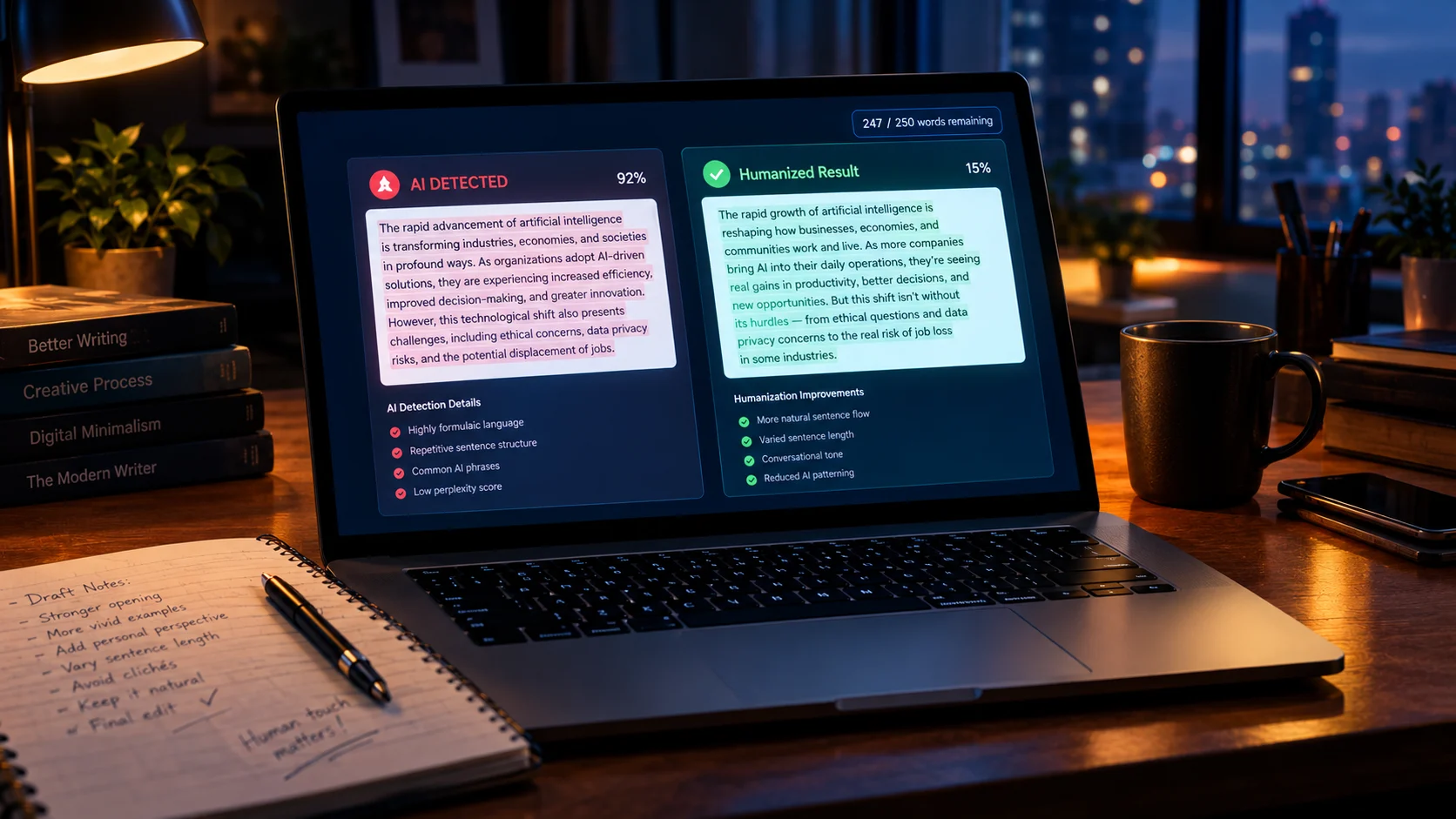
A free AI humanizer rewrites AI-generated text to sound more natural and evade AI detectors, but free tiers impose strict word caps and often lack the modes that make paid versions effective. As of October 2026, free allowances range from a 250-word trial to 1,000 words per input with daily limits, and no free tier guarantees detector bypass across all major tools .
At-a-Glance Box
- Free tiers are small. Undetectable AI offers a 250-word trial only. WriteHuman caps free use at 250 words per month. StealthWriter allows 1,000 words per input with 10 daily runs .
- Free does not mean full access. Benchmark testing runs on entry-level paid plans; free versions often exclude the “most human” settings that produce the best results .
- Detector bypass varies wildly. In HumanizerBench’s October 2026 test, WriteHuman led free-tier tools with a 74.89 score, but the benchmark used its paid plan .
- AI detectors are inconsistent. The same text can score 98% AI on one detector and 28% on another. No humanizer guarantees consistent bypass .
- Privacy claims need scrutiny. Browser extensions promising “local processing” and “no data collection” often carry broad permissions that contradict those claims .
- The only truly unlimited option is local software. Open-source humanizers running on your own machine eliminate word caps and data exposure, but require technical setup .
What a Free AI Humanizer Actually Does
An AI humanizer is a tool that rewrites text produced by large language models to reduce the statistical patterns detectors use to flag AI content. It changes sentence structure, swaps predictable phrasing, and adjusts perplexity and burstiness, the two metrics most detectors rely on.
The free version of any humanizer is a constrained demonstration. It shows you what the tool can do on a short sample, then asks for payment to continue. That is not a flaw; it is the business model. Inference costs money, and humanizing text requires running another language model over the input.
What matters is understanding where each free tier draws its line. Some limit word count per request. Others limit daily or monthly volume. A few restrict access to the modes that actually produce undetectable output. This guide maps those limits, so you know what you are testing before you invest time.
How Free Tiers Compare
The Free Tier Reality: Benchmarks Do Not Test Free Versions
HumanizerBench publishes monthly rankings of AI humanizers, and its free-tier page lists WriteHuman as the top free option for October 2026 . That ranking comes with a caveat the benchmark itself states clearly: testing runs on each tool’s entry-level paid plan, using the most human setting the vendor offers. A free tier can differ in the modes it exposes and how much text it accepts .
This distinction matters. A tool that scores well in benchmarks may perform differently when you use its free version. The free tier might lack the “undetectable” mode, or it might process text with a faster, less thorough model. Treat benchmark scores as a guide to the tool’s potential, not a guarantee of what the free plan delivers.
What the Benchmark Measures
HumanizerBench scores tools across detector bypass (42% weight), meaning preservation (32%), readability (16%), and consistency (10%) . The top overall tool in October 2026 was WriteHuman at 74.89, followed by StealthGPT at 74.50 and Undetectable.ai at 71.18 .
Those numbers are useful for comparing tools against each other. They are not promises about any free tier’s output. The benchmark’s own documentation says free tiers vary and advises checking each tool’s pricing page before relying on it .
Detector Bypass: Why Free Results Disappoint
AI detectors are not reliable arbiters of authorship. They produce inconsistent results on the same text, and the inconsistency cuts both ways.
A December 2025 review of Napkin AI’s generated content illustrates the problem. The same text scored 98% AI on Undetectable AI’s detector, 65% AI on Grammarly, and 28% AI on MyDetector, which classified nearly half the content as human-written . Three tools, three different verdicts, one piece of text.
This inconsistency shapes what a free humanizer can realistically promise. If detectors cannot agree on what counts as AI, a humanizer that passes one detector may fail another. Free tiers, with their limited word counts and restricted modes, have less room to iterate toward a version that passes the specific detector your institution or client uses.
The Modes You Cannot Access
Vendors often reserve their strongest rewriting modes for paid plans. A free tier might offer a “standard” humanization that adjusts surface-level phrasing but leaves deeper structural patterns intact. The paid tier might include an “academic” or “aggressive” mode that rewrites more thoroughly, at the cost of slower processing or greater meaning drift.
HumanizerBench tests the “most human setting” each vendor advertises . If that setting is gated behind a paywall, the free tier’s performance will fall short of the published score.
Privacy and Data Handling
AI humanizers process text you paste into them. That text may contain client work, academic drafts, internal memos, or personal writing. What happens to it after processing matters more than the marketing language suggests.
The Local Processing Claim
Several browser extensions advertise local processing and no data collection. One Firefox extension, “100% Free AI Humanizer,” states that history is stored locally and input is not sent to servers . Its required permissions include reading from the clipboard, writing to the clipboard, and blocking content on any page . Those permissions are broad. A clipboard-reading extension can access anything you copy, not only the text you intend to humanize. The extension’s data collection disclosure says it does not require data collection, but the permission scope warrants caution.
The Honest Middle Ground
Some free tools publish clearer retention policies. A humanizer on azuqe.com states that free-tool input is kept for 24 hours to handle page reloads, then deleted, and is not used for training . That is a specific, verifiable claim. Most free tiers do not offer this level of clarity.
No major free AI humanizer publicly commits to Zero Data Retention. SOC 2 certification, where present, addresses organizational controls, not whether your specific text is retained. Assume any hosted tool stores your input for some period unless its policy explicitly states otherwise.
Open-Source and Local Options
The only way to humanize text without word caps, subscription prompts, or data leaving your machine is to run humanizer software locally.
An open-source Python package called jades-ai-humanizer offers a local daemon and web interface. It can run entirely offline using a built-in mock engine, or connect to Google’s Gemini API if you provide a key . This is not a polished consumer product. It requires Python installation, dependency management, and comfort with command-line tools. For users with that skillset, it eliminates every restriction described above.
The tradeoff is effort. A hosted free tier takes seconds to start. A local setup takes an afternoon and may produce worse output than a commercial tool trained on larger datasets. Neither approach is universally superior; they serve different users.
Common Mistakes With Free AI Humanizers
Testing on short text, then committing to a plan. A 250-word sample does not reveal how a humanizer handles a 2,000-word article. Structural issues compound over longer inputs. Test with realistic length if the free tier allows it.
Assuming detector bypass is permanent. Detectors update. A humanizer that passed GPTZero in October may fail in November. Vendors do not guarantee ongoing bypass, and no free tier promises it at all.
Ignoring the word cap’s real cost. StealthWriter’s 1,000 words per input sounds generous until you realize a standard blog post is 1,500 words. You will need two runs, and the daily cap of 10 humanizations limits how many drafts you can process .
Pasting sensitive text without reading the policy. Client work, unpublished research, and personal documents should not go into a tool with an unclear retention policy. The convenience of a free tier is not worth a data exposure you cannot undo.
Confusing “human-sounding” with “undetectable.” A humanizer can make text read more naturally to a person while still carrying statistical markers that detectors flag. The two goals overlap but are not identical.
Who Should Use a Free AI Humanizer
Students checking a short passage can use Undetectable AI’s 250-word trial or WriteHuman’s monthly allowance to see whether a paragraph reads more naturally after processing. Neither provides enough volume for a full essay.
Writers evaluating tools before subscribing should test StealthWriter’s 1,000-word input limit or Clever AI Humanizer’s 3,000-word allowance. Both provide enough room for a real sample, though neither guarantees the paid version’s output.
Privacy-conscious users with technical skills should explore local open-source options. The setup cost pays for itself in unrestricted processing and zero data exposure.
Anyone processing client work or sensitive documents should avoid free hosted tiers unless the retention policy is explicit and acceptable. The word limits make free tiers impractical for professional volume anyway.
Latest Developments
The free tier landscape shifts monthly. HumanizerBench updates its rankings and free-tier list each cycle, and the October 2026 results placed WriteHuman at the top of the free category for the fourth consecutive month . StealthGPT, which ranked second overall, has no free tier at all .
The broader trend is toward tighter free allowances. As inference costs remain significant and detector competition intensifies, vendors face pressure to convert free users into paying customers. The 250-word trial and the 1,000-word daily cap may not persist indefinitely.
AI detectors are also evolving. Pangram joined HumanizerBench’s detector panel in October 2026, raising the bar for what counts as a successful bypass . Free tiers, with their limited iteration capacity, will struggle to keep pace with detector updates that paid tools can respond to more quickly.
Conclusion
A free AI humanizer is a sample, not a solution. It demonstrates what a tool can do on a short piece of text, then asks you to pay for anything resembling real work. The free tiers from WriteHuman, StealthWriter, and Undetectable AI provide legitimate testing opportunities, but their word caps and restricted modes make them unsuitable for ongoing use.
What matters most is matching the free tier to your goal. If you want to see whether humanizing improves a short paragraph, a 250-word trial suffices. If you need to process full articles regularly, no free tier will cover it, and the paid step is unavoidable. If you cannot accept any data leaving your machine, local open-source tools are the only honest option.
Before committing to any humanizer, verify three things directly: the current free word allowance, whether the free tier includes the modes the benchmarks test, and what the tool does with your text after processing. These details change frequently, and the free tier described in any review may differ from what you encounter at signup.