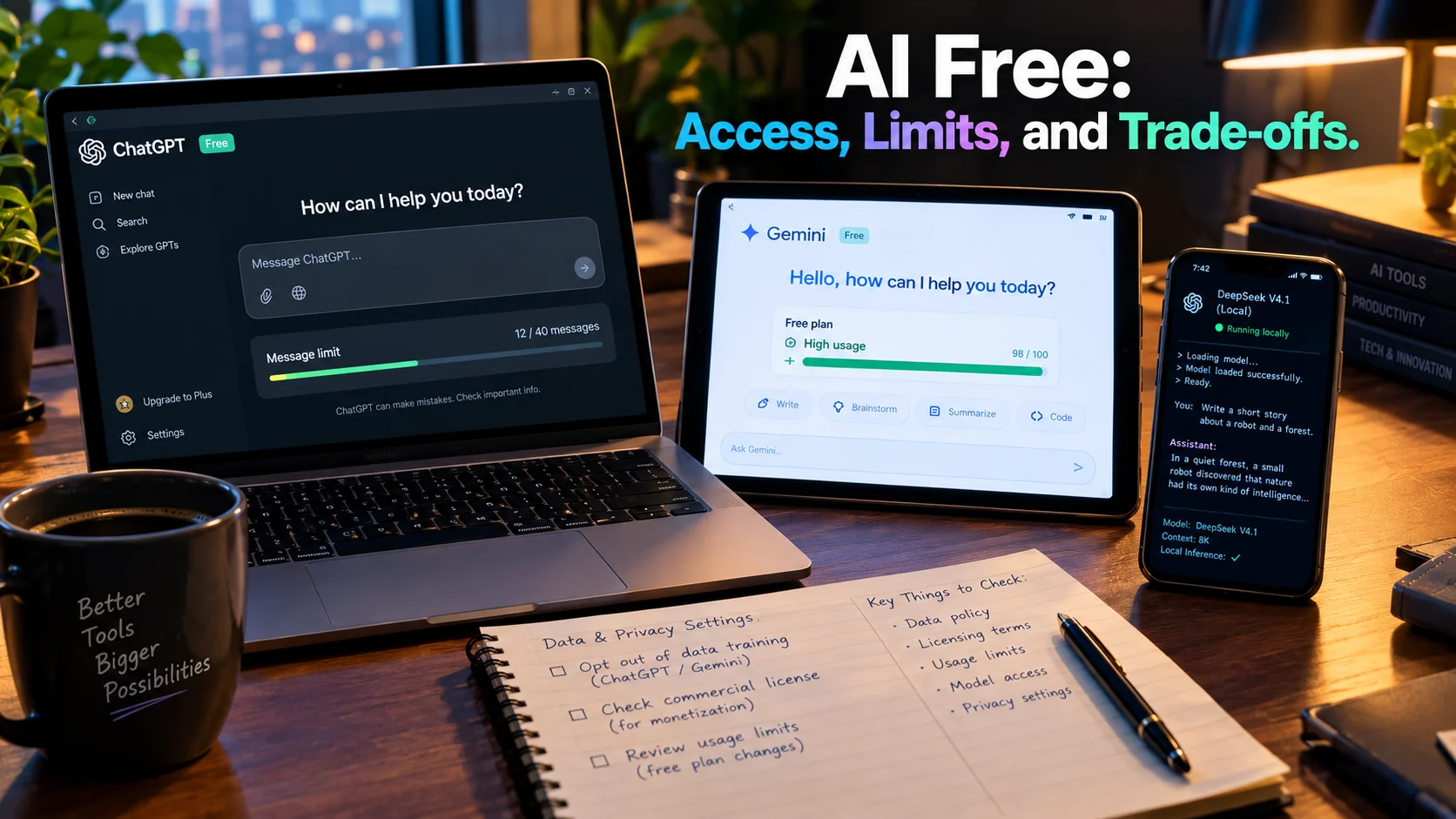
“AI free” describes the growing ecosystem of AI tools available at no cost, from consumer chatbots like ChatGPT and Gemini to open-source models you can self-host. The best free options offer real utility, but most come with usage caps, non-commercial licenses, or data-training defaults that require careful evaluation.
At-a-Glance: Key Takeaways
- Free consumer chatbots exist, but limits vary. ChatGPT Free offers 10 GPT-5.5 messages every 5 hours, Gemini Free resets every 5 hours, and Claude Free runs session and weekly caps .
- Open-source AI is genuinely free. Models like DeepSeek V4.1 and Hunyuan3D can be self-hosted with no usage fees, requiring only your own hardware .
- Data training is often the default. Most consumer AI free tiers train on your conversations unless you manually opt out .
- Commercial use is frequently restricted. Free tiers for Suno, ElevenLabs, and Meshy produce non-commercial output only .
- Free tiers change weekly. Pricing and availability are volatile, with free quotas often reduced or removed without notice .
- The best “free” AI depends on your tolerance for trade-offs. Convenience, privacy, and commercial rights rarely coexist in the same free tool.
What Is “AI Free”?
“AI free” is not a single product or company. It describes the broad category of artificial intelligence tools, models, and services available at no cost. This spans three distinct access models, each with different implications.
Consumer free tiers are the most visible. ChatGPT, Gemini, Claude, and Grok all offer free plans with usage limits. These are designed as acquisition funnels for paid subscriptions. The free tier is functional but deliberately constrained .
Open-source models are free in a different sense. DeepSeek released its V4.1 model weights under an MIT license, allowing anyone to download, modify, and use it commercially . Hunyuan3D from Tencent is similarly open-source, requiring only a GPU to run . The software is free; the hardware is not.
Freemium tools offer limited free usage to hook users. Suno gives 50 credits daily for song generation, ElevenLabs offers 10,000 characters monthly for voice synthesis, and GitHub Copilot Free provides 2,000 completions monthly . These are trial tiers, not permanent free access.
The Major Free Consumer Chatbots
ChatGPT Free
OpenAI’s free tier provides access to GPT-5.5 with a clear allowance: 10 messages every 5 hours . The plan now includes ads in the US, a change introduced in February 2026 . Free users can generate images, use voice mode (limited), and upload files (up to 3 per day) .
The trade-off is capacity. The 10-message allowance disappears quickly during intensive work. ChatGPT Go at $8/month offers more, and Plus at $20 removes ads and unlocks advanced reasoning .
Gemini Free
Google’s free tier is widely described as the most generous among major providers. Gemini Flash offers high-frequency free usage, with limits resetting every 5 hours up to a weekly cap . Gemini 3.5 Flash is now the default model for all users, including free .
Gemini Free includes 15GB of storage, web search (within Deep Research), image generation, file uploads, and voice in mobile apps . The context window for free users is listed at 32K tokens .
Claude Free
Anthropic’s free tier is the most restrictive among the major three. Claude Free runs session and weekly limits without publishing specific numbers . Claude requires users to be 18 or older (unlike ChatGPT and Gemini at 13) and requires a phone number .
Claude Free does not include image generation, and file upload availability on the free plan is not clearly documented . The free tier connects to external tools through MCP connectors .
Grok Free
xAI’s Grok offers a free tier described as “enough for chatting” . It includes web search, image generation, file uploads, and voice . The minimum age is 13 .
Grok’s data practices are notable: X enrolls every account in Grok training by default, covering both public posts and chatbot conversations. Users must manually uncheck the data-sharing option to opt out .
Open-Source AI: Free Without Tiers
DeepSeek V4.1
DeepSeek released its V4.1-Flash-1017 model in October 2026, claiming it surpasses Claude Opus 5 on software development benchmarks (77.0 vs 74.0 on DeepSWE v1.1) . The model weights and code are available under the MIT license, permitting commercial use, modification, and redistribution .
The model is available for free through DeepSeek’s web and mobile apps. API access is priced but uses the same model identifier as the previous version, with unchanged pricing .
Editorial interpretation: DeepSeek represents the most genuinely free frontier-class option. The MIT license removes legal ambiguity around commercial use. The trade-off is trust: DeepSeek is a Chinese company, and data handling practices should be evaluated against your compliance requirements.
Open-Source Creative Tools
The open-source ecosystem offers free alternatives for creative work:
These tools are free in the sense that no subscription or usage fee applies. The cost is infrastructure and technical effort.
Freemium Tools: Real Free Tiers with Real Catches
Coding Assistants
Creative Tools
Important distinction: “Free” for these tools means free to use, not free to monetize. Commercial rights require paid plans in most cases.
The Data Training Default
The most significant hidden cost of free AI is privacy. On most consumer plans in 2026, training on your conversations is the default, not the exception .
Provider-by-Provider
Important caveat: Opting out does not apply retrospectively. Conversations you had before opting out may still be used. Opting out also does not delete your data; it only stops future training use .
Business and API tiers generally do not train on customer data . If you handle confidential information, a business plan with clear data terms is the safer default.
Who Should Use Free AI Tools
Casual users exploring AI can start with ChatGPT Free or Gemini Free. The limits are real but sufficient for light daily use.
Budget-conscious developers can use GitHub Copilot Free or Gemini Code Assist for basic coding assistance, supplementing with open-source tools when limits are reached.
Privacy-conscious users with technical skills should evaluate open-source models like DeepSeek V4.1, running locally to eliminate data transmission entirely.
Users needing commercial rights should budget for paid plans. Free tiers for Suno, ElevenLabs, and Meshy produce non-commercial output only.
Organizations handling sensitive data should avoid consumer free tiers entirely. Business and enterprise plans offer clearer data terms.
Common Mistakes and Cautions
Assuming “free” means unlimited. Every consumer free tier has caps. ChatGPT Free allows 10 messages per 5 hours. The limit arrives faster than expected.
Overlooking commercial restrictions. Free creative tools often produce non-commercial output. Check the license before monetizing.
Ignoring the training default. Consumer AI trains on your conversations unless you opt out. Sensitive information should not be entered into free consumer chatbots.
Expecting free tiers to remain stable. Free quotas change weekly. A tool that is free today may introduce limits or pricing tomorrow .
Confusing open-source with easy. Open-source models are free but require hardware and technical setup. The cost shifts from subscription to infrastructure.
Frequently Asked Questions
What is the best free AI chatbot?
It depends on your needs. ChatGPT Free offers the clearest message allowance (10 GPT-5.5 messages per 5 hours). Gemini Free is described as the most generous for light daily use. Claude Free is the most restrictive and requires users to be 18+.
Are free AI tools really free?
Consumer chatbots are free with limits and data training defaults. Open-source models are free but require your own hardware. Freemium creative tools often restrict commercial use on free tiers.
Do free AI tools train on my data?
Yes, by default. ChatGPT, Claude, Gemini, and Grok all train on consumer conversations unless you manually opt out in settings. Opting out does not apply retroactively and does not delete existing data.
Can I use free AI for commercial work?
Consumer chatbots generally allow commercial use of outputs. Creative tools like Suno, ElevenLabs, and Meshy restrict free-tier output to non-commercial use. Open-source models with permissive licenses (MIT) allow commercial use.
What is the best open-source free AI?
DeepSeek V4.1 is the most capable open-source option released in 2026, with MIT licensing and benchmark performance rivaling Claude Opus 5 on coding tasks. It requires technical setup for self-hosting or can be used free through DeepSeek’s apps.
Conclusion
Free AI tools offer valuable features, but each comes with trade-offs in usage limits, privacy, or commercial rights. Choose ChatGPT Free or Gemini Free for everyday tasks, paid plans for commercial needs, or local open-source models for greater privacy. Always check data policies, licensing terms, and usage limits, as free plans can change over time.